Ethiopia has been undergoing a renaissance under new leadership and a government that is no longer under the thumb of the military and single-party rule. This renaissance includes the harnessing of the Blue Nile for Ethiopia’s 109 million people to improve freshwater access for crops and cities, and to generate 6,450 Megawatts of hydroelectricity to power homes and industry.
Known as the Grand Ethiopian Renaissance Dam (GERD), it lies just 30 kilometers to the east of the Sudan border and was started in 2011. The dam today is nearing completion and the reservoir behind it will take up to 10 years to fill. It is currently the largest hydroelectric project in Africa and will hold back 1.6 years of Blue Nile water flow on average.
It is the last fact that is of immediate concern to Ethiopia’s neighbours. Both Egypt and Sudan rely on the annual cycle of the Nile River running throughout their countries, and the Blue Nile provides more freshwater than the main branch. The animosity of Ethiopia’s nieghbours has gotten so intense of late that there have been reported clashes between neighbouring armies. There is even talk of Egypt establishing a military base in neighbouring South Sudan from which it could conceivably launch an offensive into Ethiopia.
So water wars are moving into the present whether we are describing confrontations over the Colorado River between Mexico and the United States, or the tension between Canada and the United States over diverting water from the Great Lakes to an increasingly parched mid and southwest, or China in conflict with India, Nepal, Bhutan, Vietnam, Laos, Cambodia, Thailand and Myanmar over the damming of freshwater sources in the Himalayas. Even India and China are reporting tussles along the border between their troops. Could securing freshwater be one of the reasons?
Egypt is accusing Ethiopia of “hydro-hegemony” according to a recent article published in The Guardian. Sudan originally supported the dam and now has switched back to Egypt even though Ethiopia has offered it access to the low electricity rates from GERD. The electricity Ethiopia would produce would replace what the country gets from Egypt’s 2,100 Megawatt Aswan Dam. So this becomes another point of contention between the countries.
The loss of a paying customer isn’t the only reason Egyptians are talking about war. There is a fear that the Egyptian parts of the Nile will no longer experience annual flooding that restores fertility to farms in the Delta and lower reaches of the river. To irrigate adjacent fields with lower post-Monsoon river levels, Egyptian farmers will need to pump Nile water to feed the crops. The downstream impact will mean higher fuel costs for irrigation and the potential of drought conditions when river levels drop. This latter issue is already a growing concern in the age of climate change with the Nile River valley experiencing increasing periods of prolonged drought. Today, 10% of the population faces freshwater scarcity. Climate scientists predict that by 2040 that number will grow to 35% and represent 80 million people.
Right now the freshwater wars on the Sudan-Ethiopian border are limited to skirmishes. But one can imagine an escalation as the lake behind GERD fills to maximum capacity with downstream consequences for Ethiopia’s neighbours.

]]>
Yet Africa has some of the world’s great rivers from the Nile in the Northeast to the Congo and Zambezi in central Africa, and the Niger on the Guinea Coast and Limpopo in the southeast, Africa is crisscrossed by these mighty streams. And Africa features the second largest number of large lakes with its own equivalent to the North American Great Lakes to be found in the highlands of East Africa.
But what will climate change do to these rivers? How will Africans cope with a temperature rise of 2 Celsius (3.6 Fahrenheit) degrees over the next fifty years? Let’s take a look at some of Africa’s major rivers and describe what scientists think may happen.
Nile River – The Nile River is the world’s longest (6,850 kilometers or 4,150 miles) with tributaries rising from streams and lakes in Uganda, the Democratic Republic of the Congo, Ethiopia and Eritrea. The main branches are designated White and Blue with the more easterly Blue Nile contributing the greatest water volume through seasonal variations in precipitation. This variability has been a characteristic of the Nile since human civilizations first established themselves along its banks thousands of years ago.
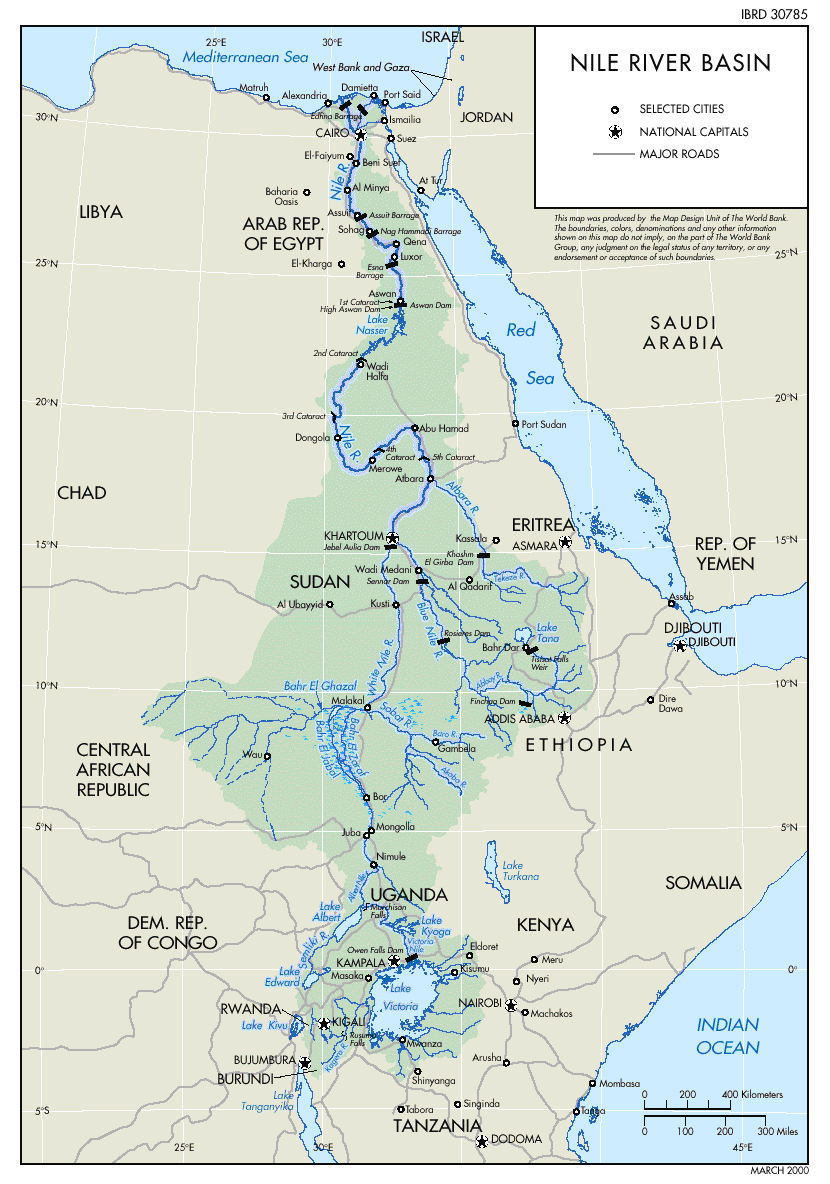
The annual flooding of the Nile enriched the agricultural lands on both banks of the river turning a narrow strip of desert green. This annual cycle occasionally experienced interruptions caused by a drop off in seasonal precipitation. But today a human factor has entered the equation – the Aswan High Dam, a hydroelectric project built in the 1970s has interrupted the normal seasonal river flow. Today the lower Nile within Egypt no longer relies on annual floods to enrich croplands. Instead the country has had to turn to irrigation to make up for the lost annual cycle. The reduced water volume has also lead to increasingly saline soils particularly in the Nile Delta, a key agricultural production center of Egypt.
What is the fate of the Nile by 2100? Current climate models estimate a decrease in river volume by as much as 75% putting much of the agricultural production of the river valley under considerable stress. Today 160 million live along its banks and that population is expected to double by 2030. Changing precipitation, increasing evapo-transpiration from a warming atmosphere, and increasing energy demands among the ten countries that share the river may lead to confrontations similar to those I have written about for rivers like the Mekong in Southeast Asia.
In Part 2 we will continue looking at Africa’s rivers including the Congo, Zambezi, Niger, Volta, Senegal, Limpopo, and Orange.
]]>


