When we think of fungi we picture toadstools, mushrooms, truffles, puffballs and brackets seen on forest floors and tree trunks. What we don’t see is what lurks beneath, the mycelium network of hyphae, long tubular filaments extending for hundreds of metres from what is visible atop. Mycelium makes up the largest living organisms on Earth. Their hyphae can tolerate cold and a lack of water and go dormant under such conditions. Add a little water and heat and mycelium starts to grow. In looking at off-world environments, NASA, therefore, sees the promise of mycelium-based mycotecture for future off-world habitats.
Today, hyphae’s properties have made mycelium an interesting material for industrial applications. Where can you find it in the 21st-century human world? Earlier this year I described mycelium as becoming the next big thing in technology. I listed its use to construct biodegradable coffins, compostable packaging, foods like faux bacon, textiles like faux leather, flooring and drywall.
Add to this the recent announcement from a Belgium-based company, Novobiom, and U.S.-based Mycocycle, who have created bioremediation products from mycelium to clean soil and contaminated construction materials.
The International Journal of Biomaterials lists existing products made from mycelium composites as substitutes for cardboard, wood, gypsum, cement, polymers and plastic. Talk about the “magic of mushrooms” turning into insulation, wallboard, bio-cement and Mycocrete.
NASA’s Lynn Rothschild who works at the agency’s Ames Research Center writes:
“Mycelial materials…show compression strengths superior to dimensional lumber, flexural strength superior to reinforced concrete, and competitive insulation values.”
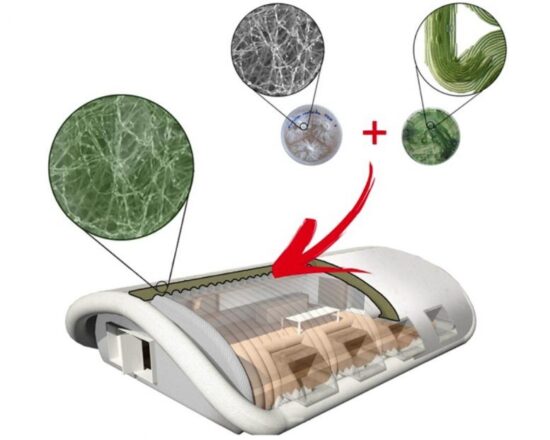
Combined with Lunar or Martian regolith and locally sourced water mycelial materials could be the way for NASA to “grow” habitats in these off-world locations. Add humans and their organic wastes and through mycelium bioremediation NASA can incorporate melanin into the walls and roofs of these habitats to produce radiation-protection barriers. Mycomaterials should prove durable in low-gravity environments, and even after degrading can serve as fertilizers for colonists’ off-world farms.
What about the cost of getting mycelium feedstocks to the Moon or Mars? Dried out, the mycelium will weigh very little when added to payloads launched from Earth. You won’t need a lot of it added to the payload, either, because once on the Moon or Mars, with a little lunar water from ice and heat from sunlight, the mycelium will replicate and start to grow the required self-repairing structures.
The bricks at the top of this posting have been made from mycelium, wood chips and yard waste. The finished product is mycocrete which could one day replace traditional concrete in building construction here on Earth.
Mycocrete consists of hyphae knitted into moulds. It is lightweight, can be shaped into a variety of forms, not just bricks, and is characterized as being stronger than concrete. It is biodegradable and eco-friendly. It can be combined with all kinds of biomaterials to serve different uses.
Newcastle University in the United Kingdom has created the Living Textiles Research Group where mycelium is turned into living engineered materials for construction and other applications. The mycelium with biohybrid fibres can make scaffolding and highway construction materials with self-healing properties. Newcastle’s research could lead to the rethinking of terrestrial building infrastructure with mycelium playing a significant role.
NASA, meanwhile, is looking to mycelium to help it out of this world. Delivering the fungi to the Moon with water from ice found in situ and simple-to-erect frameworks will grow fully functional habitats. The Mycotecture Project already has Moon habitat designs that use mycelium combined with lunar regolith such as the one in the image below. All that remains is to get humans back to the Moon. What gets designed and built there will be translatable for future habitats on Mars.
Although the Martian atmosphere is tenuous at best, the winds still blow on this planet creating much of the surface erosion observed by the robotic spacecraft, landers, and rovers we have dispatched to it. Orbiters have observed how much the landscape is shifted by winds. Jon Telling, Geochemist at the School of Natural and Environmental Sciences, Newcastle University, when describing the role of the Martian wind states that “the rate of erosion is estimated to be comparable to those of cold and arid sand dune fields on Earth.”
Ruling out wind erosion as the source for periodic methane release, therefore, made sense. The Newcastle researchers noted that detected methane on Mars is unevenly distributed and appears temporarily in isolated pockets on the surface. A biological origin based on seasonal or subsurface changes was a likely explanation. But a purely geochemical one was also plausible. No one had really considered Martian winds as the engine for methane release.
What the Newcastle researchers concluded, however, was that wind erosion could be playing a part but that the methane volumes detected suggested this was highly unlikely.
So if it is not wind erosion, what is it?
Marco Giuranna, of the National Astrophysics Institute, in Rome, participated in an international team studying Martian methane gas releases. They used data from the Curiosity rover and one of ESA’s orbiters, the Mars Express, to study a 250 square kilometer area of the Gale Crater surface. The team ran a million computer models of different emission scenarios and concluded that the most likely source for the gas was subsurface frozen methane that was occasionally leaking. But as to what created this methane layer, the team had no answer.
Near the end of June of this year, the Jet Propulsion Laboratory-Caltech team that is working with the Curiosity rover announced that they had detected the largest transient plume of methane coming from the Gale Crater so far. The amount was 21 parts per billion measured by SAM’s (sample analysis laboratory) tunable laser spectrometer.
On Earth, microbial life called methanogens, are a big source of atmospheric methane. You find methanogens in the gut bacteria of cows. You also find them in melting permafrost, in peat bogs, and almost anywhere there is decaying vegetation.
But some methane on Earth has geological origins. For example, volcanoes on Earth belch methane, although there is no evidence of active volcanism on Mars today. So we can rule out volcanism as a Martian methane source.
So what other Martian geological processes are likely the methane source?
Could the weathering of carbonate rocks exposed to liquid water in the right temperature conditions produce methane? This chemical origin of methane would follow a pattern of seasonal variation based on the rise and fall of daily temperatures. Seasonal methane variation has been observed on Mars.
But a biological origin would equally be plausible when looking at seasonal methane on Mars. Martian microbes would be more active in the right temperature conditions.
But Gale Crater methane observations have also been sudden with transient plumes of the gas being detected. It’s as if the planet is doing its own version of “cow farts.”
And even curiouser and curiouser is the lack of data showing methane’s presence from ESA’s ExoMars Trace Gas Orbiter, which has been circling the planet for the last year looking for the gas. Talk about causing methane confusion back here on Earth for exobiologists and geochemists who are still trying to figure out if Mars has native microbial life or just some exotic geological processes.

]]>
Evidence of the Anthropocene can be found in our impact on the rock strata we humans are laying down today embedded with plastic debris and other pollutants. We call these new rocks, plastiglomerates. More disturbing, however, is the chemical evidence recently uncovered of human-created pollutants found in the deepest ocean trenches of our planet.
In a study done by Newcastle University scientists, a sampling of crustaceans from the Mariana and Kermadec trenches in the Pacific Ocean show the presence of polychorinated biphenyls (PCBs), and polybrominated diphenyl ethers in the fatty tissue of these animals.
States lead author, Dr. Alan Jamieson, Marine Ecologist, “We still think of the deep ocean as being this remote and pristine realm, safe from human impact, but our research shows that, sadly, this could not be further from the truth.” The sampling from these crustaceans indicates contamination levels equal to some of the most polluted surface areas in the Pacific Ocean basin.
The likely source of deep sea pollution is contaminated plastic debris, and dead animals containing absorbed industrial chemicals, that find their way to the ocean bottom and get ingested by the local fauna. “The fact that we found such extraordinary levels of these pollutants in one of the most remote and inaccessible habitats on earth really brings home the long term, devastating impact that mankind is having on the planet…..It’s not a great legacy that we’re leaving behind.”
The complete study can be found online in the journal, Nature: Ecology & Evolution, entitled, “Bioaccumulation of persistent organic pollutants in the deepest ocean fauna,” published on February 13, 2017.
Findings like these are part of the accumulating evidence that shows we humans are changing the nature of life on this planet. It is inevitable that the 7.5 billion people on this planet plus the accompanying aspects of our civilization are bound to leave an imprint. But in the age of humans, the Anthropocene, we owe the planet the love it deserves for giving us the only place in the Universe where we can safely exist. Why are we screwing with it?

]]>