On a century timescale, CH4 packs 28 times the punch of CO2 as a greenhouse gas (GHG). And since the beginning of the Industrial Revolution, its atmospheric accumulation has more than doubled. Currently, CH4 is responsible for approximately 20% of atmospheric warming.
The biggest human sources of CH4 by percentage can be seen in the following pie chart.

Fossil fuel production, distribution, and use account for the largest share. But livestock farming is a close second. In the case of the former, the known sources are lead by oil and natural gas, with coal and bioenergy contributing the least. Solutions for oil and gas are largely manageable through above-ground actions that include repairing existing equipment and deployment of proven technologies. We are talking about leak detection equipment replacement to identify CH4 emissions.
The International Energy Agency (IEA) estimates through this simple operational improvement that 70% of CH4 emissions from the oil and natural gas sector can be avoided. And with the current spike in prices for oil and gas because of the Russian invasion of Ukraine, the sector would be able to absorb the cost easily. What this means is operations need to check and replace leaky pumps, corroded compressor seals, non-working electric motors, inadequate vapour recovery units, and both upstream and downstream leak detection monitors. The goal would be to plug the holes and eliminate the practice of non-emergency flaring and venting which today contributes to a large proportion of the industry’s CH4 emissions.
Last week New Zealand, the home to 6.3 million dairy and 3.9 million beef cattle, and 26.8 million sheep announced plans to tax farmers on CH4 emissions. Livestock in New Zealand outnumbers people by a factor of six. Cows and sheep contribute almost half of all CH4 emissions produced by the country.
A recent Guardian article reported that cows are one of New Zealand’s biggest producers of GHGs. Emissions from all sources in the country between 1990 and 2018 rose 57% which was “the second greatest increase of all industrialized countries” over that time span. So for the country to tackle its GHGs to meet a 2050 net-zero emissions target, it is bringing in a tax.
The tax is priced separately for short and long-term farm greenhouse gas (GHG) contributions. There is no mention so far of how GHGs will be measured to calculate the tax. For farmers, there are many unknowns. What can they do to reduce GHGs from livestock operations?
Herd reduction is likely the primary action farmers will take. Other ways to inhibit CH4 emissions may come from breeding new varieties of cows and sheep that burp and fart less.
Then there are changes to feeds. Since enteric fermentation occurs in the stomachs of cows and sheep, CH4 exhalations and flatulence can be reduced by changes to the food mix.
Back in 2016, a Canadian farmer on Prince Edward Island introduced seaweed he collected from local beaches into the diet of his dairy cows. What started as a practice to save money reduced CH4 flatulence by 20%. It’s not that the cows didn’t continue to burp and fart. The difference was there was no detectable CH4 coming out of either end.
Today, livestock farms around the world contribute more than 90 million tons of CH4 to the atmosphere annually. And because meat and dairy demand has doubled globally over the last half-century, so have herd populations and emissions. So the problem isn’t going to go away without significant changes to livestock management practices.
That’s why what New Zealand is attempting to do through a tax is something many other countries are watching and considering as they attempt to address agricultural emissions without dramatically upsetting the food supply.
New Zealand farmers will be given the opportunity to use carbon offsets by investing in on-farm forests. This will help offset the tax. But changing livestock management practices will be critical including the feed mix. And considering New Zealand is an island nation surrounded by the Pacific Ocean, finding seaweed as a feed shouldn’t be too difficult.
Eventually, however, the costs incurred by farmers will impact prices for meat and dairy. The government may consider some form of compensation to families to help offset rising prices because there is no doubt the entire country isn’t planning to suddenly go vegan.
]]>Could New Zealand have gone about its recommendations in a different way? Back in 2009 Norway and Guyana came up with a mutually beneficial arrangement to reduce CO2 emissions from deforestation. Norway agreed to pay Guyana to stop cutting down its trees. For Guyana, it meant a cash infusion to help alleviate poverty in the country. For Norway, the payment to keep Guyana’s forests whole offset the CO2 output from the Scandinavian country’s oil industry. The Norway-Guyana model, critics point out, puts the burden of emission-cutting on the backs of Guyanese while giving Norwegians permission to continue to pollute.
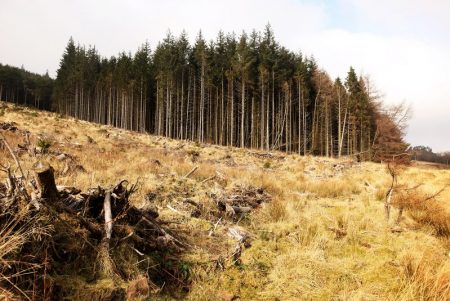
Nevertheless, there is merit in getting those in the lumber and pulp and paper industry to look at far more sustainable practices that also mitigate climate change. Whether we are talking about boreal or tropical forests, trees when cut down release significant amounts of CO2 into the atmosphere. Today tropical deforestation alone contributes about 10% of greenhouse gas emissions according to the Union of Concerned Scientists. That’s 3.0 Gigatons of CO2 annually.
Figures for boreal forest deforestation show that in Canada alone, clear-cutting creates 26 million tons of CO2 annually, equivalent to the total emissions of 5.5 million vehicles per year. Boreal forest logging operations do more than just emit CO2 from the felled trees. The practice of clear-cutting damages soils, and wetlands including peat deposits which release methane (CH4), a far more potent greenhouse gas. Russia, the other country containing 19% of the planet’s forest cover, is in the same boat as Canada with unsustainable forest harvesting practices contributing to atmospheric warming through carbon emissions.
So maybe the idea behind New Zealand’s recommendation to have its forest industry stop cutting trees in wholesale fashion could be monetized so that lumber companies receive payments for not cutting their forest reserves. If Norway can pay Guyana not to cut its trees, then why can’t governments find a formula based on net carbon emission reductions that will allow the industry to continue to harvest wood, and pulp and paper in sustainable ways while receiving compensation for forest conservancy?
I would love to hear from readers of this posting particularly those within the industry and in government who have further thoughts on the subject.
]]>

The utility, Genesis Energy, made the announcement on August 6th with December 2018 as the end date. Lower-cost renewable power generation from wind and geothermal investments along with energy conservation practices has made this decision possible.
For New Zealand the closure yields overall CO2 emission reductions moving the country closer to a 90% renewable energy generation goal. The two plants contributed 5% of the country’s total greenhouse gas emissions.
The two plants can also use natural gas and will continue to produce 450 Megawatts of power between the two.
New Zealand announced in July that its post-2020 climate change target is a 30% reduction in greenhouse gas emissions below 2005 levels by 2030. Before 2020 the country had committed to a 5% reduction from 1990 levels by 2020. The 2030 target will be 11% below 1990 levels.

How would a 5% CO2 reduction translate if it were to happen in the United States? In 2013 the U.S. emitted 6.673 billion tons of CO2 from all industry sources. A decrease of 5% would equal 333.6 million tons. That’s equivalent to 65% of New Zealand’s total greenhouse gas emissions in the same year.
The New Zealand announcement in the context of overall global carbon reduction is a blip. The one trillion tons limit which I have described in a previous posting as too much will hardly be dented by two coal-fired power plants closing their doors.
]]>Well a combined U.S. and New Zealand defense research company, Rocket Lab, partially funded by DARPA and venture capitalists, has developed a rocket called the Electron.

In the picture above, Peter Beck, the company’s CEO, is standing beside an 18-meter (approximately 60 feet) Electron weighing 10.5 tons and capable of launching payloads of 110 kilograms into 500 kilometer orbits above the Earth. First test launch is scheduled for late this year. If successful the company has commitments for has 30 additional launches beginning in 2017 with plans to ramp up to weekly launches by 2018 and up to 100 or more launches a year thereafter.
How does the technology work?
Each Electron features a cluster of Rutherford electric engines. An electric motor turbopump about the size of a beer can is powered by a battery packet generating one megawatt of energy. That amounts to 20,461 newtons (4,600 pounds) of thrust per engine. The picture above shows a cluster of nine engines. Multiply that number by 9 and you get an idea of the thrust capability of each rocket.
Compare that to rockets like the Merlin engine that powers SpaceX’s Falcon 9, each capable of generating 716,000 newtons (161,000 pounds) of thrust, you can immediately see Electron is not competing in the same market as SpaceX. Instead it is hoping to grab the small satellite launch business.
All parts of each Rutherford engine (see picture below) are 3D printed. The rocket frame is constructed from carbon composites providing lightness, strength and capability of withstanding significant heat and pressure.
The engines use liquid oxygen and a specially designed propellant described as a semi-solid to viscous liquid monopropellant (VLM) that is soluble in water and features a high ignition point making it operationally safer than traditional rocket fuels like kerosene and hydrogen. You can watch a demonstration firing of the engine here.

Electron will make New Zealand a space faring nation with launches coming from Down Under. Average cost per launch will be less than $5 million U.S. That may be attractive to small space start ups and academic institutions although payload costs at $49,000 U.S. per kilogram are higher than SpaceX which can launch a kilogram into low-Earth orbit for $4,653. The difference, however, SpaceX launches 6 to 12 times a year whereas Electron is being geared for a much higher frequency schedule.
]]>