One building in New York City, built in 2004, is going a step further than any of the above suggestions. As reported on March 10, 2023, in the New York Times, the Grand Tier, a 30-storey apartment in Manhattan, has installed a system to capture carbon dioxide (CO2) produced from natural gas used to heat its twin boilers. The boilers provide heat to the building. The CO2 would normally be vented through the building’s chimneys. But now, instead of CO2 being released into the atmosphere, a carbon capture system from CarbonQuest is liquefying the gas.
CarbonQuest states that its technology, seen in part below, can eliminate 100% of a building’s CO2 emissions. You have to love the green pipes.

The captured and liquefied CO2 can then be used by manufacturers of concrete and cement, e-fuels, non-petroleum-based chemicals, and fossil-fuel-free plastics.
The building is located at 1930 Broadway in Manhattan, Built in 2004, its carbon capture technology was installed in 2021. So far the system is reducing CO2 emissions by 60% (not quite the 100% CarbonQuest claims). And a customer has been found for the captured CO2. It is a large concrete paver manufacturer that once a week pumps the liquefied gas into a tanker truck which then delivers it to its facility where the CO2 gets converted into a powder and added to cement, sand and aggregate. The chemical reaction of CO2 when mixed with cement produces the mineral calcium carbonate. This is the same mineralization process we see in the natural world that produces limestone. And just like in limestone, the weathering or breaking up of the material releases no CO2 into the atmosphere. In other words, the sequestration is permanent.
CO2 capture and utilization is a good demonstration of circular economic principles. And curing concrete with CO2 is proving to be a way for the cement industry, which is responsible for 8% of global GHG emissions, to become a little bit greener.
One of the reasons the building on Broadway installed its carbon capture system is to comply with Local Law 97, a new climate law in New York City requiring large buildings to cut GHG emissions by 40% by 2030, and 80% by 2050. Buildings that are non-compliant face escalating fines.
What holds other buildings with natural gas or oil-fired boilers from implementing a similar system? Prior to this, the only places where carbon capture systems were being readily deployed is in coal and natural gas-fired thermal power plants. These were big installations. To make it work in a building, CarbonQuest created a smaller form factor. At 1930 Broadway, the technology takes up about three parking spaces underground.
The owner of 1930 Broadway also has 30 other large buildings in Manhattan. The company has been finding energy savings such as replacing older lighting fixtures with LEDs, upgrading its fans with more energy-efficient motors, and improving insulation.
In the New York Times article, it notes that even with these improvements the building would have faced fines of $100,000 in 2024 rising to $400,000 in 2030 because of the natural gas-fired boilers.
It explored replacing the heating of the boilers using electric heat pumps but there were concerns about renovation costs needed and whether the heating source would be reliable enough on winter’s coldest days. Heat pumps work well when outside temperatures stay above -15 Celsius (5 Fahrenheit). Below that threshold, however, although they continue to operate their heating efficiency declines.
With two winters under its belt, the building owner is now looking at installing the CarbonQuest system in five more of its properties and calculates that these installations will pay for themselves in six years.
The drafters of Local Law 97 never contemplated carbon capture as a solution for meeting the city’s carbon emission reduction targets. As a result, the law makes no mention of this technology option. New York City Department of Building officials have stated that before changing the law they want reassurances that the technology will verifiably perform as claimed.
Does a carbon capture technology solution like this make sense elsewhere? In achieving a low-carbon future, building heating is seen as an area where changes need to be made. Electrification is one answer. Energy conservation through improved thermal efficiencies is another.
Considering the already built natural gas-heating infrastructure in so many Northern Hemisphere cities like New York, Chicago, Toronto, and others, is the CarbonQuest solution realizable?
Will there be enough customers for the captured CO2? And if not, will there be enough underground capacity to sequester the CO2 that cannot be turned into useful zero-emitting products?
The New York Times article features a quote from John Mandyck, CEO of the Urban Green Council. He states, “We’re still in the early stages of what’s going to be a massive market transformation. The changes required are so big that I don’t think we can rule out any approach just yet.”
]]>
The United Nations last year launched a competition called the UN-Habitat for a Better Urban Future. This challenge is aimed at where most of us live today, in cities Executive Director of UN-Habitat, Maimunah Mohd Sharif, described the need stating, “Cities are at the heart of the climate change problem. But cities are also the key to the solution. Cities need to take climate change seriously and significantly reduce their carbon emissions while improving their resilience and adaptability to climate-related disasters and negative effects.”
The competition chose four cities. Don’t ask me why because I couldn’t find anything in the literature to warrant excluding many more from participating. The four included Bogota, Colombia, Bristol, UK, Curitiba, Brazil and Makindye Ssabagabo, Uganda. The challenge for them was to come up with both green affordable housing plans and net-zero neighbourhoods.
New York City didn’t get consideration. But that hasn’t stopped it from developing its own net-zero neighbourhood plan. For its first project, it has chosen a 47-hectare (116-acre) site in the Borough of Queens where it will build a net-zero community on currently largely vacant land that took a pummeling from Hurricane Sandy in 2012.
In the past, the area chosen was a coastal retreat for wealthy New Yorkers. It is known as the Rockaway Peninsula and today features publicly accessible beaches and a boardwalk, plus a mix of housing that combines gated neighbourhoods and low-income and public housing sites.
How will such a diverse community achieve net-zero? The site will use geothermal energy for heating and cooling. New construction will feature solar rooftop gardens and panels to supplement the geothermal installation. Plans include a storm-surge barrier that will protect the area from sea level rise and storm surges. The total cost of the project is currently estimated at $1 billion.
For the low-income residents of the area, planned commercial development includes community activity amenities with a significant amount of land set aside for green space including a 14.2-hectare (35-acre) nature preserve and urban farm. The oceanfront will feature an enhanced boardwalk and dune forest preserve. Currently, the land is largely vacant as you can see from the picture below.

A big concern for low-income and public housing residents is that improvements will lead to gentrification and the driving up of property values to make staying unaffordable. And for those in the gated communities, the response has been NIMBYism, not wanting anything to change. One thing both sides agree on is that new job opportunities coming from commercial and retail infrastructure development will be welcome.
In 2012, the Rockaway Peninsula was devastated by Hurricane Sandy. The hurricane made landfall first near Atlantic City and hugged the New Jersey shore before barreling into New York City with Queens, Brooklyn, and Lower Manhattan directly in the path. For the Rockaway Peninsula, the devastation was significant, particularly in low-income, low-elevation areas. Storm surge and coastal flooding caused significant physical damage to homes and businesses, and until today the area has remained in a prolonged post-storm recovery phase. That’s why targeting this area for development makes sense.
But the goals of net-zero and climate change resiliency make the project unique. How will the resiliency part be accomplished?
To achieve the net-zero goal, new housing will include solar panels, green roofs, and passive home design to provide airtight insulation.
The novel use of geothermal energy will be a first for the City. Described as a big heat battery by one of the companies involved in developing the area, the geothermal system will store excess heat from the summer which will be retained underground. It will be used for hot water systems and winter heating.
The geothermal solution will use heat pumps and a pipe and heat storage system that will reach 137 metres (450 feet) underground.
Two big challenges that will need to be addressed include:
The latter issue is not trivial. As Cornell University professor, Teresa Jordan, recently noted, “You’re making holes where probably, in a populated city, there are already lots of other facilities using the area under the ground. They’ve already buried all sorts of stuff under the sidewalks, under buildings. To go in and just start digging, is a huge organizational challenge.”
When will the Rockaway Peninsula Project be completed? The estimate by New York City planners and contractors is as early as the end of this decade or one or two years thereafter.
At the launch of the UN-Habitat climate innovation competition back in November of last year, it was noted that cities needed to strengthen plans to combat climate change including developing net-zero neighbourhoods and housing. Only through such efforts will humanity speed up the transition required to achieve sustainability by both mitigating and adapting urban environments to withstand global warming.
]]>New York City isn’t the first to propose such a ban. Since June of this year, a dozen American cities have enacted similar new building construction bans. Most of these cities are on the west coast including San Jose, Berkeley, San Francisco, and Seattle. But a movement to ban natural gas and oil hookups in the east is also on the rise in Massachusetts with Brookline, Cambridge and Newton, suburban centres near Boston also instituting a future ban.
What makes New York’s decision unique?
Of course, this change in policy doesn’t impact legacy buildings that will still use natural gas and oil.
Ben Furnas is the city’s Director of Climate Change and Sustainability, in a New York Times interview stated, “We’re making it clear that the next generation of buildings will be electric…that if you can do it here, you can do it anywhere…This is a very big deal. The places that have done this already don’t have four seasons, and they don’t build this big.”
The State of New York has a bill before its legislature that would require all new building construction in the state to adopt electric power from 2024 on. There is also a new governor-mandated initiative to create a network of developers, builders, and trades with decarbonized home skillsets including the provision of training and technical support to enable the transition.
In the last week, an industry-wide $263 million competition was announced by The New York City Housing Authority, New York Power Authority, and New York State Energy Research and Development Authority to develop new electrification products for multi-storey and multi-family buildings.
And finally, the Biden administration signed on to cutting GHGs in federal legacy buildings by 50% by 2030 and set a target of 2045 to be carbon neutral. Any new federal construction, under these new Biden regulations, will be mandated to be constructed using materials that produce low emissions, and will be required to use clean energy technologies for heating, lighting, hot water, and cooling.
One of the interesting aspects to this switch to electricity can be best described in the adage, “what goes around, comes around.” Natural gas was always seen as the clean alternative for heating and hot water when compared to electricity produced by thermal coal powerplants. Natural gas appliances were touted as being more energy efficient and better at heating, cooling and cooking. That was only a few decades ago. Now natural gas is seen through the lens of climate change and because of methane emissions is no longer deemed viable to achieve net-zero emissions by mid-century. In a CBS News interview recently, Bruce Nilles, Managing Director of Building Electrification at the Rocky Mountain Institute, a clean-energy think tank, states, “we pushed people to go off electric to go to gas for 30 years, and we’re now pushing them in the other direction.”
]]>The area to be protected was heavily damaged by Hurricane Sandy in 2012 and includes Wall Street, $60 billion worth of property, 75% of the city’s subway lines, 90,000 residents, and home to 500,000 jobs. The $10 billion spent will buy Manhattan protection from sea level rise until the end of the century.

In the borough of Staten Island, also heavily impacted by Hurricane Sandy, a protective $615 million seawall funded through the federal government, is to be installed on its eastern shore. And in Queens, a new barrier and boardwalk are being built to protect the southern approaches to the Long Island neighbourhood.
Jesse Keenan, of the Harvard Graduate School of Design, is quoted in a Bloomberg article stating “I can’t think of anywhere else in America where there would be a stronger impetus to make this kind of investment,” referring to the Lower Manhattan barrier. Keenan continues, “Given the elevation and total amount of economic output and productivity from this part of the country, we really have no other alternative.”
Keenan notes that the Army Corps of Engineers and Congress will have to be involved because altering a coastline and watercourse will necessitate environmental impact studies and analysis of changes to the dynamics of the offshore environment.
Stated New York’s Mayor, Bill de Blasio, “After Sandy you don’t find many climate-change deniers in New York City. This is the existential threat, the core issue that we all must face as soon as possible.”
]]>New York City is not alone. In 2012 Seattle divested itself of fossil fuel investments. Washington, DC acted similarly as did many counties and cities in California, Colorado, and Massachusetts. After similar divestment announcements San Francisco and Oakland last September launched separate lawsuits against the five largest investor-owned fossil fuel companies in the world, holding them to account for costs incurred both present and future to harden the cities’ infrastructures in the face of climate change.
International divestment from fossil fuel stocks is happening from Capetown to Berlin. Last fall the city of Victoria, British Columbia, and two other Vancouver Island communities, Saanich and Highland, issued climate accountability letters to 20 of the world’s largest fossil fuel companies requesting that they pay for the costs these communities were incurring to fight climate change.
Such legal action against the oil majors is the beginning of a rising tide of litigation aimed at the fossil fuel industry that includes citizen lawsuits from The Netherlands, from children in U.S. states, and from individuals like Saul Luciano Lliuya, a Peruvian mountain guide who sees the melting of an Andes glacier near his hometown of Huaraz as linked to the use of fossil fuels.
The oil companies treat these cases as nuisance suits and argue that linking a storm like Hurricane Sandy to an Exxon-Mobil or a Chevron is unprovable. But those launching the suits have more than the money in mind. They are of a collective mind in showing the rest of the world how fossil fuel companies are no more ethical than Big Tobacco. That oil and gas companies have been in the know since the 1970s that their carbon emissions were warming the Earth’s atmosphere. That their scientists had conclusively linked the burning of fossil fuels to anthropogenic climate change.
The analogy to Big Tobacco is both stark and apt. The major cigarette producers all knew that the products they were making caused a range of diseases in their customers and denied the link between smoking and lung cancer, heart and lung disease, and other life-ending conditions. It is only in the last few years that Big Tobacco has been made to come clean in Western countries. The companies continue to sell their cigarette brands to the Developing World with abandon. I guess the litigators in these countries have yet to mount the kind of lawsuits and publicity to expose Big Tobacco’s lies. But in Europe and North America, Big Tobacco is coming up with ways to survive the end of cigarettes creating product alternatives deemed less harmful. Among these are e-cigarettes.
In launching the San Francisco lawsuit, City Attorney, Dennis Herrera stated:
“These fossil fuel companies profited handsomely for decades while knowing they were putting the fate of our cities at risk. Instead of owning up to it, they copied a page from the Big Tobacco playbook. They launched a multi-million dollar disinformation campaign to deny and discredit what was clear even to their own scientists: global warming is real, and their product is a huge part of the problem. Now, the bill has come due. It’s time for these companies to take responsibility for the harms they have caused and are continuing to cause.”
In the Oakland lawsuit, City Attorney Barbara J. Parker was equally blunt in her comments:
“Global warming is an existential threat to humankind, to our ecosystems and to the wondrous, myriad species that inhabit our planet. These companies knew fossil fuel-driven climate change was real, they knew it was caused by their products and they lied to cover up that knowledge to protect their astronomical profits. The harm to our cities has commenced and will only get worse. The law is clear that the defendants are responsible for the consequences of their reckless and disastrous actions.”
The fossil fuel companies are making some small moves into alternative energy hedging their bets against coal, oil, and natural gas assets losing value in a low-carbon future. Some are dipping into solar and wind energy. Others are dabbling with fuel cell technology and hydrogen. And some are investing in battery storage. This isn’t the first time the companies have looked at renewables. A decade ago when oil and gas prices were peaking, some of these companies had alternative energy assets which they dumped to put all their money into their fossil fuel operations. But now in the post-Paris COP 21 Climate Agreement world, the companies are once again starting to acquire wind farms, photovoltaic and solar thermal power plants, and battery storage technology companies.
But there remain hardliners like Koch Industries which continues to push a big oil and gas agenda, bankrolling minions like Donald Trump and funding climate change denial organizations like the Heartland Institute, all in the hope of putting off the day of reckoning. The Koch brothers put money before country and the planet.
We in the general population must push back. We need to make everyone aware of these Big Oil lawsuits. We need more cities, other government sub-jurisdictions, and citizens’ groups to join in and launch similar legal actions. In the end, it will exert a growing toll on Big Oil, and like Big Tobacco will eventually lead to a day of reckoning.


The MIT team took the estimated 2013 data of weekly 3 million cab rides and applied an algorithm which took ride origins, applied ride-sharing, and came up with a much reduced need for vehicles. It found that with 3,000 autonomous vehicles shared by 2 riders, 94% of New York’s taxi demand could be met. Surprisingly a 10-person ride-sharing vehicle only yielded a coverage improvement of 1%. But with 4 rider car sharing 98% of coverage demand was met. The average wait time for on-demand ride requests using the model was calculated at 2.7 minutes. That compared favorably with Uber and Lyft on demand usage in New York today, in fact 20% less in terms of wait-time delay.
Daniela Rus, lead researcher of the study, and Professor at MIT, stated, “To our knowledge, this is the first time that scientists have been able to experimentally quantify the trade-off between fleet size, capacity, waiting time, travel delay, and operational costs for a range of vehicles, from taxis to vans and shuttles….the system is particularly suited to autonomous cars, since it can continuously reroute vehicles based on real-time requests.”
The positives to this study:
The negatives:

New York City, a little over 1,600 kilometers (1,000 miles) away also lies along a coastline. It is one of 180 municipalities in the United States that abut an ocean or salt water gulf. The city in the last month released its own version of the United Nations’ Intergovernmental Panel on Climate Change. Called the New York City Panel on Climate Change or NPCC2, it attempts to forecast the future to the end of the century and describes adaptation and mitigation strategies focused on the city’s survival.
What do New York’s experts see in their crystal ball?
New York may be better prepared than most American coastal cities. Hurricane Sandy has been a catalyst for the emergence of new policies which include the hardening of infrastructure, restoration of wetlands and other strategic investments as part of the city’s climate change strategy. With 33.8% of the city at an elevation of less than 6 meters (20 feet), the City for the most part will remain above the rising waters. But much of downtown Manhattan is at risk. The map below gives you a sense of what areas of the five New York boroughs will be most impacted.
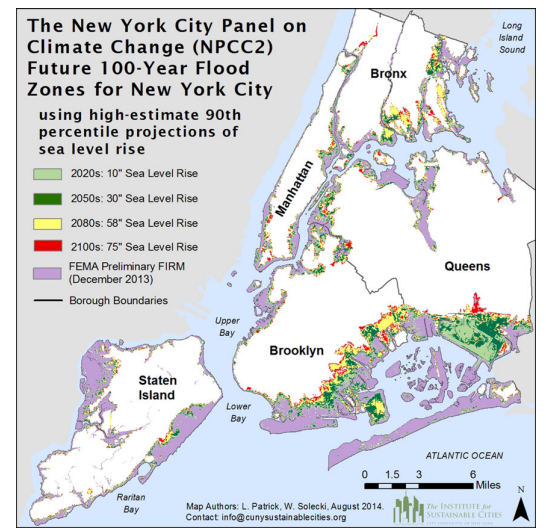
Back in 2011 a study looked at the projected impact of climate change on American coastal cities. For those with populations greater than 50,000, 9% of the land lies below 1 meter (39.36 inches) above sea level, and 36% of the land lies below 6 meters (20 feet). Using New York’s projected time lines, and all things being equal in terms of a uniform rise in sea levels, that means one-eleventh of existing city land will be underwater by 2080.
An additional factor to consider. High tide varies from place to place and high tides are always higher than elevation zero. So that means a high tide could easily exceed the 1 meter level making areas above that elevation susceptible to inundation.
The authors of the study point out that the southern tip of Manhattan in New York City has average high tides of 0.9 meters (2.95 feet) while in Seattle high tides reach 2.5 meters (8.2 feet).
The study listed the 20 largest American cities most vulnerable to rising sea levels. The ranking is done by percentage of below 6 meters in elevation. Here they are:
It is no surprise to see New Orleans (remember Hurricane Katrina) topping the list. Nor should it be a surprise to see Miami and other Florida cities in the top 5. All of South Florida is susceptible to rising sea levels, compounded by the land subsiding. A similar phenomena is happening in Chesapeake Bay where Virginia Beach can be found as well as the lower Potomac River and Washington, DC. The combination of climate change induced sea level rise and subsidence is making much of the U.S. eastern seaboard vulnerable.
How are all these American cities coping with the immediate let alone fifty year threat? According to Gary Griggs, Director of the Institute of Marine Sciences, University of California, Santa Cruz, most communities treat the increased frequency of inundations from high tides as “nuisance flooding.” This trivializes the growing threat.
In a January 15th, 2015, article in Scientific American, the author states that most cities lack a plan to tackle rising sea levels. Why? According to Klaus Jacob, a research scientist at Columbia University who consults with New York’s Metropolitan Transit Authority on the issue of climate change and rising sea levels, why cities and other governments are not pursuing policies and projects, other than in a haphazard manner, is they lack the political will to deal with it. One reason is the amount of money involved to create flood management infrastructure needed. Jacob estimates that cost this century to be over a trillion dollars, but warns, “if we don’t do anything, it’s multiple trillions of dollars.”
Where are those glass boxes today? And what do they look like? I walked by a stack of four of them on my morning outing with my dog and they very much looked like the one depicted below. None contained a telephone in any kind of working condition. It seems the only pay phones you find today are in the basement of malls, airports and train stations, and hotel lobbies. The ones on the street are for the most part broken and abandoned.

So that brings me back to the article my friend sent. It was about New York City and a plan to bring back the payphone. But not just the drop a coin in and call telephone of yesteryear. This technology will very much reflect the 21st century providing access points to the largest city-wide wireless Internet network.The proposed project is called LinkNYC. Take a look at the telephone booth of the future as proposed in this project.

Local calling from one of these locations, called Links, will be free. No more dropping coins into the slot to get a dial tone. A network of thousands will cover New York City’s five boroughs with each Link containing state-of-the-art WiFi access plus advanced security and data encryption. WiFi access at each Link will be free. And each Link will feature a touchscreen display providing city services information, directions, and instant 911 and 311 access. Find your own mobile device running out of power. Not to worry, each Link will include a charging station for recharging mobile devices.
The revenue model is interesting as well. LinkNYC intends to pay for itself through digital display advertising. The revenue sharing with the city is split 50/50 and in its proposal has stated that New York’s share over the next 12 years will equal a half-billion dollars.
The news gets better. LinkNYC intends to produce its Links in the City employing 150 full time in production and 650 in support jobs.If construction begins in 2015, the goal will be to replace the 6,500 remaining payphones with 10,000 Links. The city intends to auction off the old payphones and even dedicate a few to the fans of Superman whose used phone booths to alter his persona from Clark Kent to the red-caped flying superhero.
The public-private partnership includes the municipal government and CityBridge, a consortium of companies featuring advertising agencies, manufacturers and Qualcomm, the telecommunications giant.
In summary each Link will provide:
So what to do with the old payphone booth? Here are a couple of ideas.

City of Toronto

Toronto, my home town, boldly proclaims a Climate Change Action Plan on its website. Entitled “Change is in the Air – Toronto’s Commitment to an Environmentally Sustainable Future,” the plan was formulated in 2006.
In it the city government committed to reducing greenhouse gas emission (GHG) by 30% in 2020 and by 80% in 2050.
In addition the city plan targeted smog-causing pollutants with a planned reduction of 20% by 2012. Has the city told us if we have achieved that target? I don’t see anything on the website to confirm this.
Another Toronto goal was to increase the tree canopy to 34% across the city to reduce the heat island effect. This was also a 2012 target. Has it been achieved? Don’t know.
In the area of energy the action plan talked about supporting energy conservation and establishing renewable energy goals for municipal government use.
The plan also included reducing per capita water consumption by 50% by 2020.
On the issue of extreme weather events the action plan talked about the city conducting vulnerability scans for all operations. No talk about response to extreme weather events. No talk about hardening of infrastructure to reduce the likelihood of loss of power such over 900,000 experienced in this last week. No talk about contingency planning in the event of contamination of water sources when the filtration systems stop pumping as occurred for a short time this week. No development of backup generator capacity for the most vulnerable public facilities like hospitals. Two major city hospitals were running on emergency power for several days before the grid feed was restored.
Some climate action plan!
New York City
Let’s compare Toronto’s plan with that of New York City (NYC).

NYC took a beating after Hurricane Sandy in 2012 and as a result tackled the issue of climate change action with an eye to hardening the city to deal with extreme weather.
Besides the commitment to reducing GHGs by 30% from 2005 to 2030, plaNYC focuses on preparing the city for extreme climate events.
The plan talks about increasing the resilience of the natural systems and infrastructure to climate risks going well beyond the issues of GHGs.
This includes evaluating critical infrastructure to protect against floods, identifying where along the almost 900 kilometers (520 miles) of coastline the city is most vulnerable to extreme storms, renewing and restoring coastal wetlands to reduce erosion and storm surges, hardening power delivery and introducing a smarter grid, and creating continuous climate change projections to develop emergency management preparedness.
plaNYC also analyzes the impact rising sea levels will have on the city throughout the 21st century with contingency planning for altering land use and moving citizens to safer locations.
An Adaptation Task Force has combined 40 public and private organizations responsible for critical infrastructure in an effort to coordinate a common strategy to address all aspects of climate risk including extreme weather events.
The NYC plan includes over 500 events per year focused on educating New Yorkers, knowing that citizens and community groups can better deal with weather events when they have as much information as possible in the event of extreme weather and other climate change issues.
The planning by New York makes Toronto’s efforts to-date look like a dereliction of duty by the city government. And NYC is not alone in creating climate change action plans that have legs.
The 100 Resilient Cities Network identifies 11 U.S. and 33 international cities that have put in place action plans to address future climate change.
El Paso, Boulder and Others
One of the American cities is El Paso, Texas, population 672,500, situated on the banks of the Rio Grande River. El Paso over the last decade has experienced all kinds of climate extremes from devastating floods to multiple years of drought. But the single greatest threat the city will face in the future is a declining volume of freshwater. This has led to a strategic plan to manage water, storm water runoff and wastewater recycling. Natural landscaping that better fits the scrub of the semi-desert of West Texas has replaced lawns in many El Paso homes.

Another is Boulder, Colorardo, population 101,800. In the headlines this summer, Boulder suffered devastating floods (see image above) that washed away 1,800 homes, saw 10 people lose their lives, and cost $2 billion in property losses. CAP is the name of Boulder’s plan to integrate a number of strategies including reducing GHGs and implementing a CAP tax, the first of its kind to help defray the cost of climate change impacts. The tax is levied through the use of electricity and is collected by the local power utility. Rates vary depending on whether you are a residential, commercial or industrial user. First approved by vote in 2010, CAP was renewed by Boulder’s citizens in 2012. To-date six programs have received funding from the money raised through CAP and trash collection levies.
Other U.S. cities implementing climate change action plans include Jacksonville and Key West, Florida, New Orleans, Louisiana, Norfolk, Virginia, Los Angeles, Oakland and three other cities in the San Francisco Bay area of California.
Among international cities, many of the C40 have climate change action plans in place. Bangkok, Thailand, which has experienced significant flooding in the last decade developed an initial action plan in 2007 and has renewed it to cover the period up to 2023. The focus has moved from GHG reductions to mitigating and adapting to devastating weather events and rising sea levels.
Joining Bangkok are Berlin, Germany, Rio de Janeiro, Brazil, Bogota, Colombia, Melbourne, Australia, and Seoul, South Korea. What these cities are doing should be a wake up call to all the world’s major urban centres.


CCAP stands for the Climate Change Adaptation Project. Established at the University of Waterloo, to the west of Toronto, the project focuses on how cities need to adapt to climate change and forecasts the costs associated with changing the infrastructure to overcome vulnerabilities. In the studies done by the Project the overwhelming consensus is that it is better and cheaper to build city infrastructure rather than attempt to restore roads, sewers and other city services after a disruptive weather event. Most vulnerable are the power grid and storm water drainage systems. In 2005, a sudden thunderstorm wreaked havoc across the northern part of Toronto in a matter of minutes, submerging parking lots, flooding basements and washing out a major city street. The street I live on was one that experienced flooding in many homes. Total cost to the City – $47 million to repair washed out infrastructure. Cost to the insurance industry for damaged homes – $600 million. At the time the storm was described as a once-in-a-hundred year event, but climate models are suggesting that not to be the case. As a result Toronto has begun a program to harden the infrastructure and expand capacity to deal with extreme weather events.

And none too soon because in 2011-12 Toronto had its mildest winter on record with almost no snow and very few days of temperatures below freezing. This was followed by a summer that has been one of the hottest on record if not the hottest ever. That is why Toronto is looking at how to address future climate change. This is our future forecast for the decade between 2040 and 2050:
Urban areas suffer from the heat island effect. That alone makes them significantly warmer than surrounding countryside. But as temperatures continue to rise expect these heat islands to be even more exaggerated. The warming temperatures may decimate urban forest canopies, a counter to the urban heat island, with native trees no longer capable of surviving the rising temperatures. Air conditioning demand will increase putting further strain on power utilities, and pumping more heat into the urban environment. Add growing population and more automobiles and trucks on urban roads, and you have a recipe for environmental degradation.

Toronto isn’t alone in North America in making such predictions. Many other American and Canadian cities are looking at climate models that paint a similar picture. Urban centres west of the Mississippi in the American heartland also face the increased threat of prolonged droughts, a declining aquifer and competition from agricultural lands putting further stress on scare freshwater resources. Cities right across the Canadian prairie have to contend with similar challenges.
So what are cities to do to mitigate against the forecasted predictions in 2050? With more than half the world today, city dwellers, we need to deploy a new model for urban sustainability.
Strategies for Cities to Adapt to Climate Change
I am sure that you, my readers, can add to this conversation. What are your cities planning to do about the consequences of climate change?
]]>


