Davey points to analyst estimates indicating $28 trillion US could be wiped off the books of fossil fuel companies in the next two decades because of global commitment by nations to reduce their carbon footprints.
Davey joins Mark Carney, Governor of the Bank of England, as well as the bishops of the Catholic church in pointing out that investors need to be told the straight goods about the future of their portfolios which for most banks and investment institutions are heavily vested in energy stocks.
The map below from Carbon Tracker provides a snapshot of just how the world’s stock exchanges are heavily invested in fossil fuel companies.

This week Catholic bishops called for an end to the fossil fuel era and a focus on a future of 100 percent renewables. In their announcement in conjunction with the current ongoing climate talks in Lima, Peru, the bishops released a statement with the following:
“In viewing objectively the destructive effects of a financial and economic order based on the primacy of the market and profit, which has failed to put the human being and the common good at the heart of the economy, one must recognise the systemic failures of this order and the need for a new financial and economic order.”
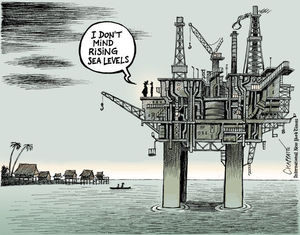
The bishops cited those front-line communities such as the island nations of the Pacific and Indian Ocean who are already suffering from the impact of a climate change. The bishops noted that the poorest and most remote people of the planet are the victims of nations that have exhibited little respect for environmental consequences stemming from consumptive behaviour.
Joining Davey, Carney, and the Catholic bishops are a number of large pension fund and asset managers who are joining together to urge fossil fuel companies to explain how they intend to address climate change. The California Public Employee’s Retirement System, U.S. public pension fund, and Aviva Investors released a statement this week in which they pointed out the following: “Investors are concerned that current business strategies being pursued by some oil and gas companies may not be sufficiently sustainable…..major trends are shaping a new direction in favor of low carbon energy systems and it is a critical time for the oil and gas sector.”
These asset managers urged fossil fuel companies to “embed stress testing for climate risk within key business processes.” And all of these urgent requests and statements are being made during a time when the price of oil is plummeting and throwing stock markets into a roller coaster of turmoil. What will happen to global investments when this next shock wave hits, when proven coal, oil and gas reserves on fossil fuel company books are declared stranded, unburnable, because the nations of the world in concert commit to a low carbon future?
Of course we may find technology solutions that let us continue to use carbon-based fuels without producing the climate-damaging CO2 and other greenhouse gas emissions. I recently wrote about one of these coming from the laboratories at Massachusetts Institute of Technology. And I am sure our human inventiveness will come up with others. But whatever we do as we recognize the need to address carbon in the atmosphere our entire energy infrastructure will need to undergo a retrofit.
Did you hear that? Economic growth, the creation of jobs, increased Gross National Product – you in government no longer have to concern yourselves that enacting climate change mitigation strategies is going to drive your country into depression or worse.
How does Clark justify the headline? She is reporting on a year-long study entitled, the New Climate Economy Report, which states that the decline in renewable energy costs, new advanced technologies, changing demographics, and changing patterns of investment have altered the economic landscape. The study commissioned by the United Kingdom, South Korea, Ethiopia, Indonesia and three other countries, sets out a 10-point action plan for governments and business.
You can skip all that follows and jump to the 10-point summary at the bottom of this posting if you are in a hurry. But you will miss some relevant data to help explain the why behind these recommended actions.
The goal of this “new climate economy” is to continue to experience growth in a lower-carbon world.
“It’s not business as usual” states the report.

Over the next 15 years global population will increase by a half billion. A billion people will move to cities. The transformation of society will be highly disruptive. At the same time rapid technological change will alter the human experience. The picture then is of an economy going through disruptive change at an unprecedented rate. And where there is change there is room for innovation.
Just look at how our demographics are changing. Today 2.4 billion humans live on less than $2 USD per day yet in the last decade a half billion have risen from poverty. This rise is largely because of urban migration. That’s because cities present better economic opportunity.
But creating energy to meet that demand is far easier in urban settings than if you had to create a nation-wide infrastructure of power plants and transmission lines.
The move to cities is also making environmental reforms easier to implement. That’s because we can see what we put into the air in an urban setting when we burn coal to generate energy. This is leading to implementing progressive environmental policies to improve air quality with the net benefit, healthier cities, healthier populations and healthier economies.
No one is suggesting that moving to a low-carbon future won’t cost money. It will.
But compare that to the economic costs of urban migration and the disruptive change brought on by rising global population and energy demand, bringing on green energy alternatives and low-carbon solutions will be a mere drop in the bucket.
The report provides the following data:
The latter includes more renewable power, mass transit, and contracting of urban centers from suburban sprawl to vertical compact cities.
Why do we know the report is credible?
Because renewable energy costs continue to drop. Solar panels are getting dramatically cheaper. Geothermal energy is on the rise. Wind farms are sprouting in high-wind areas. Wave and tidal turbines are finding customers. Today environmental products and services in support of a low-carbon economy generates 1 trillion USD in revenue per year, 5% of total global trade. By 2020 that number will jump to $2.2 trillion with most of the growth coming from the Developing World.
But for the global economy to move to a green, low-carbon world some current activities have to stop. For example, no country should be investing in new coal-fired power plants. And countries need to phase out existing subsidies to fossil fuel producers. These amount to $600 billion USD per year. For those reading this who say but don’t renewables also get subsidies? The research in the report clearly shows current renewable subsidies at one-sixth that of fossil fuels. Eventually even these subsidies can vanish.
Financial institutions, already recognize the need. They are aware of the disruptive shift that lies ahead. They will be the providers of capital to create the new low-carbon infrastructure. They will provide favorable interest rates for low-carbon investments. These policies will not be like the government subsidies of old. With better financial terms and the commitment of financial institutions there will be no need for complicated feed-in tariffs.
For countries mining coal job losses will happen as these economies transition to low-carbon. Growth of jobs in other industry sectors should compensate. For those who lose their jobs, governments have to put programs in place to ensure that no one is reduced to poverty as all nations pursue a low-carbon solution.
Which brings me to the final point. There needs to be an international agreement on a low-carbon future. Carbon has to be priced. Governments need to know that domestic policies to achieve low-carbon outcomes will not be undercut by other nations who choose not to pursue carbon reduction strategies.
What happens next week in New York City is important as 125 countries meet. And what is signed and agreed to in Paris in this next year must give us the blueprint for a successful transition to a lower-carbon world.

Summarizing It All
The 10 Point Global Action Plan described in this report follows. The authors of the report state that if we follow its recommendations we can keep climate change’s impact to a manageable mean temperature rise of 2 Celsius (3.6 Fahrenheit) on average across the globe. Follow the 10 points and we make the shift to a low-carbon, climate-resilient global economy that enhances growth while reducing climate risk. Here they are:


