In this posting, she describes the current and potential future impact of artificial intelligence in academic research. Please welcome Bernadine and feel free to send your questions and comments to this blog site.
AI is likely to change how academic research is conducted, and analyzed across multiple disciplines. It will have a profound impact on how new research papers are written.
AI-based research will change how academics work in several key areas: data processing and analysis, literature review and synthesis, research collaboration, and ethical considerations.
AI can process and analyze vast amounts of data at unprecedented speeds. This is perhaps
AI’s most significant contribution to academic research. That’s because traditional data analysis methods are time-consuming and often prone to human error, but using AI algorithms, particularly those based on machine learning, quickly can identify patterns and
trends in large datasets. This capability is particularly advantageous in fields such as genomics, climate science, and the social sciences, where researchers deal with massive datasets.
AI is also transforming how researchers conduct literature reviews which help to understand the current knowledge on subject matter that can be gleaned from published material. Using Natural Language Processing (NLP) algorithms, scientists can scan and
analyze thousands of academic papers, identify relevant studies, summarize findings, and
even highlight potential gaps in the literature. Tools like Semantic Scholar and Microsoft Academic help researchers keep up-to-date on the latest developments in the field by performing comprehensive literature reviews. This not only accelerates the research process but also ensures that researchers what they write is built on the most relevant and current research results.
The collaborative nature of academic research is being enhanced by AI-driven platforms that facilitate more efficient and effective teamwork. AI can connect researchers with similar interests, suggesting potential collaborators based on publication records, research interests, and previous work.
What’s more, AI-powered project management tools can streamline the coordination of research activities, tracking progress, and managing resources. Virtual research assistants, powered by AI can also take over routine tasks such as scheduling meetings, managing correspondence, and organizing data, allowing researchers to focus more on their core investigative work.
While AI offers immense benefits, it also raises significant ethical issues that need to be
addressed to ensure it is used responsibly to advance academic research. Issues such as data privacy, algorithmic bias, and the transparency of AI-driven decisions are paramount.
Researchers must ensure that AI systems are designed and implemented in ways that respect participants’ privacy and confidentiality. Additionally, AI algorithms should be rigorously tested for biases that could skew research findings or perpetuate existing inequalities. Whilst this is something to be aware of, there are transparent AI systems and developments that ensure there are clear insights into how decisions are made and the technology is continuously improving.
The future of academic research in an AI-driven world is one of enhanced capability and
productivity. Researchers will be able to tackle more complex questions and generate insights that were previously out of reach.
Interdisciplinary research will flourish as AI facilitates connections across different fields of
study, leading to innovative solutions to global challenges.
There is no doubt that AI is set to change academic research profoundly. Embracing its use will enable researchers to push the boundaries of knowledge and help humanity to address pressing social and environmental issues more effectively. Integrating AI use into academic research will not just be another technological innovation but instead, a paradigm shift that holds the promise of unprecedented scientific advancements.
]]> March 13, 2020 – It seems appropriate that this week of disruption should end on a Friday, the 13th. It was only yesterday that I realized the calendar had aligned itself this way because of the extra day in February. Not that I believe in numerology or omens, it’s just an interesting coincidence.
In my morning inbox I was reading about how artificial intelligence (AI) saw the coming COVID-19 pandemic. BlueDot, which describes itself as a company that helps governments, citizens, and businesses to protect themselves from public health threats, has developed a dashboard application that combines public health and medical expertise with AI algorithms to assess risk and provide notification of infectious disease outbreaks.
In the case of COVID-19 it picked up on a sudden surge in pneumonia cases in Wuhan, China in December, nine days before the World Health Organization (WHO) began to track the rising incident of illness there.
COVID-19 isn’t the only infectious disease that BlueDot has been tracking. It has been following Dengue fever in Thailand, measles in the United States, Lassa fever in Nigeria, and mumps in Ireland. In each case the machine learning algorithms make predictions on the likelihood of these diseases spreading beyond containment to other countries.
BlueDot’s origins are here in my home city of Toronto. The outbreak of another coronavirus, SARS, in 2003 led to 44 deaths here. Under the leadership of Dr. Kamran Khan at downtown St. Michael’s Hospital, a scientific research program was launched called BioDiaspora. It began by studying the effects of air travel on the spread of infectious diseases, notable in the case of SARS. In 2009 the program predicted accurately a global influenza pandemic, the first of the 21st century. And in 2014 with private investment backing the research, renamed the venture to become BlueDot, what it calls “a metaphor for our small world,” and a reference to Carl Sagan’s description of Earth seen from Saturn.
In 2014 BlueDot using its risk models predicted the spread of Ebola throughout West Africa. In 2016 after a Zika outbreak in Brazil, predicted six months ahead that it would emerge in Florida. And in December it flagged COVID-19.
How did BlueDot know?
The AI contains a natural language processor capable of reviewing foreign-language news reports, government official proclamations, and animal and human disease online network reporting. Khan notes that BlueDot avoids social media which he describes as too messy. BlueDot even looks at global airline ticketing data.
Why? Because when combined with an area where there is an outbreak of an infectious disease, it can indicate its jump potential to other countries.
The machine language component of the AI can sift through all of this range of unstructured data. Why unstructured? Because this is not in a defined-field database. Khan, in an interview with Wired, states that through the AI technology, “we can pick up news of possible outbreaks, little murmurs or forums or blogs of indications of some kind of unusual events going on.” In the case of COVID-19, BlueDot tracked the online trail of local news and official pronouncements in Wuhan and elsewhere within China. And through the airline ticketing data could predict the virus’ jumps to Bangkok, Seoul, Taipei, and Tokyo within a few days.
The reports BlueDot produces are not totally the work of the AI. On-staff epidemiologists review its conclusions and then write the reports that get shared with governments, businesses, and the public.
The circumstances around COVID-19’s initial appearance in Wuhan, and Hubei Province, involved just a trickle of local reporting. The treating physician who first noted the symptoms of COVID-19 was seen as a whistleblower by the local authorities in the Chinese Communist Party. An attempt to suppress the news could be discerned in an online trail of shared information. The attempt to control the story turned out to be fatal for that treating physician who became infected as well as the tens of thousands in Wuhan and surroundings.
The rest of the world is now paying for the Chinese Communist Party’s mistake. An AI like BlueDot in these circumstances, if seen as authoritative, could have been the difference between a local outbreak and the current global pandemic. Unfortunately, what BlueDot knew wasn’t picked up by the WHO immediately. That nine-day lag has turned out to come with a heavy price tag in terms of lives lost and the shaking of the world economy.
]]>
The research found that the training of a series of AI models emitted almost 284,000 kilograms (626,000 pounds) of carbon dioxide (CO2), five times the average lifetime emissions of an automobile including the CO2 released during manufacturing.
New AI models based on neural network computing require many hours of training and exposure to vast amounts of data. In many cases, the hardware used is top-of-the-line supercomputers or multiprocessor server farms. The energy requirements to power the hardware, plus the manufacturing of the systems themselves, if not sourced from renewables produces net new carbon emissions. This is particularly true when the hardware being used to develop the AI models is sourced from often, energy-intensive in-house data centers, and not from cloud sources which more recently have become greener by developing accompanying wind, solar and battery storage farms.
For the purpose of the study, the authors looked at model training for natural language processing (NLP), teaching AI to understand human language. The training of NLP models has involved mega datasets of scraped pages from the Internet, computationally expensive, and an enormous energy consumer. In studying the four models that represent state-of-the-art NLP performance, they were able to calculate resource usage, and total energy consumed over the model training process. They then converted the energy and resources consumed into CO2 equivalents.
What they found was that the more complex the AI model, the higher the environmental cost in CO2 equivalent emissions, with the most costly model of the four producing a carbon footprint equal to 635 kilograms (1,400 pounds) of CO2, equal to a single fare round-trip flight from New York City to Los Angeles. The CO2 amount described here covers only one modeling effort. So imagine when you are testing a number of options, how quickly the emission equivalent values would rise. For example, in a six-month AI training effort involving 4,789 modeling options, the amount of CO2 emitted equaled 35,800 kilograms (78,000 pounds). Multiply that last statistic by the geometric growth in AI research, and particularly, using large neural networks, and you have a growing and massive carbon footprint issue that needs to be addressed.
In the paper, the authors address this issue by looking at the shared computing resources offered by companies such as AWS, Google, and Microsoft, looking at advantages and disadvantages of doing the research using third-party commercial data farms. What they found out is that in most cases, the economic benefit is not immediately apparent using cloud-based commercial server farms proving to be twice as expensive as relying on home-built resources. And once built, the home-based servers can be repeatedly used for subsequent projects for the cost of energy and operational maintenance.
The authors post for consideration that because of the burgeoning field of AI research, a good national strategy consider cloud-based data farms built by governments for common use and that these facilities be powered from renewable energy sources. Continuing down the current path, the authors conclude is not feasible because the computational resource requirements for advancements in AI will in time become environmentally, energy, and cost prohibitive.

Technology has impacted and reshaped nearly every industry including the law and legal profession. Whether it is time tracking and billing systems, chatbots or contract review, the job of a lawyer has been drastically altered. Today’s lawyers are expected to be tech-savvy, to learn to use different software and technology tools and to make their practice more streamlined and efficient. Today’s lawyers are proficient at spreadsheets, databases, telecommunications, legal research software, and word processing with technology impacting every aspect of the legal field from corporate practice, courtroom operations, document management, and more.
Here are just some of the impacts technology is having on the legal field:
Telecommunication innovation is enabling lawyers to work from anywhere these days. Lawyers no longer need to be in their office to stay connected to clients, and the documentation associated with cases or issues. Just some of the tools lawyers are using include instant messaging, voicemail, email, and web conferencing.
Natural language processing or NLP was probably, after the introduction of word processing, spreadsheets, and time and billing software, the first AI tool that lawyers began to use for doing legal searches in online legal database services like Lexis, Westlaw, and QuickLaw. NLP has since been incorporated into almost any digital application from basic spell checking to Google Search. I recently read a comment that stated: “NLP makes computers think like lawyers so that lawyers can think about the law.”
Case preparation involves going through tons of documents to find evidence relevant to a specific client file. Today, almost all documentation can be found in digital form whether contained in emails, databases, on mobile devices, in computer archives, or in IoT devices. The variety for digital forms has made the role of paralegals even more critical as it is their task and their time that is involved in sorting out the case file from these various digital records. For clients, this component of legal costs cannot be underestimated.
Fortunately, there are new tools available to lawyers that go under the name E-discovery which stands for electronic discovery. E-discovery software uses analytics to search for key phrases and words in digital content. Using these software tools helps separate the wheat from the chaff, removing irrelevant documents and information, and streamlining the discovery process. A list of E-discovery software tools can be accessed here.
Time can be a lawyer’s worst enemy whether it be court scheduling dates, the assembly of case timelines and date stamping of evidence, and managing billing. That’s where case management software comes in. It can help law firms automate daily and case workflows including viewing tasks, billable time, and calendaring. And case management software makes it convenient for the sharing of a digitized case file with interested third parties when necessary. Whether a lawyer’s practice is in real estate or civil and criminal case law, there are many excellent software tools of this type available today.
One of the biggest challenges lawyers continue to face is the time-consuming routine of legal work. In a recent study, it noted that 31 to 35% of the time spent in practice goes to trying to handle the mountains of data associated with legal search. CEO, Andrew Arruda, of ROSS Intelligence, an analytics tool that works with IBM’s Watson AI, recently stated that “lawyers are drowning in this sea of data that they can’t necessarily use.”
But with IBM’s Watson AI, made famous on the game show, Jeopardy, lawyers can ask questions that then provide relevant legal case results with Watson sifting through billions of documents per second.
LawGeex is another analytics tool that, according to its website, can reduce the cost of contract preparation by as much as 90% while saving 80% of the time a law practice has to give to contract review.
And Kira Systems, another machine learning tool can identify, extract, and analyze the text within contracts and other documents while using 700 built-in models that cover due diligence, lease abstraction, compliance, finance, and more, which according to the company’s CEO, Noah Waisberg, reduces lawyer’s contract review times by 20 to 60%.
To look at other cognitive analytics tools I recommend you check out this site.
Last but not least there is the emergence of online expertise in the form of communities allowing for networking and conversation around the law. Communities vary. They can be lawyer-to-lawyer, lawyer-to-client, and lawyer-to-students of the law. A sort of online legal aid, they typically provide resources, chat, and other functions and a Google Search can identify those that are relevant to your local legal requirements.
Even social media sites provide online legal advocacy with many lawyers providing pro bono services to those who pose questions.
Lawyers have been slower to adopt legal practice automation tools than most professionals. The leap from the adoption of personal computers with word processing, to machine learning AI, has been slow. Advising clients, writing briefs, negotiating and appearing in court, to many lawyers, seem to be beyond computerization. But as you can see from this brief review of current technologies available to lawyers, the uptake over the next decade will alter legal practice in a profound way, and change the professional paradigm from the number of hours lawyers work, to billing. In a recent New York Times article citing a McKinsey report, it estimated that 23% of lawyer’s jobs can currently be automated.

AI has reached a point where it can replicate human behaviour more accurately than ever before. There are not only supercomputers capable of playing chess and poker better than humans, but also even more advanced AI bots that drive cars, perform medical operations, and analyze mountains of data to make new discoveries faster and better than any human. Today, AI software has the ability to learn by itself and correct mistakes without additional programming.
The result is the US is investing $10 billion in new AI venture capital. China has grown its AI patents by 190% in the past few years. Russia is exploring AI’s military capability with an estimated 30% of its equipment incorporating some sort of AI by 2025.
The AI software market has grown dramatically in the last three years, and some projections show that this growth will accelerate from a market worth only $1.4 billion in 2016 to one that will hit close to $60 billion annually by 2025.
AI will impact the global job market significantly. AI is ready to replace human labor in a number of industries, and it is estimated that more than 30% of U.S. jobs may be at risk within the next 10 years.
The AI revolution comes with many benefits. It will help us eliminate online cyber attacks, minimize auto fatalities and accidents, provide for better education, healthcare, agriculture, and more. And since there is a lot more about the AI revolution to write about, this infographic depicting many more details about it should whet your appetite to learn more.

]]>
Arumugam gives the following examples.
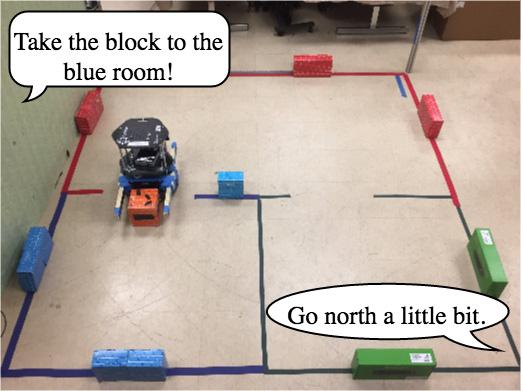
A warehouse worker shares a workload with a robot forklift that is next to him or her. When the worker says “grab that pallet,” how should the robot interpret this? Which pallet for example…the one in front of me, the one to the right, or one across the floor? In addition, “grab that pallet” isn’t the same as “lift that pallet” which may be implied by the worker but not implicitly understood by the robot. A robot receiving such a request may simply do nothing without further instruction.
So Arumugam and Karmacheti devised a software program that analyzes the language of inference within the robots spatial reality and gives it the knowledge of abstraction when executing a task. They then ran a virtual test by getting volunteers to instruct the robot software to move a chair image from a virtual red room to a virtual blue room. Instructions varied from a high-level command “take the chair to the blue room,” versus step-by-step instructions such as “take five steps north, turn right, take two more steps, get the chair, turn left, turn left, take five steps south.” In the virtual environment, through continuous testing, the software learned how to apply inference to an abstract spoken request.

The two researchers then decided to use the software with a Roomba-like robot in the real world. When the robot inferred the task objective and was then given specific additional instructions, it responded 90% of the time to the spoken command within 2 seconds. When no specificity was added it took the robot 20 seconds or more to execute on the abstraction.
States Stefanie Tellex, Professor, Computer Science at Brown, “This work is a step toward the goal of enabling people to communicate with robots in much the same way that we communicate with each other.”
We will look at the above more closely later in this posting. But first it should be noted that the study found “no cause for concern that AI is an imminent threat to humankind.” So for those who see AI through the lens of an Elon Musk or Stephen Hawking who have warned us all about its inherent evil, the Stanford research team found no machine technology developed or under consideration as likely to be developed to resemble a Skynet from the Terminator movies, or the AI of the Matrix. Instead the study refers to potential positive and negative impacts of AI on urban North American society by 2030. The study does not gloss over disruption from AI. Instead it sees this as a new challenge for the economy and society and recognizes that researchers and developers of AI must balance innovation with “mechanisms to ensure that AI’s economic and social benefits are broadly shared across society.”
What are the hot areas of AI technological development that will most impact urban life in North America by 2030?
Add to this crowdsourcing and human computation and the creation of collective wisdom knowledge repositories that AI and humans can contribute to and access, and advancements in algorithmic game theory and you have a very different urban landscape emerge.
The AI-influenced urban world of 2030 is already coming into shape. We are on the threshold of autonomous urban transportation in its various forms. With that urban dwellers will be less likely to own their own vehicles. A proliferation of sensors and cameras will alter our road networks. Autonomous vehicles will be interconnected to optimize traffic flow. On sidewalks autonomous wheeled-robots will navigate pedestrian traffic to deliver goods and services. Flying autonomous drones will also serve to deliver products to customers. On demand transportation will have reached a point of wide adoption from cars and boats to quadcopters.
Homes will continue to see an AI invasion from the trilobite-like Roomba vacuum cleaners to more sophisticated home robots capable of delivering a range of services. Advances in speech recognition will make the interaction of AI-empowered devices with humans in homes very natural. We can already see the rise of social interaction robots in Japan and through enhancements these should become ubiquitous in urban home life by 2030.
In healthcare whether in clinical setting, surgeries, or through advanced analytics we should see a significant impact on how patients interact with providers of health services. The largest impact may be in the field of elder care with North America’s greying population. AI will be applied to assisting humans with life quality and independence, with early detection of potential health threats, and with the provision of better devices to deal with sensory loss such as vision and hearing.
In education the urban learning world of 2030 will incorporate teaching robots to accompany human teachers in schools. In homes robotic tutors will help students to learn. Online learning resources plus advances in analytics will identify students at risk providing guidance and customized learning to improve educational outcomes. The implementation of AI will blur the lines between formal education and individual self-directed learning. Books will continue the transition to digital media and texts will become individualized to meet specific learning objectives. In addition machine translation will make educational materials multi-lingual eliminating language understanding as a barrier to learning.
AI technologies will have a significant impact on those urban areas defined as low-resource. AI cna be applied to address joblessness and other social problems by providing insights through data science for social good. Predictive modeling will assist government agencies to prioritize citizens at risk because of health. sanitation, disease, nutrition, domestic abuse, homelessness and inadequate housing, and lack of community programs focused on healthy socialization. Applied AI will help eliminate discriminatory practices in the delivery of these essential services.
Today AI is already being deployed for public safety and security in North American urban centres. Whether applied to policing or through analytics applied to detect anomalies pinpointing potential crime, AI will alter public trust of our security apparatus. AI today is already helping to detect credit card fraud. Further improvements to machine learning and pattern recognition using AI will help to manage crime scenes, search and rescue, and through better predictive tools thwart urban terror. Combined with the widespread use of cameras AI capable of high-speed and efficient processing of video images to detect anomalies will greatly improve safety and security. AI tools will assist law enforcement through immersive 3D interactive training. The monitoring of social media using AI tools will help to identify legitimate risk concerns.
The greatest impact of AI is in the area of the workplace and employment. Automation has already produced positive and negative effects. Globalization has distorted urban economies even further. AI will definitely take away many jobs will introducing new types of labour and skills demand that will require a different workforce. Whether AI is applied to production lines or law offices, the impact will be felt. Human fears of being marginalized need to be addressed. Taxi and bus drivers are among the most obvious to be impacted by AI as implemented in autonomous and on-demand transportation. Delivery service jobs will disappear. The loss of jobs will impact quality of life unless governments create political changes that address economic displacement. Social safety net policy will by necessity require alteration. Continuous learning assisted by AI will serve to help urban citizens transition to new employment opportunities. A guaranteed basic income, once thought as radical, may be instituted as a means by which the dividends of AI become equally shared across urban society.
In entertainment AI will enable the further advancement of user-generated content from social media and other sources. AI can help to facilitate creativity in new forms using tools that generate 3D scenes from written text, or visually recreate the results of historic research. And AI will be able to mine the aggregated digital content of the Internet to personalize the delivery of news and information. The traditional newspaper as we know it will vanish. Libraries will evolve to become digital repositories that AI tools will help to mine for readers. For marketers, advertisers and retailers AI will serve them to better understand consumer preferences and usage providing micro-analysis of buyer behaviour. Some would say this last capability will not better the urban environment of 2030.
In part two describing the results of the Stanford study we’ll look at what the researchers have defined as prospects and recommendations on AI public policy based on their 2030 projections.

So far there are no guidelines on the nature of the innovation a team can produce. This fits with IBM’s Watson strategy overall, which is to put the artificial intelligence technology to the test in a wide range of industries. Watson is being used in healthcare, education, finance, human resource management, travel planning, law, retailing, meteorology, security, agriculture and publishing, just to name a few of the areas where its AI is being applied.
Peter Diamandis, one of the founders of the X Prize states, “I’m sick and tired of the dystopian vision of artificial intelligence…AI is one of the most important inventions we will create to solve humanity’s grand challenges, to understand the potential the future provides for us.” I guess Diamandis is reacting to Elon Musk and Steven Hawking and those who fear that AI will wipe out 50% of all human employment on the planet by 2030.
Watson was first unveiled by IBM in a contest with the two biggest human winners of the TV trivia show, Jeopardy. The AI wiped the floor with its human challengers. The technology uses natural language processing and machine learning to analyze unstructured data such as news articles, research reports, social media postings, and business systems. Its natural language processing lets it understand grammar and context. It can evaluate all possible meanings of a statement to determine its purpose. And it presents answers based on found evidence.
How does Watson start to learn? Its human handlers load it with unstructured information (articles, documents, books, reports, memos, email, etc.). Then Watson is trained through an iterative process to match questions and answers. As new information is added Watson stays current.
How does Watson answer a question? Watson uses a scoring algorithm as it searches through unstructured data and then ranks all possible answers to a query.
The XPrize contestants will be able to join the Watson Ecosystem receiving APIs from IBM that will let them tackle the problems they want to solve.


