Quantum logic and quantum algorithms have been the stuff of physics labs to date. Quantum computers have progressed from one qubit to two and three with the biggest challenge being getting them to scale to a point where they are practical for commercial use. The University Maryland’s five-qubit programmable module uses ion trap quantum architecture (see illustration below) and its inventors state it can scale by connecting a number of individual modules together. Not yet demonstrated this would be the logical next step to creating a commercial device.

On the other hand, D-Wave’s latest quantum processor, seen in the image below, makes the University of Maryland efforts seem passe. The company’s latest model claims to break the 1,000 qubit mark although many physicists including those at Maryland are skeptical. But not the folks at Google and NASA who have upgraded from 512 qubits to this new processing capability. D-Wave intends to keep making upgrades to these systems in strategic partnership with its users at University of Southern California, NASA, Google and Lockheed Martin.

It would seem, therefore, that existing computing technology will face a challenge from quantum processors and their amazing potential. As quantum computing approaches a threshold where it will serve commercial applications and become widely distributed, the National Security Agency (NSA) of the United States is voicing its concern that existing security and encryption standards will prove inadequate as a defense against quantum computing purchasers with malevolence on their minds. In other words, once quantum computers are being used not by a few, but by many, the NSA believes any secrets protected by current best encryption standards will no longer be secret.
The truth is, today, no one knows how to make quantum-computer-proof encryption. And as quantum computers scale to millions or hundreds of millions of qubits, any current computer and current software will be vulnerable.
Google, IBM, Microsoft and NSA are cognizant of the importance of developing cryptographic keys that even a 100-million qubit quantum devices cannot break. In their pursuit of developing commercial quantum computing circuits it is, therefore, clear that a window of vulnerability exists now as the technology scales up.
That brought to mind Edward Snowden and Wikileaks and the recent series of disclosures that have given us a new picture of government’s overreach into our private lives. Snowden’s leaks of which the latest reported in The Washington Post, show us that 90% of conversations, texts and emails sent over telecommunications networks are intercepted and have nothing to do with legitimate targeted surveillance. And to make matters worse, the captured data by organizations like the National Security Agency where Snowden worked as a contractor, is being retained. This captured data which you and I would consider personal and private, is now in the hands of an agency that appears to have few limits put on its authority.
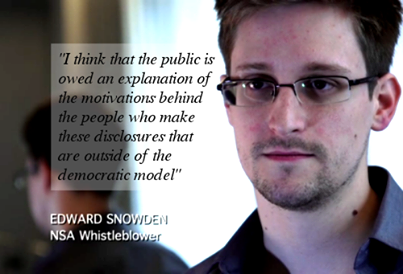
So my friend had a point when he pointed to his smartphone. Every picture you take, every text you send, every phone call you make, is no longer private. And this is not limited to transmissions through mobile networks. Your WiFi home network is as vulnerable. Your land line phone calls which today are converted from analog to digital signals may also be intercepted as they travel from you to the person on the receiving end. Privacy is vanishing rapidly. So should we be worried? Absolutely and when we elect our governments we should be holding them to account on the issue of what is private and should remain so.
But getting back to our debate on greatest threats, I couldn’t help but think that we have seen cycles of this type of invasive and irrational “fear stoked” behaviour in the past by governments. We have had Soviet Communist invasive behaviour. We have seen fascist and Nazi invasive behaviour. We have had McCarthyism. We have profiled people by the colour of their skin and shape of their eyes and displaced them in times of war. We have discriminated and murdered people because of their cultural heritage and beliefs. So is this behaviour today much different than the past? Only in scale because we have the technology to reach further into private lives than ever before all because we are addicted to a telecommunications revolution that makes two-way communication ubiquitous. And with that comes the dark side.
On the other hand, our influence on the environment is more subtle than eavesdropping on conversations. When sea levels rise they go up in fractions of millimeters per year. You don’t notice the change that much because it is gradual and insidious. Climate scientists like to talk about the frog sitting in pot of water being heated on a stove. The frog doesn’t know to jump out until it boils to death. That’s the threat to humanity that I see as most compelling because we can ignore its insidious effects more easily.


