This is not the first attempt to create a robot substitute for bees. In my past research I have come across the RoboBee developed by engineers at Harvard, and about work on pollinating flying robots in Japan.
What has inspired this type of invention? One thing is the threat to honey bees from Colony Collapse Disorder, a problem that has seen bee populations plummet globally. The second is the collapse in insect populations recently revealed in a United Nations’ report. And third is the challenge of micro gravity in space and low-gravity environments such as on the Moon and Mars that would impact insect pollinators negatively.
What makes this new artificial flying insect substitute, the Bee+, more like a real insect than any previously designed? The Southern California team built it with four wings, unlike RoboBee which has only two. That extra pair makes Bee+ fly like the insects it was designed to emulate.
At present, there is a limitation to Bee+. It needs an external power source and as a result is tethered, a major limitation. But the USC team is developing actuators with the assistance of a National Science Foundation grant that is focused on achieving maneuverable, autonomous, untethered, insect-scale flight.
The team is working on catalytic artificial muscles to achieve this, using fuel-powered, shape-memory-alloys that generate heat to induce material phase transitions to create powered, stable, aerodynamically controllable flight. Critical to the research is the latter function will be control, the ability to fly where and when it wants and achieve whatever task it is asked to do.
And just what do the inventors of Bee+ have in mind?
Nestor Perez-Arancibia, USC professor in the Department of Aerospace and Mechanical Engineering, is team leader in the development of Bee+. His current work includes the Bee+ micro flyers project which also requires the development of controlling algorithms for this tiny robot, new microfabrication techniques needed to build Bee+, and soft robotic actuators that eventually will allow Bee+ to fly untethered.
Perez-Arancibia believes the other-world application for the flying robot would be one of the most exciting. He recently told Digital Trends, “I would like to see our robots flying on Mars and Titan.” He added further, “I believe that we can create ant-inspired colonies of explorers in which each member has unique capabilities and can perform specialized exploring tasks, [taking] geological samples, [measuring] the gases in atmospheres, et cetera.”

]]>
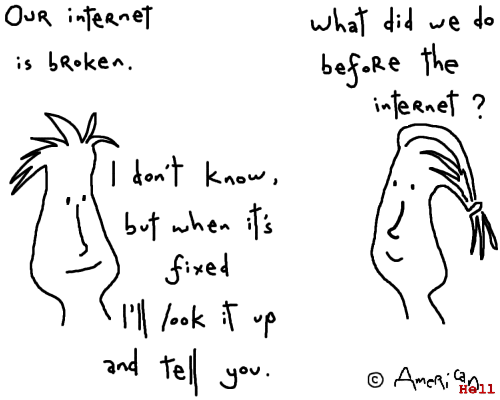
In 2006, a writer with the MIT Technology Review published an article entitled The Internet is Broken in which he described the incremental changes happening in Internet usage and the lack of response by network specialists to a growing number of problems. That same author this week posted a follow up article on the same subject arguing that the “creeping complexity” of the Internet in supporting mobile device technology will expose serious architectural and security problems unless something is done about it.
I’ll give you an example of the kinds of issues that I face with my Internet usage today. In my home I have a desktop computer running Windows 7. I also have a five-year old laptop running Windows XP, an Android tablet, an Android smartphone, and a WiFi enabled eReader. My daughter has her Windows7 laptop, an Android tablet, an iPod and a semi-smartphone good for email and short messaging. My wife has a Windows XP netbook and an Android smartphone. Currently our televisions are hooked up to satellite so no Internet capability as of yet. But soon I think.
We are all connected to the Internet through a single DSL line that is also our home voice line. The DSL is plugged into a WiFi-enabled modem that serves the house and a range extender that pushes the WiFi out to the end of the backyard.
All this connectivity and yet when I send an email to my wife sitting at a desk a few feet away from me it has to go out to the Internet and then come back into the house to get to her inbox. That just seems dumb to me.
Some documents and images that can be opened on my smartphone cannot be opened on my wife’s netbook but she can see them when she looks at the same attachment or document on her smartphone. And sometimes when I send an email from my smartphone through the Gmail application running on the device, I don’t see the sent email in my Gmail sent box on my desktop right away because I’m sending my message through the mobile 3G phone network. But if I send that Gmail from my smartphone while in the house my phone uses its WiFi connectivity and the email appears right away in the sent box. It’s even worse with my wife’s smartphone and netbook often requiring her to shut the computer off and restart for the sent mail to appear. She doesn’t use Gmail.
This latency issue where you have multiple communication protocols all using the same Internet pipe is a bottleneck and I can imagine as I along with so many other populate our houses with more smart devices just how congested communication through the Internet will become.
One organization that is engaging the issue is the National Science Foundation (NSF) which launched the Future Internet Architecture Project in the summer of 2010. In its introduction the NSF stated, “The continued success of the Internet…..is increasingly threatened by the ever-mounting sophistication of security attacks and by the lack of performance reliability of Internet services.” The project highlighted the following challenges:
Without addressing each of these challenges an Internet of 15 billion things forecasted in 2015, and 50 billion possibly a decade later, will suffer from interruptions in service and network breakdowns.