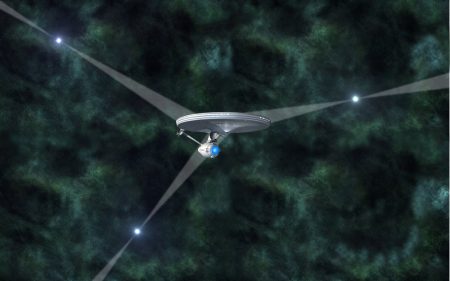
What is a XNAV? It’s a small X-ray telescope that tracks the position, velocity and timing of reliable pulsars. Pulsars are rapidly rotating neutron stars, stars that have erupted in the past into super novae leaving an inner core approximately 20 kilometers in diameter with a mass greater than our Sun. According to their namesake these remnants are largely composed of neutrons. They rotate with a periodicity that can vary but in some cases the rate is predictable. In rotation they emit X-ray pulses that can be timed and used as a beacon for celestial navigation.
Triangulating on three pulsars resembles the way GPS works here on Earth. A GPS system relies on three passing satellites to triangulate the position of your car as you drive down a road. Now a spaceship with an on board XNAV can do the same with pulsars and accurately plot its position in space.
The current accuracy of the XNAV created by NPL and the University can place a spacecraft within 2 to 5 kilometers of its celestial position. Now that sounds like a big miss but when you are talking about distances in Deep Space, that’s close enough for a spaceship with other navigational instruments to make course adjustments to correct the distance error.
The XNAV will soon be tested in space with plans to include it on board for a European Space Agency mission to Mercury scheduled for 2018. If successful it will replace the current European Space Tracking (ESTRACK) network and NASA’s Deep Space Network which can take several hours to plot the accurate position of a spacecraft on a mission to the outer planets of the Solar System.
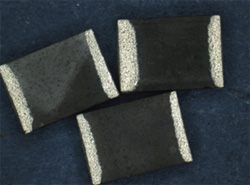
Capacitors play an important role in doing that conversion but current technology is limited in its heat capacity and therefore struggles in the high temperatures environments of EV engines. Research to develop new capacitors is being conduction at the National Physical Laboratory in the United Kingdom. One of the projects is called HITECA, a capacitor capable of functioning in extreme high temperatures. It can operate in temperatures above 200 Celsius (392 Fahrenheit) degrees. That’s twice the boiling point of water. Current capacitors have an operating temperature range of between -55 and 125 Celsius (-67 and 257 Fahrenheit).
The technology involves the application of ultrathin films of alumina deposited in layers on a ceramic surface increasing energy storage capacity. Potential markets go beyond EVs and include applications for integrated circuits, space, renewable energy, extreme environments and high-power energy pulses for use in xrays, energy beams and electromagnetic systems.
But for EVs HITECA is a capacitor with high heat tolerance meaning less insulation and lighter vehicle weights. The high energy density means faster response in terms of energy release. The bottom line is significant improvements in EV range as well as reduced maintenance, so less down time and lower operating costs.
]]>