The dire warnings contained in this 52-page essay, which should be read by every politician on the planet, point to the uncertainty of atmospheric tinkering by humans. The atmosphere knows no borders. So one country doing a geoengineering experiment with aerosols could unintentionally impact countries thousands of kilometers way in a “butterfly effect.”
That isn’t stopping the U.S. Congress which just gave the National Oceanic and Atmospheric Administration (NOAA) a $4 million budget to cool the Earth using two different experiments. The first would inject sulfur dioxide or other aerosols into the stratosphere to scatter sunlight in an attempt to mimic the effect of volcanic eruptions. The second involves injecting sea salt particles into low altitude clouds over the ocean to create more shade mimicking ship tracks, the long clouds that follow emissions from ocean vessels.
To make the idea more palatable to the uninformed, the word geoengineering is struck from the project. Instead, the term being used is climate intervention. You see words matter when you are describing an experiment that could have unintended consequences such as altering wind and precipitation patterns thousands of kilometers away.
This isn’t the first time that wordsmithing has appeared in association with the climate crisis. The original term of global warming that first appeared in the 1970s, became climate change under the presidency of George W. Bush. Climate change could mean cooler or warmer. It didn’t sound quite as ominous as global warming and was acceptable to those who could use the term to make comments like “the climate is always changing.”
So here we are now with climate intervention as the new terminology to describe a very dangerous next step by a government led by a global warming denier in the White House.
States David Fahey, Director of the Chemical Sciences Division of NOAA’s Earth System Research Laboratory, and the recipient of the $4 million, “When you put aerosols up into the atmosphere, it does a lot of things. That opens up this whole menu of things that you’d have to worry about.”
There are still some impediments to a proposed future experiment. NOAA has no authority to experiment in the stratosphere and would need Congress to approve aerosol injections into that layer of the atmosphere.
In their essay, Oreskes and Conway described how the geoengineering experiment had to be stopped after the Indian Monsoon failed killing millions of people and causing a mass movement of climate-displaced refugees. Global temperatures that had dropped by 2 to 3 Celsius during the three-year of upper atmosphere aerosol injections, now soared by 5 Celsius.
In 2060 the Arctic Ocean was ice-free in the summer.
In the 2070s Antarctic and Greenland ice sheets began disintegrating.
And by 2093 the oceans rose 5 meters creating 1.5 billion climate refugees.
The mass movement of people to high ground soon overwhelmed many nations. Crop failures followed. Disease and privation ensued. Political structures and nation-states failed. In the end, billions died with 60 to 70% of life on the planet driven to extinction.
The tragic fictional history only ends in the 24th century with the survivors of the Great Collapse having learned that planet tinkering is a perilous act.
All I can say to NOAA and those who approved the $4million from the U.S. Congress, the story of Pandora’s Box is a Greek myth. Geoengineering could turn it into a reality.

]]>
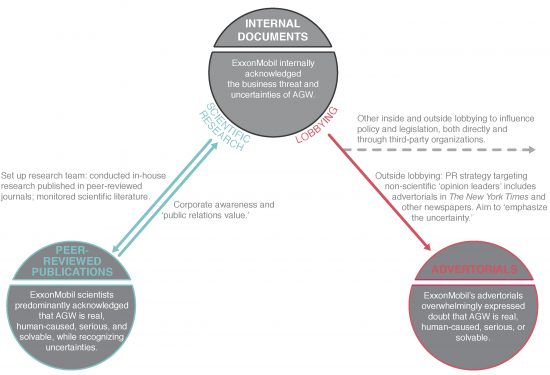
In an empirically peer-reviewed paper published in IOP Science this last week Geoffrey Supran and Naomi Oreskes, of Harvard University, studied 187 climate communications from ExxonMobil Corporation, the company that was recently headed up by Rex Tillerson, the current U.S. Secretary of State. In their analysis, the researchers look at those within the company describing their position on whether climate change is “real, human-caused, serious, and solvable.”
Based on these four criteria what the researchers discovered was the watering down of climate change message, casting doubt, the closer the communication came to be open and public.
Here are some interesting statistics from the analysis:
The conclusion based on these statistics is undeniable. The management of ExxonMobil deliberately misled the public while its internal scientists contributed to academic publications on climate change and its human cause. Could one describe ExxonMobil’s executive suite as being anything more than duplicitous?
ExxonMobil faces charges of racketeering and deceiving of consumers and investors through their external communications. Attorneys General in 17 American states and territories plus the U.S. Securities and Exchange Commission (SEC) have begun an investigation to reveal the deception with issued subpoenas to ExxonMobil executives, alleging the company’s accounting of climate risk “may be a sham.”
In response to these allegations and subpoenas, ExxonMobil has responded stating, “We unequivocally reject allegations that ExxonMobil suppressed climate change research contained in media reports that are inaccurate distortions of ExxonMobil’s nearly 40-year history of climate research. We understand that climate risks are real. The company has continuously, publicly and openly researched and discussed the risks of climate change, carbon life cycle analysis, and emissions reductions.” The company further states that the attorneys general and SEC are “cherry-picking” the internal communications to create their case.
Waith an open invitation to study ExxonMobil’s documents, Supran and Oreskes took up the challenge concentratin on the internal and external communications made available in an on-line database. They specifically looked at content to determine whether it was designed to dissuade officials from action and build public opinion doubt about anthropogenic climate change.
The documents studied included:
Supran and Oreskes applied rigor to their analysis. For documents published 1990 or prior they exempted any expression of doubts about anthropogenic climate change described. After 1990 and the first Intergovernmental Panel on Climate Change (IPCC) report indicating scientific consensus regarding the human causal link to global warming, Supran and Oreskes assigned to ExxonMobil communications such attributes as deception, denial, confirmation and complicity.
In the paper the authors provide excerpts from internal, peer and non-peer reviewed, and advertorial publications produced by ExxonMobil over a range of dates from 1979 to 2008. In one 1979 internally distributed document, staff write,
“The most widely held theory is that:—The increase [in atmospheric CO2] is due to fossil fuel combustion;—Increasing CO2 concentration will cause a warming of the earth’s surface;—The present trend of fossil fuel consumption will cause dramatic environmental effects before the year 2050.”
So the company is already engaged in assessing CO2 and its role in climate change.
Three years later another internal document states,
“The question of which predictions and which models best simulate a carbon dioxide induced climate change is still being debated by the scientific community. Our best estimate is that doubling of the current concentration could increase average global temperature by about 1.3° to 3.1 °C….”
Twelve years later in 1995, in a peer-reviewed paper, ExxonMobil scientists propose geoengineering to limit climate change stating the following,
“We present a preliminary analysis of a geoengineering option based on the intentional increase of ocean alkalinity to enhance marine storage of atmospheric CO2.”
A year later in a non-peer reviewed paper, an ExxonMobil writer asks the question: “Global warming, who’s right?” and goes on to describe anthropogenic warming as an “unproven theory.”
And as late as 2008 in a non-peer reviewed paper, an ExxonMobil writer denies any direct connection between greenhouse gas emissions from the oil and natural industry, “and the phenomenon commonly referred to as climate change.”
In advertorial content produced by ExxonMobil, the denial of fossil fuel industry complicity in anthropogenic global warming is remarkable. Here are two quotes from separate advertorials published in 1997. The first states,
“Let’s face it: The science of climate change is too uncertain to mandate a plan of action that could plunge economies into turmoil…Scientists cannot predict with certainty if temperatures will increase, by how much and where changes will occur. We still don’t know what role man-made greenhouse gases might play in warming the planet.”
The second is very much of the same ilk and states,
“There is a high degree of uncertainty over the timing and magnitude of the potential impacts that man-made emissions of greenhouse gases have on climate.”
Consider that both of these public statements occur 18 years after ExxonMobil’s own scientists circulated internal documents that conclusively linked their industry to global warming.
As for stranded assets, that is, the leaving of oil and natural gas in the ground, an internal 1979 circulated document states that CO2 and dramatic climate change are linked and concludes,
“Should it be deemed necessary to maintain atmospheric CO2 levels to prevent significant climatic changes, dramatic changes in patterns of energy use would be required. World fossil fuel resources other than oil and gas could never be used to an appreciable extent…Removal of CO2 from flue gases does not appear practical due to economics and lack of reasonable disposal methods. If it becomes necessary to limit future CO2 emissions without practical removal/disposal methods, coal and possibly other fossil fuel resources could not be utilized to an appreciable extent.”
But nowhere in any ExxonMobil annual report dating back to 1979 is there any hint of risk to the company’s assets. No shareholders are given the scoop. And the public at large remains unaware of what ExxonMobil already knows.
It should, therefore, not be a surprise that Supran and Oreskes conclude that ExxonMobil misled non-scientific audiences about climate science while studying climate change internally and reporting results in peer-reviewed journals.
It’s almost schizophrenic, this two-headed monster that ExxonMobil created, one steeped in science and the other in deception. One can guess that as the scientists’ research reached the extreme altitudes of corporate head office and its marketing division, facts were suppressed or whitewashed to make them more palatable to shareholders’ profit expectations.
The scientists at ExxonMobil weren’t actually restricted from publishing what they found out about anthropogenic causes of global warming and the role the company was playing in the problem. But the audiences that read these published studies were limited to academics and readers of limited circulation science and engineering journals.
And as for advertorial content, all one can say is that ExxonMobil blatantly lied to its largest reading audience. Advertorials were bought and paid for to give prominence to a message of uncertainty. Sponsored content appeared within the pages of American mass media such as the New York Times, Los Angeles Times, Wall Street Journal, and the Washington Post to name just a few.
]]>
The author of this narrative is a scholar living in The Second People’s Republic of China, a nation born out of climate change, a survivor in the catastrophe created by us and our successors. Beginning with denial and obfuscation on the part of Western business and governments, the story outlines a probable history where warming events eventually lead to runaway temperature increases, attempts at geoengineering countermeasures that ultimately have unforeseen consequences, and finally polar ice cap collapses in both the Greenland and West Antarctica ice sheets.
Featuring four future maps, one labeled Amsterdam, a second New York City, a third Bangladesh and a fourth Florida, we see a redrawn world with major coastal cities and an entire country abandoned after valiant efforts to fight off rising sea levels fail. We read about the spraying of aerosols in the atmosphere in the mid-21st century to try and reduce global heating with temporary success, but with devastating effects on the annual Indian Ocean monsoons leading to mass starvation in South Asia.
Political entities as we know them cease to exist and few nations survive. One of the most telling statements in this book describes the collapse of past civilizations, the Maya, Rome, the Incas and others giving reasons for their demise. Often those living in these past empires could not foresee their demise. But in the case of western civilization the narrator states that the consequences “were not only predictable, but predicted.”
The narrator then justifies this statement laying out the case from the 1970s onward when scientists first recognized that humanity was altering the physical environment and for the first time dubbed this new geological period the Anthropocene. In 1988 there was sufficient concern globally for nations and scientists to construct the Intergovernmental Panel on Climate Change (IPCC). The idea was to track the science investigating human impact on the atmosphere of our planet and report back findings. In 1989 the Montreal Protocol represented the first model for international cooperation to combat ozone depletion in the atmosphere. In 1992 the world’s nations agreed to the United Nations Framework Convention on Climate Change with a common goal to prevent anthropogenic influences on climate. In 1997 the Kyoto Protocol was an extension of that earlier framework but the largest contributors to greenhouse gases and anthropogenic warming chose to ignore the signing and ratification. So all progress of any significant value stopped.
The climate change denial movement took hold with almost all of the “scholarship” and “skepticism” emanating from United States’ sources. Other nations soon followed the American lead contributing further skepticism on the issue. Canada, first a supporter of Kyoto, withdrew. Others like Australia initiated climate change action and then reversed themselves in two election cycles.
Science and scientists, the narrator states, were as much to blame for fueling the skepticism, In their pursuit of narrowly-defined research on aspects of atmospheric change, and in the language of science, their arguments often appeared incomprehensible to an inquiring public.
Probably the most damaging acts came, states the narrator, when nations finally agreed in light of successive years of new record temperatures and increasing extreme weather events, to begin the transition from fossil-fuel dependency through a transition from more carbon intensive fuels to less. This was the so-called middle path, switching off coal and turning on natural gas. Natural gas was less carbon intensive and therefore was seen as a stop gap to an eventual fossil free energy future. Fracking, the biggest source of shale gas, a methodology first invented in the United States, soon spread across the globe as many nations made the transition. The increase in natural gas supply drove the price of fossil fuel energy down and consequently drove usage up. The potential for a lower carbon footprint was more than offset by the trillions of cubic meters of gas burned and the methane and carbon dioxide that escaped from fracked field wellheads.
By 2040 heat waves and droughts were becoming the norm. Sea levels had risen by 9 to 15 centimeters (3.5 to 6 inches). Some Pacific island nations had ceased to exist but coastal populations remained unaffected although storm surges were causing nations to build infrastructure to hold back the rising water. But for how long? By 2050 social order in Africa had completely broken down succumbing to drought, disease epidemics and crop failures. The North American Desert of the U.S. Southwest spread to the north and east engulfing vast amounts of formerly productive farmland. In the late 2050s the U.S. government faced food riots that led to the declaration of martial law. Soon, to manage depleting water resources collectively, and to deal with climate change refugees seeking northern escape routes, Canada and the United States formed a North American union. Similar redrawing of political boundaries occurred in Europe as populations abandoned the Mediterranean countries to seek refuge in more northerly climates.
The engineers finally convinced the world that it was time to launch aerosol injection climate engineering in 2059. Submicrometer-sized sulfate particles were sprayed into the stratosphere. Global temperatures subsequently dropped over the first three years of the experiment but in the fourth year the Indian Ocean monsoon stopped. So the geoengineering experiment ended and, in the rebound, global temperatures rose 5 Celsius (9 Fahrenheit).
By 2060 the Arctic Ocean was ice free in the summer and even though all countries were now hell bent to transition to renewable energy the delayed impact of rising greenhouse gases continued to accelerate the warming. The final blow to western civilization came with the disintegration of the Greenland and West Antarctic ice sheets, first through destabilization in the 2070s, and finally in 2093 with 90% of the latter breaking away from the Antarctic continent. The subsequent 5 meter (16.4 foot) rise in sea levels led to what the narrator describes as the “Great Collapse.” 1.5 billion people became climate refugees just from sea level impacts. The mass movement of populations overwhelmed inland communities. Disease and starvation did the rest. Along with the billions of humans succumbing to death, 60 to 70% of all life on the planet was driven to extinction.
The survivors of the Great Collapse had to reconstruct civilization. By the 24th century, aided and abetted by the discovery of a lichen that sequestered carbon at significant levels, and by a prolonged Solar Minimum, the survivors began to see temperatures decline and sea level rising slow down. Civilization re-emerged to a very different world.
So ends the tragic fiction describing the collapse of the world we know today as told by a fictional historian living three centuries in our future. Reading it, some may scoff. But the description of the present and our current path is undeniably dead on. We can continue down this path and maybe the road ahead will diverge from this fictional ending, or maybe Oreskes and Conway will have proved prescient.
Let’s hope, collectively, that saner actions take hold.


