In a LinkedIn comment raised in the Global Issues group a few weeks ago I argued that every politician, and every CEO of a fossil fuel and energy company should read Klein’s book, and hopefully, take its message to heart. Where Elon Musk sees Mars as a way out of planet-ending extinction, Klein argues that Earth is where we are and we have just enough time to meet the climate crisis before it gets out of hand. She sees fear as the prime reason we are holding back. That our free-market ideology and the governments we are currently electing are delaying tackling the challenge. And that social movements akin in scale to the civil rights movement of the 1960s and the anti-apartheid conviction by national governments in the 1980s are necessary for humanity to address global warming.
Klein takes us on her life journey and on visits to a Heartland Institute conference of climate change deniers bankrolled by business interests, an academic think tank focused on designing geo-engineering solutions to block sunlight or dump particulate matter in the stratosphere, and United Nations-sponsored conferences where delegates break down crying because of lack of consensus on what to do.
She acknowledges that to defeat climate change we must break “so many rules at once – rules written into national laws and trade agreements, as well as powerful unwritten rules that tell us that no government can increase taxes and stay in power.”
Where she and I disagree is on immediate solutions. She would forgo a carbon tax, a first stage remedy in my opinion. and tackle climate change by introducing guaranteed minimum incomes for everyone. This solution of income redistribution would then foster a spirit of cooperation for all humanity to tackle climate change both at a personal and national level. It is her steadfast belief that those dispossessed, the wretched of the Earth as Franz Fanon described them, would then be given a voice in government decision making, and with that voice they would rescue the planet from “ecocide.”
The term ecocide was first introduced in the 1970s when some of us began to realize that the patterns of the past were no longer the norm when looking at climate, when we were observing an accelerating downward trend in biodiversity in the oceans, on land and in the air. Defined as ecocide we were acknowledging that humanity was playing a part in this ecosystem destruction. As a result, today, ten countries have enshrined laws of ecocide as crimes against humanity and the planet.
To me Klein is a wonderful idealist and that her solution although appealing doesn’t take into consideration human nature. I agree with her that addressing climate change as a moral issue is an absolute. She draws analogies to the 19th century actions that finally led to the abolition of slavery in the Western World and quotes Adam Smith in his book “The Wealth of Nations” describing capitalism’s reason for ending the abhorrent practice based on pragmatic financial arguments rather than moral ones. She then goes on to note that Smith’s approach did nothing to end slavery and it wasn’t until emotion rather than pragmatism entered the picture that slavery was abolished. It took polarizing rhetoric and a civil war.
Klein notes parallels between the institution of slavery and unfettered capitalism, the latter which she blames for global warming. She sees the need for a collective moral and emotional uprising on the world stage as the means to overcome our collective fear to act. She believes we can unwrite the last 150 years of the Industrial Revolution driven by James Watt’s invention of the steam engine and its voracious descendants with their demand for more and more energy. She argues that humanity’s march away from a dependence on the natural world to sustain us can then be revisited and the high-risk behaviours associated with fossil fuel extraction can finally end. Only in this way will we address climate change.
I, on the other hand, believe that we can institute a progressive carbon tax across all governments across the planet. That these taxes would be focused on extractive industries and polluters, and that the money raised would be put into projects to mitigate risk from climate change. Through a carbon tax I believe we can accomplish, to a degree, the redistribution of wealth that Klein argues is the answer. That by lowering income taxes for those most impacted by global warming we can make our democracy more inclusive. And that through carbon tax wealth redistribution we can provide the necessary financial assistance to help other nations most at risk from extreme weather events and rising sea levels. Interestingly, The Globe and Mail, a national newspaper here in Canada that has a strong business orientation came out with a similar proposal on its editorial pages on November 7th.. Let’s hope our political leaders take note.
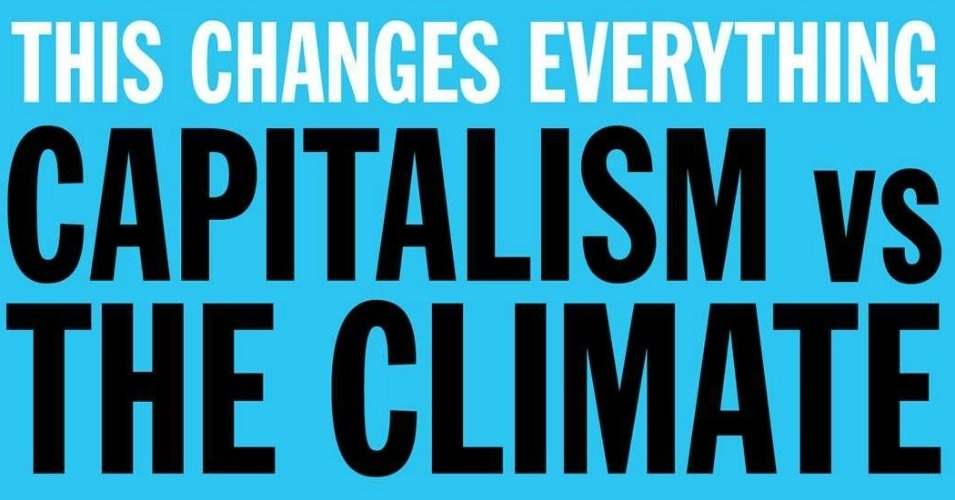
In an article appearing in today’s Globe and Mail, Naomi Klein writes that in her study of globalization and international trade laws in the early 2000s she noted that “green programs….were increasingly being challenged under international trade agreements, particularly the World Trade Organization‘s (WTO) rules.” What Klein refers to in this comment is just a small part of why free trade regulation can directly conflict with the best intentions of a government to create policy to address climate change. Ontario, created favorable conditions for a solar panel manufacturer to set up shop in the province. At the same time the government instituted local content requirements for meeting government requests for renewable energy contracts. When Chinese and Japanese companies challenged the government’s policies under WTO rules the international body declared local buy provisions illegal. Trade trumped the governments climate change mitigation strategy.
The World Bank has also looked at the issue of trade and climate change. In a paper, “Trade and Climate Change: An Analytical Review of Key Issues,” Harun Onder, of the World Bank’s Poverty Reduction and Economic Management Network, writes that “trade measures carry a significant risk of triggering waves of protectionist policies” around the issue of climate change mitigation strategies and that this seems to be the basis for challenges by those attempting to enter into a foreign country ostensibly under free trade terms. But Klein argues, “how absurd…for the WTO to interfere….to let trade trump the planet itself.”
She points out that under NAFTA, the North American Free Trade Agreement, a U.S. oil company, Lone Pine, has challenged the government of Quebec, because the province implemented a moratorium on fracking. Lone Pine is suing the province for $230 million because it has been denied “fair and equitable treatment” under WTO rules. Whether you are for or against fracking based on understanding its potential risks (methane release at the well head, aquifer contamination) or benefits (freedom from foreign fossil fuel imports) the right of a province to implement environmental regulation should not be subject to such frivolous suits.
Joseph Stiglitz, the Nobel Prize-winning economist is quoted by Klein as stating, “Should you let a group of foolish lawyers, who put together something before they understood the issues, interfere with saving the planet?”
Let’s go back to the questions I asked in the first paragraph. There is a correlation between trade liberalization and growth and increased atmospheric carbon. But it is not so much the trade as it is the increased global economic output that is the cause. We humans have more than doubled our population between 1950 and today. We have recovered from the shock of a World War and the decolonization of much of the planet in the post-War period with the resulting rapid expansion of national economies. Demand for goods and services has naturally grown and therefore global trade has risen as well.
Do carbon emissions go up as well? Trade requires transportation and fossil fuels are the primary fuel of our transportation infrastructure. This alone is a net contributor to increased carbon emissions. Increased manufacturing capacity, growing urbanization, all have led to a massive need for new energy capacity and an additional contributor to increased carbon emissions. So there is no doubt that trade plays a negative role in our current fight to reduce our global carbon footprint.
Can it be different? To date global efforts have failed utterly to reduce carbon. Where we have the WTO to provide a means to govern and enforce trade rules, we have no comparable organization or rule book for carbon. And yet Onder, in his paper states, “global climate is a public good.” So one would think that the WTO would come up with a new set of rules to address climate change mitigation and trade. Or at least the WTO should get agreement among all its members that climate change mitigation policies that meet agreed to standards should trump any free trade challenges.
It will be interesting to see how world leaders meeting in New York on September 23rd handle this issue. And when the nations of the world meet in Paris in 2015 to hammer out a worldwide climate change agreement, that they can drive the “foolish lawyers” from the room and set out a new rule book for both mitigation as well as carbon reduction.