Most of the time when I write about a positive disruptive technology it is because I find them doing a Google Search. And most of the time the companies are far away from my Toronto home base. But in the case of Clear Blue, it is right in my backyard which gives me the opportunity to have some face time with what I consider to be a company that understands the paradigm shifts happening in this century around power and connectivity.
Clear Blue builds smart off-grid power systems designed to light up villages and streets, power wireless base stations, and provide a reliable energy source to security cameras, and Internet-of-Things (IoT) sensors and devices anywhere in the world. The technology comes in different flavours beginning with installations capable of delivering 25-watt base power and growing to the low-kilowatt base load range. Clear Blue has technology solutions that work with solar, wind and battery, managing the power and load, with the company remotely monitoring every site in real time. Its installations can be found in 34 countries around the globe with many of the sites in remote locales where off-grid low-watt power systems can make a significant difference in the lives of people who have never had access to reliable, continuous power and connectivity.
Their latest project is just one example of just how much a difference off-the-grid can make. Located in Delta State, Nigeria, Clear Blue has been involved in the deployment of a power and remote management system for 280 lights over 20 kilometers of rural road. Where a traditional utility provider would have had to build a hard-wired transmission infrastructure to reach the location, Clear Blue’s solution was dropped in, deployed smoothly, and provided results in less than a month.
The company’s modus operandi is to work with local telecommunications and infrastructure development companies at most global sites. In the case of the Delta State project, the local partner is Raeanna Nigeria Limited. Jay Ogor, the CEO of Raeanna, describes the challenges to deliver reliable power where needed with more than 80 million of Nigeria’s 186 million who have no access to electricity. He states: “Many previous projects in Nigeria have struggled to deliver reliable, high-quality power solutions…The success of Clear Blue’s Smart Off-Grid power technology on…previous collaboration made it an easy decision to utilize it for…street lighting in Delta State. Our plans and focus are to expand our rollout across Delta State and other regions of Nigeria, as it is key to the long-term betterment of Nigeria by bringing back a vibrant street life.”
This is not a unique story. A lack of rural electrification is a symptom of an overall deficit throughout much of Sub-saharan Africa. Solving the continent’s perennial power shortage problem is critical with more than half the people of Africa living without electricity. In a recent World Energy Outlook, it reported that number to be 26% of rural Sub-saharan Africa. The lack of reliable continuous electricity holds back the continent, and the economies of every one of its nations impacting commerce, education, health and more. As a result, Africa cannot fully take advantage of other transformative technologies that would raise all boats including reliable and continuous Internet access, adoption of smartphone technologies on mass, development of a thriving fintech and micropayment system independent of and in cooperation with banks, and more. That’s why dropping off-grid power systems into rural Africa and other remote locales around the world makes so much sense.
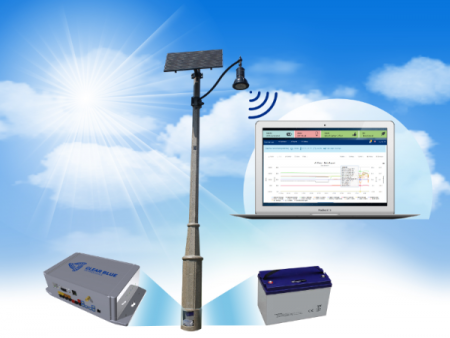
Clear Blue’s unique ability to remotely manage every installed site means implementation can be put in place quickly with continuous 24 x 7 monitoring. The Illumience cloud management system is Clear Blue’s secret sauce turning power system solutions into a subscription service. From its Toronto headquarters, Clear Blue manages and monitors the performance of every street light, telecommunications base station, security camera, and IoT device and sensor at all installation sites around the world. Every node is visually mapped and seen in real time. Automatic alarms get triggered by any light or other device not performing to the criteria established at the time of installation.
Tuerk described to me a recent installation site which required bringing the hardware into a remote cross-Andes Amazonian area of Peru. That meant transporting the equipment over mountainous terrain where no roads existed and dropping it into the upper Amazon jungle. Once it arrived the installation was straightforward and the system was able to provide base power for lighting and telecommunications while back in Toronto operators more than 6,000 kilometers away remotely monitored the site the moment it went live.
Tuerk describes how the various hardware and software management solutions the company offers is, in fact, turning power delivery and the associated technologies the company supports into a subscription service. And although the company remains relatively small, through its Developing World partners, it is seeing rapid growth in its customer base with demand for its unique value proposition continuing to grow.
This summer the company went public and today trades on Toronto’s TSX Venture Exchange (TSXV?CBLU), where it represents one of the first cleantech companies to be listed there. Clear Blue is truly representative of a rising number of positive disruptive technology companies bringing change to the 21st century, and helping to solve its many challenges. I promise to keep you informed about its progress in future postings.

]]>
As the 20th century unfolded we witnessed the development of centralized power generation and voice distribution systems operated by utilities with growing networks of wires and transmission towers that first spanned cities, and then entire continents.
The latter half of the 20th century saw the emergence of the computer. Suddenly electrons flowing down wires weren’t limited to just power and voice. Data had joined the mix. And then as the last two decades of the century unfolded, the wires got cut with wireless transmission evolving from radio to telephony and data transmission. And data networks made the Internet possible.
Was all this connectivity evenly distributed across the planet? No. Vast areas of the Developing World, sub-Saharan Africa in particular, continue to remain in the dark. In fact, over one billion on the planet have no access to reliable electricity. Connectivity to the power grid comes at a very high cost.The problem is not limited to Developing World communities. In my country, Canada, more than 200 indigenous communities largely in remote and northern locales remain without access to power from the electrical grid. Instead, they are dependent on diesel generators.
For utilities operating from centrally-located generation facilities, meeting the needs of the disconnected last billion with 20th-century technology remains problematic and costly. And then there is anthropogenic climate change requiring power generators to consider distributed power generation and renewable energy alternatives.
We may be witnessing the beginning of the end for the ubiquitous power grid as the 21st century unfolds. What will replace it? Last week, I went to find out when I visited Clear Blue Technologies, a Toronto, Canada-based company, founded in 2011, whose CEO, Miriam Tuerk sat down with me to talk about the future of electrical power generation and distribution. She and her husband, John, are well versed in understanding the future of the power grid and the role off-grid will play in providing electricity to wireless, standalone applications.
Clear Blue Technologies represents a new generation of companies focused on providing a hardware-software service for off-grid power delivery and management. The company’s technology optimizes power to any off-grid installation requiring a reliable continuous electrical feed. This applies to everything from street lighting to telecommunications towers supporting mobile wireless.
Tuerk’s company has built the world’s first, smart management system for off-grid systems. She uses the word “nano-grid” defining the types of power requirements of these off-grid devices as being in the low kilowatt range, in comparison with microgrid megawatt range.
Tuerk also notes that Clear Blue Technologies is built as a service. So it is not just shipping a product to its customers, but rather, offering management of the energy powering the lights, or the wireless base stations, or other infrastructure requiring off-grid power.
One of its more recent installations in Hamilton, Ontario, received the Canadian Outdoor Lighting Project of the Year award. Clear Blue technology was deployed to manage 40 solar-powered lights. Solar-hybrid controllers mounted on the light poles, connected to remote management software at Clear Blue providing real-time dashboard views of the power to the lights, tracking performance, and flagging and correcting potential disruptions before they happen.
Lighting today poses a particular challenge for cities. It is their number one operating expense and is largely managed through periodic visual inspection neighbourhood by neighbourhood and block by block. United Nations calls for cities to be dark sky compliant will require them to rethink the lighting deployed. Clear Blue’s technology can certainly help through the remote management and monitoring of off-grid light sources turning them off when conditions are appropriate. That is the degree of granularity possible using Illumience, Clear Blue’s cloud-based software application.
Facebook, the social media giant of the Internet, has made Internet connectivity to areas of the world still disconnected, a major initiative of the company. Tuerk describes how Facebook approached her to help in this effort. The social media company identified Clear Blue as the only company today capable of making it possible to deploy and remotely manage thousands of small sites using off-grid energy sources to power up the technology being deployed to connect these remote communities to the Internet.
Clear Blue can do this because of Illumience, its cloud-based open-source compliant software that features continuous remote monitoring, proactive maintenance sending alerts as text or email, predictive weather analysis, and remote changing of off-grid power feeds to match changing local conditions.
Ultimately what Clear Blue is doing today is a reflection of the fundamental change occurring worldwide as more technology becomes powered by off-grid sources in a world increasingly no longer dependent on power over wires. In this new wireless world, energy will be sourced from solar, wind, battery, and other standalone technologies replacing utility-based delivery and leading to the democratization of power generation. It cannot come soon enough for those sites on our planet today that are held back by the lack of reliable, sustainable energy, and Internet connectivity.
]]>