Moon Archives - Techso Mogro
https://techsomogro.com/tag/moon/
Science, Technology and the FutureFri, 22 Sep 2023 19:41:35 +0000en-US
hourly
1 https://wordpress.org/?v=7.1Are The Humans Who Have Evolved On Earth Going to be the Ones to Inhabit Mars, the Moon, and Deep Space?
https://techsomogro.com/humans-evolved-earth-inhabit-mars-moon-deep-space/?utm_source=rss&utm_medium=rss&utm_campaign=humans-evolved-earth-inhabit-mars-moon-deep-space
https://techsomogro.com/humans-evolved-earth-inhabit-mars-moon-deep-space/#commentsFri, 22 Sep 2023 19:41:35 +0000https://techsomogro.com/?p=35104Going to the Moon and Mars isn't colonization as practiced in the past here on Earth. On Mars, the soil will be barren containing perchlorate chemicals that our current plants cannot tolerate. The air outside the Earth bubbles we build will be unbreathable. The low gravity will weaken bodies adapted to Earth's gravity. This is at best dangerous, and at worse, suicidal.
]]>The efforts by agencies like NASA and China’s Space Agency, along with companies like SpaceX, Blue Origin, and Sierra Space, are making a critical error in trying to put human square pegs into space round holes. As much as I have often written about humanity’s future on other worlds, it is clear to me that the more I study the less I am convinced that we, as we currently are, can thrive and multiply in the extreme environments to which we are headed.
For those of us who evolved here within the protective bubble of Earth, outer space, the Moon, and Mars are foreboding environments. We wouldn’t stand a chance of surviving without bringing a micro version of the contents of Earth bubbles along with us. And even then, external forces could lead to our early demise.
Are Humans Built for Space?
Establishing a permanent human presence in space let alone on the Moon and Mars would indeed be a lot easier if we could be pre-adapted to handle the environment. When Charles Darwin observed how species adapted to their environments or died out by way of natural selection, the rules of nature and probability determined outcomes. This is the Earth-based evolution model.
A modern version would be selection by unnatural means using tools like CRISPR or engineered stem cells to enhance humans to adapt to low gravity and exoplanet and lunar environments. Re-engineered humanity would be capable of tolerating high-radiation environments. Genetically engineered traits would change us to make the odds of our survival much better.
Not to be outdone by those committed to conquering the environment of space, there are those here on Earth who suggest we do the same to humans living here as we face a changing planet because of global warming. Instead of dispensing with fossil fuels, we would genetically alter ourselves to make us climate-change resistant.
Is it realistic for Elon Musk to endeavour to establish a permanent human presence on Mars in his dream to save the species should an asteroid wipe out life on Earth even while knowing that we are ill-adapted to survive the environment of the Red Planet?
Is living in an Earth bubble on another planet, a moon, or a Deep Space habitat our human destiny? Some people believe if we can get to a place like Mars we could begin terraforming it to turn it into an Earth twin. Musk has proposed setting off thermonuclear bombs on Mars to warm the planet, unleash its subsurface and polar ice cap water, and the oxygen trapped in its oxidized red soils. He has also proposed to use a satellite network to create an artificial magnetic field to block solar and cosmic radiation.
Humans Never Evolved to Live in Space
The human body cannot handle space. When astronauts were first chosen for NASA’s Mercury program they were an elite group in top physical shape. They were subjected to all kinds of torture tests. The Mercury missions were short. The Gemini that followed were longer. And the Apollo missions lasted the duration of a lunar voyage and back.
Today, after more than two decades of human habitation of the International Space Station (ISS) we know now that we don’t adapt. Instead, exposure to low-Earth orbit space changes DNA, flattens eyeballs to impair vision, disrupts sleep patterns, decalcifies bones, reduces muscle mass, weakens hearts, causes brains to swell, and compromises immune systems.
Add to that the radiation from cosmic rays and the Sun. In low-Earth orbit which is really in the high atmosphere of Earth, the ISS crews are relatively shielded from space-based radiation. But a solar storm in Deep Space, on the Moon or Mars, would cause acute radiation sickness. And unlike the shielded ships of Star Trek, at present, there is no technology to protect us in space.
Again, if we could re-engineer our human DNA, we might be able to mend ourselves when exposed to radiation, or for that matter, any other damage to our bodies that could occur in space. So, maybe, a new version of ourselves could become spacefaring.
But what about dealing with the mental side of outer space travel and living in isolated settlements on the Moon or Mars? Imagine being confined within a small spaceship, no bigger than a house trailer for a six to seven-month voyage to Mars. What will be the mental toll on humans undergoing such a journey? And upon arrival on Mars, where crews will largely be confined to live within an Earth-bubble equivalent, what other mental crises will these humans face?
This isn’t colonization as practiced in the past here on Earth. On Mars, the soil will be barren containing perchlorate chemicals that our current plants cannot tolerate. The air outside the Earth bubbles we build will be unbreathable. The low gravity will weaken bodies adapted to Earth’s gravity. This is not the equivalent of Europe’s discovery of the Americas which already were richly populated by native civilizations. This is at best dangerous, and at worse, suicidal.
The romanticism of space has been brought to us by the writers of science fiction. But unless we change physically to have a chance to survive conditions worse than any found on Earth, there will be no happy endings to those bitten by the outward urge bug that is motivating people like Musk, NASA and others to send humans to other celestial bodies.
And yet, at a recent conference held at Biosphere 2 in the Arizona desert, the mood of attendees was optimistic about going to the Moon, Mars and beyond. When the audience was asked “Where do we go from here?” after hearing all the things that could go wrong, enthusiastically shouted, “To the Moon.”
]]>https://techsomogro.com/humans-evolved-earth-inhabit-mars-moon-deep-space/feed/1U.S. Government’s Office of Science and Technology Issues Call for Cislunar Strategies
https://techsomogro.com/u-s-governments-office-science-technology-issues-call-cislunar-strategies/?utm_source=rss&utm_medium=rss&utm_campaign=u-s-governments-office-science-technology-issues-call-cislunar-strategies
https://techsomogro.com/u-s-governments-office-science-technology-issues-call-cislunar-strategies/#respondFri, 15 Jul 2022 20:40:25 +0000https://techsomogro.com/?p=32757The Apollo Program last visited the Moon in 1972. Artemis will return us to the lunar surface and cislunar space. Now the U.S. government is asking for ideas on what science and technology advances we hope to achieve in our return.
]]>The U.S. has plans to return to the moon by the middle of this decade through NASA’s Artemis Program. But going back to the lunar surface and cislunar space isn’t just about putting boots on the ground. That’s why the White House Office of Science and Technology Policy on behalf of the Cislunar Science and Technology Subcommittee of the National Science and Technology Council has issued a request for ideas (RFI) with a deadline of Wednesday, July 20, 2022, for interested parties to make submissions.
The U.S. government has defined cislunar space as the entire region beyond Earth’s geostationary orbit subject to the gravity of both our planet and the Moon. The RFI covers both orbiting and lunar surface activities.
The government is seeking help in creating research priorities, technical standards and the development of a sustainable presence for human activity in cislunar space.
The RFI requests answers to two questions:
What research and development should the U.S. government prioritize to help advance a robust, cooperative, and sustainable ecosystem in cislunar space in the next 10 years? And over the next 50 years?
What key technical standards are most useful to develop in support of activities in cislunar space, and how could these standards enable and support a vibrant and sustainable cislunar ecosystem?
The U.S. government notes in its RFI request that any information obtained can be used by the government without attribution, and may become the basis for future cislunar plans. So you can give them all of your ideas and not necessarily get any subsequent commitment to fund them with you on the receiving end of that money.
With the success of the Apollo Moon landings beginning in 1969 and extending to 1972, the Cold War space race came to an end and the driving force of ideological competition stopped. The Apollo astronauts wanted to continue returning to the lunar surface but U.S. government priorities steered NASA into low-Earth orbit activities and the Shuttle Program in addition to the agency’s science missions.
Many at NASA expected that by 2022 there would be boots on the ground on Mars, and that a permanent inhabited lunar base would be already in place. More than fifty years later the dream is being revived.
Artemis intends to not just land humans on the Moon but establish a long-term presence. But why revisit that desolate terrain? After all, going there is dangerous business. Apollo 13 showed us just how fragile the Apollo Program was. A lack of adequate space infrastructure almost led to a catastrophe. And building and testing Apollo led to the tragic death of three of NASA’s astronauts.
So what will these RFI responses say? Here are 10 likely themes that the U.S. White House Office of Science and Technology Policy will receive:
The lunar surface can be exploited for its material resources that can both sustain a permanent human presence there as well as provide valuable materials for Earth.
Working in the low-gravity lunar and micro-gravity cislunar vacuum will yield manufacturing and material breakthroughs.
Exploiting the low and micro-gravity environments of the Moon and cislunar space will yield medical and human health breakthroughs.
Studying the lunar surface will give us a better understanding of Earth’s history.
The side of the Moon that permanently faces away from the Earth represents an incredible location for radio astronomy with no signal interference from our planet.
The Moon and cislunar space are better places for us to find and observe near-Earth asteroids that could conceivably present a future threat to the planet.
Developing cislunar infrastructure at Lagrange points will be an opportunity to develop permanent outposts for human habitation independent of Earth or the Moon.
Earth satellite networks, particularly those in geosynchronous orbit would be cheaper to manage and support from cislunar space and the Moon.
The return to the Moon will be a foundation and test bed for future missions to Mars, the asteroids and other destinations in the Solar System.
And if Elon Musk and SpaceX respond to the RFI, no doubt that RFI submission will state that our permanent presence on the Moon and in cislunar space will ensure humanity can become an interplanetary species.
]]>https://techsomogro.com/u-s-governments-office-science-technology-issues-call-cislunar-strategies/feed/0SpaceX States It Will to Get to Mars Before NASA While the Latter Lists its Objectives to Get There
https://techsomogro.com/spacex-states-mars-nasa-lists-objectives/?utm_source=rss&utm_medium=rss&utm_campaign=spacex-states-mars-nasa-lists-objectives
https://techsomogro.com/spacex-states-mars-nasa-lists-objectives/#commentsTue, 24 May 2022 16:34:11 +0000https://techsomogro.com/?p=32470SpaceX has taken a different approach to conquer space than NASA and other government space agencies. It has been willing to take risks, experiment, fail, and then learn and build better. The results are impressive with Falcon 9 demonstrating reusability, and the pending Starship about to revolutionize our idea of how rockets operate. So why should we be surprised that the company's President and COO claim it will get to Mars this decade.
]]>Gwynne Shotwell, President and COO of SpaceX in recent weeks stated that her company will get to Mars before the end of the 2020s. She also expects that SpaceX can get to the Moon with NASA’s Artemis program by 2025, and send its Starship on an around the Moon voyage next year.
But NASA’s timelines are different. The Artemis program is seen as a testbed for an eventual crewed mission to Mars around 2040. How can a commercial space company do something that the premier space agency in the world cannot?
Shotwell made her prediction on television despite having yet to launch the Starship on its first maiden orbital test flight which should happen sometime this summer once the Federal Aviation Administration gives SpaceX its blessing. So the aggressive timeline being sold to the public remains hypothetical. But there is no doubt that SpaceX is pushing the envelope using an entirely different innovation and design paradigm. SpaceX has built multiple versions of the Starship to test systems and design. It embraces failure as a means to perfect its final product. That has never been the NASA way.
NASA as a public agency doesn’t do well when something it builds fails. Note the Apollo program fire that killed three. Or the two shuttle disasters that eventually revealed the design flaws of a system and program that killed 14. The consequences of these accidents have made NASA more risk-averse and instead of boldly going forth “a la Star Trek,” the agency is very much an incrementalist. The “giant leap for mankind” that Neil Armstrong proclaimed in July of 1969 is not in the NASA playbook. So 2040 to get to Mars gives the Agency the time to do all the detail work needed to achieve the goal.
The draft objectives NASA has recently released for future lunar and Martian missions contain four categories: 1. transportation and habitation, 2. infrastructure, 3. operations, and 4. science. In this posting, we look at the first three. We can save the science for another day because commercial space operators don’t have science roadmaps in their plans.
Here is what NASA sees as the necessary incremental objectives.
1. Transportation and Habitation
Develop the cislunar operational capability to orbit the Moon, descend to its surface, and stay there for extended periods.
Routinely deliver payloads to the surface of the Moon.
Build and operate systems to live and work on the lunar and Martian surfaces.
Develop habitation systems for crews to work in deep space for extended durations.
Build a transportation network between the Earth and the Moon, and the Moon and Mars.
Develop systems for monitoring the health and providing medical care for missions to the Moon and Mars.
Develop integrated human and robotic systems for missions to the Moon and Mars.
Develop systems capable of returning large payloads from the Moon and Mars for scientific purposes.
2. Lunar and Martian Infrastructure Objectives
Develop and demonstrate a system that can enter, descend and land on Mars capable of delivering human crews and large cargo payloads.
Develop a power grid for the Moon and duplicate the effort for Mars.
Develop lunar to Earth communications, navigation systems, and the tools and technologies to support scientific and industrial needs. Then do it again for Mars.
Demonstrate autonomous and robotic systems that can do construction, provide transportation, and manufacture the necessities to support both a lunar community and one on Mars.
Use lunar and Martian materials in-situ to support the development of a sustainable on the Moon, in cislunar and interplanetary space, and on Mars.
3. Operations Objectives
Develop and test all of the technology necessary for lunar and Martian missions first here on Earth and in Earth orbit, followed by further development in cislunar space and on the surface of the Moon.
Build a support team on Earth for both lunar and Martian exploration.
Train crews for extended missions to the Moon and Mars.
Develop extravehicular capacity for exploring the Moon and Mars.
Demonstrate integrated robotic systems to support human exploration and habitation of both the Moon and Mars.
Demonstrate the capability to use materials from the lunar and Martian surface as well as in-space resources to reduce the mass required to be transported from Earth.
The SpaceX Planning Objectives
When you go to the SpaceX website, there are no objectives described in a plan to get from Earth to the Moon and then to Mars. It remains aspirational. Instead, the website describes its commercial space operations, products and services.
SpaceX, as it has from the beginning, continues to advance its technologies through experimentation, preliminary builds, and testing. Its contracts with NASA and launch agreements with numerous other companies feed its revenue stream. The Starlink telecommunications business is becoming a reality and a revenue contributor. Starlink is a blueprint that can be duplicated in cislunar and Martian space.
SpaceX’s commercial crew contract with NASA and its lunar lander contract for the Artemis program are sources of revenue. Likely, the business it currently does in crew and supply missions to the International Space Station will expand as private space station opportunities are realized in this decade.
And as for the Moon and Mars, SpaceX and other commercial space aspirants can wait for NASA to continue to issue requests for proposals to meet the Agency’s objectives. These are always accompanied by NASA seed money to cover some of the development costs.
Once Starship is proven, SpaceX will have made its first giant leap beyond low-Earth orbit. Then will come the Moon, and finally Mars. Although Shotwell says the company will get to Mars this decade, I doubt there will be a crew on board that first Starship as it descends to the surface. But one may soon follow once a bunch of Starships have delivered all the stuff laid out in NASA’s objectives to make it possible for humans to explore Mars in person.
With the bravado that has characterized SpaceX since its beginning, therefore, the company is likely to beat NASA to Mars. Will it be as much as a decade ahead in this new space race? SpaceX has a history of stating milestone dates that tend to slip through the trial and error process that is its development and experimentation paradigm. So we will see if the 2030 date can be met.
]]>https://techsomogro.com/spacex-states-mars-nasa-lists-objectives/feed/2Europe’s Space Agency Develops a Way to Manufacture Oxygen from Moondust
https://techsomogro.com/europes-space-agency-develops-manufacture-oxygen-moondust/?utm_source=rss&utm_medium=rss&utm_campaign=europes-space-agency-develops-manufacture-oxygen-moondust
https://techsomogro.com/europes-space-agency-develops-manufacture-oxygen-moondust/#respondThu, 23 Jan 2020 16:21:35 +0000https://techsomogro.com/?p=28835January 23, 2020 – It is only simulated moondust right now, but the European Space Agency (ESA) is on to a key technological invention that fills one of the two most important needs when humans begin living and working on the Moon and Mars. The first is finding breathable air. The second is finding freshwater. […]
]]>January 23, 2020 – It is only simulated moondust right now, but the European Space Agency (ESA) is on to a key technological invention that fills one of the two most important needs when humans begin living and working on the Moon and Mars. The first is finding breathable air. The second is finding freshwater.
In a January 17th press release ESA described a prototype oxygen generation technology developed at a research centre located in Noordwijk, the Netherlands. Using lunar regolith samples from the Apollo program, the researchers were able to create simulated moondust which contains 40 to 45% oxygen by weight, the single most abundant element bound up in the Moon’s surface.
The method to extract oxygen was developed by a UK company, Metalysis, and is called molten salt electrolysis. Metalysis’ process has been designed to extract tantalum and niobium from feedstocks. The oxygen produced is vented as a waste product because with more than 21% of our atmosphere made up of the gas we don’t need to harvest it.
In the Netherlands laboratory, the feedstock used is simulated moon dust to which calcium chloride salt is added. The mix is heated to 950 Celsius (1,742 Fahrenheit), then a current is passed through the material causing it to release oxygen which then is captured. The process also yields the metal alloys for which Metalysis designed its process. On the Moon, however, the captured oxygen is the critical end product of the process. The metal alloys are a nice bonus.
Taking the process out of the Dutch-based laboratory and turning it into a manufacturing plant that could operate on the Moon is ESA’s goal by the mid-2020s. The development of the technology would be crucial to supporting crewed missions to the Moon, and would probably be equally effective on Mars, which surface also contains large volumes of oxygen bound up in the regolith (hence the oxidized red colour of the planet).
Tommaso Ghidini, Head of ESA’s Structures, Mechanisms and Materials Division noted in his comments in the press release that sustained human presence on the Moon is just the first step. Mars is very much on the minds of these researchers in the development of their oxygen extraction process.
The metal alloys left behind after the process could also serve a lunar or Martian colony providing useful fabrication and construction materials. The question of how consistent is the content of the lunar regolith across the entire surface of the Moon has yet to be answered? If it turns out to be reasonably uniform it could lead to the development of a lunar regolith manufacturing industry that produces not just breathable air, but essential metals to support human colonies.
What would be equally interesting is to see if the technology could be adapted to harvest oxygen and metals from asteroids creating a space industry for self-sustaining Deep Space colonies neither bound to a remote planet, nor to one of its satellite moons.
So that gives us one down in terms of basic resources for human presence off-planet. We have oxygen. The next step is finding plentiful supplies of water off-Earth. It appears that may be the easier of the two resource challenges to solve with both Mars and the Moon showing the presence of water ice on or near the surface.
ESA is making oxygen from simulated moondust shown in microscopic view during the extraction process. The next step is to put a pilot plant on the Moon to do the real thing by the mid-2020s. (Image credit: European Space Agency)
]]>https://techsomogro.com/europes-space-agency-develops-manufacture-oxygen-moondust/feed/0NASA and Its Commercial Partners Plan for a 2024 Moon Landing
https://techsomogro.com/nasa-commercial-partners-plan-2024-moon-landing/?utm_source=rss&utm_medium=rss&utm_campaign=nasa-commercial-partners-plan-2024-moon-landing
https://techsomogro.com/nasa-commercial-partners-plan-2024-moon-landing/#respondSat, 18 May 2019 19:36:50 +0000https://techsomogro.com/?p=27621May 18, 2019 – The NASA of 1969 contracted a few companies to help it get a human crew to the Moon and back. But in 2019 the floodgates for commercial partners have been opened wide as the Agency tries to meet a politically-set target date of 2024. First on the agenda is to develop […]
]]>May 18, 2019 – The NASA of 1969 contracted a few companies to help it get a human crew to the Moon and back. But in 2019 the floodgates for commercial partners have been opened wide as the Agency tries to meet a politically-set target date of 2024.
First on the agenda is to develop the Lunar Gateway, a mini version of the International Space Station (ISS) to be located in close proximity to the Moon from which human crews can descend and return to and from the lunar surface.
So how to go about doing that?
In 1969 Grumman Aircraft, a Long Island, New York-based company was the builder of the Lunar Excursion Module (LEM), a one-time use vehicle that combined a descent and ascent stage and pressurized cabin with life support systems for the astronauts. The cost of each LEM worked out to around $150 million USD a pop and 9 flew on missions equaling a total cost of $1.35 billion. The LEM contract was awarded in 1963 and it was six years before the first made it to space.
So two announcements about NASA’s future Moon project, now called Artemis, caught my eye in the last couple of weeks.
First, it was the Trump administration’s request to Congress to top up the NASA budget by an additional $1.6 billion for the current year. I wondered just how far that money would go to meet the new Moon mission. Remember the entire LEM build was costed in 1960s US dollars, not based on the current dollar’s purchasing power. I would imagine $1.6 billion isn’t going to pay for much today.
Then the second announcement involving a $45.5 million contract from NASA to 11 commercial partners begin preliminary work on lunar lander designs and prototypes seemed to me to be a pittance of what was needed for Artemis to begin. The 11 companies include the known suspects and a few outsiders. They are in alphabetical order:
Aerojet Rocketdyne
Blue Origin
Boeing
Dynetics
Lockheed Martin
Masten Space Systems
Northrop Grumman Innovation Systems
OrbitBeyond
Sierra Nevada Corporation
SpaceX
SSL
The $45.5 million isn’t evenly divided among the 11 with some companies being asked to create prototypes for sub-systems, while others compete on designing main elements of a future lunar lander.
For example, Blue Origin, Boeing, Dynetics, Northrop Grumman, Lockheed Martin, Sierra Nevada, and SpaceX are all being asked to do descent stage prototypes and may the best one win. It is hard to tell if this is or is not being structured like one of NASA’s many prize contests which award money to one or more project teams when they develop innovative solutions the Agency deems necessary for the future of the space program. And even though $45.8 million is being offered the companies receiving the money have been asked to foot 20% of the total project costs. I don’t know if any other NASA contracts ask commercial providers to eat some of their costs specifying just how much.
What’s in a Name?
And another thing, when Jim Bridenstine, NASA’s administrator, announced the new mission’s name, Artemis, the Greek goddess associated with the hunt and the Moon, he may have overlooked a legacy NASA mission also named ARTEMIS first launched as Themis-Artemis to study the Earth’s magnetosphere and the Moon’s interactions with the Sun. That ARTEMIS is an acronym for the Acceleration, Reconnection, Turbulence and Electrodynamics of the Moon’s Interaction with the Sun mission.
It is ongoing to this day studying how solar and cosmic radiation impacts the lunar surface in the absence of a protective magnetic field such as the one we have here on Earth. For humans landing, exploring, and living on the Moon, that ARTEMIS should help to determine what ways are needed to protect those who plan to arrive in 2024 on the other Artemis, the lunar lander.
I’ll forgive Jim Bridenstine for not having brushed up on NASA history. But didn’t anyone at the Agency not tell him that the name Artemis had already been taken?
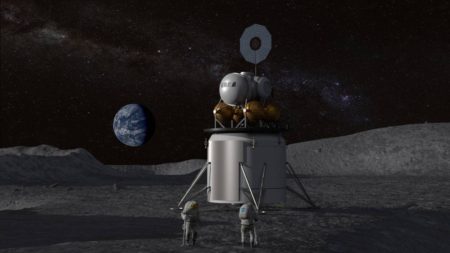
Artist depiction of a future Artemis lunar lander. (Image credit: NASA)
]]>https://techsomogro.com/nasa-commercial-partners-plan-2024-moon-landing/feed/0Political Interference and Lack of Vision Have Led NASA to Spend Almost $50 Billion on Make-Work Projects
https://techsomogro.com/political-interference-lack-vision-led-nasa-spend-50-billion-work-projects/?utm_source=rss&utm_medium=rss&utm_campaign=political-interference-lack-vision-led-nasa-spend-50-billion-work-projects
https://techsomogro.com/political-interference-lack-vision-led-nasa-spend-50-billion-work-projects/#respondThu, 21 Feb 2019 15:53:09 +0000https://techsomogro.com/?p=27160February 21, 2019 – NASA suffers from split personality syndrome. On the one hand, the agency is encouraging commercial space business, while on the other it continues to build a vanity project that has absorbed billions of dollars for more than a decade with no results. I’m talking about NASA’s Human Deep Space project. On […]
]]>February 21, 2019 – NASA suffers from split personality syndrome. On the one hand, the agency is encouraging commercial space business, while on the other it continues to build a vanity project that has absorbed billions of dollars for more than a decade with no results. I’m talking about NASA’s Human Deep Space project. On the science side, I have no quarrel with NASA’s continuing level of excellence in unfolding the mysteries of our Solar System, the Galaxy, and the Universe. But the human-in-space program is a total bust other than the International Space Station (ISS). Even ISS may succumb to NASA’s misdirected thinking with talk of ending its life by the mid-2020s.
What does NASA have to show for almost two decades of investment in its Deep Space plans? The Orion capsule remains a work in progress, having spent more than $16 billion on it, with one test flight with no humans aboard under its belt. And then there is the Space Launch System (SLS), the enormous single-use rocket that NASA is building to take American astronauts back to the Moon and on to Mars. A colossal ego trip is one way to describe the SLS misadventure which so far has had NASA spend $14 billion with nothing substantial to show for it.
Why has this happened?
The Columbia Space Shuttle disaster in February of 2003 began NASA’s transition away from its human spaceflight program. The Shuttle Program was already a boondoggle with every flight costing close to a billion dollars because reusability, one of the goals of the program, failed utterly. Every launch and return was followed by costly refits. Mounting a spaceplane on the side of a rocket turned out to be a dumb idea leading to not just Columbia’s failure, but also that of the Challenger in 1986.
In ending the shuttle program, NASA went through two restarts. First, there was the Ares rocket and Constellation Program under President George W. Bush. The Orion space capsule was to ride into space atop the Ares rocket while a second launcher would deliver an additional payload to be mated to the capsule in low-Earth orbit. The two would then travel to cislunar space, or to an asteroid, or even eventually to Mars.
When President Obama took office, the Constellation Program was mothballed permanently. Instead, NASA offered a successor to the Saturn V, the SLS. Sold to the government as a solution that would take the best of existing technology already developed by NASA, SLS was supposed to be a more affordable way to get America back into human space flight. But almost everything in the SLS program is new. To build a rocket surpassing the Saturn V in payload capacity, more than forty years after the last Apollo-Saturn mission, couldn’t just be the same thing, only bigger. New manufacturing methods and new materials meant SLS was going to not be just bigger, but also a brand new rocket. Hence significant cost overruns, and flight delays that will now possibly see the first non-crew test flight in 2021.
Where does NASA’s split personality come in?
While NASA has been assembling the SLS and its Orion capsule, it has contributed to the funding of commercial space companies with their own human space programs. SpaceX will launch in early March a reusable Dragon 2.0 capsule atop its partially reusable (first stage only) Falcon 9 rocket. And Boeing, later in the year, will launch its CST-100 Starliner capsule atop a United Launch Alliance (ULA) Atlas 5 rocket. By year-end, both SpaceX and Boeing should deliver American astronauts to the ISS from the United States for the first time since the last Space Shuttle flight in 2011. Until then NASA will continue to rent a chair or two on Russian Soyuz launch systems to fulfill crew complements onboard ISS.
With commercial space companies added to the mix, does NASA really need the SLS or Orion? The billions of dollars invested in these two projects could be better spent on assisting private ventures developing payload capacity to support NASA’s human-in-space ambitions. In the last two weeks, NASA administration has pledged to put American boots back on the Moon by 2028, and with little in the way of explanation, has described human voyages to Mars in the 2030s. At what cost? No one at NASA is publicly talking about the dollars and cents needed to achieve these two milestones. The administration talks about building a cislunar infrastructure, and a permanent presence on the lunar surface. It waves in front of our noses Orion and the SLS as the delivery vehicle for humans getting to Deep Space.
Who is NASA kidding?
SLS and Orion are make-work projects compared to what will be needed in terms of space infrastructure to make a permanent human presence on the Moon possible, let alone what will be needed for a successful Mars mission.
Every plan involving a human presence on the Moon and Mars includes a live-off-the-land strategy. That is, human crews will have to extract from the Moon and Mars, the necessities of life to ensure their survival. Oxygen, water, hydrogen for fuel, and food will all have to be produced from the lunar and Martian environments.
Technologies to extract resources from the Moon and Mars have yet to be developed to any great extent. The Mars 2020 rover will include a harvester prototype that will attempt to extract oxygen from the Martian atmosphere which is almost 100% carbon dioxide, and tenuous at that. And NASA has been growing plants on the ISS, as well as experimenting with self-contained environmental systems here on Earth where everything gets recycled and reused to make future crews on the Moon, or Mars, or on the long flight to get to and from the latter possible.
Didn’t NASA learn anything from the building of the ISS?
The idea of launching an enormous payload into orbit and beyond justify in the minds of some at NASA the building of the SLS. But NASA, Russia, and a consortium of partner nations assembled ISS in low-Earth orbit sending one module at a time to construct the 450-ton behemoth that is larger in dimension than a soccer pitch.
The rockets and Space Shuttles used to assemble the ISS didn’t need enormous payload capacity. Conceivably, the space infrastructure needed to return to the Moon, and to go to Mars can be built in the same way as the ISS. It may take a little longer but I highly doubt it, considering the many years the SLS and Orion projects have been around and not flown anywhere with anyone on board. And the reusable rocket technology being developed by SpaceX and other commercial space companies could lower the cost of delivery, not only in bringing materials needed for assembly, but also the fuel, oxygen, water, and other consumables required for Deep Space missions.
Partially to fully assembled, a return-to-the-Moon system could be pushed into a translunar trajectory using propulsion systems that NASA has been experimenting with on robotic space missions and that do not require tons of hydrogen and liquid oxygen to move payloads out of Earth’s gravity well.
And for the mission to Mars, the assembly could occur in two stages. An initial number of builds in low-Earth orbit could be transported to cislunar space where these modules could be joined to create a final, more robust Mars spacecraft with greater capacity to ensure the safety and sustainability of human crews on the voyages to and from the Red Planet. NASA should also consider developing and deploying a network of robotic-controlled resupply stations in the space between Earth and Mars that can serve as emergency stops on the journey to and from Mars.
Will NASA end the SLS and Orion programs?
No, because these two programs provide thousands of jobs for contractors and NASA employees who would otherwise leave to go work elsewhere. And once they have left, their expertise would be gone as well. So $3 to 4 billion per each will continue to be spent annually for its Deep Space project while NASA expends far less in using commercial space companies to help it in getting to low-Earth orbit, companies that also have expertise that the agency could use for its lunar and Martian ambitions.
This infographic prepared by the Jet Propulsion Laboratory illustrates the complexity, direction and misdirectional changes that have been part of NASA’s human spaceflight program. Can NASA continue to support projects like Orion and SLS when it is invested in growing the U.S. commercial space industry which is about to give the agency human-launch capacity from American soil for the first time since 2011? (Image Credit: JPL)
]]>https://techsomogro.com/political-interference-lack-vision-led-nasa-spend-50-billion-work-projects/feed/0China’s Trip to the Dark Side – of the Moon That Is
https://techsomogro.com/chinas-trip-dark-side-moon/?utm_source=rss&utm_medium=rss&utm_campaign=chinas-trip-dark-side-moon
https://techsomogro.com/chinas-trip-dark-side-moon/#respondSat, 12 Jan 2019 20:38:55 +0000https://techsomogro.com/?p=26893 January 12, 2019 – It keeps on getting more interesting in space these days as NASA breezes by a duo-planetoid 1.6 billion kilometers past Pluto, begins circling the asteroid Bennu with plans to grab a surface sample to return to Earth, Juno keeps doing flybys of the upper atmosphere of Jupiter sending us pictures […]
January 12, 2019 – It keeps on getting more interesting in space these days as NASA breezes by a duo-planetoid 1.6 billion kilometers past Pluto, begins circling the asteroid Bennu with plans to grab a surface sample to return to Earth, Juno keeps doing flybys of the upper atmosphere of Jupiter sending us pictures that you want to hang on your walls as pieces of art, and China soft lands a mission on the hemisphere of the Moon we never see, colloquially known as the Dark Side.
The only reason it has been referred to as the Dark Side is that the Moon is in tidal lock with Earth, always presenting the same face to us down here. But in fact, the side that faces away receives just as much sunlight as our side. We just never see it unless we send a spacecraft to view what’s back there and send us pictures. There have been lots of those, so many in fact, that we have created detailed maps and named most if not all of the geological features found there. And China chose one of those named areas for its first attempt at landing on the never seen side.
This was a first for any spacefaring nation. Landing on January 2, 2019, the spacecraft touched down in the Von Kármán crater (named after a Hungarian scientist), 186 kilometers in diameter, and located in proximity to the Moon’s South Pole. The Von Kármán crater is part of a much larger impact zone stretching more than 2,500 kilometers and is one of the oldest geological features on the Moon. This area of our celestial neighbour witnessed several basaltic flooding events in the Moon’s early history creating what is referred to as a basin-scale impact melt deposit. Chang’e 4 should have a field day studying the composition of the surface of the crater as it samples the regolith and gathers a ton of data.
Since its soft landing, the spacecraft has unleashed its rover named Yuta 2, or Jade Rabbit 2. The rover is the second one that China has put on the Moon. The first called Yuta, explored an area of the Moon we see in 2013 for 973 days before falling silent.
This rover is carrying a bevy of scientific instruments including:
VNIS, the Visible Near-Infrared Spectrometer,
PCam, a Panoramic Camera,
LPR, a Lunar Penetrating Radar,
and a unique biological experiment with eggs of silkworms, and seeds from a number of plant species, including potatoes. The Chinese scientists want to monitor how the lunar environment impacts biological growth.
Some interesting facts about the Moon’s other side. The lunar crust is thicker and contains less potassium and phosphorus. Scientists don’t know why. The far side is also considerably rougher with the exception being the Von Kármán crater seen in the image below.
The Moon’s Von Kármán crater is seen here in a picture taken by the Lunar Reconnaissance Orbiter Camera. (Photo credit: NASA/GSFC/Arizona State University)
To ensure continuous communication between Chang’e 4, Yuta 2, and Earth’s ground stations, China placed a bridge relay communication satellite, Queqiao, in orbit around the Moon in June of 2018. We should be able to get a continuous feed of data and images over the coming months and learn a little bit more about a side of our nearest celestial neighbour, a side that has kept us in the dark for years, but certainly not a Dark Side.
The lander and rover shortly after arrival hunkered down to protect their instrumentation from the heat of the 14-Earth-day long lunar day where temperatures at high noon exceed 100 Celsius (212 Fahrenheit). But two days ago both lander and rover awakened.
NASA’s Lunar Reconnaissance Orbiter will fly over the Change’e 4 landing site on January 31st and maybe give us a “birds-eye” satellite view of the site. It should make for an interesting picture. Meanwhile, you can check out Yutu 2 in the picture below.
This image of Yutu 2 was taken by the Chang’e 4 lander. (Photo Credit: CNSA)
]]>https://techsomogro.com/chinas-trip-dark-side-moon/feed/0Holding the Moon: The High Ground of Space
https://techsomogro.com/holding-moon-high-ground-space/?utm_source=rss&utm_medium=rss&utm_campaign=holding-moon-high-ground-space
https://techsomogro.com/holding-moon-high-ground-space/#commentsSun, 19 Aug 2018 20:06:22 +0000http://www.21stcentech.com/?p=26156August 19, 2018 – In 1958, a Strangelovian American military commander stated in a speech, “He who controls the Moon, controls the Earth.” Now sixty years later a U.S. President is executing on that strategy with the formation of a military Space Force with its likely targeted high ground, the Earth’s Moon. The last time […]
]]>August 19, 2018 – In 1958, a Strangelovian American military commander stated in a speech, “He who controls the Moon, controls the Earth.” Now sixty years later a U.S. President is executing on that strategy with the formation of a military Space Force with its likely targeted high ground, the Earth’s Moon.
The last time Americans visited the Moon was 1972. At the time they came “in peace for all mankind.” They explored, took pictures, picked and packed some rocks, left scientific instruments on the surface, and then left. For a long time, the attitude of the United States about the Moon was “been there, done that.” But now President Trump has his latest hot notion to create an American Space Force. Suddenly the Moon has become a strategic military and natural resource asset that must be protected by the United States. What doesn’t matter is that the creation of the Space Force would be a contravention of the Outer Space Treaty of 1967 to which the United States is a signatory.
The American Space program, it seems, is returning to its roots which began as a military exercise in response to the launching of Sputnik 1 by the Soviet Union in 1957. The first American attempts to put satellites into space came on military rockets. America saw Sputnik in military terms. The Soviets would hold the high ground of space and would spy on everything the United States was doing. Eventually, Americans saw the Soviets as weaponizing satellites to fire missiles on American cities and military installations. That threat remained on the mind of the American military throughout the 1960s.
The beginning of the thaw came when the United States civilian space program under NASA beat the Soviets to the Moon in a series of lunar landings with astronauts aboard. The Soviets waved the white flag in the Space Race. Soon to follow was a thawing of the Cold War first in space and then on the ground. In both nations, Soviet and American space programs became more civilian in nature. That cooperation continued leading to today’s International Space Station.
Military activity in space hasn’t gone away. Spy satellites have been launched by both countries over the years to check each other out. But no weapons have ever made it into space, the notable exception, a Soviet rifle which was brought along by cosmonauts just in case when they landed on Earth and opened their Soyuz capsule, they weren’t going to be staring at a hungry bear. Today, outer space is dominated more by satellites studying land use, Earth resources, and weather, and delivering telecommunications services to billions on the planet below, than by payloads sent aloft to spy.
The Moon through all this post-Apollo time has remained sacred, unspoiled ground, equivalent to Antarctica here on Earth. Antarctica, if you are not aware, is collectively shared by all the nations of the world. Its resources are not to be exploited. The few humans living there carry on scientific research. The 1967 outer space treaty used Antarctica as its model. If the Moon was to receive human explorers it would be for scientific purposes. No country could make a land claim. No country could mine there.
But it seems that is changing. Why?
Because satellites sent to orbit the Moon have discovered valuable resources for use by humans here on Earth. The most important is Helium-3 which can only be produced in nuclear fission reactors down here on Earth. But on the Moon Helium-3 can be scraped off the surface and shipped back to Earth. There is enough Helium-3 for the next great energy revolution to happen, the dawning of the nuclear fusion age providing unlimited power for at least 500 years. In addition, the Moon has revealed that it has water stored as ice at the lunar poles where it lies in the shadowy bottoms of craters. And there is a lot of it. So suddenly the Moon is no longer a scientific curiosity, but rather a resource to be exploited by the first nation to plant its flag. The purpose of the Apollo missions with flag raising ceremonies at each landing looks pretty suspicious in that light.
But there’s more. Something else was discovered by satellites orbiting the Moon. When they look back at Earth they have a bird’s-eye view of everything in low-Earth and geocentric orbit, as well as human activity on the surface of the planet and in the oceans. Talk about the high ground of space, the Moon now looks like the ultimate military outpost. With a satellite in lunar orbit or at a fixed point of cislunar space, it becomes possible to keep an eye on everything going on below.
With a Space Force deployed on the Moon or in its environs, it would mean world dominance. And that doesn’t even count exploiting the resource potential of the surface. Helium 3 would accelerate development of nuclear fusion on Earth. It would become an important resource in the development of next-generation nuclear propulsion systems allowing humans to get to Mars and beyond far faster than the chemical rocket propulsion systems in use today. And the use of the Moon’s water resources would ensure the sustainability of human presence on the surface.
In light of the above, it becomes awfully tempting for Americans to buy into President Trump’s Space Force. One can only hope that the other spacefaring nations of our planet aren’t equally inclined to proceed the same way. An arms race in space would have unintended consequences.
Here on Earth, the nuclear arms race between the Soviet Union and the United States led to MAD, a condition of agreed to mutual assured destruction should these weapons be used. Thus the world has avoided the Doomsday scenario of Hiroshima and Nagasaki being repeated on a global scale.
But in the name of defending space resources, what would stop space force adversaries from deploying and using nuclear weapons on or near the Moon? Without the equivalent danger of MAD in the vacuum of space what is there to stop a wrong-headed general or president from using a nuclear weapon to protect assets there? The consequence of such an action could then trigger the unintended scenario of MAD back here on Earth?
With Space Force, the United States could militarize the Moon and cislunar space giving the Pentagon a bird’s eye view of everything happening on and above the Earth. (Image credit: NASA)
]]>https://techsomogro.com/holding-moon-high-ground-space/feed/3NASA’s Off Again, On Again Human Deep Space Program
https://techsomogro.com/nasas-again-human-deep-space-program/?utm_source=rss&utm_medium=rss&utm_campaign=nasas-again-human-deep-space-program
https://techsomogro.com/nasas-again-human-deep-space-program/#respondFri, 20 Jul 2018 20:53:31 +0000http://www.21stcentech.com/?p=25979July 20, 2018 – It wasn’t that long ago that NASA was gearing up to fly astronauts to a Near-Earth Asteroid (NEO), capture it, and bring it back to lunar orbit where it could be studied in depth. This contrived human space mission was supposed to happen in the mid-2020s but saw its end at […]
]]>July 20, 2018 – It wasn’t that long ago that NASA was gearing up to fly astronauts to a Near-Earth Asteroid (NEO), capture it, and bring it back to lunar orbit where it could be studied in depth. This contrived human space mission was supposed to happen in the mid-2020s but saw its end at the expiration of President Obama’s mandate in 2016.
In the Donald Trump era, with Jim Bridenstine, a politician who is neither scientist nor engineer, now in charge of NASA, the agency has set a politically-motivated agenda to return to the Moon and from there to go on to Mars claiming the high ground of space.
Returning humans to the Moon has been the dream of many in NASA’s astronaut corps. The decision, therefore, is popular in the agency and NASA’s administrators have started putting together a plan to develop new spacecraft and a space station to add to the agency’s Orion space capsule and Space Launch System booster.
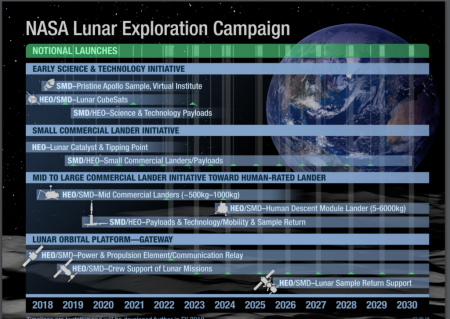
This infographic illustrates the milestones NASA intends to achieve for a future return to the Moon.
The spacecraft needed are ones that will fly in the cislunar space. They will be reusable descent and ascent modules in the tradition of the Lunar Excursion Module (LEM) of the Apollo era.
The Lunar Gateway
The space station program, named the Lunar Orbital Platform-Gateway, essentially will be a miniature version of today’s International Space Station (ISS). The plan is to place it in an elliptical polar orbit from 1,900 kilometers (1,200 miles) to 75,000 kilometers (47,000 miles) above the Moon. The Gateway will be rendezvous and docking facility for human travelers coming from the Earth, and from those going to and from the Moon.
The Gateway will also serve as a testbed for developing and experimenting with the tools and technology needed to go further into Deep Space, in other words, to get to Mars. More than likely a similar Gateway will eventually orbit Mars.
Of course, on NASA’s current $20 billion annual budget, none of this is possible. And even if commercial space companies were to get involved they would be looking for NASA contracts to fulfill on the deliverables the agency will need to fit all the mission pieces together.
This Gateway is expected to be about one-sixth the size of the existing ISS. Some speculate that ISS parts may be flown to cislunar space to be used to build it once the existing station is decommissioned in the mid-2020s.
Right now the likely structures will include:
Two school-bus sized habitation modules
One power and propulsion module
One or more docking ports
One or more airlock modules
Lots of solar panels
And a propellant fueling station
The docking port will be universally adapted to allow almost any commercial or other space agency’s spacecraft to dock with the Gateway. It will initially accommodate between 4 and 6 humans at any time. The polar orbit would be most advantageous to humans wanting to go to the Moon’s surface because from that perspective they can reach anywhere on the lunar surface including the side we never see from Earth (the Moon is in tidal lock and always presents the same face to observers here on the ground).
The ISS cost $150 billion to make. The Gateway, being more remote and having learned from ISS construction, should cost no more and possibly considerably less. Commercial alternatives to the aluminum canisters of the ISS, may prove to be the better way to go for Gateway construction. For example, using Bigelow’s inflatable modules of which is currently attached to ISS, can be launched in a small volume package and upon arrival in cislunar space be inflated to create substantial accommodation, much bigger than two school buses.
So when will this all happen? Right now the NASA budget for 2019 has assigned over $4.5 billion to Deep Space exploration systems. And budgets for 2020 through 2023 amount to nearly the same annually. If we go by the 2023 budget, money for the Gateway which could cost $150 billion when completed will be in such short supply that the likelihood of it being built within the decade is virtually nil.
The Space Launch System
Today NASA’s non-science program budget is being eaten by two big-ticket items of which the biggest is the Space Launch System (SLS). The ISS annual cost represents a paltry $2.9 billion while SLS has cost since inception in 2004, nearly $18 billion. Just firing one a year adds between $1.5 and 2.5 billion to the NASA budget.
So what is the SLS? Designed to replace the Saturn V rocket behemoth of the Apollo era, the SLS is an old-style monster liquid-fuel rocket that is not reusable. It serves one purpose, to launch to orbit or beyond huge payloads out of the gravity well that is our Earth. NASA describes the SLS as its ticket to Mars. But others have their doubts including veteran astronauts like Canadian, Chris Hadfield, who sees chemical rockets as a dead-end solution to interplanetary travel. Hadfield argues that SLS is just a bigger version of the technology that took us to the Moon in 1969. Using it to get to Mars would be suicide for the astronauts according to him. There is nothing appreciably new about SLS. It is just a bigger version of the Saturn V providing incrementally more horsepower to launch bigger payloads. But for a journey to Mars states Hadfield, the SLS with an Orion payload on top would be equivalent to crossing the Atlantic Ocean in a canoe.
The Orion Exploration Vehicle
The last of the legacy pieces from the Bush and Obama eras is Orion, a space command capsule that supposedly will be a successor to Apollo and meet Deep Space requirements for human crews. Orion was designed initially for a different rocket, not the SLS. Its crew module can carry four into Deep Space for missions lasting up to 21 days in its simplest configuration mated to an accompanying cargo and logistics module. It is outfitted with the latest communications, safety, radiation, and life-support systems. And when mated to a complex of other modules can become the bridge of a spaceship for longer missions of up to 1,000 Earth-days in space. In other words, Orion is NASA’s choice in a voyage to Mars and back.
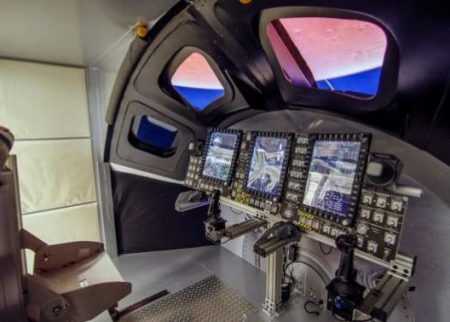
Lockheed-Martin, builders of the Orion spaceship, have outfitted it with a 21st-century bridge. (From a company technical paper presented July 2017)
An uncrewed test of Orion and the SLS is currently slated to happen sometime in 2020. It will take Orion to the Moon where it will enter orbit about 100 kilometers (62 miles) above the surface. It will then do a maneuver to attain a retrograde orbit 70,000 kilometers (40,000 miles) above the Moon where it will stay for six Earth-days. After that, a close flyby combined by engine firing will insert Orion into a trajectory back to Earth were it will splash down in the Pacific Ocean. Total elapsed Earth time will be 21 days.
The building of the Gateway will follow so that a future Orion with a crew of four aboard will dock with it and begin the planned return to the Moon by the mid to late 2020s. The Moon is a good objective for NASA to re-engage. Missions to it will teach the agency about its planned technology and its limits. It will also be a good test for human crews who will for the first time since Apollo be exposed to the hazards of Deep Space. The leap to Mars will be a whole different ballgame.
]]>https://techsomogro.com/nasas-again-human-deep-space-program/feed/0Water Ice May Be One of the Most Abundant Substances Found In Our Solar System
https://techsomogro.com/water-ice-abundant-substances-solar-system/?utm_source=rss&utm_medium=rss&utm_campaign=water-ice-abundant-substances-solar-system
https://techsomogro.com/water-ice-abundant-substances-solar-system/#respondSat, 13 Jan 2018 17:14:44 +0000http://www.21stcentech.com/?p=24778January 13, 2018 – Whether talking about the ice worlds of the outer Solar System, the Moon, Mars, asteroids, and comets, it appears that there is “water, water, everywhere.” Ceres, and Pluto, two of our designated dwarf planets contain seas of water with eruptions from below becoming frozen on their surfaces. Europa and Enceladus actively […]
]]>January 13, 2018 – Whether talking about the ice worlds of the outer Solar System, the Moon, Mars, asteroids, and comets, it appears that there is “water, water, everywhere.” Ceres, and Pluto, two of our designated dwarf planets contain seas of water with eruptions from below becoming frozen on their surfaces. Europa and Enceladus actively spout geysers of water into surrounding outer space. Even on Mercury, the planet closest to our Sun, there is evidence of water.
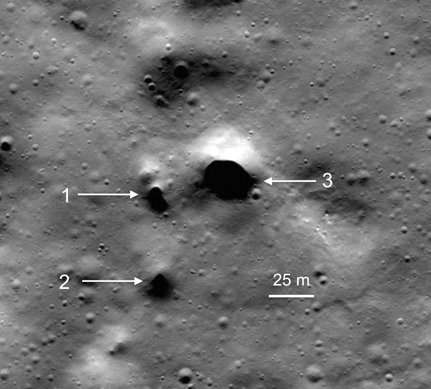
The discovery of tube structures on the Moon has astronomers predicting an abundance of underground frozen water below the surface. Observed holes in a crater near the Moon’s North Pole indicate entrances to a network of underground passages leading to the interior and a source of ice. The tubes are remnants of a more volcanically active Moon in the past. So far 200 have been identified in other areas of the lunar surface, but these are at the Moon’s mid-latitudes and less likely to harbour ice deposits. The ones, however, recently identified lie at 70 degrees latitude and higher making them likely places where water ice has accumulated.
NASA’s Lunar Reconnaissance Orbiter took high-resolution images of newly discovered lava tubes and one exhibiting a collapsed skylight near the Moon’s north pole. (Image credit: NASA/LRO/SETI Institute/Pascal Lee).
And now with radar data and images compiled by NASA’s Mars Reconnaissance Orbiter (MRO), we have proof of glacial amounts of water just below the surface of the Red Planet. A new paper, published on January 12, 2018, appearing in the journal Science, and entitled Exposed subsurface ice sheets in the Martian mid-latitudes, describes erosion features, exposed cliffs made of water ice which is slowly sublimating from the planet surface into its thin atmosphere. The ice sheets are as much as 100 meters or more in thickness.
So far seven locales have been identified with deposits of ice covering a significant amount of Mars from the mid-latitudes to close to the equator. Much of the ice lies a mere 1 or 2 meters below its surface.
The discovery of large deposits of subsurface water ice exposed to the surface through erosion counters previous evidence that recurring slope lineae may, in fact, be evidence of the presence of abundant subsurface water and not just shifting Martian sand. (Image credit: Mars Reconnaissance Orbiter).
Where did the water ice come from? Certainly not a recent phenomenon, they are likely deposits dating back to a period in the planet’s history when the atmosphere was much thicker and wetter. Finding water on Mars is no surprise. It’s where it is being found that is.
We’ve known about ice on Mars for several centuries as we have observed through Earth-based telescopes, the seasonal changes to the planet’s polar ice caps. Astronomers speculated that the ice wasn’t water, but rather frozen carbon dioxide (dry ice) precipitating from its atmosphere as the planet orbited the Sun. But we know from more recent observations that the polar ice caps are, in fact, more water than dry ice.
The existence of the ice caps was always seen as a sign that Mars could be habitable, that future human colonists could harvest water from these extensive ice fields. But as we have studied the weather and climate of Mars, any human settlement placed near the polar ice caps to harvest the water would face severe weather extremes making the locale inhospitable.
These newly discovered water sources, however, are far more appealing because they are located where Martian climate extremes are somewhat mitigated. The presence of high volumes of water ice makes settlement near these subsurface ice fields a much better proposition although still fraught with many other challenges.
And with all the other recent discoveries of water ice in abundance elsewhere in the Solar System, it serves as a bellwether sign for those here on Earth who see humanity’s future as an interplanetary species.