The grand prize offered was $20 million US. Second place would receive $5 million, and an additional $5 million would be offered in bonus prizes. The latter included $1.75 million for the contest entrant to complete one orbit around the Moon or do a direct descent to the surface, and $3 million to demonstrate a soft landing.
Initially, 25 teams accepted the challenge. The deadline date to achieve the contest goals slipped from December 31st, 2015, to March 31st next year. So we are now a mere 4.5 months from the end date with two finalists looking pretty good, two maybes, and one also-ran.
So who are these entrepreneurs and inventors? And how and when will they be going to the Moon?
The also-ran is SpaceIL, an Israeli not-for-profit that was the first to sign a launch contract back in 2015 with SpaceX, but has been challenged by the design of its lunar lander and the ability to fit it into the payload constraints required for the Falcon 9 launch vehicle. If SpaceIL does solve the remaining challenges it may still get into the race with a launch before the deadline but that requires SpaceX to reserve payload space on an upcoming mission. Time is running out even with SpaceX ambitious launch schedule of five flights including the first test of the Falcon Heavy between now and the March 31st deadline. SpaceIL’s approach to meeting the three objectives was different from other entries. Instead of a combination lander and rover, the spacecraft would land and then take off again to land 500 meters away from the original touchdown point. What may save this team is a further extension of the deadline.

One of the two maybes is Moon Express an American entry with a launch contract that may prove its undoing. The rocket they have chosen is the New Zealand-founded Electron, a product of Rocket Lab. The company flew its first mission back in May of this year. Supposed to be an orbital test mission, it didn’t quite make it. Its next launch is planned in the very near future but doesn’t include Moon Express. The payload is likely going to be two CubeSats.

Moon Express has achieved two of the Milestone prizes offered to contestants during the development phase of the contest. The first, a Landing Prize worth $1 million, and the second, an Imaging Prize worth $250,000. But getting to the Moon with an unproven launch system may be impossible within the deadline. So this team, like SpaceIL may need an extension or it, too, will drop out.
But even if Moon Express doesn’t succeed with the XPrize, they intend to develop lunar exploration and mining with a sample return mission planned for as early as 2020.
The next maybe is Synergy Moon, an international entry with 10 different contributors from 15 different countries involved in the project. Recently they signed a launch contract with Interorbital Systems, a California-based developer of the Neptune N-8 rocket. This is a launcher designed to put small payloads into Earth orbit, but clearly, for the lunar mission, it will need to escape Earth’s gravity which could be done with elaborate orbital maneuvers. The payload will include both a lander and rover. From the web site information, it is hard to see what the final design looks like. The picture below is more conjecture than accurate. And as for a launch date, nothing appears to have been announced. So that’s why it is a maybe.

I place my bets on the final two described below.
The first is TeamIndus. This Indian-based competitor is also a $1 million winner of one of the Milestone prizes within the competition. The launch vehicle is the PSLV, one of the Indian Space Agency, ISRA’s two rockets capable of putting satellites in orbit. The PSLV is used for polar-orbital insertion missions in Earth orbit.
So how will TeamIndus get to the Moon? The plan is to launch the spacecraft into an elongated Earth orbit with an apogee of 70,000 kilometers above the planet, and then do a series of orbital maneuvers to get it into position where it can decelerate and soft land on Mare Imbrium, on the lunar surface. The mission duration will last 24 days, 10 days outbound, and 14 days on the Moon’s surface. Earliest launch date is December 28, 2017.

Team Hakuto is also a good bet. This Japanese team has won a $500,000 Milestone prize demonstrating mobility in the run-up to the finals. The product of ispace inc., a Tokyo company interested in lunar mining, Hakuto appears to be the most sophisticated of all entries in the competition, built of carbon-fiber-reinforced plastic, and capable of withstanding the extreme heat and cold of the lunar environment. It is powered by side-mounted solar arrays, has four stereo cameras covering a 360-degree view, and can be operated remotely from Earth. On-board hazard cameras and infrared detectors see dangerous hazards ahead and can avoid them. Hakuto plans to use a PSLV, ISRA’s launch vehicle to escape Earth. It may even turn out to be a payload partner of TeamIndus’ entry. So December 28th could be the mission start date if all goes well.

With these latter two appearing ready to go, I see no reason for the XPrize to extend its deadline, which means that by March we may have two multi-million dollar winners claiming victory and runner-up in this most ambitious venture.
What will this prove? That space exploration doesn’t necessarily require multibillion-dollar budgets to succeed.
When offered a tantalizing carrot it seems that we humans can apply our ingenuity and creativity in ways that surprise all of us. In the end, if successful the Lunar XPrize will be an important step in demonetizing the exploration and exploitation of space. If you are not familiar with the term “demonetizing,” is a favourite of Peter Diamandis who uses it when describing the disruptive impact of technological progress in the 21st century.
]]>Article 4 of that agreement states the “use of the moon shall be the province of all mankind and shall be carried out for the benefit and in the interests of all countries, irrespective of their degree of economic or scientific development.”
In Article 11 it further states “the moon and its natural resources are the common heritage of mankind.”
It goes on further to state “neither the surface nor the subsurface of the moon, nor any part thereof or natural resources in place, shall become property of any State, international intergovernmental or non-governmental organization, national organization or non-governmental entity” and that “placement of personnel, space vehicles, equipment, facilities, stations and installations on or below the surface of the moon….shall not create a right of ownership over the surface or subsurface of the moon.”
It should be noted that the United States, Russia and China, the world’s most significant space-faring nations, are not signatories to the 1979 United Nations agreement on the Moon. The only nation of consequence in space that is a signatory is India. The lunar agreement governs all other major celestial bodies with the exception of those that come in contact with our Earth. So meteors and meteorites are fair game wherever they land.
In 2015 the United States government enacted the Commercial Space Act which governs commercial exploitation of space resources. The act gives Americans the right to exploit asteroid and other space resources including the Moon. The justification for the act was expressed by the sponsor of the bill, congressman Kevin McCarthy, who states “this bill will unite law with innovation, allowing the next generation of pioneers to experiment, learn and succeed without being constrained by premature regulatory action.” In other words, outer space is open for business to any American with the means to exploit its potential wealth.
Damn the torpedoes and full speed ahead
With the legislation to justify the action in place the American government on the basis of a domestic law is forging ahead and given permission to a U.S. private company to send a robotic lunar lander to the Moon in 2017.
Moon Express, a California company, applied to the U.S. Federal Aviation Administration on April 8, 2016 for flight plan approval to go to the Moon and land on it. They have been okayed by the agency to proceed.
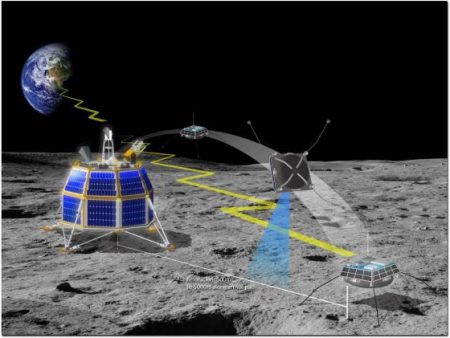
Moon Express is one of 16 companies competing for the Google Lunar X-Prize, a $3o million U.S. competition in which the winner collects a grand prize of $20 million. If all goes according to plan Moon Express will launch its MX-1 lander, seen in the image below, near the end of 2017 within the deadline imposed by the prize and meet the conditions set by it. The MX-1 must get there and then perform a maneuver after landing that has it travel 500 meters from its original touchdown site. And finally the lander must beam its success in high definition back to Earth.
Winning the prize is just the first step. Moon Express has much more ambitious goals. States Naveen Jain, co-founder and chairman, “In the immediate future, we envision bringing precious resources, metals, and Moon rocks back to Earth.” Eventually the company hopes to offer a filling station service to other space faring companies that drop by taking advantage of the known water resources discovered on the lunar surface.
How does Moon Express intend to get to the lunar surface?
The company has signed a multi-launch agreement with Rocket Lab, a New Zealand-based company, the developer of the Electron. Last year I wrote about the company and its unique rocket featuring electric engines each capable of generating 716,000 Newtons (161,000 pounds) of thrust. Rocket Lab, according to its founder, has a mission to make space launch to orbit and the Moon cheaper than any agency or company including SpaceX. The rocket structure is made from carbon composites giving it low mass and high strength. That means it needs less fuel on board to get to space. That combined with its unique electric motors powered by lithium polymer batteries and a proprietary fuel and liquid oxygen mixture makes it a very different commercial player than its commercial launch rivals.
How will the world react to commercial companies exploiting space resources?
Moon Express may be the first to have received regulatory approval for a commercial mission to the Moon, but many other companies are well on their way to establishing for profit space businesses. Whether it is Bigelow with its inflatable hotel habitats, or Planetary Resources, with its mission to mine asteroids, we are seeing activity that is contrary to the initial efforts of most of the world’s nations to establish outer space as a province to benefit all humanity.
If the United States has the right to do this then what is to stop commercial operators in China, Russia, and elsewhere, to get their nations’ approval to carve out economic exploitation zones on the Moon, Mars and other space destinations?
]]>Backed by Autodesk, the computer-aided-design software company, Moon Express is out to win the Google-sponsored Lunar XPrize with its deadline of end of year 2015 to safely land on the Moon. The lander must perform an additional task. It has to travel 500 meters from the landing site and send back two “Mooncasts” to Earth. $40 million is up for grabs as well as bonus cash prizes for other feats including finding lunar artifacts and surviving through the two-week lunar night.
Moon Express is headquartered in Mountain View, California. Its robotic spacecraft will be solar-powered using hydrogen peroxide (the stuff you put on your face as an astringent) as rocket fuel. Slightly more powerful than the hydrogen peroxide you buy in bottles at the drugstore, the choice of fuel is deliberate because the MX-1 can be refueled from the lunar surface by synthesizing the fuel using elements commonly found there.

The rocket motor is dual mode burning kerosene for translunar insertion, landings and liftoff from the Moon. The SpaceX Falcon 9 would be the launch vehicle.
MX-1 is toroidal in shape and about the size of a large coffee table. It has been designed for multiple applications, so that it not only can land on the lunar surface, but also be used for space-based applications such as servicing and refueling other satellites, acting as a space tug, cleaning up space junk, carrying cubesats to orbit and monitoring the presence of near-Earth asteroids as well as the Earth’s surface . The developers call the MX-1 the iPhone of space with many of its applications being developed from members of the Autodesk community.

Thirty-three teams are vying for the $40 million Lunar XPrize. You can learn more about them by visiting the Google website.


