The post COP28’s Focus and Agreed to Action on Methane is Delusional Collective Thinking appeared first on Techso Mogro.
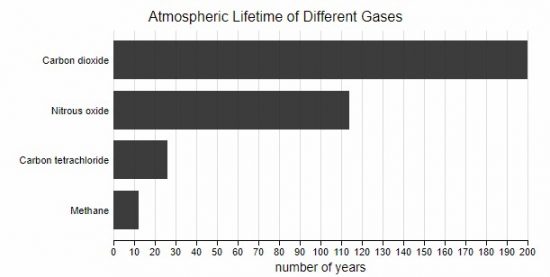
]]>But what is missing when describing CH4’s atmospheric impact is its short duration lasting a mere 12 years, and certainly no more than 20. CH4 after becomes CO2 and water vapour. So we still have two potent greenhouse gasses to deal with after the fact.
A quick comparison with CO2 shows that its impact is far greater lasting between 300 and 1,000 years. CO2 only leaves the atmosphere when it is absorbed by oceans, plants, soil, and the weathering of rocks. The latter occurs when CO2 combined with water falls as precipitation on basalt which turns into calcium carbonate, better known as limestone.
CH4 and CO2 aren’t the only greenhouse gasses. What follows gives you some pertinent facts:
Why is a potency comparison between CH4 and CO2 such an issue? Because headlines from COP28 in Dubai included agreements about CH4 and got front-page coverage.
A global pledge by 155 governments and 50 oil and gas companies to reduce CH4 from oil and gas, waste, and agricultural activities was featured in press conferences and the final communiqué. It contained a CH4 reduction target of 30% by 2030 from 2020 levels, describing this as “the fastest way to reduce near-term warming” and “to keep a 1.5 Celsius temperature limit within reach.”
CH4 was described as contributing 30% of current global warming and was further seen as a contributor to tropospheric ozone (aka ground-level ozone), the latter described as being the cause of hundreds of thousands of deaths and millions of tons in crop losses annually.
The communiqué went further, stating that a rapid reduction in CH4 emissions would mitigate near-term global warming and contribute to better health, food security, and energy security for humanity and the planet.
CH4 emissions are the least of our greenhouse gas worries. The amount of warming caused by CH4 is short-term because it doesn’t accumulate in the atmosphere for 12 to 20 years. Then it degrades to become a CO2 problem. Delay CH4 action and its effect vanishes in two decades. Delay acting on CO2, and it keeps accumulating for up to 1,000 years. That’s why every added kilogram of CO2 is the much greater global warming threat.
If you don’t believe me, Raymond Pierrehumbert, a physicist and professor at the University of Oxford, in a recent interview appearing in the Bulletin of the Atomic Scientists makes the same point. He states,
“Whereas a kilogram per year of CO2 will mount up to a certain amount of warming in the first 20 years…if you keep emitting that kilogram per year, the amount of warming you get continues to increase indefinitely, which does not happen with CH4.”
Pierrehumbert compares the two gasses for their global warming impact using the analogy of a car trip.
“CO2 is like the total distance your car has gone, so it’s the cumulative progress towards your destination, and our destination, in this case, is making the world too hot to be livable. Whereas CH4 is just like the speed at which the car is going…a stock versus flow problem…CH4 is a flow pollutant; it doesn’t accumulate in the atmosphere. CO2 is a stock pollutant. The harm is determined by the cumulative stock of it in the atmosphere.”
Regarding COP28, Pierrehumbert concludes that the fixation with CH4 is a “seduction” a “mass delusion and wishful thinking.” The focus on CH4 reduction will not contribute significantly to mitigating climate change when “compared to how much warming we’re going to get in 100 years if we don’t decarbonize.”
The post COP28’s Focus and Agreed to Action on Methane is Delusional Collective Thinking appeared first on Techso Mogro.
]]>The post If You Cook With Gas Are You Putting Your Family At Risk? appeared first on Techso Mogro.
]]>During the presidency of Barack Obama, the U.S. government policy related to climate change made natural gas a transition fuel away from coal and oil. Utilities were encouraged to shutter their coal-fired and oil-burning infrastructure and convert it to natural gas. Today, the transitional strategy is still in place fuelled by the rationale that switching to natural gas reduced GHGs per heating unit by 42%.
In 2021 the U.S. Energy Information Administration (EIA) estimated natural gas contributed to 34% of the country’s total GHG emissions. The transitional strategy, therefore, although lessening emissions from coal and oil, was doing little to reduce the country’s global warming impact.
Natural gas, however, is more than just a fuel to heat homes and businesses. In the United States cooking with gas appears to be the method of choice for the majority of homeowners who prefer it to electricity.
The latest controversy has arisen because an official, Richard Trumka Jr., a member of the U.S. Consumer Product Safety Commission told a Bloomberg reporter that there is research linking gas stoves in homes to increased levels of asthma in children. Trumka mentioned that the agency was considering regulating natural gas indoor home appliances because of this remark that “products that can’t be made safe can be banned.”
This comment was interpreted by some in politics to be an assault on freedom of choice with Matt Gaetz, a Republican Member of the House tweeting “you’ll have to pry it from my COLD DEAD HANDS!” (Note: The use of uppercase on Twitter is the equivalent of shouting.)
What does the science say about cooking with gas pertaining to emissions? How much does it contribute to respiratory illnesses in children? And how much does it contribute to global warming?
The former is a real issue, the latter not nearly as much. And it is not CH4 consumption that is the kitchen appliance issue. Almost all the CH4 used during cooking burns up. The problem occurs if an appliance is not well maintained because that’s when leaks occur. Those leaks can be CH4. But they can also be carbon monoxide (CO) and nitrogen dioxide (NO2). CO leaks can kill you. NO2 leaks contribute to increased incidents of respiratory disease.
NO2 can also come from emissions produced by internal combustion engines. It contributes to ground-level ozone in cities, a known respiratory irritant that can cause asthma in children and pulmonary disease in adults. In China, for example, where urban air pollution from burning coal and other fossil fuels is far worse, the daily death toll from the air is 4,400. And if you don’t believe that NO2 and other noxious gasses are the real deal, just walk along a busy city street during rush hour and feel the effects of these pollutants on your eyes and in your nose. The NO2 and other pollutants coming from tailpipes are exposing you to medical risk.
So when you get home and light the stove or turn up the thermostat, do you want to continue experiencing what is on the outside? The risk of exposure to indoor air pollution is real. But which is worse, the outside air or the inside air?
The outside air undoubtedly. That’s because the actual contribution cooking with gas in a home makes, according to U.S. figures amounts to no more than 0.1% of the total GHG emissions produced by the country annually. And cooking with gas uses only 3% of the natural gas consumed in homes. The rest is for heating. So is this really a kitchen appliance problem or more a problem about the right fuel energy choices to be made now and in the future to achieve two goals: respiratory disease reduction, and climate change mitigation?
For Matt Gaetz with his cold dead hands’ declaration, I wonder, would he have been so vehement if the agency spokesperson had cited furnaces and water heaters. After all, that stuff is hidden away in the utility room or basement and not front and centre with the stainless-steel, four-burner, state-of-the-art appliance in the family kitchen surrounded by granite countertops.
Studies that link respiratory illnesses like asthma in children and gas stoves show varying increases of between 12 and 42%. As early as 2005, the World Health Organization (WHO) produced guidelines about exposure to NO2 from gas stoves. While the U.S. has yet to do this, Health Canada, in 2015, revised its recommendations on indoor air quality referencing gas stoves as a NO2 issue particularly during brief periods after a burner is shut off. The Canadian guidelines stated that gas stoves shouldn’t be used without a hood fan turned on and connected directly to the outdoors, or the use of other ventilation such as an open kitchen window.
The gas stove controversy has seen new fuel poured upon it by New York City which recently announced a change to its municipal building code, banning gas hookups for all new construction. The ban didn’t apply to legacy buildings. Other municipalities and some states enacted similar new gas hookup bans, while at the same time in protest, a number of contrarian jurisdictions banned the ban.
The greater natural gas risk really isn’t centred on the kitchen stove although the NO2 link to childhood asthma and adult pulmonary disease cannot be discounted. The real risk is the reliance on and acceptance of a transitional fuel strategy to get to net zero that has entrenched natural gas as a greener option to combat climate change.
Even the European Union with all its environmental activism recently gave natural gas the green stamp which had more to do with the Russian invasion of Ukraine than combatting climate change.
The result of the transitional fuel notion means we continue to pay for a policy that has outlived its short-term purpose which was to get utilities to shutter coal-fired operations. Natural gas is no different from other fossil fuels that produce GHG emissions. It is certainly not green and definitely continues to contribute to rising atmospheric and ocean temperatures.
The post If You Cook With Gas Are You Putting Your Family At Risk? appeared first on Techso Mogro.
]]>The post If You Call Natural Gas a Low-Carbon Fuel Does That Make It Green? appeared first on Techso Mogro.
]]>CH4 is a potent greenhouse gas (GHG), about 80 times more climate influencing in the short-term than carbon dioxide (CO2). But now, because the European Union (EU) plans to slash GHGs by 55% by 2030, the way the 27-country bloc plans to do this is to pivot from coal first to natural gas combined with wind and solar renewables, and then eventually eliminate gas entirely. But during the pivot, the EU wants to define CH4 as low-carbon and subsidize the building of infrastructure and projects to use it for electricity and heating.
Today 25% of the electricity produced in the EU comes from burning CH4. CLose to 100% of the heating of buildings and homes in the EU is also done using CH4.
This week the European Commission, the executive branch of the EU, is asking the European Parliament to vote to designate CH4 as a low-carbon fuel and to put in place subsidies and low-interest loans to support a buildout of the natural gas infrastructure beyond what already exists. It’s not likely that the Parliament will vote in favour.
The EU’s dilemma today is the fact that almost all CH4 it uses for electricity and heat comes from Russia. And unless you have been on a desert island for the last six months, it is pretty obvious why the EU doesn’t want to continue to be reliant on Russian CH4.
So the EU is faced with a series of dilemmas. It needs to wean itself off coal to lower GHG emissions. It needs to wean itself off Russian gas. It needs to deal with Germany’s poor decision-making around nuclear energy and that country committing itself to Russian gas in lieu of nuclear power. And then there is the dilemma of how much to invest to support a temporary new gas and energy infrastructure that may only last for a few decades as the EU meets its interim 2030 goal and net-zero 2050 one.
Where will it go for CH4? It is looking to the Middle East, Africa, the United States, and Canada for its new “low-carbon” energy. Europe needs to build terminals to get natural gas stored as a liquid, (liquid natural gas or LNG) from most of these sources. It cannot rely on a pipeline infrastructure such as it has with Russia. (Recently a pipeline moving natural gas through Turkey to Europe was completed.) So that means terminals will need to be built at European ports with pipelines to connect to powerplants and industry. And it means pipelines and shipping terminals will need to be in place in North America and Africa, from where the CH4 will need to come.
Some European politicians are questioning why Germany is continuing with its disastrous nuclear policy. They are also arguing for a rapid expansion of renewables like offshore and inland wind, geothermal, large-scale battery storage, and utility and residential solar arrays. Money spent on renewables and storage will last well beyond the few decades that the temporary CH4 fix addresses.
Putting a low-carbon label on CH4 is a greenwashing ploy to meet a political need caused by poor policy decision-making in the past. It may seem palatable to those vested in maintaining fossil fuel energy, but it doesn’t change the outcome that burning more of it means increasing GHGs.
The post If You Call Natural Gas a Low-Carbon Fuel Does That Make It Green? appeared first on Techso Mogro.
]]>The post Agricultural Emissions Taxes Are Coming in an Effort to Deal with Methane appeared first on Techso Mogro.
]]>On a century timescale, CH4 packs 28 times the punch of CO2 as a greenhouse gas (GHG). And since the beginning of the Industrial Revolution, its atmospheric accumulation has more than doubled. Currently, CH4 is responsible for approximately 20% of atmospheric warming.
The biggest human sources of CH4 by percentage can be seen in the following pie chart.

Fossil fuel production, distribution, and use account for the largest share. But livestock farming is a close second. In the case of the former, the known sources are lead by oil and natural gas, with coal and bioenergy contributing the least. Solutions for oil and gas are largely manageable through above-ground actions that include repairing existing equipment and deployment of proven technologies. We are talking about leak detection equipment replacement to identify CH4 emissions.
The International Energy Agency (IEA) estimates through this simple operational improvement that 70% of CH4 emissions from the oil and natural gas sector can be avoided. And with the current spike in prices for oil and gas because of the Russian invasion of Ukraine, the sector would be able to absorb the cost easily. What this means is operations need to check and replace leaky pumps, corroded compressor seals, non-working electric motors, inadequate vapour recovery units, and both upstream and downstream leak detection monitors. The goal would be to plug the holes and eliminate the practice of non-emergency flaring and venting which today contributes to a large proportion of the industry’s CH4 emissions.
Last week New Zealand, the home to 6.3 million dairy and 3.9 million beef cattle, and 26.8 million sheep announced plans to tax farmers on CH4 emissions. Livestock in New Zealand outnumbers people by a factor of six. Cows and sheep contribute almost half of all CH4 emissions produced by the country.
A recent Guardian article reported that cows are one of New Zealand’s biggest producers of GHGs. Emissions from all sources in the country between 1990 and 2018 rose 57% which was “the second greatest increase of all industrialized countries” over that time span. So for the country to tackle its GHGs to meet a 2050 net-zero emissions target, it is bringing in a tax.
The tax is priced separately for short and long-term farm greenhouse gas (GHG) contributions. There is no mention so far of how GHGs will be measured to calculate the tax. For farmers, there are many unknowns. What can they do to reduce GHGs from livestock operations?
Herd reduction is likely the primary action farmers will take. Other ways to inhibit CH4 emissions may come from breeding new varieties of cows and sheep that burp and fart less.
Then there are changes to feeds. Since enteric fermentation occurs in the stomachs of cows and sheep, CH4 exhalations and flatulence can be reduced by changes to the food mix.
Back in 2016, a Canadian farmer on Prince Edward Island introduced seaweed he collected from local beaches into the diet of his dairy cows. What started as a practice to save money reduced CH4 flatulence by 20%. It’s not that the cows didn’t continue to burp and fart. The difference was there was no detectable CH4 coming out of either end.
Today, livestock farms around the world contribute more than 90 million tons of CH4 to the atmosphere annually. And because meat and dairy demand has doubled globally over the last half-century, so have herd populations and emissions. So the problem isn’t going to go away without significant changes to livestock management practices.
That’s why what New Zealand is attempting to do through a tax is something many other countries are watching and considering as they attempt to address agricultural emissions without dramatically upsetting the food supply.
New Zealand farmers will be given the opportunity to use carbon offsets by investing in on-farm forests. This will help offset the tax. But changing livestock management practices will be critical including the feed mix. And considering New Zealand is an island nation surrounded by the Pacific Ocean, finding seaweed as a feed shouldn’t be too difficult.
Eventually, however, the costs incurred by farmers will impact prices for meat and dairy. The government may consider some form of compensation to families to help offset rising prices because there is no doubt the entire country isn’t planning to suddenly go vegan.
The post Agricultural Emissions Taxes Are Coming in an Effort to Deal with Methane appeared first on Techso Mogro.
]]>The post Methane is the Immediate Climate Change Threat State Climatologists appeared first on Techso Mogro.
]]> The latest data from October 2021 shows global monthly means reaching 1,907.2 PPB. The uptick has been steady with current levels triple those from the pre-industrial period. How do we know what those pre-industrial levels were? Through the analysis of ice cores taken from Greenland, scientists have measured the concentrations of gasses in trapped bubbles giving us a record of both CH4 and CO2 levels and how they have changed over 2,000 years.
What could be causing the recent rise?
The likely source of rising CH4 levels one would think is coming from the fossil fuel industry. But that appears not to be the case according to some scientists who are looking at the volume of radioactive carbon isotopes found in sampled gasses. CH4 molecules contain both stable and radioactive carbon isotopes. The two most notable of the latter are carbon-12 and carbon-13. They are analogous to a more well-known radioactive carbon isotope, carbon-14, which if you remember from studying ancient history in high school, has been used to date archeological, anthropological, and other historical remains and findings.
Those Greenland ice cores show an interesting pattern in the percentage of isotopes found in the trapped CH4. Since the Industrial Revolution, they indicate an increase in carbon-13 over carbon-12, that is, until the last fifteen years when carbon-13 started decreasing. Scientists conjecture that the current CH4 spike coinciding with carbon-13 decreases indicates microbes may be the principal source for the increase, and not oil and natural gas operations. In fact, NOAA scientists working at the Global Monitoring Laboratory in Boulder, Colorado, have estimated that 85% of the recent growth in CH4 levels is microbe related.
Where are these microbes located? In the gut of livestock, in wetlands, landfills, in cultivation (particularly rice the world’s largest staple crop), wild and controlled plant matter fires, and wild animals. The histogram below breaks down the major suspects and their contributing shares.

But fossil fuel extraction doesn’t get off the hook that easily despite the NOAA report. Another data source comes from satellites, and last week the journal Science published a report that points to human oil and natural gas extraction and production as the prime culprit. The data collected comes from the European Space Agency’s Sentinel-5P satellite which has the ability to measure CH4 levels in the atmosphere daily and spot the contributing sources. The data collected shows that two-thirds of CH4 emissions are coming from oil and natural gas extraction and production. The remaining one-third is being emitted by coal, agriculture, and landfill sites. The biggest leaks of the gas are coming from malfunctioning equipment and pipelines. Levels of the gas in some areas are so high, for example, the Permian Basin in Texas, and the oil sands in Alberta, Canada, that the satellite cannot pinpoint which of the fossil fuel operators are the most egregious leakers.
The two aforementioned published reports have surprised me for what they didn’t mention – melting permafrost. Permafrost, found throughout much of the Northern Hemisphere north of 60 degrees latitude, has historically been a carbon sink. But not anymore. The permanently frozen ground in the Arctic is now impermanent and thawing. What is leaking out is largely CH4 with smaller amounts of CO2. Could permafrost be the big contributor to the spike? Based on sampling from Siberian sites, more carbon-12 than 13 is found in melting permafrost samples. So maybe that is an additional biogenic source of rising CH4.
Why are we looking at CH4 when the vast majority of literature on anthropogenic climate change talks about CO2? The U.S. Environmental Protection Agency site includes a considerable amount of information comparing the two greenhouse gasses. It states that CH4 represents about 10% of the country’s overall greenhouse gas emissions but goes on to add, “pound for pound…is 25 times greater than CO2.” That’s why eliminating CH4 would be a climate game-changer. Plugging up CH4 leaks in fossil fuel operations seems comparatively simple, certainly far easier than trying to tackle microbial emissions of the gas.
Last year in Glasgow, at the COP 26 climate conference, 111 countries, representing almost 50% of anthropogenic CH4 contributions agreed to reduce emission by 30% by 2030. This global pledge described that meeting this goal would yield a reduction of 0.2 Celsius in atmospheric temperature rise between now and 2050. The effort will almost exclusively come from the elimination of CH4 in oil, gas, coal, and landfill operations. Trying to cut down cow fart-based CH4 will be trickier. And as for permafrost, with Arctic temperatures rising faster than anywhere else, these thawing parts of our planet represent a ticking time bomb.
The post Methane is the Immediate Climate Change Threat State Climatologists appeared first on Techso Mogro.
]]>The post Whiffs of Methane on Mars – Is There Life or is the Source Geological? appeared first on Techso Mogro.
]]>Although the Martian atmosphere is tenuous at best, the winds still blow on this planet creating much of the surface erosion observed by the robotic spacecraft, landers, and rovers we have dispatched to it. Orbiters have observed how much the landscape is shifted by winds. Jon Telling, Geochemist at the School of Natural and Environmental Sciences, Newcastle University, when describing the role of the Martian wind states that “the rate of erosion is estimated to be comparable to those of cold and arid sand dune fields on Earth.”
Ruling out wind erosion as the source for periodic methane release, therefore, made sense. The Newcastle researchers noted that detected methane on Mars is unevenly distributed and appears temporarily in isolated pockets on the surface. A biological origin based on seasonal or subsurface changes was a likely explanation. But a purely geochemical one was also plausible. No one had really considered Martian winds as the engine for methane release.
What the Newcastle researchers concluded, however, was that wind erosion could be playing a part but that the methane volumes detected suggested this was highly unlikely.
So if it is not wind erosion, what is it?
Marco Giuranna, of the National Astrophysics Institute, in Rome, participated in an international team studying Martian methane gas releases. They used data from the Curiosity rover and one of ESA’s orbiters, the Mars Express, to study a 250 square kilometer area of the Gale Crater surface. The team ran a million computer models of different emission scenarios and concluded that the most likely source for the gas was subsurface frozen methane that was occasionally leaking. But as to what created this methane layer, the team had no answer.
Near the end of June of this year, the Jet Propulsion Laboratory-Caltech team that is working with the Curiosity rover announced that they had detected the largest transient plume of methane coming from the Gale Crater so far. The amount was 21 parts per billion measured by SAM’s (sample analysis laboratory) tunable laser spectrometer.
On Earth, microbial life called methanogens, are a big source of atmospheric methane. You find methanogens in the gut bacteria of cows. You also find them in melting permafrost, in peat bogs, and almost anywhere there is decaying vegetation.
But some methane on Earth has geological origins. For example, volcanoes on Earth belch methane, although there is no evidence of active volcanism on Mars today. So we can rule out volcanism as a Martian methane source.
So what other Martian geological processes are likely the methane source?
Could the weathering of carbonate rocks exposed to liquid water in the right temperature conditions produce methane? This chemical origin of methane would follow a pattern of seasonal variation based on the rise and fall of daily temperatures. Seasonal methane variation has been observed on Mars.
But a biological origin would equally be plausible when looking at seasonal methane on Mars. Martian microbes would be more active in the right temperature conditions.
But Gale Crater methane observations have also been sudden with transient plumes of the gas being detected. It’s as if the planet is doing its own version of “cow farts.”
And even curiouser and curiouser is the lack of data showing methane’s presence from ESA’s ExoMars Trace Gas Orbiter, which has been circling the planet for the last year looking for the gas. Talk about causing methane confusion back here on Earth for exobiologists and geochemists who are still trying to figure out if Mars has native microbial life or just some exotic geological processes.

The post Whiffs of Methane on Mars – Is There Life or is the Source Geological? appeared first on Techso Mogro.
]]>The post Our Atmosphere Has Seen a Methane Spike and Guess Why appeared first on Techso Mogro.
]]>I haven’t been totally idle while remaining with my leg elevated. Instead, I have been catching up on my reading about our changing climate, the mystery surrounding the SpaceX Zuma mission, the latest non-science bashing genetically modified organisms, and, of course, Donald Trump.
One study that caught my eye comes from NASA, the agency that the current administration wants to stop looking at the Earth and instead look to the Moon and Mars. NASA’s Earth science portfolio is very deep. Satellites it has launched study greenhouse gas levels in the atmosphere, the state of our oceans and continents, weather and climate, land use, deforestation, and more.
The latest from NASA to be published is a study of atmospheric methane (CH4), a greenhouse gas that doesn’t endure in the atmosphere as long as carbon dioxide (CO2), but nonetheless, contributes to global warming. And CH4 has increased in the atmosphere at a rate of 25 teragrams annually since 2006.
What’s a teragram? One is equivalent to 1 million metric tons (1.2 million American tons). So CH4 emissions have been accumulating at a rate of 25 million metric tons each year for more than a decade. When compared to CO2 accumulations over the same period 25 million tons is a blip. That’s because CO2 contributions amount to more than 25 gigatons annually and a gigaton equals a billion metric tons. That latter contribution accounts for 82% of all greenhouse gas emissions produced from human activities.
So why worry about 25 million tons of CH4?
Here is an interesting statistic. Although CH4 contributes a mere 1% of the amount of greenhouse gases entering the atmosphere, that small percentage translates to 9% when weighing the total impact the gas has on global atmospheric warming. In other words, CH$ has a nine times greater impact per ton than CO2.
CH4 comes from many sources; wetlands, swamps, mangroves, tidal ponds, Arctic permafrost, fossil subsoils, underground natural gas reservoirs, the digestive tracts of ruminants (cows), and from fermented manure used as fertilizer on farms. It also is a common byproduct of forest fires like those that have stricken parts of Southern California in the last two months.
The signature of CH4 from every source can be isotopically isolated. So we know the difference between CH4 from cow farts and CH4 from a gas wellhead. This gives NASA scientists the ability to accurately measure origins which they do using satellite and ground-based imaging spectrometry. The collected data shows that the observed global rise in atmospheric CH4 is largely attributable to oil and gas exploration, production, and distribution. Of the 25 teragrams of CH4 being added to the atmosphere annually, NASA data indicates that 17 is derived from oil and gas.
Should we be worried?
If we continue to expand oil and gas exploration as is evident in the policies of the current Trump government in the United States, then indeed we have a problem.
Surprisingly, the study doesn’t include data about CH4 short atmospheric life. When compared to CO2, CH4 hangs around as a greenhouse gas for 12 years before it breaks down through natural processes, whereas CO2 hangs around for up to 200 years if not trapped in natural sinks or by human-created carbon sequestration technologies that have yet to exist.
Scientists describe CH4’s warming as short and sharp while attributing words like “creeping” and “insidious” when talking about increasing CO2 in the atmosphere.
Contributors, other than NASA to this study, include the National Center for Atmospheric Research, Boulder, Colorado, the Netherlands Institute for Space Research, and the University of Utrecht, also in The Netherlands.
The post Our Atmosphere Has Seen a Methane Spike and Guess Why appeared first on Techso Mogro.
]]>The post Oil and Natural Gas Producers Still Treat the Commons as a Public Dumping Ground – This Has to Stop appeared first on Techso Mogro.
]]>No one wants to go back to feudal Europe. But we might want to consider what we can learn from the Inuit and First Nations if we are to remain in harmony with this planet, the only place we know where complex life exists in the Universe.
So what has put us out of synch with nature and the planet? The rise of capitalism and individual rights has moved us away from the commons. Today it is these foundational concepts in Western culture that has led us to where we are facing the issues of global warming and other climate change phenomena. We have taken individualism and asserted it over collective environmental responsibility for far too long. And in spreading the values and ideas of capitalism across the globe during colonial expansion we now face a problem that some of us would rather deny exists.
The oil and gas industry remain in that state of denial to this day. The industry sees its worth in its economic an energy contribution across the planet. It considers the environmental challenges an irritant. The result, the industry continues to pollute the commons as necessary to its business model and to the profit of shareholders. And now, in its latest denial effort, is pushing back against governments trying to reduce greenhouse gas emissions, and in particular, methane pollution from extraction and exploration operations.
Methane (CH4) is a potent greenhouse gas, up to 30 times more significant in affecting atmospheric warming than carbon dioxide (CO2). CH4 may not last as long in the atmosphere but it from industry and natural sources is currently contributing to warming in its own way.
For the industry, CH4 comes with the territory. When you are drilling a new well, or during fracking operations, or even after a well goes into production, CH4 is a natural byproduct. In the past CH4 was dealt with two ways. It was allowed to escape into the atmosphere, or if in high concentrations, flared off by burning it at the wellhead. Leaks were just part of the business model.

But as the Canadian and Alberta governments attempt to mitigate climate change while giving the oil and gas industry the means to continue to operate, they have proposed regulations requiring producers to seal CH4 leaks and capture the gas at all other times during exploration, production, and extraction. The industry has responded to these regulations by asking for flexibility in the oversight of operations. What the industry has lobbied for is the government to only make compulsory visits to wells at high risk of leakage rather than monitor all sites. The industry also wants the government to relax oversight of CH4 reductions at heavy oil operations, the oil sands. Their rationale is that the technology to reduce CH4 in the latter represents a more significant investment which for the moment it appears they are not prepared to make even in the face of global warming. The latest research on oil sands operations indicates that CH4 emissions are 50% greater at these sites than from other oil and natural gas sources.
Two of the governments in Canada, the federal and the province of Alberta, have agreed to set CH4 reduction targets of 45% by 2025. They want to see CH4 emissions decline by 282 megatons by 2035. They estimate this will put $13.4 billion back into sustainable economic development rather than into adaptation and mitigation projects to deal with the impacts of global warming and other climate change elsewhere.
It is pretty clear that the industry continues to maintain a mindset established right at the beginning of the Industrial Revolution. The commons, the air we breathe, the water we drink, the ocean, and the land, all just dumping grounds for the dross and waste that comes from enterprise, whether capitalist, communist or from central planning. Whether it’s Europe, Russia, China, the United States, Canada, Australia, Brazil, or the many Developing World nations, this disregard for the health of the commons is prevalent across the planet, a byproduct of the global reach of advanced industrial technologies and short-term thinking.
The industry can argue that regulation and unrealistic deadlines could produce job losses, and therefore, less tax revenue to government. But these statements represent no more than strong-arm tactics to weaken environmental resolve. There is, however, only one prescription to heal the commons. If government won’t prescribe it, and industry won’t prescribe it, then who will? For the sake of those who inherit the legacy of our climate inaction, we owe it to them to start delivering the medicine that will heal the commons for posterity.
The post Oil and Natural Gas Producers Still Treat the Commons as a Public Dumping Ground – This Has to Stop appeared first on Techso Mogro.
]]>The post Cigarette Industry More Than Damaging To Lungs appeared first on Techso Mogro.
]]>“We all know that smoking is harmful to the human body, but there is actually a second damaging side to smoking and cigarettes. Both cigarette smoke itself and the waste from cigarettes can have a major impact on the environment.”
So how much damage is tobacco and smoking doing to more than just human lungs? I think you will find the statistics on discarded cigarette butts pretty appalling.
The arrival of Jenny’s infographic coincides with my visit to my rheumatologist to get a cortisone injection in my knee. To get there I walked the 1.2 kilometers to the subway with cane in hand. But as I walked it was impossible not to notice the refuse of cigarettes everywhere. I shared my observations with Jenny in an email.
This is what I saw and obsessively counted thinking I might write about this very subject:

The post Cigarette Industry More Than Damaging To Lungs appeared first on Techso Mogro.
]]>The post In Canada’s North the Permafrost Thaw is Pockmarking the Landscape as Methane Gets Released appeared first on Techso Mogro.
]]>Some of this CH4 is clearly not just derived from organic decomposition. Locked beneath the permafrost are pockets of fossil natural gas that seep through faults and cracks into the permafrost and local lakes eventually to be released into the atmosphere.
The findings come from two years of atmospheric sampling above 1% of Canada’s permafrost over the Mackenzie River delta (seen in the photograph below). That 1% is contributing 17% of all the CH4 measured in the high Arctic. Imagine then what the remaining 99% can potentially contribute with an increased partial permafrost thaw.

This new study concludes that the higher concentration of CH4 has geologic and largely nonorganic origins. So under the Mackenzie River delta, there are likely significant pockets of natural gas.
Nonetheless, CH4 releases from under or within the permafrost represent a significant greenhouse gas threat, 28 times more potent than carbon dioxide (CO2) the gas most associated with global warming studies. CH4 may dissipate much sooner than CO2 but a massive release of it could cause a significant temporary spike in global temperatures.
In a recent study by the U.S. Geological Survey, it estimated that between 16 and 24% of its Alaska permafrost is expected to melt by 2100. The implications for a CH4 release from rapid warming just from Alaska alone cannot be underestimated. But the larger permafrost basins lie in Canada and Siberia. And in the latter there is plenty of evidence of significant CH4 releases causing gigantic sinkholes which have led to the release of buried pathogens causing human and animal deaths.
The post In Canada’s North the Permafrost Thaw is Pockmarking the Landscape as Methane Gets Released appeared first on Techso Mogro.
]]>