The post Conversations About AI: Part 7 – Your Next Weather Forecaster May Be An AI appeared first on Techso Mogro.
]]>Getting the weather forecast right this summer seems to have gone by the wayside where I live. Accuracy appears to be taking a holiday. So it was interesting to come across articles about using artificial intelligence (AI) to forecast the weather, doing it with speed and accuracy.
Why are speed and accuracy so important? Munich RE, the reinsurer that underwrites millions of policies, has predicted that extreme weather events by 2050 will result in 1 million lives lost and USD 1.7 trillion annually. That’s why weather forecasting operations use supercomputers today to estimate probabilities.
So meteorologists now have competition beginning with these three companies: Alphabet, Huawei and Nvidia. Each is using AI to model the weather based on historical data. And each claims to be doing it better and faster than any human meteorologist. So how are they doing this? Here’s a deeper look.
The company has developed an AI in partnership with the United Kingdom’s Met Office, one of the most advanced meteorological services on the planet. The AI is called Deep Generative Models of Rainfall or DGMR and it is doing nowcasting which constitutes high-resolution, short-term predictions of precipitation. It seems fitting considering the UK’s reputation as a pretty wet place that the AI has first focused on rain.
DGMR has trained by studying historic radar images of rainfall allowing it to predict future precipitation patterns by location and amount. Early implementation has DGMR being used to help with air traffic control and energy management.
The model is a conditional generative adversarial network that takes four observed radar frames to predict the next 18 output frames. The historical radar observations used to teach the AI cover a period from 2016 to 2019. And DGMR takes just over a second currently to generate a forecast. It is proving to be 93% accurate.
Pangu-Weather AI is a forecaster that predicts not only the weather but also the path of tropical cyclones. Huawei, the Chinese telecommunications company, developed the model using its CLOUD team. The deep learning AI studied 43 years of weather data. Recently, it accurately predicted the trajectory of Typhoon Mawar five days before the storm changed course near Taiwan.
In an interview, Tian Qi, Chief Scientist at Huawei CLOUD described the complexity that is involved in developing accurate AI weather predictors.
He stated, “Weather forecasting is one of the most important scenarios in the field of scientific computing because meteorological prediction is a very complex system, yet it is difficult to cover all aspects of mathematical and physical knowledge. AI models mine statistical laws of atmospheric evolution from massive data.”
The current Pangu
At present, Pangu-Weather mainly completes the work of the forecast system, and its main ability is to predict the evolution of atmospheric states. Our ultimate goal is to build a next-generation weather forecasting framework using AI to strengthen existing forecasting systems.”
Pangu Weather-AI uses a 3D Earth-Specific Transformer (3DEST) architecture to process complex non-uniform 3D meteorological data. It has studied historical data from 1979 to 2021 and can do 1-hour, 3-hour, 6-hour and 24-hour predictions. It can produce a complete 24-hour global weather forecast in 1.4 seconds.
FourCastNet is an open-source machine-learning weather modeller. The link I have provided takes you to an essay with embedded source code.
FourCastNet uses a neural network to produce its accurate short-to-medium term (up to 10 days) weather forecasts with a high degree of accuracy. It has trained using historical data from 1979 to 2015 provided by Europe’s ECMWF Integrated Forecasting, a state-of-the-art meteorological system. The model uses 20 different variables to make accurate and speedy forecasts.
Are the days of the weather person numbered?
Peter Dueben who heads up the aforementioned ECMWF, doesn’t believe conventional human weather predictors will go the way of the dinosaur.
All the current AIs he notes have been trained on historical data. But as we are learning from the past few years, and in the last few months, climate change is making weather patterns more unpredictable. So a combination of human expertise and AI may end up tracking, recording and forecasting the weather well into the future.
The post Conversations About AI: Part 7 – Your Next Weather Forecaster May Be An AI appeared first on Techso Mogro.
]]>The post Space and Climate Update: Forecasting a Crisis We Can Do Something About appeared first on Techso Mogro.
]]>So let’s see what it is saying about today. Since yesterday it has fallen steadily and this morning’s reading is 29.78 inches (1,008.46 millibars) which according to the guide on its face dial means – unsettled weather. It’s absolutely right because when I look out it’s raining cats and dogs out there. I could have predicted today’s rain the old way by looking at yesterday’s clouds which included mare’s tails in the upper atmosphere followed by cirrostratus and stratus clouds, always a pretty good indicator of coming rain or snow.

But I couldn’t predict what would happen with the weather beyond the day-to-day. That’s where the art of weather prediction came in with forecasters on radio and television making their prognostications that were as often wrong as right, that is, until weather satellites became a fixture of the latter part of the 20th and now the 21st century.
The Coming Crisis in Weather Prediction
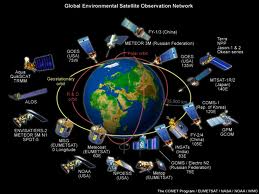
Satellites are our eyes on the planet. We use them for short and long-range forecasting. We use other ground-based on atmosphere-based tools as well but satellites make a huge difference. Because of satellite we can receive forecasts that serve to warn us well ahead about impending hurricanes and other severe weather events, and that provide accurate long-term predictions of weather patterns.
Satellites provide 90% of the information that gets crunched by climate modelling computers which give meteorologists the ability to provide uncannily accurate forecasts with few surprises. Satellites measure surface temperatures of the ocean on one side of the planet and predict the warming effect of an El Nino and what it will do to weather patterns thousands of kilometers away. Satellites can watch tropical cyclones over the Atlantic and Pacific and track and measure them as they turn into hurricanes and typhoons. They can monitor the paths of these storms and accurately predict landfall with a very small margin of error. They can see storm cloud patterns that forecast an outbreak of tornadoes so that communities can be warned not a minute before but 5-20 minutes ahead.
So what’s the forecasting crisis I speak of in my blog headline? The current satellites we rely on for giving us a daily picture of our planet and its weather are aging and we are not replacing them when they fail. The American National Academy of Sciences points out that NASA’s Earth Sciences Division is progressively being underfunded and, as a result, Earth-observation satellite launches are declining. The Academy warns that based on current trends we may end up with a global weather prediction data gap of 12 months beginning in 2017. That’s because we will not have a critical replacement satellite in place when another we rely on no longer can function.
Why do satellites fail? We are not talking about the ones that never get to orbit (we had two Earth-observation satellite launch failures in the last year to compound the problem). We are talking about those that are already in space and operating.
That’s why replacing them isn’t an option but a necessity. Currently planned satellite launches for 2012 number 23. But by 2020 there are only 6 planned launches on the books. That means Earth-observation satellites in space will decline from the 90 we have today to 20 by 2020.
Going blind about the weather because we choose not to make this necessary investment is just plain dumb.
The post Space and Climate Update: Forecasting a Crisis We Can Do Something About appeared first on Techso Mogro.
]]>