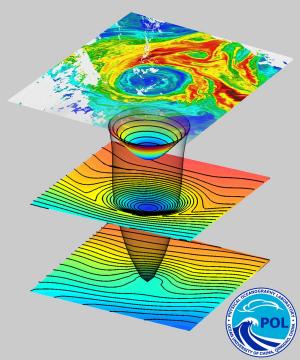
Researchers at the Ocean University of China and University of Hawaii are using the data to study a previously little known phenomenon called mesoscale ocean eddies. These are spinning masses of water that can be 80 to 500 kilometers (50 to 300 miles) in diameter. Not to be confused with gyres or the eddies caused by passing ships, these phenomena form depressions in the ocean surface as they spin. They are found in sub-tropical waters and tend to flow east to west following the direction of the Earth’s spin. They typically last months but in some cases years moving masses of ocean water and trapping floating debris and chemical pollutants within the water column.
We have a lot still to learn about the ocean. We know that the ocean currents alone are not responsible for the mixing and distribution of water across the planet. Some other factors are involved. For example, the so called Butterfly Effect, where the wing flaps of a butterfly on one side of the globe can spawn a hurricane on the other side, has a parallel in our oceans. And oceanographers are studying it looking at the smallest movement of zooplankton, and jellies, as well as larger ocean life to determine how all impact ocean circulation.
Mesoscale ocean eddies appear to be another ocean mixer. Much bigger than the Butterfly Effect of ocean life, these water vortices are contributing to the distribution of seawater and all that is contained within it possibly even more than our more familiar ocean currents like the Gulf Stream. And as a result, these eddies may influence El Nino and La Nina southern ocean oscillation events that have such a profound impact on climate thousands of kilometers away.