NASA’s other active rover, Curiosity, has identified organic matter at its landing site, the Gale Crater, indicating the presence of the building blocks for life were at some point widely distributed across the Martian landscape.
But it is the presence of aromatic organic molecules at Jezero that has led to a conclusion that the conditions for life on Mars persisted for a long period, between 2.3 and 2.6 billion years. SHERLOC found three rock surfaces with organic molecules present, and when Perseverance used its drill, identified similar molecules 8 to 10 millimetres deep within collected rock samples. Four of these samples have been stored for pickup by the future Mars Sample Return mission still in the planning stages.
The Jezero Crater has produced an abundance of organic molecules by an order of magnitude over what has been found at Gale Crater so far, proving that NASA chose well to plant Perseverance there. Much of the rock from which the organic molecules have been detected is water-altered basalt with low amounts of ferrous oxide (FeO) embedded. This reinforces the hypothesis that where there is water, that’s where we likely will find organics and life.
The discoveries of organic molecules were found in concentration in two Jezero sites. The results appear in a published article appearing July 12, 2023, in Nature, which states that the “key building blocks for life may have been present over an extended period of time” and “two potentially habitable paleo-depositional settings in Jezero crater.”
How do we know the extent of time of up to 2.6 billion years when conditions for life existed? Because basalt is an igneous rock which makes it useful for doing accurate dating. That’s what makes Jezero such an incredible site because it contains a combination of sedimentary and igneous rocks with the latter highly suitable to accurately age. As a result, we know that the lake systems that formed in Jezero existed 3.8 to 3.6 billion Earth years ago. A Martian year is almost twice as long as an Earth year so in terms of Mars’ timeline, between 1.9 and 1.8 billion Martian years ago. The interaction between free-standing water and rock would have been a comfortable environment for Martian microbes to evolve.
Could there be another explanation for the organic compounds found in these Jezero rock samples? The organics could have been brought to Mars when comets and meteorites intersected its orbit. Or the existence of organic compounds could be from inorganic chemistry with chemicals on Mars interacting with carbon dioxide (CO2) which today makes up almost the entire atmosphere of the planet.
Would Mars have been a more hospitable place over up to 2.6 billion years back in time? One thing is for sure, Perseverance tells us it was because today, free-standing water cannot be found anywhere on the planet’s surface. For it to have flowed back then, the climate of the planet had to be far more benign.
Why did it change? The lack of a strong magnetic field similar to that on Earth may be one of the reasons the Martian surface today is inhospitable. Another reason may have to do with the planet’s mass, just not big enough to hold onto a thick atmosphere to protect the surface from cosmic and solar radiation.
]]>
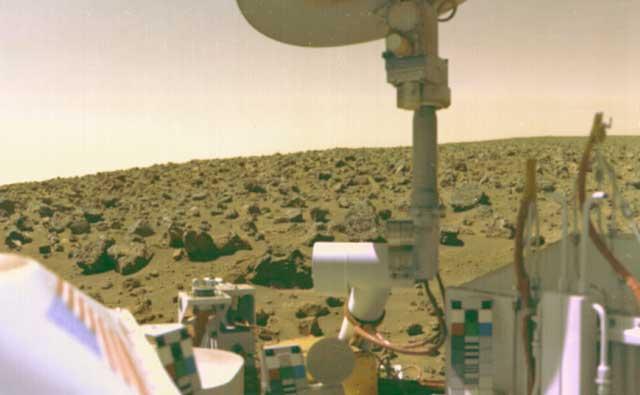
Revisiting the Viking experiments has become a repetitive process with NASA scientists. Both Vikings had on board a chemistry lab which could sample soil dug up by the landers trenching tools. In the Label Release Experiment, a diluted solution with added carbon compounds was added to each soil sample. The onboard then measured gases coming from the soil. The experiment was repeated this time with the soil sample heated to 160 Celsius (320 Fahrenheit) degrees. Again the gases emanating from the sample were measured. The experiments were duplicated on Earth using terrestrial soil samples with the results compared to what Viking produced.
Today a large number of scientists interpret the results of those Viking experiments as evidence to support that there has been in the past and is today active microbial life on Mars. They rate the certainty of this at 99%. And although no one in the NASA scientific community or at JPL Pasadena is shouting it out, there is no doubt that Curiosity’s confirmation of similar organics found at Gale Crater further validates this interpretation of the Viking experiments.
NASA remains overly cautious whenever the subject of life on Mars, both past and present comes up. That’s the public face the agency presents. But inside NASA there is an excitement about Mars that is driving interest in what will be discovered and confirmed when the Mars 2020 and European Space Agency ExoMars travel to the planet in 2020.
The latest paper published on the subject of organics found on Mars appears in the June 20, 2018 issue of the Journal of Geophysical Research. This peer-reviewed paper states that chlorobenzene, a chlorinated organic molecule that is a commonly used solvent here on Earth, was identified by both the Vikings and Curiosity, and is of Martian origin.
How does the confirmation of that discovery alter our approach to exploring and potentially colonizing Mars?
In our effort to find life elsewhere in the Universe, will we, in going to Mars, destroy the very evidence we seek? How will humans arriving on Mars not negatively impact an existing Martian microbial ecosystem? Is it in our plans to create refuges for Martian life as we begin to colonize the planet? The history of human exploration and our restless expansion to new lands has never been kind to the local flora and fauna. The mega extinctions in North America fauna that occurred when humans crossed from Asia tens of thousands of years ago is but one example. A second is the one when European explorers landed on North American shores leading to a pandemic that wiped out more than 90% of the continent’s native human population.
We need to “do no harm” when it comes to going to the Moon and Mars. It’s time to come up with a plan.