So how would we establish suitable soil for crops on Mars. Very much in the same manner that was depicted in the Andy Weir authored novel, The Martian. A stranded astronaut, Mark Watney, survives on potatoes which germinate in Martian soil fertilized by organic waste (poop) from his fellow astronauts. But Mark didn’t have earthworms which would have made things a lot easier.
The research being done at Wageningen University for the Mars One project has successfully grown vegetables in simulated Martian soil. But could earthworms survive and thrive in this medium? That’s what a team at Wageningen decided to find out. Instead of human excrement to fertilize the soil, the researchers used pig manure. Then they added earthworms.
States Wieger Wamelink, one of the researchers, “Clearly the manure stimulated growth, especially in the Mars soil simulant, and we saw that the worms were active. However, the best surprise came at the end of the experiment when we found two young worms in the Mars soil simulant.”
It’s one thing for earthworms to survive in the soil. It’s quite another if they begin propagating. That’s pretty exciting for any future human who chooses to live on Mars.
Simulated Martian soil is turning out to be a pretty good growth medium if you add organic matter (poop). To date, the researchers at Wageningen have grown green beans, peas, radishes, tomatoes, potatoes, arugula, carrots and garden cress. If you are a salad lover, you need not worry when you get to Mars. All you’ll need to bring is the Ranch dressing.
An additional note: when we bring earthworms to Mars will we rename them marsworms?

Only the Viking landers were equipped with experiments designed to sniff out potential evidence of life signatures in samples dug from the Martian regolith. The results of the tests, when aired in the press in 1976 stated that life had not been discovered. But in April of 2012, a revisit of the data collected from Viking’s two landers and their Label Release Experiment measuring the gases emitted by soil samples heated to 160 Celsius (320 Fahrenheit) degrees, overturned that assessment.
The results, published in the International Journal of Aeronautical and Space Sciences (IASS) stated there was 99% certainty that microbial life exists on Mars. Unequivocally the results the investigators reported were not caused by any Earth-borne contaminants arriving on the landers but were unique to Mars. The results were also consistent with similar tests run on Earth in Antarctica with conditions resembling the extremes of cold and dryness found on the Red Planet. Since Viking, NASA has sent many landers and probes to Mars including Opportunity and Curiosity (the latest), but strangely the agency has never tried a Viking retest or included more advanced life detection experiments, a surprising oversight by the agency. Instead, we have looked for organic molecules, the presence of water today, and evidence of significant surface water in the Marian past. And we have found all three.
The Mars 2020 lander, which will be the successor to Curiosity, doesn’t include any onboard life detection experiments in its current configuration. One wonders why not? Is NASA deliberately avoiding the question of life on Mars? And if so, why?
There could be several reasons.
One is religious. If life is not unique to Earth then the creation myths of the world’s major faiths are called into question.
The second is the ethical dilemma that Mars presents. An inhabited Mars, even if only microorganisms, is not something to be trampled upon and suborned by alien life brought to the planet by humanity. That would be a criminal act.
The third reason is the profound implications of finding Martian life in a world seemingly inhospitable to it, and what that could mean for other places in the Solar System and beyond where conditions seem equally if not more inhospitable.
Here are just a few relatively nearby examples:
Planetary scientists today note that Titan bears similarities to Earth with liquid both on the surface and in its thick atmosphere, that falls as rain and flows through river valleys into lakes and seas. But there are differences as well. It’s not water but liquid methane in those rivers and seas. And the temperatures on Titan are so cold that water exists as ice and forms much of the land mass through which those methane rivers flow.
On Titan there is also an abundance of organic molecules bearing a resemblance to the building blocks of life we find here on Earth. And needless to say life on Titan may be organic-based but one cannot imagine it turning into anything resembling that which exists on Earth. Would a future robotic rover or human visitor even recognize life on Titan if stumbled upon?
Considering the Viking experiments and the controversy associated with detecting or not detecting life on Mars, it is pretty clear that recognizing life we find elsewhere in the near-space of the Solar System will be difficult. And when we can’t devise an experiment to recognize it or visually identify it, yet it’s there, that will certainly be problematic.
That to me makes Elon Musk’s Martian venture and the Mars One project very dangerous steps for our species to take. Establishing colonies there means permanent contamination of an alien ecosystem with the potential extermination of its native life. Or maybe that life kills us before we kill it.
In H.G. Wells, War of the Worlds, the Martians, with their superior technology, arrive on Earth and overwhelm our human defenses. Ultimately, however, it is our native microbial allies that kill them off.
Wells parable should not be taken lightly. We may not come as invaders to conquer Mars, but when we arrive there we may face the risk of being exposed to an incompatible form of life that kills us.
Yet it is clear that we, as a species, are outward bound to go beyond Earth this century. Why does that mean we need to find alien ground to colonize?
We have the potential to engineer communities in space, to make them self-sustaining habitats capable of duplicating conditions on Earth. A Deep Space habitat would use resources mined from lifeless asteroids and comets to provide the material, fuel, water and breathable air needed to be self-sustaining. Such habitats could draw upon the continuous energy of the Sun and move around on the solar wind. Habitats could even simulate Earth gravity, and if and when we want to feel like we are on the Moon, Mars, or elsewhere, we could create habitats that simulate those bodies’ conditions.
To me, this is a far better way for us to establish our off-world presence than what Musk and others are proposing, and certainly, one that is less fraught with risk to both our species and to life that may already exist on nearby alien worlds.

When you think about the two planets’ orbits, Earth’s follows a path that takes it as close as 147 million and as far away as 152 million kilometers from the Sun. Mars orbit varies from 207 million to 249 million kilometers from the Sun. A Martian year equals 687 Earth days. Mars is at opposition to Earth (that is closest in approach) approximately every 780 days.
To come up with an optimal plan in sending humans to Mars celestial navigators use the Hohmann Transfer Ellipse. Massachusetts Institute of Technology offers open courseware on the subject so you too can plot an interplanetary trajectory between Earth and Mars. The Hohmann transfer takes into consideration from launch time to arrival time the relative change in position of the two planets. If so inclined you can apply the mathematical formulae yourself using the information supplied in the open courseware to plot the journey.

There are many variables to achieving a successful Hohmann transfer. One has to consider the size of the object being sent between Earth and Mars. One has to consider the amount of fuel and the needed heavy lift capability of any rocket attempting to escape Earth’s gravity well. And then one has to consider fuel requirements within the payload weight for planned deceleration upon reaching the proximity of Mars.
Well Elon Musk has been thinking long and hard about this subject ever since he launched SpaceX, his private rocket company. Musk has repeatedly stated a goal to establish a permanent human presence on Mars turning us into an interplanetary species. He sees this as insurance for our survival. And he also sees it in the same pioneering spirit at that done by the first European colonists setting out across the Atlantic Ocean to the Americas starting in the 16th century.
But Musk knows something that those Europeans didn’t. He has a vast accumulation of scientific knowledge about Mars from four decades of robotic missions to the planet. Mars has been mapped and measured. So as difficult as the journey and settlement may be he believes we start out on the voyage with some advantages over those earliest Atlantic voyagers.
He also has a plan to send equipment ahead of colonists to adequately prepare a site. And he wants to start making those preparations as early as 2018 and thereafter approximately every two years until enough resources are put in place on the Martian surface to ensure the success of the operation. This sounds a lot like Mars One, the Dutch-based initiative to send four people selected from hundreds of thousands applicants on a one-way voyage to Mars. And in fact Musk has provided Mars One with moral support to date. Engineering students at Massachusetts Institute of Technology, who have studied Mars One’s announced plans, however, have come to a conclusion that within a short period of time all Mars One colonists would die.
Which brings us back to the plans Musk has revealed to the press in the past week. Here is the timeline:

Musk acknowledges there is a significant amount of infrastructure to be built to ensure his plan’s success. He also intends to reveal more details in September. But it should be pointed out that any comparison between the 16th century Atlantic Ocean voyages of Europeans to the Americas is fanciful to say the least. Those voyagers could drop a net into the Atlantic and catch fish. Those voyagers didn’t have to carry the atmosphere along with them. Those voyagers at worst were no more than a month away from their point of origin. And those voyagers also found stepping stones along the way where they could make resupply stops. And when they arrived their destination wasn’t a barren landscape, but a verdant land filled with food and resources with which to build.
Musk talks about a “self-sustaining city on Mars.” But what he doesn’t talk about, or is keeping under his vest, is the complexity of infrastructure he and others will need to deliver to achieve his vision.
As much as I admire the ambition I cannot wonder why Musk is not considering a more nuanced and safe incremental strategy. I have stated repeatedly on this blog site that to reach Mars humans need to establish way stations along the way. The most obvious first way station is the Moon where a permanent habitation and human presence could be established a mere 3.5 days away from Earth should something go wrong. Everything needed for Mars could be built and tested on the lunar surface and in the near-lunar environment. We could build self-sustaining space habitations in lunar orbit. We could move them to Lagrange points near the Moon to ensure that they are indeed self-sustaining. Then we could launch them into stable solar orbits between Earth and Mars. Bigelow Aerospace with its inflatable habitats similar to the one currently undergoing tests on the International Space Station, is positioned to deliver the type of structures that could serve us well for a lunar colony, deep space habitat, and eventually a home for human Martians.
Musk in talking to the press describes his Martian adventure as “mind blowing….I’m so tempted to talk more about the deails of it. But I have to restrain myself.” As much as I admire his boyish enthusiasm for the enterprise I believe the Musk plan as revealed to date is no better than Mars One. Maybe he will reveal enough details in September to make me revise my opinion, but I am highly skeptical.

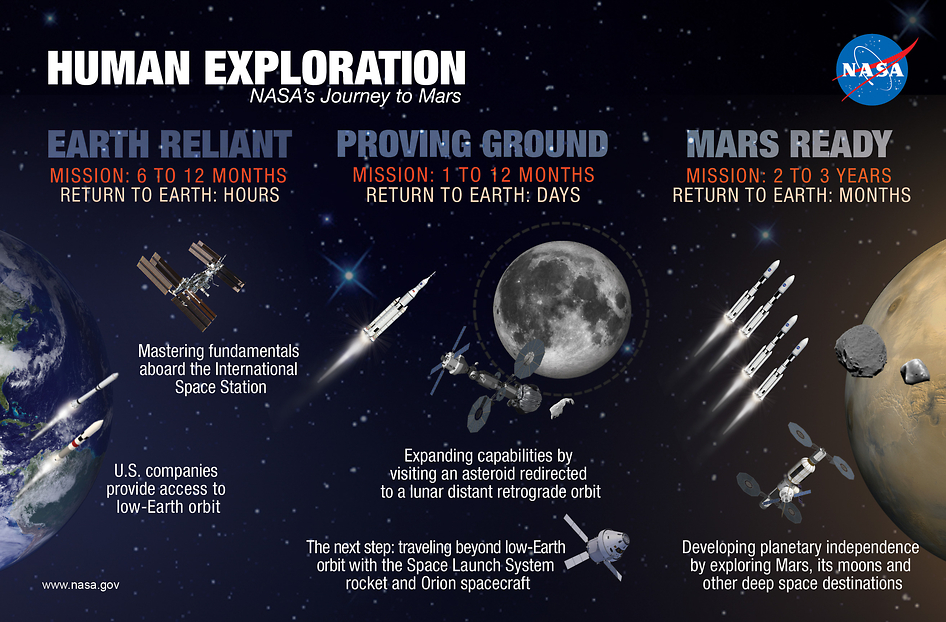
On the other hand NASA’s ambitions to go to Mars with human crews seem far more practical although somewhat fantasy. With successful robot explorers orbiting or crawling on Mars’ surface, one wonders why humans are needed at all. NASA answers that in a document entitled, NASA’s Journey to Mars: Pioneering Next Steps in Space Exploration, where Mars is described as “the horizon goal for pioneering space…the next tangible frontier for expanding human presence.” What NASA wants to learn are it describes as some of humanity’s most fundamental questions and it believes humans need to be present for the answers. These questions are:
I would argue that question #1 doesn’t require our human presence whatsoever. A succession of robotic landers can drill and scoop and test for years to let us know. The same is true for questions #3 and 4. We don’t need to put living humans on Mars to get answers to these queries. So it really comes down to question #2 and our own human drive to explore in person. For that reason alone NASA has laid out a plan that is ambitious and thorough.
The first step is getting there while surviving the conditions, distance and time needed for the trip. Then once we are there it is about surviving on the surface of the planet for the duration of the mission. And then there’s the long voyage home. This is complicated stuff and NASA believes it has a handle on all of it, whether it’s existing technology, or concepts that have yet to be turned into engineering solutions.
NASA has been sharing its plans with the public and its latest outreach reveals how it intends to use the Orion spacecraft, the heavy-lift Space Launch System (SLS) and its experience in long-duration flight garnered from the International Space Station (ISS) to take the steps that will get humans to the Red Planet and back.
So as we conclude the year 2015 let’s look ahead as NASA describes how it will be done.
It all begins with Orion’s Exploration Mission 1 in 2018. This will be a flight without a human crew. Orion doesn’t need humans to fly because it can be completely controlled from Earth. On this three-week mission the spacecraft will fly past the Moon to a point about a half-million kilometers from Earth and then do a second Moon flyby before returning to Earth.

Mission 2 comes five years later in 2023 with a human crew of four aboard following the same route.
Mission 3 is three years later than that, in 2026. It will be preceded by an Asteroid Redirect Robotic Mission launched in 2020. That robotic spacecraft will grab a chunk of a Near-Earth asteroid and ferry it to a location in lunar space where the Mission 3 crew will rendezvous with it to gather samples for study.
Don’t ask for a timetable after 2026 because it doesn’t exist. As of this date a human presence on Mars is likely to happen sometime in the 2030s. There is much in theory that has to be turned into practical technology between now and then. Any trip to Mars and back with present propulsion technologies amounts to a venture lasting longer than an Earth year. And that doesn’t include the time spent on the Martian surface. As NASA sees it any human mission to Mars will last approximately 1,100 Earth days. That’s almost 3 years.
Today with our human spaceflight destination the ISS, we are totally Earth reliant. Other than a small test garden growing lettuce and a space toilet system that recycles wastewater to make it potable we have no means of keeping people alive in space without supplying them from our planet. We are about half-way through an experiment to see the impact of prolonged exposure to near-Earth space to two humans on board the ISS. If a mission to Mars takes 3 years we still have a lot to learn about how this will effect us.
NASA has set a goal for human presence in space without Earth reliance. An Earth-independent operation is critical to any Mars mission. The technological challenges can be categorized as:
NASA is pretty good so far in figuring out the transportation part. It has toyed with propulsion options that could dramatically shorten the time it takes to get to Mars and back. This alone would make habitation and human sustainability challenges easier to address.
Building a habitation that can address the hazards of space, that can be smart, reliable, and self-repairing remains a bit of a dream. The use of materials from space is one of the objectives of Orion’s Mission 3. Can we exploit the materials found in asteroids to help us with both habitation and human sustainability? After 2026 we will know more. And once we get to Mars what will be the nature of the habitations we construct there? How and with what will we construct them? Without technological answers to habitation we cannot address human sustainability. NASA talks about using the Proving Ground of the near-lunar space environment to address habitation and sustainability. Will it take a decade or more to perfect the technology? Will there be sufficient funding of this endeavour to ensure its success?
In November NASA announced it was accepting applications for the next generation of astronauts. Submissions will be accepted from December 14th to mid-February 2016. Those accepted will be announced in 2017. Work-related and academic experience needed – degrees in engineering and mathematics, biological or physical sciences, 3-years of related professional experience or 1,000 hours of jet flight experience. The astronauts selected in this recruitment drive will likely be the first human Martians. That is, of course, if all the technological challenges can be solved.

In the last two week the Mars One mission announced it had narrowed down to 100 finalists from the original 200,000 applicants. The press couldn’t help themselves jumping on this story. But another one was lurking in background.
It seems that Mars One is not really going anywhere. The reason, it has yet to be able to pay its contractors, Lockheed Martin and Surrey Satellite Technology, beyond creating conceptual plans for the preliminary robotic spacecraft and landers needed to set the stage for establishing a future human colony on the planet’s surface.
In July of last year I posted a blog about the issuing of a 56-page specification and requests for proposals for these two important first steps in the Mars One timeline. But since both Lockheed Martin and Surrey delivered on the RFP nothing further has happened. Based on mission timelines, see below, with the orbiter supposed to be sent to Mars in 2018, to build and deliver the spacecraft Mars One is running out of time.
Lockheed Martin intended to use the Phoenix mission design for the lander and maybe the orbiter can also be built using the technology and schematics from other Mars missions. But unless Mars One gets more sponsors or its crowdfunding efforts spectacularly improve it would seem that the 100 finalists and the eventual 24 final picks will have nowhere to go but Earth.
Of course the Mars One project has many detractors, one of which is not Elon Musk. He remains enthusiastic about helping Mars One achieve its goal of a permanent human colony on the Red Planet. But the technology to keep humans alive indefinitely on Mars still does not exist according to Massachusetts Institute of Technology graduate student study that concluded Mars One colonists would be dead within a few months either from starvation or from asphyxia as dangerous levels of gases accumulate in the planned surface habitats.
Bas Landsorp, Mars One chief executive and co-founder has yet to address the recent comments about no further progress on these precursor robotic missions, both necessary if the colonization attempt is to go ahead. Instead the public relations engine, remember that’s what he knows best, is at work hyping the colonist selection process. This is grossly unfair to those who will likely, should Mars One go ahead, be on display in a reality television drama that will witness their deaths.
As I have stated before, if humans are to colonize Mars we need first to develop the space survival skills in near Deep Space or on the lunar surface where rescue within a few days would be possible should something go wrong.
This is not the equivalent of the first European voyages to settle in North America and so many of those pioneers died shortly after arrival. They had air to breath and water to drink. And they even had other humans living nearby that could show them how to survive in their New World. And yet so many succumbed.
My questions for Landsorp are this:
What makes you think you can successfully carry off Mars One when you cannot even get the preliminary stuff done?
How will you feel if you try shortcuts, which is effectively what you are doing to get Mars One done on your timetable, and watch those you send die in the attempt?
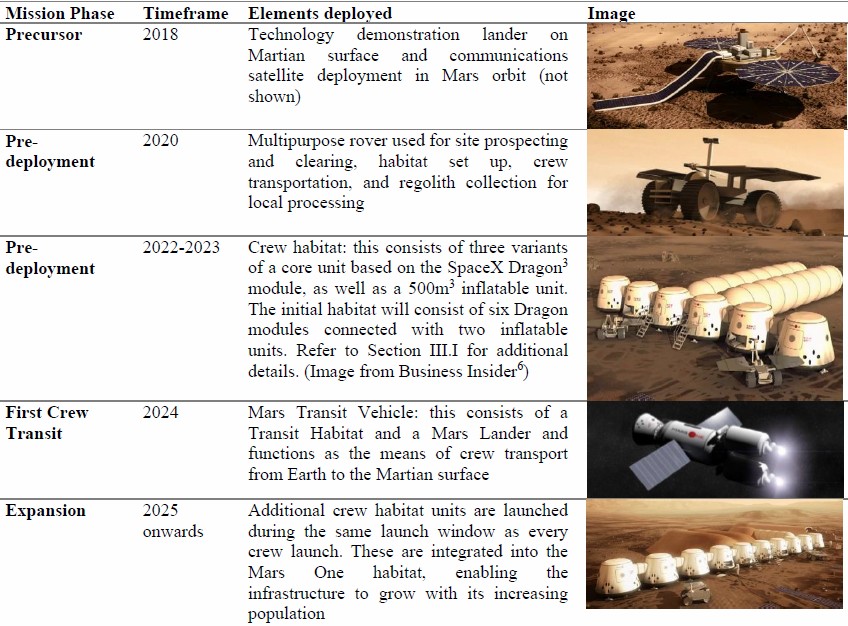
In my review of Mars One I have been a skeptic, questioning everything from the one-way journey, to the existence of proven technology to land the necessary equipment let alone human payloads on the surface, to the living accommodations and closed life-support infrastructure to maintain humans upon arrival, and to the long-term outlook for survival. In all these areas I have found Mars One to be wanting. And I’m not the only one. Students at Massachusetts Institute of Technology just published An independent Assessment of the Technical Feasibility of the Mars One Mission Plan. The author lead is Sydney Do, a doctoral student in aeronautics and astronautics. He and his four associates developed a simulation using state-of-the-art technologies and advances anticipated within the timetable Mars One has published. Their conclusion – a not very pretty ending for the first Mars’ colonists.
The MIT simulation reveals a number of crucial shortcomings in the Mars One plan including:
In the MIT report’s conclusions Mars One fails to meet conditions that would ensure those who are selected to go will have any chance of surviving over the long term. The lack of tested technology components required for sustaining life remain a significant impediment. The lack of sufficient understanding of closed-life support and experience with self-sustaining crop production technology will expose the colonists to extreme risks. And the logistics of the entire project understate the launch requirements, resupply needs and required redundancies necessary to ensure human survival. In other words, Mars One as staged and planned (see below), will be a reality show with a horrifying ending as the human colonists fail to survive.
Musk, in an interview on CNBC this week told viewers,
“I’m hopeful that the first people could be taken to Mars in 10 to 12 years, I think it’s certainly possible for that to occur…..but the thing that matters long term is to have a self-sustaining city on Mars, to make life multiplanetary.”
Musk is a huge supporter of the Mars One initiative and I am sure that his CNBC statement is in support of the aggressive timelines that this project has put forward.
I, for one, am highly skeptical about the current state of space technology and what will be needed to safely transit interplanetary space and land human colonists on Mars by 2026. But the chutzpanik Musk is mission driven. He has shown it in developing reusable launch vehicles. And he has shown it in unveiling recently the Dragon V 2.0 space capsule, also reusable.
When SpaceX rolls out the Falcon Heavy in 2015, a rocket launcher with payload delivery capacity equal to NASA’s old Saturn V rocket, he will have created the technology that could lead to the assembly of an interplanetary spaceship. NASA, Roscosmos and ESA will have nothing like this for several years.
So it is hard to ignore the chutzpanik Musk. He has built up SpaceX largely through launch contracts with NASA and today uses the current Dragon capsule and Falcon9 rocket to supply the crews on board the International Space Station. But he is also winning launch contracts with private companies and is in the running to have Dragon V 2.0 become the first American crew capsule to go back to near-Earth space within two years. In his musings about the future and Mars this week he even indicated that SpaceX may become a publicly traded company by the time of the first mission to the Red Planet.

]]>

For soil, NASA has provided the medium made from earth collected in Hawaii on the edge of volcanoes. The plants so far have thrived because we know the Hawaiian and Martian soils are similar containing phosphorus, iron and nitrogen. The experiment involved 14 different plant species over 50 days. The plants germinated and grew. Some even blossomed. So we know the soil is a suitable medium.
But it is what the pilot project cannot tell us that concerns anyone who would consider hopping on a one-way voyage to Mars. Here is a list of Mars challenges that any agricultural enterprise will have to address:
So how do we overcome these challenges?

It is clear that the life support systems needed on Mars will not only support a breathable environment for the colonists but also that for the plants as well. Today, however, we are more than a decade away from achieving such workable closed-system environments to test in near-Earth space, let alone on the Moon or Mars.
Our experiences here on Earth in places like Biosphere 2 have shown us just how challenging it is to build an ecologically-balanced bio-regenerative system. Biosphere 2 failed here on Earth but at least when it went wrong those inside were able to open a door and leave. That opportunity will not be one to which Mars One colonists can avail themselves. And consider that the ambitious departure date for the first Mars One colonists is tentatively set for 2024 with arrival on the planet early in 2025, even the researchers at Wageningen admit a decade may not be enough time to perfect reliable life support systems that can grow food to sustain human settlement.
A symposium entitled Genetics, Biomedicine, and the Human Experience in Space, was recently held at Harvard Medical School. The premise of the discussion was the role genetics could play in the successful conquest of space by our species. Could genetics alter us to withstand cosmic rays bombardment or long-duration exposure to micro-gravity? Could we alter our muscles and skeletons, change our diurnal circadian rhythm to match that of a different world, make our bodies handle greater extremes of heat and cold, and develop respiratory systems that function in low-oxygen or even the absence of free oxygen environments?
Those at the symposium looked at our human genome seeking factors as of yet unknown that could be unleashed to alter us to thrive off this world. What genetic triggers could we pull to make us absorb oxygen from an atmosphere largely composed of carbon dioxide? What genes could make our bones, muscles, and circulatory system accommodate low gravity environments.
On Mars, gravity is 38% of that found here on Earth. That means our existing bodies would be tricked into thinking we have too much blood in circulation because it would be more evenly distributed throughout our bodies. Our blood pressure would be uniform from head to toe. Our heads would swell. And of course bones would thin in low gravity and with muscles not having to work as hard we would see them atrophy. All this is okay if no Martian human plans to return to Earth which is the idea behind Mars One, a one way trip.
But what else can we do genetically to make humans adapt to Mars? Could we make it possible for humans to live outside pressurized environments? Could we be altered biologically to withstand the low pressure (equivalent to Earth’s atmosphere at 30,000 meters altitude)? Could we be designed to adapt to severe swings in temperature with nocturnal cold unlike anything here on Earth? Since the Martian environment doesn’t take kindly to free-flowing water let alone a thin-skinned creature like us largely composed of water, could we alter our skin to make it less porous and increase its thermal insulating capability? Or will we always have to wear protective, pressurized gear should we choose to live on Mars?
Could we through nanotechnology change the way humans absorb oxygen, making it possible for us to extract it from an atmosphere, virtually 100% carbon dioxide? Could we incorporate nanobots to alter our metabolic processes so that our cellular structure can withstand anything Mars throws at us?
In an article written in 2007, called Our Biotech Future, Freeman Dyson, speculated on a future where humans are altered through biotechnology. His world of 2050 is far different from the one of today. Is he right?
Ultimately for humanity to spread outward from this, our home planet, we have two choices. Bring Earth along for the ride, or change ourselves to adapt to the environments we encounter such as Mars. The Mars One project plans to do the former. But for future human colonization scientists like the ones who met last month at Harvard, are speculating about a very different course of action – altering us!

If Mars One is to succeed it will need a reliable technology that addresses this challenge. Currently SpaceX is working on controlled descent and landing with its Grasshopper test flights. That program successfully ended but at best the Grasshopper effected a controlled descent in Earth’s much thicker atmosphere, and did it from just over 600 meters (2,000 feet). In the coming weeks SpaceX will test controlled descent of a first stage Falcon 9 in its next Dragon supply mission to the International Space Station. If perfected SpaceX may have an answer for Earth descent but they will have to think about how this translates to the thinner atmosphere of the Martian environment where retrorockets alone are not the answer.

NASA, too, is working on developing heavy payload descent capability for robotic and future human missions to Mars. The parachute and Sky Crane method used to land the Mars Space Lab, Curiosity, is not viable for landing astronauts along with heavy supporting payloads. Even for the next planned mission, Mars 2020, a bigger and heavier robot than Curiosity, NASA needs a next generation atmospheric drag and descent technology. As a result they are starting to test one called the Low Density Supersonic Decelerator or LDSD. Testing of sub-components began in 2012 and will continue through to 2015.
Part of the challenge in landing on Mars is the deceleration from supersonic to subsonic speeds in a targeted controlled descent. Mars is neither the Moon, nor the Earth. On the Moon there is no atmosphere to speak of. On Earth the atmosphere is thick. But on Mars it is somewhere in between. Rocket descent as done by the LEM in the Apollo missions would not work on Mars. And parachutes deployed to create drag on Mars descents have been the biggest ever created by NASA because that thin atmosphere requires them. Where a team of parachutes slowed the Apollo crew capsule to an ocean landing, those parachutes could not handle a similar payload on Mars. That’s why Spirit and Opportunity used airbags to land and Curiosity used the rocket-powered Sky Crane.
So what can be deployed to ensure a safe landing on the Martian surface? NASA hopes LDSD is the answer. It is a combination of technologies. First there is a 30.5 meter (100 feet) in diameter supersonic ring sail parachute. The parachute used by Curiosity was half that size. The descent modules, two are being tested, are much larger as well, one at 6 meters (just under 20 feet), and the other 8.5 meters (almost 28 feet) in diameter. In comparison Apollo’s crew capsule had a diameter of 3.91 meters (12 feet, 10 inches). The descent modules are undergoing supersonic testing in Earth’s atmosphere over this next year and by then NASA should have a good handle on what future payload weights are possible. Current capacity is 1.5 tons. LDSD is being designed to double that.

The combined parachute and descent modules are also being built to allow for landings in a wider range of elevations on Mars. Currently landings are limited to low altitudes to take advantage of maximum atmospheric drag. But LDSD may make it possible to land at elevations on Mars that are 2 to 3 kilometers (1.2 to 1.8 miles) above low lying areas. And the LDSD will also improve landing accuracy from a margin of 10 kilometers (6 miles) to one of 3 kilometers (1.8 miles).
Now think about Mars One and its ambitions to land a crew of four on the surface of the planet. NASA hopes to have landing capacity of 3 tons. Take those 4 Mars One passengers and all their gear and life support systems as well as some supplies just in case not everything on the Martian surface is in full operation for them upon arrival and you have very little if any spare payload weight.
Full high altitude testing of the LDSD begins this summer. The plan for the first flight is shown in the illustration below.


