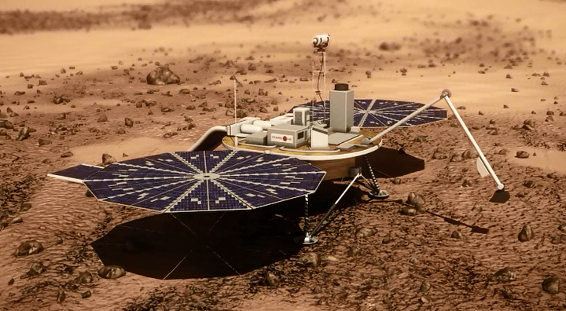
Lockheed-Martin, contracted to design the spacecraft. are planning to use their successful Phoenix Lander design which NASA landed on Mars in May of 2008. Phoenix provided us here on Earth the first daily Martian weather reports during its five months of operation.
What types of experiments is Mars One putting on board? The following are considered essential:
The rest of the on board experiments will come from those who win the RFP (Request for Proposal). One will be selected from university entries. If you are interested in submitting an idea then visit the Mars One University Competition. Two will be selected from contributors who will pay Mars One to put their payload on board. This latter competition is open to any number of types of proposals from experiments to technology demonstrations to marketing promotions.
The image below shows the configuration and location of the four confirmed plus four potential payloads that will be on board. Note the sample acquisition area from which the robotic arm will perform on board experiments.

Lest you think Mars One isn’t serious the details provided in the 56-page specification document deal with the design of the Lander base, its thermal insulation, and the operational characteristics and limits for each payload component. For those already confirmed such as the water extraction experiment, the specification includes a thermally regulated enclosure that allows the experiment to remain optimal even when the Lander’s solar panels are shutdown during the cold of Martian night.
Another specification related to the soil sampler has it placed as close to the edge of the lander’s main deck so that the on board robotic arm can easily feed retrieved samples into it from the surface. And of course the camera module which will deploy a mast upon landing will be there to provide stereo imagery for all relevant payload experiments including soil sample retrieval.
Of course all of this will only happen if Mars One successfully raises money through sponsorship and partners. So far Lockheed-Martin and Surrey Satellite Technology are on board as contract suppliers. But I don’t know if they are doing this work “pro bono.” The rest of the organizations and companies listed at the Mars One website include “silver sponsors,” of which there are eight, “science and education partners,” of which there is one, and “contributors,” of which there are thirty. This latter group is not representative of the “who’s who” in space. Many are media companies.
Elon Musk, founder of SpaceX, talks about Mars One and colonizing the planet. But it remains unclear whether Musk plans to provide the rocket technology to serve the Mars One series of missions. For a timeline on the planned missions visit my previous roadmap posting.