Here on Earth, helicopter’s gain altitude as the blades push against an atmosphere that is a one hundred times denser than that which is found on Mars. So you can’t use helicopter designs that work here to fly there. NASA has described what they have invented as a proof of concept and purely a demonstration of what is possible in the future.
The plan is to limit flights to 90 seconds or less, distances of 300 meters (980 feet) or less, and initially at elevations of 3 to 5 meters (approximately 10 to 15 feet). The distance limit is largely determined by the onboard 350-watt lithium-ion batteries which are recharged using the onboard solar panel. If successful in these early flights, the helicopter may exceed the height limit in later flights reaching as much as 100 meters (330 feet) in altitude.
Any attempt to control the helicopter from Earth in real-time would be impossible. The signal latency between 4 and 14 minutes in sending commands from Earth to Mars makes it imperative that the helicopter fly autonomously. It has no science instrumentation on board but does include a number of sensors to orient it during takeoff, flight, and landing. At all times it will stay in communication with Perseverance.
The plan is to release the helicopter after Perseverance arrives on Mars and then begin a series of short-hop tests over 30 Martian days. The first flight will be next spring and will be 20 to 30 seconds in length and will only involve hovering a meter or so above the surface. If successful, the plan is for at least four flights during the 30 days. If successful you can bet that NASA will build robot helicopters for future missions to the Red Planet.
The mission is one of the few at NASA this is sticking to schedule largely because the optimal launch window this summer between July 17th and August 5th, if missed will mean a wait of two years before the two planets align properly for the next attempt.
Perseverance should reach the Martian surface next February. It won’t be long thereafter before the helicopter takes flight proving that we have the technological capacity to fly on Mars.
We can only hope, we have a similar capacity to control and beat down the pandemic here on Earth and get through the next four months until the launch date.

The technology has more than proven itself and thus the Mars 2020 rover is largely a carbon copy. We are two years out from launch and finalized instrumentation includes some enhancements to Curiosity instrumentation as well as some new experiments. Here is a list of finalists that NASA recently published:
Yesterday NASA and the European Space Agency (ESA) announced where the Mars 2020 will do its exploring. The site is Jezero Crater, a 50-kilometer-wide geological feature with some intriguing features. Satellite images reveal the crater bottom once featured a large lake fed by a stream that actually cut through the rim and formed a delta. It is believed that the existence of the stream and lake date back over 3.5 billion years ago when Mars was warmer and wetter. It is the existence of the delta that has scientists excited. States Ken Farley, NASA’s project scientist for Mars 2020, “A delta is extremely good at preserving bio-signatures – any evidence of life that might have existed in the lake water, or at the interface of the sediment and the lake water, or possibly things that lived in the headwaters region that were swept in by the river and deposited in the delta.”

The Mars 2020 will at some point be given a name that is less formal. Curiosity’s formal name, the Mars Science Laboratory or MSL, has little cachet with the public so it is likely the new rover will get its own memorable iconic name. I would love to see it named Discovery or Endeavor.
Let’s hope that NASA doesn’t hold a naming contest leading to something ridiculous such as Boaty McBoatface, the name given to a UK research vessel after a the science ministry in that country held an online public poll.
Mars 2020’s tentative launch will be from Earth in the July-August 2020 period with the landing scheduled for mid-February 2021. An interesting addition to this mission is the gathering and caching of rock samples to be stored until a future mission to Jezero can collect them for a return to Earth. That mission has yet to be announced and will likely not happen until the late 2020s or early 2030s.
Meanwhile, there is another mission to Mars about to rendezvous and land on the planet. InSight is an acronym for Interior Exploration using Seismic Investigations, Geodesy and Heat Transport. The lander today is five days away from touchdown. NASA is broadcasting the landing live. The landing site is Elysium Planitia, about 3 degrees north of the Martian equator. Not a rover, InSight has instrumentation designed to study the Martian interior. Included in its science package are:
And then there is ExoMars 2020, an ESA six-wheeled rover planned for a 2020 launch as well. ExoMars will be powered by solar energy and state-of-the-art batteries unlike Mars 2020 (using plutonium-238). Its Pasteur instrumentation package is designed to analyze the planet’s geochemistry as well as detect exobiology. ExoMars will feature autonomous navigation so that Earth-based scientists can designate target destinations and let the rover pick the safest route using onboard digitally-created maps from its stereo navigation and collision-avoidance cameras. ExoMars will feature an articulated assembly to allow each wheel to drive independently and lift the main body of the rover to adjust its height to deal with local terrain obstacles. It should make an admirable companion to Mars 2020, Curiosity, and the InSight lander, helping scientists to reveal more Martian secrets.
]]>
NASA calls this In-Situ Resource Utilization (ISRU) and it is seen as the way forward for humans to become Deep Space inhabitants. It is not that NASA hasn’t been working on ISRU technologies over several decades (see the MOXIE O2 extraction technology that will be tested on the Mars 2020 rover), but rather that the agency sees in commercial partnerships a parallel track to innovation. After all, the agency has invested billions of dollars in the Space Launch System (SLS) a rocket designed to launch large payloads and human-crewed spacecraft into cislunar space and beyond. Meanwhile, NASA has encouraged and significantly funded initiatives by Boeing, SpaceX, Lockheed-Martin, Orbital ATK, Blue Origin, Sierra Nevada, Bigelow Aerospace, Virgin Galactic and others in supporting the International Space Station and low-Earth orbit (LEO) missions.
Whether it is budget constraints or driven by the desire to create a commercial space industry, NASA, through its NextStep initiatives, is creating significant commercial opportunities to make a future for humans in space that is Earth independent.
The current programs, the Evolvable Mars Campaign, the crewed missions to cislunar space in the 2020s, or the crewed missions planned to go to the vicinity of Mars in the 2030s, the common requirement involves harvesting essentials including O2 for breathing, methane (CH4) and hydrogen (H) for propulsion, and H2O, all coming from Deep Space involving resource extraction from asteroids, lunar regolith and Martian materials. ISRU technology projects that NASA wants to encourage, therefore, will include collecting and converting of space resources into products that help reduce large payload launches from Earth.
In the case of Mars, ISRU technology being sought will harvest from the CO2 in Mars’ atmosphere and from Martian icy soils, the H2O and O2 vital to human crews. In addition, any Mars mission will need to extract and store 30 metric tons of O2 and CH4 propellant for a Martian ascent vehicle. To create the 30 tons will require processing 20 tons of CO2 and 16 tons of H2O. And any ISRU technology built for such a mission will need to have multiple redundancies to ensure if something fails there will be sufficient overcapacity.
For the Moon, asteroid and Mars vicinity missions where crews would visit the Martian moons, Phobos and Deimos, the ISRU technology needed will have to extract from regolith an metric ton of O2 annually for life support, H2O in sufficient quantity for life support, and up 14 to 50 tons of O2 and H2 for each mission.
The timetable to create these ISRU technologies is short if NASA is to meet its milestone objectives. Development of critical components will have to be completed within the next three years. Design and testing of these components are scheduled for two years thereafter. Final integration of all of the elements is expected to take another three years. So we are talking about having in place the necessary fully-tested technology by 2025 for the first cislunar missions.
NASA is holding an Industry Forum on December 11, 2017, and has set January 22, 2018, as the deadline for notices of intent from industry partners planning to propose ISRU solutions. Final proposals are due on March 5, 2018. Eligibility requirements are not restricted to U.S. companies, universities or non-profits. Foreign companies and institutions can also file notices of intent to participate.

]]>
Mars 2020 would be more intelligent than Curiosity, able to make its own decisions on where to go across the surface of the planet. It would target rocks formed in Mars’ past that showed signs of biosignatures, that is, past microbial life. It would also study Martian geology to better understand the past Martian climate while assessing that in the present. And its oxygen harvesting effort would prove that future missions to Mars would not have to carry a surplus of resources for life support as well as fuel. With oxygen harvesting, future human missions would have the means to be self-reliant in these two important areas.
Having established the objectives for Mars 2020, the next step involved figuring out where to go. Originally eight sites were picked as candidates. But at a February 8, 2017, meeting the eight were cut down to three. One of the following sites will be determined the winner.


The new nickname for Mars 2020 is Odyssey. Named after one of Homer’s two epic poems, this robot lander may finally answer the question, “does life exist elsewhere in the Universe?” It is not the first time on going to Mars that we have posed it and tried to get an answer. The Viking landers‘ experiments back in 1976 had some of the scientists at NASA convinced they had discovered chemical organics, the proof of past or present life on the planet. But since Viking, no repeat test has been done. The year 2020 may finally give us that proof.


ExoMars is a program with more than one mission (see image above). First an orbiter is scheduled for launch in 2016. The rover is to follow two years later. The latter’s mission focus is the search for life both past and present, the study of water and other geochemistry in the Martian environment, and atmospheric investigations looking at trace gases such as methane and sources. The 2016 orbiter is also designed to study the atmosphere and may even help pinpoint methane sources that the rover, arriving a few years later, can investigate.
The Mars 2020 mission, which announced its instrumentation package in the last week, is built on proven Sky Crane descent technology (see picture below) and Curiosity performing to meet expectation. NASA has no intention to alter any of what has proven to be a very successful design. Only material improvements are planned based on observed weathering effects from more than two years of wandering through the varied terrain at Gale Crater. The biggest change will be in wheel design and composition. Curiosity’s wheels made of thin aluminum sheeting have taken a beating from what has been described as “sharper-than-expected” rocks encountered on the crater bottom.

NASA finalized the package of instrumentation that Mars 2020 will carry. Seven have been chosen from 58 competitors. Among the many firsts include a zoom camera, an oxygen extraction system that will harvest the gas from carbon dioxide, ground penetrating radar capable of looking a half-kilometer below the surface, and a rock and dirt sample collector with on board storage. The plan is for a future mission to retrieve these samples.
The zoom camera should allow Mars 2020 to navigate the Martian terrain more quickly than Curiosity because the rover will be able to view and calculate hazard avoidance with less involvement of an Earthbound support team.
The remaining instrumentation on Mars 2020 includes a weather station to provide daily bulletins, an X-spectrometer and ultraviolet laser to do high resolution studies of Martian rocks, and a camera designed to look for organic compounds.
The Mars 2020 and ExoMars landing sites have yet to be chosen. What if both choose the same landing site? Will we see a war of the rovers?
Yet to be determined – a landing site. This is critical for sample collection. Sites where we have evidence of water will be preferred. There are a number of craters and valleys on Mars that are on the short list.
This rover won’t be limited to probing, grinding and analyzing the planet surface. It won’t be limited to looking for evidence of free flowing water in Mars past. Some 58 teams of scientists have submitted instrumentation and experiment proposals to put on board. NASA will begin shortening that list sometime in the summer before making final selections. One potential experiment package may repeat the tests of the original Viking landers in search of the chemistry of life that may still inhabit the planet in microbial form.
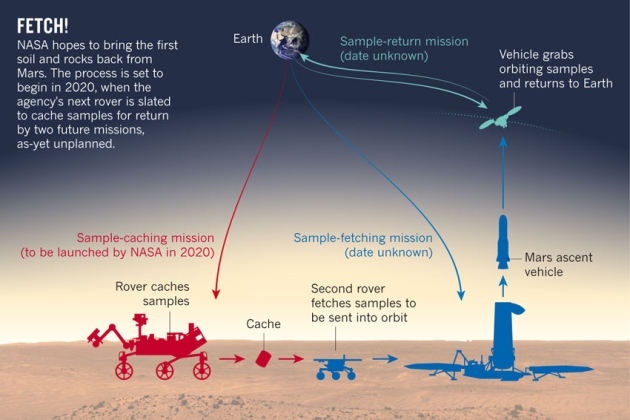
And this rover will be designed to collect samples and cache them for a return trip to Earth. The current plan involves sampling and storing 30 cylinders containing rock and soil. A second rocket with a rover would be dispatched from Earth to pick up the samples and then lift off from Mars on a return voyage to Earth. Upon returning it would enter into low-Earth orbit where it would rendezvous with another spacecraft which would then re-enter the atmosphere with samples on board.
The accompanying NASA illustration gives you a good idea of just what will be involved. As you can see this is a complicated robotic mission and hence six years doesn’t seem like an excessive timeline for planning.