Entitled “The Health and Climate Impacts of Carbon Capture and Direct Air Capture,” researcher, Mark Z. Jacobson, Professor of Civil and Environmental Engineering and a Senior Fellow at Stanford Woods Institute for the Environment, Stanford University, analyzes carbon capture, storage, and reuse, including direct air carbon capture, and argues that the technologies may do more harm than good by putting more non-carbon pollutants into the air.
Jacobson studied two existing carbon capture plants, one attached to a coal-fired thermal power plant, and the other pulling carbon dioxide (CO2) directly from the air. Starting with the industry assumption of efficiencies of 85 to 90% for carbon capture technology, he compared those aforementioned numbers with actual net efficiency and found when averaged over 20 years would amount to 10 to 11% at both facilities. The sites in question received energy input from natural-gas-powered sources which offset the CO2 capture efficiencies of both. Jacobson then looked at using renewable energy like wind power as an alternative source to power the carbon capture technology and over 20 years found only a nominal efficiency improvement.
In his paper, Jacobson argues that a better investment than carbon capture would be a wind farm stating, “Not only does carbon capture hardly work at existing plants, but there’s no way it can actually improve to be better than replacing coal or gas with wind or solar directly…The latter will always be better, no matter what, in terms of the social cost. You can’t just ignore health costs or climate costs.” He further states there is “no net social benefit” in using carbon capture technology, and in fact, when the equipment is powered by natural gas it “causes more damage than does doing nothing at all.”
Jacobson second argument is even more compelling. He notes that carbon capture technology “does not capture health-affecting air pollutants.” In fact, when attached to coal-fired power plants air pollution emissions continue to have negative impacts on health and social costs. That’s because CO2 isn’t the only greenhouse gas (GHG) these plants produce. So equipment only treating CO2 and not the sulfur and nitrous oxides commonly associated with the smokestack output of these facilities does nothing for people with asthma, chronic respiratory, and other debilitating illnesses impacted by bad air.
In the past, energy companies balked at the cost of building carbon capture technology linked to existing power plants and fossil fuel extraction operations. So many joint ventures between government and these businesses failed to complete projects because of the enormous investment required. In Canada, the Saskatchewan Boundary Dam Project, and Quest were the only two to survive the cuts and today are removing several million tons of CO2 from getting into the atmosphere. A third operating CCS project is the Sleipner Statoil project, the first in the world and operating since 1996.
As for capturing CO2 from the air, Carbon Engineering, a Canadian company, has been successfully operating a pilot project in Squamish, British Columbia since 2015 and will soon have a second facility in Texas associated with an Occidental Petroleum site. Backed by Bill Gates and oil sands magnate, Murray Edwards, this is one of only a handful of working or planned projects of this type. The Texas project is expected to capture a half-million tons of CO2 annually with expansion plans to grow to one million tons.
Meanwhile, the numbers for CCS projects to-date remain small with only 21 in operation or under construction around the world. And although the industry association for these nascent technologies describes them as capable of removing almost 100% of the CO2 from large-scale point sources including refineries, power plants, cement factories, and steel mills, Jacobson’s data calls those claims into question.
Social cost is a combination of investment in equipment, plus health, plus climate cost. He states that the social cost of coal with CCS or CCUS, when powered by natural gas for energy input, would be 24% higher over 20 years, and 19% higher over a century than coal without carbon capture. In other words, there would be no net social benefit. And even if wind or another renewable energy source were used to power the carbon capture technology, the social costs would still be higher by 6% in 20 years, and 2% over 100 years. In other words, even wind plus carbon capture would not justify an investment considering the minimal social cost gain.
Why has this come to light now after billions have already been spent on carbon capture research and development?
Jacobson cites:
Jacobson also notes that the problem of CCS and CCUS technology deepens when the fate of the captured CO2 is considered. Consider these scenarios:
The strongest argument for CO2 capture from ambient air would occur once humans stopped using fossil fuels. Then the reduction in CO2 would be possible without incurring any social cost. But one could argue that wouldn’t natural carbon sequestration be equally if not more effective and less costly than the technology?
To me and to Jacobson, the only argument that justifies investments in carbon capture technology is if we continue to extract and burn fossil fuels. That may explain why so many fossil fuel companies have recently re-entered the carbon capture business. I consider this equivalent to Philip Morris, the tobacco company making investments in cancer prevention therapy, making money at both ends of the cigarette business lifecycle without consideration of the social cost.

Jacobson’s energy mix includes wind, concentrated solar (molten salt heated by solar mirrors), photovoltaics, geothermal, tidal and wave, and hydroelectricity. No coal fired power plants. No natural gas plants. and no nuclear.
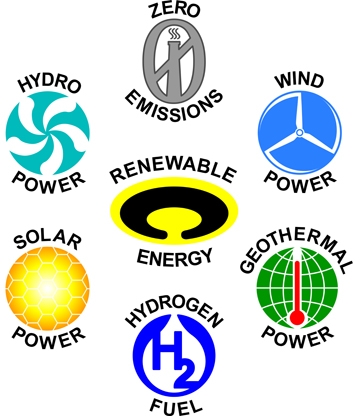
To meet a world powered completely by sustainable renewable energy we would use approximately 1% of the total Earth’s surface, an area approximately the size of the Canadian province of Quebec.
What would be in the mix?
These renewable sources would produce 17 trillion watts in total.
Jacobson recently provided an alternative energy future plan to Governor Andrew Cuomo of New York State in which he laid out a plan to achieve 100% renewable energy by 2030. He lays out ideas for legislation and policies that New York could use to achieve such a goal. He also provides detailed costs over a 17 year period and shows shows the reduction in carbon emissions that would result as coal, natural gas and other fossil fuel energy power plants go offline. For New York to switch to renewable energy sources for electricity would mean ending an almost 100% dependence on imported oil, coal and gas. In the proposed energy mix 40% would come from local wind power, 38% from local solar and the balance from a combination of hydroelectric, geothermal, tidal and wave energy.
Jacobson’s plan looks at transportation as well. By 2030 all vehicles would be electric or powered by hydrogen-fuel cells. Homes would be retrofitted to use geothermal heat pumps and heat exchangers rather than natural gas and oil for heating and air conditioning. Solar water heaters would be in common use. And industry would switch as well to rely on geothermal, hydrogen, solar and a mix of on and off-grid energy sources.
The plan also includes a comprehensive smart grid management system to smooth out variability from renewable power sources, the chief concern in moving away from a reliance on coal, natural gas and oil-fired power plants. These smart grid system would time match industry and residential power requirements with output from the renewable energy mix to meet peaks and valleys that occur with daily and seasonal energy demand.
I have often stated in previous postings on energy that we need vision and leadership and the equivalent effort of a number of Manhattan Projects to globally reduce our carbon footprint.
Jacobson along with other environmental engineers are providing with the road map we need to implement. What will it take? Governments that have the resolve to enact policy to make rooftop photovoltaic and other renewable systems mandatory for any new housing or redevelopment projects.And of course we need the commercial sector to put creative hats on and come up with marketable solutions that make renewable energy a zero-sum game for industry and household use. Some companies are stepping up as are some governments. Jacobson and his team have recently been asked to create similar plans for California and Washington.
]]>