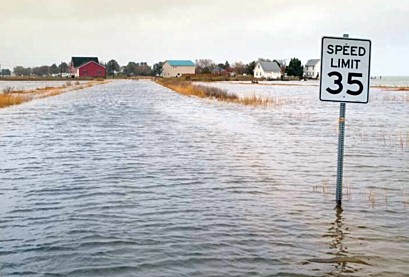
To reduce such impacts the U.S. is looking at whether to rebuild in place, shore up coastal defences, or relocate communities, assets and people to take them out of harm’s way in what is being called a “managed retreat.”
When it comes to disaster planning, the U.S. government is a laggard at almost every level. Little attention is paid to prevention, pre-disaster planning and adaptation. The issue of retreating from the country’s coastlines is seen by many as a defeat rather than as a responsible act of self-preservation.
The Gulf of Mexico shoreline, despite increasing environmental threats, has witnessed a population increase over the last 50 years. The coastline is increasingly being gentrified. Property values have steadily risen. High-rise condominium construction in many communities is replacing low-rise businesses and housing.
The Gulf coastline features older communities with history and established relationships with the flora and fauna of the area. The accumulated knowledge and expertise of locals and their understanding of the Gulf and its characteristics are being lost when these communities get uprooted. The demographic of these communities is not high-income. Much of the population lacks access to significant financial resources if faced with climate disasters. Also, these populations are inclined to be more culturally attached to their locations making it harder to convince them of the need to retreat.
Relocating and resettling involves more than the physical act of moving. It requires planning, cooperation, problem-solving, and coordination. In some cases, towns that get uprooted will become part of an existing community, or they may situate themselves where no town currently exists. Either way, infrastructure and institutional capacity will be needed to ensure essential services such as housing, water treatment and water supply, power and fuel distribution, broadband, education, health services, employment, and transportation are either in place or will be created. To date, in the United States and in many other countries where rising sea levels will negatively impact coastal communities, there is neither planning nor funding for population relocation.
In 2022, the White House launched a Subcommittee of its National Climate Task Force involving FEMA and the Department of the Interior to support moving Americans away from high-risk regions. Funding for voluntary relocation amounting to $111 million was made available to 11 indigenous communities impacted by wildfire and drought, and Alaskan coastal communities inundated by Pacific extreme weather events. This could be the model for future relocation programs, or a one-off.
Back in 2018, I wrote about how two coastal communities in the U.S. were coping with ocean inundation. Norfolk, Virginia was one. The other was Del Mar, California.
Norfolk’s plans involved abandoning areas that would flood as sea levels rise and fortifying other areas requiring new construction to be elevated one metre above a 100-year flood line. Norfolk is a good example of towns and cities along the Atlantic Ocean seaboard where it is expected to see rising sea levels displace millions by century’s end causing social disruption and negative economic consequences amounting to hundreds of billions of dollars.
Del Mar has a plan to manage its retreat from the Pacific ahead of rising seas beginning with 600 homes within a few years, all in danger of vanishing into the Pacific. The city’s retreat includes eliminating seawalls, roads, and other infrastructure using a risk model to help make choices. A buy-back program and other forms of financial are being put in place.
Del Mar is a fairly wealthy community, but coastal towns by the Gulf of Mexico are anything but, particularly many in Louisiana. There, funding for buy-back programs will likely exceed the capacity of the communities being affected. Even state and federal government assistance may be insufficient to cover the loss of property and relocation costs. Then add in mental health costs from uprooting people from places where they have lived for centuries. Medical resources will have to be beefed up to deal with the fallout.
]]>Take Norfolk, Virginia as a prime example. The seas have been rising here for several decades, in fact, more than 15 centimeters (6 inches) since 1992. That’s twice the global average. And research indicates that the rise is accelerating.
There is a reason why Norfolk is seeing higher water than average along its shores because:
Norfolk until recently allowed building on floodplain lands, in old creek beds and along the low-lying edges of the Elizabeth, Lafayette and Nansemond Rivers which flow through and around much of the city. Much of the city is built on land that lies within a meter of sea level today. Currently, tidal flooding inundates 56 kilometers (35 miles) of roads regularly. Should sea level rise three times higher than it has in the last two decades, the flooding would inundate 166 kilometers (104 miles). Six times higher than in the last two decades and inundation increases to 430 kilometers (269 miles).
In yesterday’s Washington Post, Jim Morrison has written an article entitled, “Climate Change Turns the Tide on Waterfront Living,” with a subtitle, “Rising seas and worsening flooding are forcing many communities to plan their retreat from the coasts.” Morrison spoke with George Homewood, the city’s planning director who talked about whether the city should continue to try and maintain roadways inundated constantly by high tides and storms, or should it begin its retreat from the ocean’s edge.
Right now the city is building storm surge barriers and floodwalls. The Norfolk Naval Station has its own sea walls rising to protect what is the largest and oldest U.S. naval installation on the Atlantic coast. But the billions being spent to hold back global warming’s impact on the Eastern Seaboard is becoming a money pit. What the city needs to do is begin a managed retreat.
The alternative, the fortification of America’s Eastern Seaboard will cost U.S. cities trillions of dollars over the next half-century. It’s not just the building of seawalls. It means rebuilding ports, storm and wastewater infrastructure, freshwater management systems, roads, bridges, and, of course, buildings and homes. There isn’t enough money to go around to achieve this, let alone, money to repair what gets built and rebuilt after extreme weather events like hurricanes and storm surges.
What’s counterintuitive in the story of America’s Eastern Seaboard is the way real estate values for oceanfront properties don’t reflect the precarious nature of these investments. An ocean view, a property right at the edge of the beach, fetches top dollar in the real estate market. Yet it is increasingly at risk of being inundated within decades. And property valued at top dollar comes with premium property taxes which fund coastal cities and towns. When ratepayers of these properties start complaining about rising water, the cities and towns listen. So they invest in building temporary fixes, raising a seawall a meter here, and adding a berm and levee here and there to put the rising waters on hold.
In Morrison’s article, he puts some numbers to the problem.
What’s involved in a managed retreat?
Morrison in talks with homeowners in Norfolk describes their lack of concern about the rising of the ocean that they look out on every day. One was incredulous to think that the city would move to higher ground when his taxes were paying for Norfolk to keep the water from causing his home to be inundated. As a taxpayer, he was incredulous noting that what happens decades from now is too far in the future to worry about. That homeowner valued his property at a half-million dollars, and his flood insurance annual premium cost $500.