
Get on one of these new elevators and it plans the route to your destination when you tell it where you need to go. It goes up, moves to the left or the right and arrives. Today most engineers will tell you that the limit of vertical height in buildings has more to do with its elevators than any other factor. Known in the industry as the “rope,” conventional elevators are defined by the length of the cable that suspends them. That distance amounts to about 500 meters (1,640 feet). And a single elevator with a conventional “rope” carrying 24 passengers, will consume 130,000 Kilowatt hours of energy per year and weigh up to 27,000 kilograms (almost 60,000 pounds).
The Multi is not constrained by the “rope.” It uses linear motors, rails, and magnets, and a fraction of the energy needed by conventional elevator systems. When an elevator cab arrives at a floor the rails can rotate to move sideways and then rotate back to the vertical. The first commercial building to have a Multi installed will be the East Side Tower in Berlin developed by OVG Real Estate.
The biggest advantage of the technology for future architects is the flexibility the Multi brings to building design. The constraints of a vertical shaft are no longer there. Buildings can be taller and geometrically more imaginative in design than ever.

The biggest drawback, however, is the cost. A building that installs a Multi elevator system will spend as much as five times more than the elevator technology that is still based on Otis’ original invention.

Fifty-five years with so many advances in our knowledge, but very little in the way of advancement in the way we send humans and payloads into space. Because we continue to rely on chemical-based propulsion systems to climb out of the gravity well that is Earth. What if there were another way to get off the planet? What, if instead of putting the propulsion system at the tail end of the payload we want to launch we remove it entirely?
In past blog entries we have talked about the future of rocketry with heavy launch systems, nuclear rockets, solar sails, plasma engines, and other propulsion technologies. Heavy launch whether Ariane, NASA’s Space Launch System, Space X Falcon Heavy, or Russia’s Angara are all chemical-based. The others are technologies that cannot get us off the ground into space but are choices we can make once out of the Earth’s atmosphere.
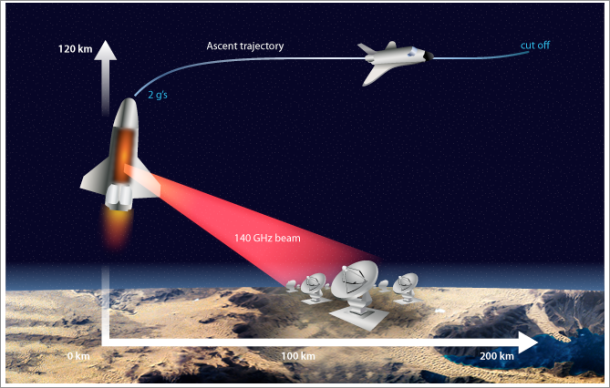
Currently we have seen the development of hybrid launch technologies for sub-orbital flights. Virgin Galactic is a good example with its White Knight and SpaceShipOne mated configuration. But engineers and scientists have proposed other alternatives as well. These include:

Today we launch satellites from locations at relatively low elevations. The Baikonur Cosmodrome sits 90 meters above sea level. Cape Canaveral sits on the edge of the Atlantic Ocean. The Guiana Space Center is another coastal site from which the European Space Agency launches its satellites. Jiuquan, where China launches its human space flight program sits 1,000 meters (3,300 feet) above sea level. Spaceport America, Virgin Galactic’s new commercial launch site sits 1,400 meters (4.595 feet) above sea level. To minimize the gravity well I wonder why we are not launching rockets from locations at much higher elevations. One could argue the top of mountains would be most suitable. And a mountain top near the Equator would prove to be ideal. Some engineers have suggested that launching from a mountain top would not only dramatically cut down on chemical rocket fuel requirements it would also limit the amount of stress the rocket would experience as it ascends. Current rockets throttle back during ascent to avoid structural damage from air resistance. This is referred to as Max Q or maximum dynamic pressure. In thinner air this would go away. It was during throttle up after passing through Max Q that the Space Shuttle Challenger in 1986 exploded.

As we experience the next 55 years in space it is clear that we will need to change the technology we currently use to make space more accessible from Earth and far more affordable. Advanced chemical-based launch systems may continue to get large payloads into near-Earth space but as the century unfolds where we go will depend on us changing this paradigm. Only then will space become an experience not for just a select few.
]]>Today our rockets use kerosene, hydrogen or solid combustible fuels combined with oxidizers to get off the Earth and into space. Given an unlimited amount of fuel on board these rockets can provide continuous acceleration but unlimited is impossible. So we always try to lighten the load when flying to space to keep the size of the rocket within reason. Our biggest rockets, Proton, Energia, Saturn, Titan, and Ariane-5 are monsters in size, weighing millions of kilograms. To achieve Earth orbit these rockets have had to carry enough fuel and oxidizer on board to reach speeds of 28,157 kilometers (17,500 miles) per hour. To escape Earth’s gravity the rockets have had to go at least 10,000 kilometers (6,200 miles) per hour faster. And to escape the gravitational pull of the Sun, our rockets have needed to attain speeds of 59,000 kilometers (approximately 36,500 miles) per hour. The way we have accomplished missions to-date has involved launching multi-stage rockets with the first stage containing the most fuel getting us out of the lower Earth atmosphere, a second stage getting us to Earth orbit and a third giving us the means to achieve lunar, interplanetary or solar trajectories. When we have had to go further we have used other planetary bodies to give our spacecraft a gravity assist. Venus and Jupiter have often played a part in accelerating spacecraft to achieve velocities that exceed 100,000 kilometers (62,000 miles) per hour or more.
To economize on the massive amounts of fuel we have needed we have had to keep our payloads very small. When we have sent humans into space they have gone up in modules as small as a shower stall with barely enough room for one let alone many travellers. We have had to shrink the electronics and economize on consumables making space faring a more than risky enterprise. It is downright dangerous. When we add distances beyond low-Earth orbit we compound the risk for any human crew aboard a spacecraft. If our destination is the Moon, approximately 380,000 kilometers (238,000 miles) our travel time is measured in a few days. We have successfully done this in the Apollo Program. But a destination like Mars, closest at 57 million kilometers (36 million miles), it would take our conventional rockets months to get there and get back and that means human space flight becomes problematic.
That’s why we need to look at alternative technologies for powering spacecraft while in space. And to help get more baggage up there to ensure our human spacefarers have enough food, water, oxygen and consumables on board we have to develop a substitute for the rocket technologies we currently use at launch. That means driving down the cost per kilogram of materials we send into space.
So let’s take a look at what is currently available, and what may be able to see on the horizon in the 21st century.
Current Alternatives to Getting Spacecraft into Low Earth Orbit
Airborne Launches
We launch our human payloads today on ground-based rockets. What if we launched from in the air? That’s the idea behind SpaceShipOne (seen below under the belly of its mother ship), the reusable suborbital ship, developed by Scaled Composites, that won the Ansari X Prize in 2004.

A larger version, SpaceShipTwo, will begin commercial suborbital flights within the next two years. But SpaceShipTwo is aimed at suborbital space tourism and not at launching large payloads into low-Earth orbit.
The developers of SpaceShipOne and Two are working with anther commercial operator, Stratolaunch Systems, with its plan to build a carrier aircraft that can be mated to rocket systems for launching payloads and humans into low-Earth orbit from the stratosphere. Stratolaunch plans include the disassembly of two Boeing-747-400 aircraft and then the combining of the two to create a stable airborne launch platform with an orbital mission range of over 2,000 kilometers (1,300 miles) .

Talk about floating an idea, airships as space launch platforms offer an alternative method of getting humans and payloads into low-Earth orbit. Airships can achieve higher release altitudes than jets ascending to elevations of 40 kilometers (25 miles). JP Aerospace, a California company, hopes to create a permanently manned station in the upper atmosphere that can be visited by cargo and passenger airships, a way station on the edge of space.

Rail Gun Launches
Today we have Mag-Lev trains. Why not use this technology for launching very large payloads and human crews into low-Earth orbit? The Startram Project hopes to do just that using taking existing Mag-Lev technology and building a Maglifter to reduce the cost of sending materials and humans into low-Earth orbit.
A Maglifter launch vehicle would run on an electromagnetic rail just like those used in Mag-Lev trains. The rail would be built on the side of a mountain or later as a free-standing structure supported by cables just like a suspension bridge.
There are two proposed alternatives for using Mag-Lev. In the first the launch vehicle, carried on a launch sled would reach speeds of 1,000 kilometers (620 miles) per hour before the launch vehicle with payload and rocket on board would ignite to accelerate to escape velocity.
In the second the track would be housed in a tethered vacuum tunnel to minimize heat stress on the launch vehicle and to absorb the shock waves created when the Mag-Lev would accelerate to hypersonic speeds of 9 kilometers (5.6 miles) per second sufficient to attain low-Earth orbit.

This type of technology has the potential of dramatically reducing payload costs from thousands to a few dollars per kilo making travel to and from outer space much cheaper to support and making it possible for many more humans to get into space.
Space Elevators
In the 19th century a Russian scientist speculated about building a “Celestial Castle” located in geosynchronous orbit around Earth and tethered to an Earth-bound castle. The scientist was Konstantin Tsiolkovsky, the father of Russian space science. The idea was further expounded upon by a Soviet engineer, Yuri Artsutanov, who wrote a non-technical article in 1960 describing a tethered satellite permanently fixed in space that would lift payloads into space at a fraction of the cost of rockets. Arthur C. Clarke, the noted science fiction writer popularized the idea later in one of his stories, “The Fountains of Paradise” in 1978.
Is a space elevator possible or just fantasy?

So all of the technologies described above exist for us to consider. We can begin to build these alternatives to chemical rockets. This can be done through private enterprise and through private-public partnerships, for it is the partnership model that has led to the success of SpaceX in this last week, an encouraging new approach to the conquest of space.
Finally, once we drive down the cost of getting materials and humans into space we will then be in a position to build the infrastructure in low-Earth orbit that will lead to the creation of faster transportation technologies to get us to more remote destinations in reasonable amounts of time. We will explore that subject in our next installment on space in the 21st century.
As always your questions, comments and ideas are welcome.
]]>