Those ideas have ebbed as the commercialization of outer space is taking hold first in the United States, and now in other nascent space programs in other countries. In particular, a number of private companies have become competitors to national space agencies and their previous monopoly in outer space. Space to be used for the benefit of all mankind, as first proposed in the 1960s, has now added a bottom line.
In 2015 the United States Congress passed legislation giving commercial companies the right to appropriate resources from space. Two laws, the Space Resource Exploration and Utilization Act, and the Commercial Space Launch Competitiveness Act, give American companies the right to exploit space resources including the mining and harvesting of minerals and water from the Moon, asteroids, and planets. The only exemption is the biology discovered. The latter of the two acts specifically states, “A U.S. citizen engaged in commercial recovery of an asteroid resource or a space resource shall be entitled to any asteroid resource or space resource obtained, including to possess, own, transport, use, and sell it according to applicable law, including U.S. international obligations.”
These laws reverse the American commitment to the Moon treaty of 1979 which forbade countries from exploiting our nearest space neighbour as well as planets and asteroids until an international agreement on common use was enacted. It would appear an international agreement is no longer likely, particularly in light of the rise of private companies focused on commercial space development. From commercial satellites in near-Earth to geostationary orbits around our planet, to robot miners of asteroids, it is not such a dramatic leap.
So it should be no surprise that America’s abandonment of space inviolability is being joined by others of which the first is the Grand Duchy of Luxembourg, the European Union’s tiniest member. This week Luxembourg enacted a new law with Article 1 stating, “Space resources are capable of being appropriated.” Responsibility for issuing permits comes from Ministries in charge of economic development and space activities. They are authorized to issue permits to any person requesting the right to explore and “use space resources for commercial purposes.” Rights will be granted to public companies, corporate partnerships, and private limited liability companies registered in Luxembourg.
One of those registered Luxembourg companies is Planetary Resources, founded in 2009. The government, along with the Société Nationale de Crédit et d’Investissement, a Luxembourg bank, has made a 12 million Euros investment and extended a 13 million Euros grant to this American company that now has its European headquarters in Luxembourg. Established in 2009, Planetary Resources describes asteroids as the resource that will “unlock the Solar System’s economy.”
The company intends to utilize space resources, particularly near-Earth asteroids, described as the “low-hanging fruit” of the Solar System. The focus will be on harvesting water and platinum. Water is seen as a space game changer for human presence in space. It can be drunk. It can serve as shielding for space habitations. In its molecular components, hydrogen can be exploited for fuel, while oxygen for life support.
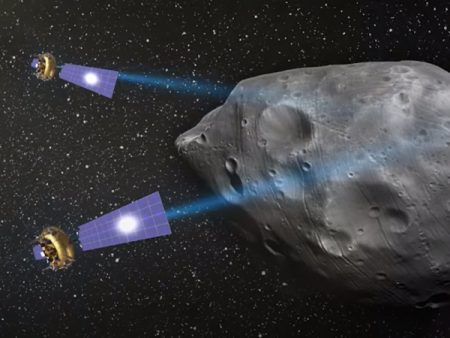
Planetary Resources is sending out robotic explorers to identify asteroids rich in minerals, particularly platinum, which on Earth is found at asteroid impact sites or is a product of volcanic eruptions. Platinum has many uses here on Earth and creating an almost unlimited supply will spur an era of innovation in advanced manufacturing.
So it would seem that Luxembourg’s new space appropriation law serves the country well. After all, they are creating a law to protect their investment.
]]>
Deep Space Industries‘ (DSI) launch of Prospector-X (see infographic below) will test out all systems to ensure that the sequel, Prospector-1, succeeds as the first space mining mission to an asteroid.

States Grant Bonin, chief engineer, “DSI is developing Prospector-1 both for its own asteroid mining ambitions, as well as to bring an extremely low-cost, yet high-performance exploration capability to the market. We hope to enable both existing and new public and private organizations to explore the inner solar system using this affordable platform.”
DSI is a California company with roots in NASA’s Ames Research Laboratory. Recently it entered into partnership with the nation of Luxembourg who through the Spaceresources.lu initiative have established a European equivalent to the American commercial space act. The goal is to give Europe the ability to create a space-based economy using in situ space resources.
DSI isn’t the only company with which Luxembourg is working. A similar understanding has been entered into with Planetary Resources, a rival to DSI in the race to mine asteroids.
What is novel about DSI’s technology?
Prospector-1 weighs less than 50 kilograms (110 pounds) when fueled so it doesn’t require a powerful booster rocket to get it to orbit and beyond. It also uses a water propulsion system called Comet (TM) that generates thrust by expelling heated water vapour. Comet is an electrothermal micro-propulsion thruster that can be incorporated into a wide range of spacecraft. The advantage of this propulsion technology is that it can harvest water from the asteroids it visits and refuel.

As its name suggests the Prospector-1 is an exploration spacecraft designed to assess a target for its resource value. It has on board an optical navigation system, visible and mid-wave infrared camera, a scanning antenna and star tracker for deep space navigation and communication, and a triple array of solar panels. It is capable of studying an asteroid in detail, able to assess its resource content including locating water ice to a depth of one meter (3.3 feet) below the surface regolith. Once Prospector-1 successfully maps the asteroid it will touchdown on the surface with its instrumented landing legs testing the geological characteristics of the surface.
The follow up mission is a mining robotic spacecraft which will upon rendezvous and contact with the asteroid begin the process of harvesting water ice for fuel and other materials of value for return to Earth orbit. Once back the mining spacecraft will rendezvous with a harvester in orbit which will perform material separation. Materials from these missions will be used to build a space manufacturing capacity capable of fabricating structures impossible to launch and assemble from Earth. These mega-structures will become the home of humans in Deep Space. Other structures will be sent to the Moon or Mars where they will serve to make us an interplanetary species.

]]>