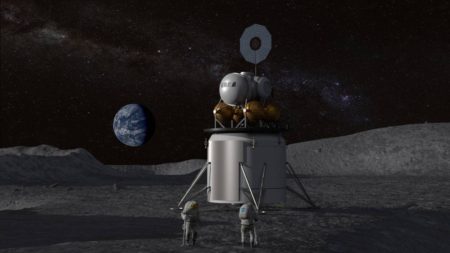
Artemis is following in the footsteps of the 1960s Apollo Program with design concepts similar to that program, with one exception, NASA has added the Lunar Gateway, a waystation or mini International Space Station (ISS) in cislunar space that could serve a number of purposes.
The original voyage to the Moon involved the Saturn V rocket, Apollo Command and Service Module, and a Lunar Excursion Module (LEM) with a descent and ascent stage. The Command and Service Module remained in lunar orbit with the detached LEM descending to the surface and then returning to orbit and rendezvous.
The justification of the Lunar Gateway has many arguing for it. The idea of a permanent mini-ISS well beyond Earth orbit has its proponents who see it as a place to practice deeper space science, a way to study long-term human exposure beyond low-Earth orbit (something we have yet to do), and as a resupply and assembly centre for missions to the Moon and beyond to the asteroids and Mars. These are all very justifiable reasons for building and maintaining the Gateway for Artemis and other future tasks.
Then there is the military aspect of building the Gateway. If it were solely a United States project (which it appears it is not since Canada, Japan, and the European Space Agency appear to be very much involved) then occupying the high ground of space for America’s Space Force would have strategic appeal. Sitting some 320,000 kilometers (200,000 miles) above the Earth would give the American military a view from the planet’s surface to all satellites in orbit.
But there are others who are detractors who see the Gateway as a make-work project for U.S. space and defense contractors, throwing billion-dollar bones to companies already feeding at NASA’s tranche of funding from the U.S. Congress. To-date NASA has received less than $500 million for the Gateway project and the Artemis back to the Moon deadline of 2024 is less than five years away. Congress will have to authorize many billions of dollars more for the entire program and that doesn’t seem to be on the minds of most in Washington, D.C.
The Boeing proposal to build a lunar lander brings up further questions about the need for a Lunar Gateway. The lander proposed goes by the name Human Lander System or HLS. Boeing would use its rocket, the Space Launch System (SLS), to deliver the HLS in a single launch to lunar orbit and then down to the surface and back. Boeing calls it the “Fewest Steps to the Moon” approach to minimize mission complexity and create the most direct path to a successful landing. Boeing noted that the HLS could dock with the Gateway or directly with the Orion Command Module (the successor to the Apollo Command Module). It is this latter ability that makes the Gateway appear redundant.
Should SLS continue to be the funding boondoggle it appears to be and should continue to fail to meet milestones, then Boeing’s proposal will prove to be unfeasible. For SpaceX and Blue Origin, who both have launch capacity either in planning or already built that could achieve a return to the Moon agenda, the failure of Boeing would not necessarily end the idea of fewer steps which would eliminate the Gateway. SpaceX’s Starship wouldn’t need the Gateway or a Lander. And Blue Origin’s New Glenn rocket and Blue Moon lunar lander can likely achieve the same without a Gateway.
So why the Gateway has become a NASA must-have?
It has its roots in an idea first proposed by Werner von Braun, the brain behind America’s space program. Von Braun shared the idea of the Gateway with an American television audience back in 1955 in a Disney-produced series on the human exploration of space. At the time viewers saw animations of low-Earth and lunar-orbiting space stations permanently inhabited, and passenger shuttles traveling between the two and coming from Earth to the Moon and back. Von Braun’s imagination took the television audience on a journey that went even beyond the Moon anticipating a future voyage to Mars and the other planets of the Solar System. There must have been a lot of nascent NASA-bound youth watching the program because it appears that Disney Musketeers are now driving the future vision of NASA. Artemis is the first step. And recently NASA talked about human missions to Mars by the mid 2030s. Much of this agenda appears driven by NASA Administrator, Jim Bridenstine, a political appointee of Donald Trump, who has no engineering or space science background.
What can I say? “Little boys and their dreams” are driving the NASA agenda these days down roads that may not need to be traveled, nor money needlessly spent.

]]>
First on the agenda is to develop the Lunar Gateway, a mini version of the International Space Station (ISS) to be located in close proximity to the Moon from which human crews can descend and return to and from the lunar surface.
In 1969 Grumman Aircraft, a Long Island, New York-based company was the builder of the Lunar Excursion Module (LEM), a one-time use vehicle that combined a descent and ascent stage and pressurized cabin with life support systems for the astronauts. The cost of each LEM worked out to around $150 million USD a pop and 9 flew on missions equaling a total cost of $1.35 billion. The LEM contract was awarded in 1963 and it was six years before the first made it to space.
So two announcements about NASA’s future Moon project, now called Artemis, caught my eye in the last couple of weeks.
First, it was the Trump administration’s request to Congress to top up the NASA budget by an additional $1.6 billion for the current year. I wondered just how far that money would go to meet the new Moon mission. Remember the entire LEM build was costed in 1960s US dollars, not based on the current dollar’s purchasing power. I would imagine $1.6 billion isn’t going to pay for much today.
Then the second announcement involving a $45.5 million contract from NASA to 11 commercial partners begin preliminary work on lunar lander designs and prototypes seemed to me to be a pittance of what was needed for Artemis to begin. The 11 companies include the known suspects and a few outsiders. They are in alphabetical order:
The $45.5 million isn’t evenly divided among the 11 with some companies being asked to create prototypes for sub-systems, while others compete on designing main elements of a future lunar lander.
For example, Blue Origin, Boeing, Dynetics, Northrop Grumman, Lockheed Martin, Sierra Nevada, and SpaceX are all being asked to do descent stage prototypes and may the best one win. It is hard to tell if this is or is not being structured like one of NASA’s many prize contests which award money to one or more project teams when they develop innovative solutions the Agency deems necessary for the future of the space program. And even though $45.8 million is being offered the companies receiving the money have been asked to foot 20% of the total project costs. I don’t know if any other NASA contracts ask commercial providers to eat some of their costs specifying just how much.
And another thing, when Jim Bridenstine, NASA’s administrator, announced the new mission’s name, Artemis, the Greek goddess associated with the hunt and the Moon, he may have overlooked a legacy NASA mission also named ARTEMIS first launched as Themis-Artemis to study the Earth’s magnetosphere and the Moon’s interactions with the Sun. That ARTEMIS is an acronym for the Acceleration, Reconnection, Turbulence and Electrodynamics of the Moon’s Interaction with the Sun mission.
It is ongoing to this day studying how solar and cosmic radiation impacts the lunar surface in the absence of a protective magnetic field such as the one we have here on Earth. For humans landing, exploring, and living on the Moon, that ARTEMIS should help to determine what ways are needed to protect those who plan to arrive in 2024 on the other Artemis, the lunar lander.
I’ll forgive Jim Bridenstine for not having brushed up on NASA history. But didn’t anyone at the Agency not tell him that the name Artemis had already been taken?