“But I guess I’d say if it is just us… seems like an awful waste of space.”
Based on the number of Starlink satellites being launched each month since the end of last year, plus all the other space companies and government agencies launching satellites, that number has grown by hundreds more as of April 28, 2024, including both operational and non-operational satellites.
That means as of the writing date of this blog, there are at least 12,000 working satellites circling the Earth. Considering that the Space Age began 67 years ago with the launch of Sputnik 1, the skies have become very crowded above our planet with Arroway’s “waste of space” comment becoming less than applicable to our local corner of the Universe.
Some low-Earth orbits are getting crowded, and coveted geosynchronous orbiting slots are quickly disappearing. Defunct satellites in the thousands continue to circle the planet with the potential of these non-working artifacts becoming deadly moving pieces of space junk.
The space insurance industry is reporting record payouts on claims by satellite operators. In 2023, insurers collected US $557 million in premiums and paid out $995 million, a record loss. If this trend continues, insurers will either increase premiums or just get out of the space business.
Satellites are increasingly big and small business opportunities. As of today, 105 countries have at least one satellite in Earth orbit. When in 2010, futurists predicted the democratization of space, they weren’t wrong. The reason for their prognostications was fuelled by:
Since 2020, the vast majority of new satellites are coming in at weights below 600 kilograms (1,320 pounds). The Starlink, OneWeb, Project Kuiper and other telecommunication constellations are driving average weights down. The number of these is expected to grow by as much as 40,000 in the next decade.
And therein lies an enormous problem. Earlier this year NASA reported a near miss between one of its satellites and one from Russia. The two came within 10 metres (33 feet) of each other. This wasn’t an isolated event.
Since the mid-1980s when the space above our planet was far less crowded, there have been space collisions. That’s because many satellites placed in orbit are not built with manoeuvering capabilities. Many others no longer have any onboard fuel for maneuvering, and, finally, many have been put into space without a deorbit plan.
Current methods of monitoring satellites from Earth to avoid collisions remain a challenge. It continues to be a challenge to pinpoint the exact location or trajectory of non-operational satellites or space junk debris. According to Stefan Frey, CEO of Vyoma, a German space traffic management company, the average operator of low-Earth orbit satellites performs two collision avoidance maneuvers per satellite per year. Robert Sproles, the senior director of constellation planning and operations at Spire, a company that builds and operates hundreds of satellites, recently reported his company receives 12 daily close pass and near collision notifications from orbiting space junk and non-operational satellites.
About once a year, the ISS has had to alter its orbit to avoid a collision threat. A recent ISS routine maintenance extravehicular space walk by two Russian cosmonauts included the discarding of used equipment into space. In April, a Florida home was impacted by a discarded pallet of old battery packs from the ISS which proves that throwing out garbage in space has consequences just like it does here on Earth.
Deliberate acts of spacefaring nations have also contributed to space junk. In the mid-1980s both the United States and the Soviet Union tested anti-satellite missile technology. In 2007, China demonstrated this capability. And in 2022 a Russian anti-satellite weapon test struck a dead satellite and produced thousands of pieces of debris. Since 2022 collision risks have risen 50% for satellites deployed between 370 and 570 kilometres (230 and 350 miles) above the Earth because of that one test.
Today, the phrase “waste of space” needs to be turned around. We have a “space waste” problem which the Stuffin Space website adequately illustrates.
What are we doing about the space junk we create?
Considering the explosion in the current numbers of near-Earth satellites and what is being forecasted in the near term, developing the capacity to remove the garbage we leave in space cannot come soon enough.
Data from SpaceX on just how crowded low-Earth orbit is getting sheds light on this growing problem. The company recently reported to the U.S. Federal Communications Commission (FCC), that between June 1, 2023, and Nov. 30, 2023, Starlink Network satellites performed 24,410 collision avoidance maneuvers, an equivalent of six maneuvers per spacecraft.
]]>The list that follows includes past, current, and future launch systems in order of descending payload capacity. I may not have found all of them but this does give you a good idea of the past and current capacity of our planet to put things into orbit or Deep Space. Of the twenty-seven listed here, four are retired, and three are reusable. Also not included here are Stratolaunch Systems and Virgin Galactic, two companies that are in the process of completing air-launch systems capable of putting payloads into LEO.

But in treating the subject of space in the 21st century we need to look beyond the race to space, the Moon, and the planets, comets and asteroids of the Solar System. We need to understand what’s in it for us, why space and the technology we invent to explore it will be a driving force for innovation throughout the 21st century.
So how did we get started? It began with the Soviet Union and Sputnik-1, on October 4, 1957 and humanity has never looked back. Sputnik circled the Earth. We then launched many more satellites, some to spy on our neighbours, some to help us improve global communications, some to study the atmosphere, weather, our oceans, land use and more. What started as a two-nation duopoly in space has broadened to become a global adventure today. The United States and Russia have been joined by 48 other countries with satellites in orbit. Nine countries have launched satellites into near-Earth orbit. Six countries and Europe through the 18-member European Space Agency (ESA) have sent probes to explore Solar System neighbours. Business is getting into the act with the United States moving from a government-only contractor to a mixed economic model embracing for-profit companies working on sub-orbital and low-Earth orbit transportation systems.
In the articles that follow we look at the history of our outward urge, starting with the Moon and other nearby Solar System neighbours. We look at this from the perspective of technological accomplishments in achieving success beyond Earth orbit. In this immediate posting we focus on the Soviet Union’s contribution to escaping the bonds of Earth. They were the first to do it and it is a remarkable story.
The Technology to Leave Earth Orbit – The Soviet Union Came First
The launch of Luna-1 by the Soviet Union represented the first human-made object to escape Earth’s gravity.What did it take to send a satellite beyond Earth orbit? It meant developing a rocket capable of lifting a 361 kilogram (790 pound) object, Luna-1, into space traveling at a speed of 11.2 kilometers (7 miles) per second. That amounts to 40,234 kilometers (25,000 miles) per hour.
An augmented R-7 rocket, named Vostok, provided the launch capability. In an earlier blog we talked about the R-7 program, the most successful rocket launching system ever built. For the Soviets to turn it into an orbital escape booster they added a third-stage. This gave them capability to deliver 6-ton payloads into low-Earth orbit, and 1.5 ton payloads into trans-lunar trajectory. Luna-1 proved a remarkable achievement for technology in 1959, passing within 6,000 kilometers of the Moon before entering solar orbit. Its onboard instruments fed telemetry back to Earth providing measurements of our planet’s magnetic field.
A second 1959 triumph was Luna-2. It was the first probe to target and hit a non-Earth object, the lunar surface. The Soviets recognized that reaching the Moon required longer duration power systems to keep instrumentation working. In Luna-3, launched a month after Luna-2, they incorporated solar cell technology to supplement the onboard batteries. When Luna-3 reached the Moon it circled it and returned to pass by Earth. During this elongated orbit of both Earth and Moon its onboard camera photographed 70% of the Moon’s unseen side. The camera used standard 35 mm film. An onboard film laboratory developed the images which were then scanned by a television camera and transmitted using radio waves back to ground stations as the spacecraft approached Earth.
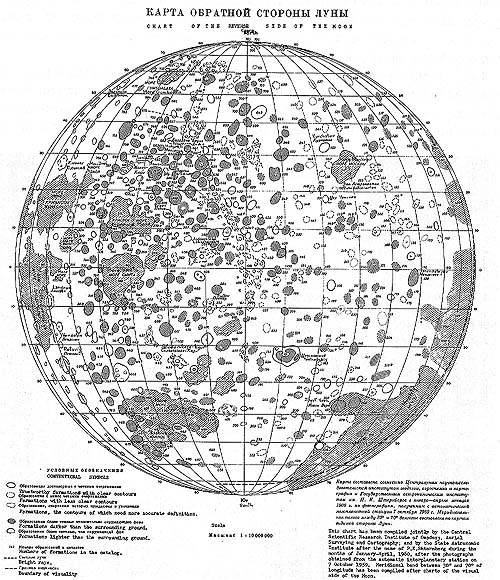
The Soviets Develop Robotic Systems for Planetary Exploration
Right from the start the Soviet Union made the Moon a target of its space program. When President Kennedy announced the Moon as the goal of the American space program in the 1960s he was abundantly aware of Soviet ambitions. The Soviets weren’t hiding anything. They had built heavy lift capacity in their rocket systems far more than needed for ballistic missiles. But the Soviets needed much more than big rockets if they were to succeed. Their shopping list included:
The Soviets mastered these skills but they came at great cost. In 1965 they made four failed attempts (Luna-5 through 8) to soft land Luna probes on the Moon. The technology included vernier rocket packs for controlled descent, nitrogen-bag inflation systems to cushion probes on impact, and instrumentation shielding to achieve ambient temperatures (19 and 30 degrees Celsius, 66 to 86 Fahrenheit)in a space vacuum. These technologies worked to perfection in January 1966 with Luna-9 making the first powered descent to the Moon’s surface. Luna-9 incorporated a panoramic television camera onboard capable of 360 degree coverage.

Two months after Luna-9, the Soviets once again proved they had mastered another technological accomplishment, successfully placing a satellite into lunar orbit. Luna-10 achieved this feat using its course correction engines to slow the spacecraft sufficiently for lunar orbit insertion. The battery-operated instrumentation package included gamma radiation, electric and magnetic field, micro-meteoroid, and solar wind detectors. After 57 days and 460 orbits the batteries finally ran out and the Moon’s first artificial satellite ceased transmissions.
In 1966 the Soviets followed with two more Luna orbiters, Luna-12 providing television transmissions of the lunar surface back to Earth and Luna-13, deploying a lander with a penetrometer to dig 45 centimeters (18 inches) into the Moon surface to study its soil properties.
Luna-16, launched in 1970, after the first two Apollo Moon landings, incorporated robotic systems for descent, sample collecting of lunar surface materials, ascent and then return to Earth. In 1970, Luna-17 delivered a robotic rover to the Moon’s surface, Lunokhod-1.
In 1973, Luna-21 delivered a more sophisticated robotic rover to the Moon’s surface, Lunokhod-2. This rover traveled 37 kilometers during its mission, transmitting more than 80,000 and conducting over 700 lunar soil tests.

The last Luna probe, Luna-24 landed on the Moon in 1976 where it proceeded to take a 2.5 meter lunar core sample and return it to Earth.
The Soviets in their lunar exploration activity created all the technologies needed for planetary exploration beyond the Moon.
What were the Americans doing in parallel? Read the next blog.
]]>