Developed in a joint venture between Britain and France, the Concorde first flew in 1969, the same year as the Apollo moon landing. But it wasn’t until 1976 that the first commercial flights began. The 2000 Air France crash caused by a Concorde hitting debris left on a Paris runway led to a flight hiatus. But Concorde did resume flying across the Atlantic and to destinations in the Middle and Far East, remaining an attractive option for transatlantic commercial passengers in a hurry.
Concorde wasn’t the only SST developed in the 1960s. The Soviet Union built the Tupolev Tu-144, nicknamed the Konkordski. Its first flight happened two months before Concorde but it was plagued with technical issues and safety concerns and after a little more than 100 flights was permanently grounded.
American airplane manufacturers like Boeing and Lockheed flirted with the idea of building an SST during this time but soon dropped out of the competition. With the Tupolev grounding, Concorde then became the fastest commercial passenger jet on the planet and the sole one in operation until 2003.
Why did Concorde flights end? Rising operational costs and the amount of air pollution it produced ended it. But these weren’t the aircraft’s only operational problems. The most limiting challenge was that when Concorde flew at heights of more than 15,000 metres (50,000 feet) it generated a downward sonic boom that could break windows and rattle homes on the ground. That meant overland flights were prohibited from going supersonic which meant no Concorde would be used on a New York to Los Angeles route. The SST was restricted to transoceanic routes where the sonic boom wasn’t perceived to be an issue. The speed of the aircraft at 2,170 kilometres per hour (kph) (1,350 miles per hour) was impressive cutting the time on flights between London and New York, and London and Paris to less than three hours. No commercial airborne technology since has matched those speeds with today’s fastest commercial passenger jets like the Boeing 747-8i attaining 1,136 kph (706 mph) and the Airbus 380, 1,020 kph (634 mph).
A decade after the last Concorde flight, in 2013, NASA began working with the U.S. Department of Defense on an SST successor. Ten years later with Lockheed Martin as a partner, a working design was developed for a low-boom SST. Low boom meant the aircraft would be at least 30% softer than the Concorde at supersonic speeds with its developers describing the sonic boom as no more than a gentle thump.
The prototype is called the X-59 QueSST and in its latest design features a long and very sharp nose with no surface interruptions to cause noise when the aircraft goes supersonic. There is no windshield or canopy. The external vision system is monitored by a pilot using cameras integrated into the fuselage (see image below).
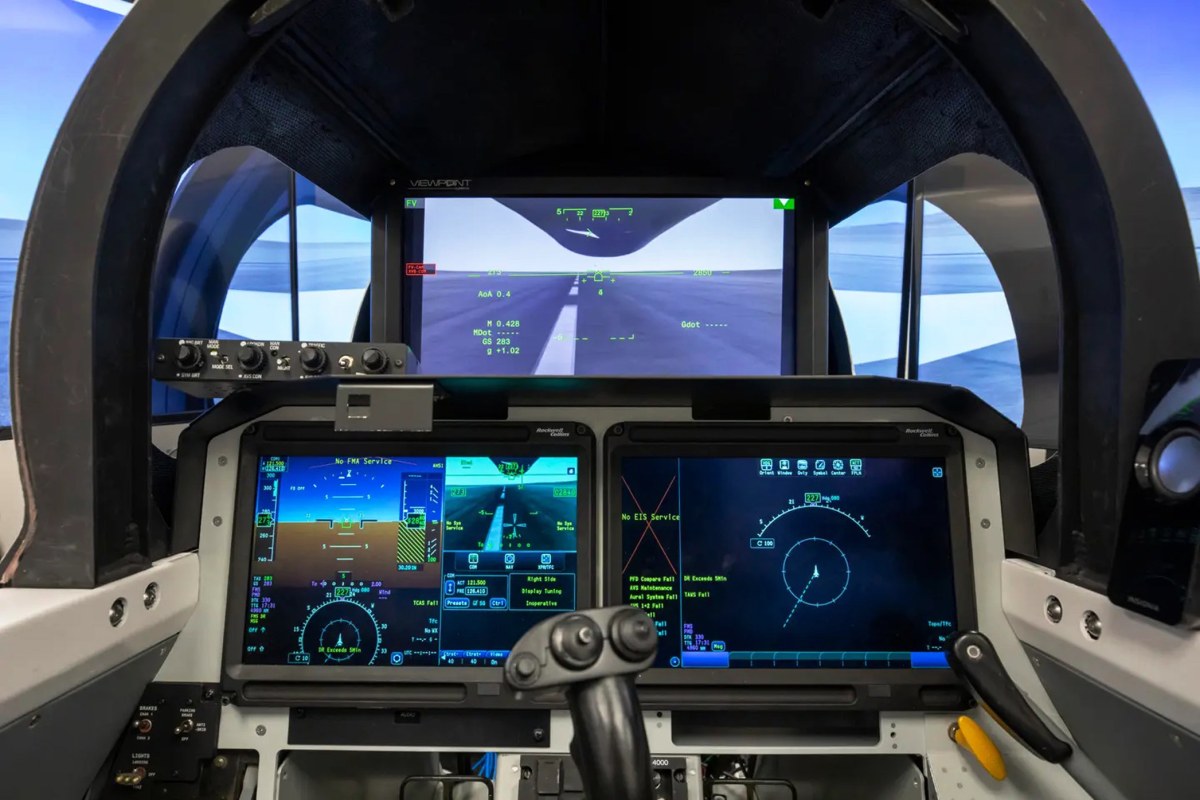
Sonic shockwaves go up rather than down because the jet engines are mounted on top. The cruising speed is 30% less than the Concorde with the X-59 attaining speeds of 1,488 kph (925 mph) which is still at least 25% faster than the fastest current commercial passenger jets.
When will the X-59 make its first test flights? The inaugural had been scheduled for December 2023 but it looks like it won’t be until early 2024 when the prototype flies. It will undergo multiple tests over urban and rural areas with teams on the ground assessing its low boom.
But the X-59 is not meant to be a commercial aircraft. It is only a prototype which becomes evident when you look at the image below where there is no evidence of a passenger cabin. Lockheed Martin, however, has plans to build a commercial version twice as long with room for 44 passengers.

How many more years will pass before we see successors to the Concorde flying out of commercial airports? I estimate it will not be earlier than 2030. But by then we may see the dawning of commercial passenger suborbital and orbital rocket flights and spaceports, a SpaceX dream. So will we need a Concorde successor?
]]>In a very Star Trekkian development, Lockheed Martin demonstrated DEIMOS, (Directed Energy Interceptor for Maneuver Short-Range) system. This 50 Kilowatt tactical laser will be mounted on the army’s Stryker combat vehicle for use against enemy drones, helicopters and other aircraft.
One cannot imagine a future when DEIMOS will spawn space-based lasers to make Marjorie Taylor Greene almost sound prophetic except the lasers will be Lockheed Martin and not Jewish.
Speaking of Jewish, Israel recently announced that its Iron Beam laser interception system had shot down a missile fired at the country. The cost per shot was US $3.50. A Patriot missile would have cost $4 million to knock out the enemy attacker.
It is the economics of laser weapon systems that makes this type of ordinance so attractive. At the moment various vendors like Lockheed Martin, and Raytheon are building 50 Kilowatt laser weapons. But there is no determining limit on the strength. The U.S. Department of Defense estimates a 100 Kilowatt laser could easily handle a drone, a small boat, a shell fired by artillery, and even a mortar. For a cruise missile, the estimate is a 300 Kilowatt laser, and for a ballistic missile or hypersonic weapon, a 1 Megawatt laser. Lockheed Martin is already testing a 300 Kilowatt version of DEIMOS.
The US Navy is looking at 100 Kilowatt versions of DEIMOS for its ships and looks like it will replace arming vessels with rail gun technology which now appears to be considered obsolete. Rail guns were high-speed ordinance systems designed to knock down incoming cruise missiles but when costs are compared the laser has the technology beat.
Lockheed Martin’s version performs in any atmospheric condition. Combined with target tracking radar the laser can be pointed at a target with precision even when travelling at hypersonic speeds.
DEIMOS is one of three types of beam weapons being developed by the military. It uses concentrated light to burn a target. The biggest disadvantage of the technology is the narrowness of the beam may damage a weapon by punching a hole in it, but it may not disable it.
DEIMOS has two cousins. The first is the particle-beam weapon which is more akin to what is seen in Star Trek. It can be deployed as a ray gun like the phaser. It can be mounted to serve as a cannon, but instead of shooting shells or cannonballs, it fires a high-energy ion beam. When you think of a particle beam picture the Large Hadron Collider and then shrink it down from 27 kilometres in length to a system as small as a battery on a naval ship or a handgun. When fired a particle-beam weapon emits high-speed streams of subatomic particles with enough kinetic force to damage anything they strike.
The second cousin of DEIMOS is a plasma weapon, one that uses magnets to concentrate ionized gasses and then hurl them at high speed at targets. Powerful magnets today are used in Tokamaks that contain high temperatures and dense plasmas in test fusion reactors.
In all three cases, whether laser, particle or plasma, the width and precision of the beam determine its effectiveness as a weapon.
]]>
If you are too young to remember how the LEM was designed, it included a descent module and ascent module. Astronauts decoupled from their Apollo mothership and descended to the lunar surface using the engines of the descent module. After exploring the surface they then left behind the descent module engine and its base, and using the rocket of the ascent module rose to rendezvous and reconnect with the Apollo Command Module. So, in effect, NASA wants to continue using a three-stage methodology for lunar activity.
Not SpaceX. Elon Musk’s company is building a two-stage rocketship. The first stage is called the Super Heavy. The second which is being prototyped will be the Starship. The prototype, that stainless steel stubby rocket being assembled in South Texas, is called the Starhopper. It is intended to be launched and landed extensively in 2019 to ensure it meets the expectations of the company, to produce a single-stage solution for landing on the Moon, or in the future, on Mars. SpaceX doesn’t need a lunar gateway in orbit to fulfill its plans to land on the Moon. Part of SpaceX plans includes a voyage around the Moon in 2023 by a space tourist and invited guests who will ride in the Starship. Then SpaceX may take the next step and land the Starship on the Moon and take off from there to return to Earth.
Meanwhile, NASA has announced what it refers to as an ambitious plan to get back to the lunar surface to stay. The timetable to build the lunar gateway has a completion date of 2024. Getting down to the surface will happen in 2026 or later. The official name of the gateway is the Lunar Orbital Platform-Gateway, or LOP-G, a 55-ton, multi-compartmented, modular space station (see image below) to act as an in lunar orbit habitat, maintenance hub, and launch platform to the lunar surface.
The first sections of LOP-G which will include power and propulsion are scheduled to be completed and deployed in 2022. The remaining modules including the habitat, airlock, and maintenance hub would be delivered by NASA’s super-heavy Space Launch System, the SLS, scheduled for its first flight in 2020, a three-week crewless mission to cislunar space and back. The SLS is years late and billions of dollars over budget. And being largely a throwaway rocket seems like a make-work project for a bunch of NASA contractors.
When you compare the two approaches, there is an elegance to what SpaceX has in mind. And as for the cost of what this commercial rocket company is proposing, much of the cost of development to-date is currently being borne through revenues earned from commercial and NASA launch contracts.
SpaceX may be overly ambitious in their timelines but you can bet the cost of delivery will be far less than what NASA, in its plans, is intending to build. And NASA hasn’t exactly executed meeting its deadlines on SLS, so why should we expect the organization to be any more successful in developing and delivering LOP-G, which at present, only exists on paper.
And here’s another tidbit of information which makes me suspicious of NASA’s plans. The LOP-G looks suspiciously like a May 2016 proposal made by Lockheed Martin called the Martian Orbiting Laboratory. Lockheed’s chief technologist for civil space exploration, Tony Antonelli, envisioned a deep space platform with a central-core cis-Martian habitat to circle the Red Planet and act as a launch platform for crewed missions to the surface. Lockheed didn’t put a price on what was being spitball proposed, but when you consider the cost of the International Space Station at $100 billion USD, it is likely that whatever NASA puts in lunar orbit will run into the tens of billions. And don’t be surprised if Lockheed Martin isn’t the principal contractor.
I would argue that there is a use for a permanent orbiting, or LaGrange-point located human habitat in the cislunar space. It is probably, over time, an essential waystation for human exploration and occupation of Deep Space. But there is less justification for it if a company like SpaceX can get human crews to the Moon and back with a single-stage solution, and do it at a fraction of the cost. If I were NASA I’d be putting my money on SpaceX and likely saving a bundle for American taxpayers.

Mars 2022 and 2024 – Elon Musk’s BFR Reveal
Musk’s new vision is code named BFR. He intends to build and launch the first two of these new rockets in 2022, followed by four heading for Mars in 2024. The first two would be cargo ships. The next four would be split between cargo and passengers.
In his previous proposal unveiled at a similar event in Guadalajara, Mexico in 2016, Musk described the Interplanetary Transport System, a 90-meter tall, reusable ship that would operate on a 26-month cycle between Earth and Mars, when the two planets were best aligned.
The challenge to this idea was its sheer scale, very ambitious, and very expensive. Musk, at the time, described a private-public partnership as the means by which his Mars vision could be realized.
But in this new iteration, he is going smaller and plans to use the resources of SpaceX and its reusability paradigm to achieve his Martian dream. Everything in SpaceX current inventory, Falcon 9, Falcon Heavy, and Dragon, can be repurposed to achieve his 2024 timeline, Musk states. The first ships would carry a complement of 100 on board. Musk envisions 40 cabins, a large common area, central storage, a galley, and solar storm shelter for its human occupants.
Musk also believes that the BFR concept could serve Earth travel as well. At his presentation, he described how the rocket could provide sub-orbital transportation between any two points on Earth in 30 to 60 minutes. With 100% reusability, multiple redundancies for safety, and the expertise already gained from SpaceX increasing successes, Musk argues that the cost to provide these services beyond the fuel requirement and regular maintenance of the vehicle and launch facility will be minimal, like flying on any commercial aircraft today.
The BFR project, as Musk describes it, doesn’t need the private-public partnership of his previous Mars’ vision. He stated that the revenue SpaceX receives today from its Earth satellite launches, as well as the sub-orbital transportation business he envisions will make more than enough money to make the Mars project viable.

Lockheed Martin’s Red Planet Base Camp Plans
The company, that along with Boeing, has been NASA’s primary commercial supplier, was also in Adelaide, presenting a different vision from that of Musk and SpaceX. Lockheed Martin has its own plan to send humans to Mars in the 2020s. Instead of hundreds, the company sees a crew of between four and six making the trip.
Called Mars Base Camp, it involves several steps.
Lockheed Martin claims to have all the technology at present needed to achieve the Base Camp mission which would utilize:

The company envisions a three-year mission where its human crews would largely never step foot on Mars but rather would orbit the planet. The crews would send robotic landers and rovers to the surface to explore potential landing sites, discover areas where resources could be exploited, and pick up samples for analysis back in orbit. In a white paper the company has prepared, it describes side visits by astronauts to the Martian moons, Phobos and Deimos. It also introduces a reusable lander, seen in the illustration below, which would be able to descend with a crew of four to the surface and return for refueling in orbit. The lander would have sufficient life-support on board for missions lasting up to two weeks away from the Base Camp.

Lockheed Martin doesn’t speculate on how its Mars Base Camp will be funded. It more than likely sees NASA and its international space program partners coming up with the cash. Its project is very much in the tradition of NASA, focused on science and exploration.
Musk founded SpaceX, on the other hand with a mission to make the human species multi-planetary. Musk wants to settle us on Mars and eventually terraform it to make it our second home.
In his presentation in Adelaide, he talked about the red skies and blue sunsets of Mars, the opposite of what we see here on Earth. You can feel his passion and the sense of urgency he brings to this vision, far different from that displayed in the promotional-style video that accompanied Lockheed Martin’s presentation.
Will either of these two projects ever happen?
We saw humans land on the Moon from 1969 to 1972. It’s 45 years later and no humans have ventured beyond Earth orbit. Musk, in his presentation, asked why there is no human lunar presence today, no research station in orbit or on the surface. It’s a fair question and one that many who lived through the Apollo landings continue to ask.
]]>
MPLMs were flown in the cargo bay of the now retired shuttles, and after the latter program ended the three that were developed were put on the shelf. Built for NASA by the Italian Space Agency, the three were aptly named Leonardo, Raffaello, and Donatello. The former two flew 12 missions between 2001 and 2011. Then Leonardo was adapted for use on the International Space Station. Raffaello was retired. And Donatello, which never flew sat in a NASA warehouse at the Kennedy Space Center in Florida. That is until recently when NASA contracted Lockheed Martin to build a space habitat prototype. Donatello was chosen.
Lockheed Martin has had a habitat on its drawing boards for years, and now it is getting the opportunity to make it a reality. Seen in the Space Station Processing Facility at the Kennedy Space Center, Donatello is being worked on today so that it can become the model for what eventually will become a permanent Deep Space habitat circling the Moon.

Donatello won’t ever fly. It will be a test bed prototype. It will allow NASA to work out all the kinks in creating the permanently-crewed, lunar orbiting spaceport. And it will become a place for the newly picked 2017 astronauts to practice and simulate what life will be like in Deep Space.
Once finally launched on top of the Space Launch System (SLS), NASA’s next generation heavy launch rocket, the Deep Space Gateway placed in lunar orbit will serve as a way station for astronauts coming from Earth and going on to other missions in Deep Space. It will be designed to operate autonomously when no human crews are present. And because it will no longer be in close proximity to Earth’s sheltering Van Allen Belts, will give NASA a laboratory for experimenting
The Deep Space Gateway will operate autonomously in the absence of human crews. But when crews are present it will become NASA’s living laboratory for experimenting with technologies designed to protect human crews beyond Earth orbit where cosmic and gamma ray bursts would be among the many dangers these pioneers of outer space would face.
On its website, NASA describes the Gateway as a small habitat with docking capability, airlock, electric propulsion system, and attached logistics module.
States William Gerstenmaier, NASA Associate Administrator, Human Exploration and Operations, “the gateway could move to support robotic or partner missions to the surface of the moon, or to a high lunar orbit to support missions departing from the gateway to other destinations in the solar system.”

In the last couple of weeks SpaceX has announced a proposed Red Dragon mission to land a spacecraft on Mars by 2018. Meanwhile Curiosity data has given us a picture of weather conditions for the last two Martian years from the perspective of Gale Crater. Now joining the Mars hype is Lockheed Martin who this week unveiled plans for a Martian laboratory staffed by six to be put in orbit around the planet in 2028. States Tony Antonelli, Lockheed Martin’s chief technologist for civil space exploration, “we think that orbiting Mars is a necessary precursor to landing humans on the surface.”
The plan would be to build a deep space platform with a central-core habitat, multiple Orion spacecraft, liquid oxygen and hydrogen tanks, and solar arrays. Called the Mars Base Camp it would be designed for a 1,000-day mission. All the pieces to build the Mars Base Camp already exist. In fact, Lockheed Martin has proposed a cis-lunar orbital habitat using similar modular elements. In charge of that project is Bill Pratt who sees it as a suitable test platform for the future Mars Base Camp. Pratt states about the cis-lunar proposal, “the habitat would be located just far enough away that astronauts couldn’t easily turn around and come home when problems arise. That really forces us to operate in a different mindset that’s more akin to a long trip to Mars.” Whether a cis-lunar habitat or one destined for Mars, the pieces would be launched from Earth using NASA’s Space Launch System (SLS) currently under development. Assembly would occur in orbit near the Moon. The propulsion technologies would include solar electric (currently being perfected by NASA) and traditional chemical rockets.
The cis-lunar habitat would be designed to accommodate a crew of six for up to 60 days. Between human expeditions it would operate autonomously. The Mars Base Camp, however, would be capable of supporting a crew of six for up to 11 months. In the case of the latter the Base Camp would serve as a launching point for further exploration of the Martian environment. One of the Orion capsules could be used to explore near-Martian space visiting its two moons. On board the Base Camp crew members would remotely operate landers and rovers on the planet’s surface in real time unlike the way we work with Curiosity and Opportunity today with no 20 minute communication time lag between Earth operators and Martian deployed robots. Mars Base Camps could be a launch platform for new technologies including airborne robots to expand our exploration range.
Antonelli, a former shuttle astronaut, says he would like to be one of those assigned to the Mars Base Camp mission, stating, “we think that putting scientists with laboratories right there in Mars orbit will allow them, in just a few months, to accomplish more science than we’ve been able to accomplish in the past 40 years.”
No price tag is put on Lockheed Martin’s plans. Would it be as much as the International Space Station (ISS) which cost to build about $100 billion U.S? More than likely. Would it be a multi-nation effort? Lockheed Martin says nothing about this on their web site but following in the footsteps of ISS, I would think the costs would be shared among the Earth’s space faring nations.

So what is a cubesat? Cubesats are to space what smartphones are to telecommunications and Internet access. These small satellites are democratizing access to near-Earth orbit. You can even go online and purchase your own cubesat kit. In a world where we are creating an Internet of Things we have witnessed explosive growth in miniaturized devices. Cubesats are the beneficiaries of this revolution.
Typically you can build a cubesat within a framework no bigger than a 10 centimeter cube (think less than 4 x 4 x 4 inches), weighing no more than 1.33 kilograms (less than 3 pounds). If you need something bigger you can stack cubesats like building blocks and inside each pack commercial, off-the-shelf components containing sensors, processors, cameras, data storage and software. Because they are small and weigh so little the cubesat you create could be added to planned rocket launch carrying a much larger primer payload, riding along as shotgun.
The downside of cubesats is durability and longevity. They really aren’t, as of yet, meant for long missions. Typically they don’t carry onboard propulsion technology (fuel adds weight). But take the components of your smartphone and put them into a cubesat and you can deliver a pretty powerful little satellite that could probably gather a few days of data including high resolution imagery and communicate it back to you. And do all this for about $8,000 U.S. including all your materials and fabrication. I suspect that price will even be less in years to come.
But getting back to the NextSTEP announcement by NASA involving Morehead and Lockheed Martin, these two are to deliver cubesat payloads for launch in 2017 or 2018 on board NASA’s new heavylift rocket, the Space Launch System (SLS). NASA has room for 11 cubesats on this first SLS flight. Three are being developed by NASA and other U.S. government branches. Morehead is specifically tasked with designing and delivering a cubesat (similar to the one seen in the image below) that will prospect for water ice on the Moon. Called the Lunar IceCube, the cubesat will reside in a ring-like adapter connected to the Orion capsule mounted on top of the SLS. It will be spring-ejected into a low-perigee lunar orbit 100 kilometers (62 miles) above the surface.This will be the first time a cubesat is deployed into Deep Space. Lockheed Martin’s contributing mission is currently not described anywhere in the literature.

But Lockheed Martin is big into cubesat technology. The company proposed in 2013 to use cubesats to improve space situational awareness (SSA) for the United States. SSA refers to the current congestion caused by the number of objects in orbit around our planet. The rising risk of collision between satellites launched by many providers is of great concern to the U.S. space agency. It seems with increasing frequency we hear that on board the International Space Station, the crew has to take emergency precautions as NASA tracks incoming space junk. In some cases the crew have been instructed to alter the orbit of the ISS to move it out of the way of orbital debris. It may sound counter intuitive to more stuff into orbit to track stuff in orbit but Lockheed Martin believes cubesats present the best answer providing depth of coverage in tracking all objects in both low-Earth and geostationary orbit (see image below from 2013 study of the problem).

In any case NASA is confident that cubesats are the future of satellite technology, able to observe and collect data for a fraction of the cost of larger, heavier and more complex satellites. For the rest of the world cubesats represent a paradigm shift in our ability to access space and we should see explosive growth for national space and private space research programs in the coming decades as more of these small satellites are deployed.
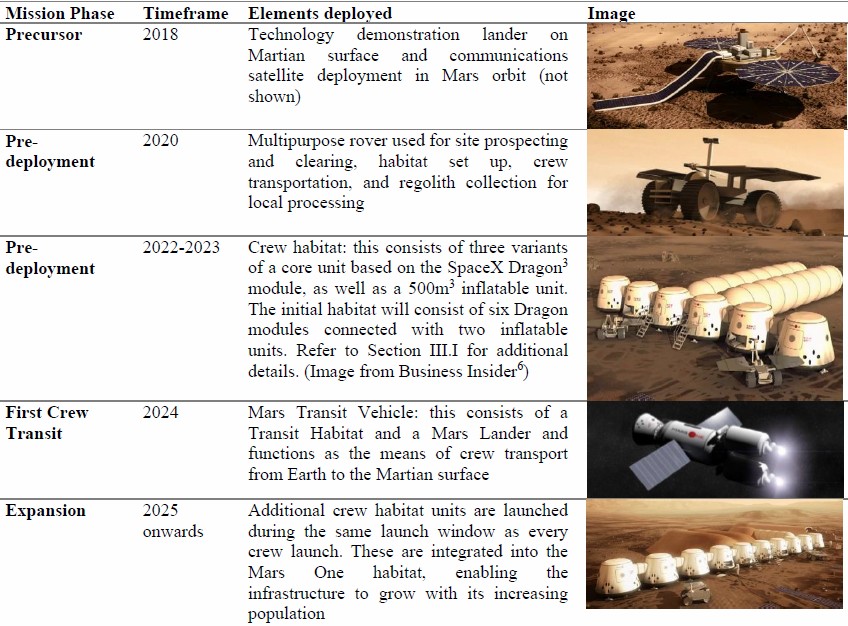
]]>In the last two week the Mars One mission announced it had narrowed down to 100 finalists from the original 200,000 applicants. The press couldn’t help themselves jumping on this story. But another one was lurking in background.
It seems that Mars One is not really going anywhere. The reason, it has yet to be able to pay its contractors, Lockheed Martin and Surrey Satellite Technology, beyond creating conceptual plans for the preliminary robotic spacecraft and landers needed to set the stage for establishing a future human colony on the planet’s surface.
In July of last year I posted a blog about the issuing of a 56-page specification and requests for proposals for these two important first steps in the Mars One timeline. But since both Lockheed Martin and Surrey delivered on the RFP nothing further has happened. Based on mission timelines, see below, with the orbiter supposed to be sent to Mars in 2018, to build and deliver the spacecraft Mars One is running out of time.
Lockheed Martin intended to use the Phoenix mission design for the lander and maybe the orbiter can also be built using the technology and schematics from other Mars missions. But unless Mars One gets more sponsors or its crowdfunding efforts spectacularly improve it would seem that the 100 finalists and the eventual 24 final picks will have nowhere to go but Earth.
Of course the Mars One project has many detractors, one of which is not Elon Musk. He remains enthusiastic about helping Mars One achieve its goal of a permanent human colony on the Red Planet. But the technology to keep humans alive indefinitely on Mars still does not exist according to Massachusetts Institute of Technology graduate student study that concluded Mars One colonists would be dead within a few months either from starvation or from asphyxia as dangerous levels of gases accumulate in the planned surface habitats.
Bas Landsorp, Mars One chief executive and co-founder has yet to address the recent comments about no further progress on these precursor robotic missions, both necessary if the colonization attempt is to go ahead. Instead the public relations engine, remember that’s what he knows best, is at work hyping the colonist selection process. This is grossly unfair to those who will likely, should Mars One go ahead, be on display in a reality television drama that will witness their deaths.
As I have stated before, if humans are to colonize Mars we need first to develop the space survival skills in near Deep Space or on the lunar surface where rescue within a few days would be possible should something go wrong.
This is not the equivalent of the first European voyages to settle in North America and so many of those pioneers died shortly after arrival. They had air to breath and water to drink. And they even had other humans living nearby that could show them how to survive in their New World. And yet so many succumbed.
My questions for Landsorp are this:
What makes you think you can successfully carry off Mars One when you cannot even get the preliminary stuff done?
How will you feel if you try shortcuts, which is effectively what you are doing to get Mars One done on your timetable, and watch those you send die in the attempt?

The purpose of the flight was to test Orion’s on board systems, check out the tolerances of the capsules construction, and make sure all external components worked as planned. With 1,200 sensors on board Orion past the check up with flying colors. And all the external components – the launch-abort system, heat shield, and parachutes, all appeared “nominal,” NASA parlance for “worked as planned.”
If an astronaut had tried to stow away, the flight would have been more than unpleasant because in this test there were no seats and no life support. On board, however, was a James Kirk doll courtesy of Bill Shatner.
Lockheed Martin is the builder of Orion. Subject to congressional funding the company intends to build a fleet of them. A second will fly, once again unmanned, in 2017. And in 2021 Orion will fly with a human crew on a voyage around the Moon. After that NASA has stated their intention to launch at least one Orion mission a year with the space agency hoping to use the spaceship as its workhorse into the 2030s when a mission to Mars is planned.
Some basic Orion specs:
So what does this mean for the commercial space companies contracted to NASA to deliver their own space capsules? In today’s NASA telecast a short clip played describing Boeing and SpaceX as the builders of space ferries to transport crews from Earth to and from the International Space Station, freeing NASA to do the Deep Space stuff.
I don’t know about Boeing, but Elon Musk of SpaceX has a very different idea for his so called “NASA ferry.” Musk talks about getting to Mars much sooner than the 2030s and is building alliances with organizations, commercial space ventures and other space-faring nations to achieve this.
But today felt like deja vu as I watched the launch, flight and recovery of Orion. As the cone-shaped capsule descended under its main parachutes to a splashdown in the Pacific (see NASA image below) it brought back my memories of Apollo and I could hear my 1960s Beach Boys albums playing in the background..

The company, Lockheed Martin, engages a skunk works team working on energy projects. And in the last few days that team has revealed the work it is doing on a commercial hot fusion reactor technology that is a tenth the size of the tokamak-designed ITER project in France. It literally will fit on the back of a truck.
They call the device a CFR, standing for compact fusion reactor and they expect to have one ready for testing within a year, a reactor prototype ready in five, and the first full production commercial product in ten. In a video on YouTube, Thomas McGuire, a graduate of MIT and lead in Lockheed Martin’s Skunk Works Revolutionary Technology Program, describes his vision for the CFR, a technology that will replace conventional power generation and help humanity deal with climate change. CFRs will operate in power plants and even will be used in airplanes where they will make it possible to stay aloft for long periods without landing to refuel.
So how does a CFR work? Like the ITER project, the energy of the Sun when created here on Earth must be put in a bottle. In both the ITER and CFR that bottle is magnetic. One difference is scale. The ITER is the size of a building. The CFR is no bigger than the bed on the back of a semitrailer. Another difference is the vessel design itself which is the secret behind the confident declaration of the Skunk Works team.
In the CFR a gas containing deuterium and tritium provides the fuel. Both of these elements, hydrogen isotopes, are readily available here on Earth. The deuterium-tritium gas gets injected into the compact containment vessel. Energy is applied causing the gases to form a plasma which is contained by a magnetic field. The tight containment concentrates the ions and electrons which ten collide and fuse. Fusion releases lots of energy and helium-4, the latter useful for medical, chemistry, space and the creation of super-fluids. The energy heats the reactor walls which are surrounded by conventional heat exchangers. It is this heat that can then be used to drive turbines to generate power. There is no radioactive waste
The initial prototype when finished will only run for ten seconds but it will generate much more power output than the energy input. A truck-sized CFR, 7 by 13 meters (23 by 43 feet) will have the capacity to generate 100 Megawatts of power. That’s enough energy to power 18,000 American homes.
It all sounds incredible and you would think that Lockheed Martin would be moving ahead on their own to make the CFR a reality. But instead the company is seeking partners to put money into the project. Talk about hedging your bets. Maybe this isn’t the sure thing that McGuire describes with confidence in the video. But if it is then talk about a game changer for the planet.


