Today’s lithium-ion (LiON) technology has limits: range, recharge rates, and recharge cycles. For example, a Tesla Model S has a range limit of 400 kilometers (250 miles) before recharge. With a fast charger, it can take 30 minutes for a full recharge. That’s pretty much state of the art for EVs today.
On the other hand, there are solid-state batteries which can extend range dramatically while recharging much faster. A solid-state battery of similar output to Tesla’s LiON could extend the car’s range two to three times. That battery would be smaller and lighter as well.
Other solid-state advantages:

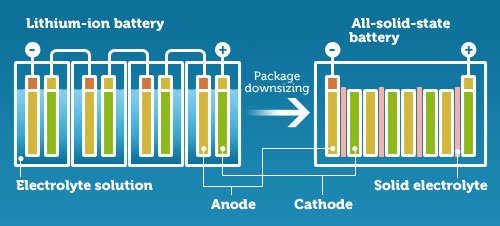
Solid-state batteries can be made using the following materials:
And they come in two varieties:
Lithium-phosphorus-oxynitride, also known by the acronym, LiPON is a material suitable for thin film solid state. These batteries are ideal for watches, other wearables, and cell phones. After 40,000 charge cycles, a typical LiPON battery will lose a mere 5% of capacity. That means LiPON technology can last from 40 to 130 times longer than comparable LiON.
Garnet-oxide is a material suitable for bulk solid state. It can produce the same energy output as current LiON technology using a much smaller footprint while at the same time retaining capacity over many more charge cycles.
In all cases, solid-state recharges much faster than LiON. The batteries Toyota expects to use in its 2022 EV models will recharge in 5 minutes (about the same amount of time it takes today to fill a gasoline-powered vehicle fuel tank.) The batteries will retain 100% charge capacity over a minimum 1,200 recharge cycles outperforming LiON by 400%.
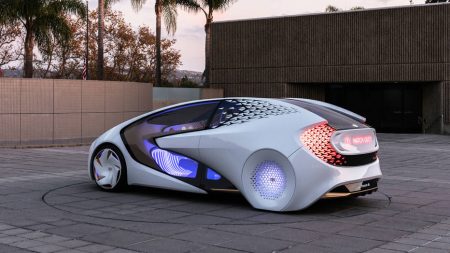
When you consider Toyota has not been a big adopter of LiON technology it is not surprising that the company is choosing a different route in the evolution of its EVs. The leap to solid-state will be dramatic. But in the interim, the company intends to continue producing its existing Prius and other brand-hybrid cars, a hydrogen-fuel-cell car, and in 2019 will begin manufacturing LiON-powered EVs in China.
Panasonic has standardized on lithium-ion battery packs capable of generating 1.35 kilowatt hours of energy. Each battery pack comes with a battery management system to monitor charging and discharging. Germany is Panasonic’s first market. That’s because Germany currently is leading the world in the use of renewable energy sources with 20% of the total electricity consumed within the country coming from wind and solar sources.
During the month of May this year, on one very sunny day, solar panels generated almost 75% of daily electricity demand. On May 28, solar power hit 22,000 megawatts per hour while the nation consumed 28,000 megawatts in total. Much of the power being generated by solar arrays in Germany is on the grid but more and more residential solar units are popping up on homes around the country that can feed the grid or operate autonomously. And Germany is not the only country where solar power is happening. Australia is fast tracking the technology for utilities and private residences. In the United States, California is seeing rapid adoption. Spain and Portugal are following suit as are China and Japan. In fact, half of the new power generation capacity development across our planet in the past year has come from renewable sources, largely solar and wind.
But renewables like solar and power suffer from highly variable conditions for sustainable energy production. The Sun sets. The wind dies. That’s where storage systems come in. They can charge up when renewable energy systems are operating and discharge when not. Panasonic’s storage system, called the Energy Creation-Storage Linked System for Home Use, manages residential electricity requirements around the clock providing a stable power supply. It includes photovoltaic panels, a power station and a lithium-ion battery stack. The power station features an inverter that converts direct current generated by the solar panels or battery into alternating current for operating home appliances and electronic devices. The home lithium-ion battery system has an estimated 5,000 load cycle and a capacity of 1.35 kilowatt hours. The storage system can provide power to a residential unit for two days when fully charged.
The system can be used both on or off the grid. In an on-the-grid installation excess solar energy generated during the day is sold to the local utility and at night the batteries provide supplemental power to meet residential demand. The battery pack recharges overnight when utility rates are at their lowest. Off the grid, the system is a self-contained power generation system with excess solar power topping up the batteries during the day and discharging through the night to provide power when the solar arrays are inoperative. Power consumption can be tracked remotely using its wi-fi interface on mobile devices and televisions within the home.
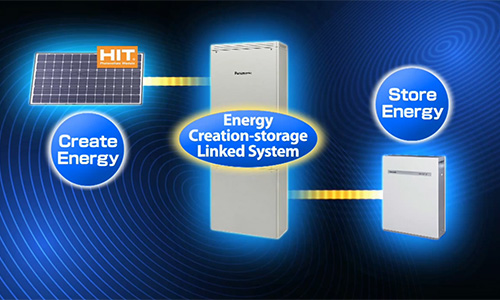
This is not Panasonic’s first renewable-storage system. It has been working with a German energy company to develop the E3/DC power management and storage system which went on sale this year. The E3/DC system features 4 kilowatt hour capacity considered sufficient for the average German home. The Energy Creation-Storage Linked System for Home Use may fulfil the need for renewable energy solutions for multi-residential condominium and apartment units.
]]>