The fear of running out of juice before reaching a charging station is a valid concern. So is the cost on the showroom floor. But over a lifetime of ownership EVs compare favourably to the most economical gas and diesel-powered vehicle models. And sticker prices are coming down. Tesla has introduced discounts on existing models and promised lower-priced ones soon. More companies are getting into the EV business, and Chinese manufacturers are starting to stick it to Tesla, the front-runner to date.
The latest public anxieties about EVs include discussions about their environmentally friendliness when compared to fossil-fuel-powered vehicles. Aren’t the battery materials an environmental hazard? Doesn’t the mining of lithium, the metal most commonly used in today’s EV batteries, produce toxic chemicals and runoff? When batteries die do they not contribute to pollution? Will keeping EVs powered up not put unnecessary strain on the electrical grid? Are batteries safer than gasoline and diesel-powered cars? What about those videos of Tesla EVs bursting into flames?
In terms of environmental friendliness, EVs have gasoline and diesel-powered vehicles beat by a long shot. Lithium is the metal of choice for EV battery packs at present. It is mined and handled responsibly today. Battery disposal is becoming a non-issue as new factories are built to recycle lithium and other battery components.
In Canada, two companies, Li-Cycle and Nemaska Lithium have established partnerships with EV companies to recycle and recover lithium, cobalt, and nickel, keeping these metals and minerals out of landfills.
Compare that to the greenhouse gas emissions (GHGs) contributed by fossil-fuel-powered transportation. In Canada, as an example, the latter accounts for approximately 25% of the country’s GHGs. Numbers elsewhere are certainly similar to the Canadian experience.
We can watch EVs going up in flames on social media. I’m happy that we don’t get to see similar video clips of fossil-fuel-powered cars and trucks in flames whether on TikTok, YouTube, Instagram or other social media sites. Why? Gasoline and diesel are inflammable ingredients, so much so that U.S. data sources track fire incidents caused by fossil fuel-powered vehicles. Compared to EVs they are far more prone to going up in smoke. Statistics kept by the U.S. National Fire Protection Association, in 2020, noted that 15% of fires that year across the country originated in gasoline and diesel-powered vehicles and represented the cause of 18% in total civilian deaths and 11% in injuries. Comparatively, EV fires amounted to 0.02% of the total that year.
The risk of fire in EVs comes from the liquid electrolyte in the batteries. Electrolytes are inflammable if improperly maintained, if there is a manufacturing defect, or if the batteries are improperly charged. The low number in 2020 is partially attributable to the difference in the number of EVs on the road that year. But, industry experts argue that EV liquid electrolytes represent a far lower fire risk than the liquids used to power gasoline and diesel vehicles which in an accident can suffer fuel leaks, or can burst into flames when an engine overheats, or if the wiring systems short circuit.
Is growing EV adoption a real concern for the utilities and operators of the power grid? Electrification of industry, housing and transportation as the world decarbonizes energy sources is driving significant grid capacity growth. The International Energy Agency (IEA) tracks, the rate of growth in grid capacity globally is expected to reach 18,800 GigaWatt/Hours (GwH) by 2030, up from 13,300 GwH in 2020, and by 2040 hit 24,600 GwH, and by 2050, 31,600 GwH. Most of that growth will come from renewable and nuclear power generation. Distributed power generation from off-the-grid solar panel rooftops isn’t included in the estimates. Many home chargers will benefit from distributed power generation sources.
Currently, the top-performing range for EVs is approximately 700 kilometres (over 430 miles) on a single charge. But many early and lower-priced models have distance ratings around 400 kilometres (around 250 miles). All of these EV models feature Lithium-ion (Li-ion) liquid battery packs.
Li-ion isn’t the only battery being used by EV manufacturers. BYD, the Chinese EV manufacturer that surpassed Tesla in sales in the last month offers cars running on Li-ion and Sodium-ion (Na-ion). One of its vehicle models, the Seagull uses a Na-ion battery and offers a driving range of 300 kilometres (approximately 180 miles) per charge.
The Seagull isn’t an answer to the range anxiety issue. It is meant to be an urban commute vehicle and is priced well below Tesla’s models. Na-ion battery advantages include lower material costs, faster recharge rates, longer battery lifecycles, and better performance in extreme heat and cold.
Americans, Canadians and those who live in rural areas where 700 clicks are still seen as a low number are looking for batteries that can power a vehicle to go 1,000 kilometres (610 miles) or more between charges. Experiments replacing lithium or sodium with aluminum, iron, potassium, nickel, and mixes of these metals are ongoing.
Solid-state batteries with no liquid electrolyte have recently moved from the world’s universities and manufacturers’ laboratories to the largest automobile manufacturers on the planet. Toyota recently announced plans to introduce models meeting the 1,000-kilometre milestone as early as 2026, and an entire fleet of solid-state battery-powered cars by 2027 and 2028.
Solid-state batteries have many advantages over their liquid cousins. They are lighter in weight, exhibit faster recharge rates, and don’t need the liquid electrolytes that are a potential fire risk (see earlier discussion).
These new generations of batteries will extend EV ranges to 1,100 kilometres (almost 700 miles) and I will talk more about them in Part 2 of this series.
For the liquid Li-ion battery, however, there is some good news. Stanford researchers recently noted that by draining an EV battery pack and letting it rest for an hour before plugging it in, EV owners will get incredible improvements in battery lifecycle performance and range. In a Stanford News release, Wenbo Zhang, a material sciences Ph.D. candidate at Stanford is quoted stating:
“We discovered that by resting the battery in the discharged state, lost capacity can be recovered and cycle life increased. These improvements can be realized just by reprogramming the battery management software, with no additional cost or changes needed for equipment, materials, or production flow.”
The discharge and rest for just an hour allows a battery to recover what is referred to as its “dead lithium.” This is lithium that becomes isolated by being trapped in a solid electrolyte interface (SEI) which forms a spongy matrix between the electrolyte and the anode. The rest phase with no current in the battery dissolves the SEI and brings back to life the isolated and dead lithium so that it can retain a charge. This was always considered irreversible in Li-ion batteries.
This discovery implies that almost all existing EV batteries can see extended lifecycles and range through a simple software fix uploaded to the onboard battery management system. Considering that the average driver probably uses a car for an hour a day, resting the car battery for an hour rather than plugging it into a recharger seems like a no-brainer and should dramatically improve performance for those who still suffer from EV range anxiety.
]]>The conversation around battery recycling is more potent than ever as climate change pushes public concerns about electrification and the adoption of EVs for transportation. The desire to switch to eco-friendly alternatives to gas and diesel vehicles is growing. Lithium-ion (Li-ion) battery-powered EVs are the current standard. Li-ion batteries are recyclable but present a challenge that is both demanding and expensive which is discouraging to proponents of the technology switch.
Even batteries not based on Li-ion, such as lead-acid or zinc-carbon3 present recycling challenges. Both of these battery types release toxic chemicals into the environment because of improper programs for their disposal. What is needed are circular economic solutions to make battery adoption more appealing and recycling and reuse work better.
Four companies are at the forefront of implementing technical solutions that could become industry standards and game changers. Here is a little bit about each.
Ascend collects Li-ion batteries and transforms them using a patented technology they call hydro-to-cathode. Instead of extracting the metals from scrap materials, Ascend extracts impurities rather than trying to separate and split battery materials. This method not only upcycles batteries with a 98% success rate in material reclamation but represents a reimagining of the battery-recycling industry to meet 21st-century expectations.
Prior to Ascend introducing hydro-to-cathode technology the industry was rife with excuses. Battery recycling was seen as too expensive. Some companies claimed to not have the infrastructure to support battery recycling. Some suggested that upcycled batteries would not produce the equivalent power of new Li-ion battery packs. But Ascend’s simplified alternative to hydrometallurgy and pyrometallurgy could prove revolutionary for recycling and repurposing.
Redwood wants to reduce the number of batteries that go into landfills. They want to minimize environmental degradation caused by the transportation of raw materials as well. Their goal is to maximize material recovery by up to 95%, reviving previously dead batteries into greener versions.
They have successfully revived batteries as a result and have developed partnerships with the capacity to power a million EVs. They have created a drop-off network for people to offload old cellphones, laptops and other battery-powered technology to increase the number of batteries that end up being recycled.
Currently, Redwood operates in the United States only, keeping the resources domestic to align with the company’s environmental objectives.
This company is a European startup that is focused on rebuilding end-of-life batteries. It has a mission to reduce carbon emissions while being in the battery recycling business and strives to be a role model for exceeding regulatory EU targets with a proprietary and patented carbon-efficient hydrometallurgy first developed at RWTH Aachen University in Germany.
Hydrometallurgy as a battery recycling methodology is not new. But what Cylib is doing is improving its efficiency. The end-to-end process recovers all the valuable metals in a battery pack down to the individual cell level.
Li-Cycle’s goal is to reinvigorate supply chains by increasing Li-ion battery availability. It does this by saving and recycling batteries. Li-Cycle uses a proprietary technology it calls Spoke & Hub that combines safe mechanical size reduction and hydrometallurgical processes. It also provides consulting services to its clients related to the packaging and logistics for battery storage.
Li-ion batteries are transformed from a charged to an inert state. Cathode and anode materials get processed into battery-grade end products for reuse providing a secondary source of supply to meet the demand for critical battery materials including lithium, nickel, and cobalt to minimize the need for new resource extraction. The approach the company takes has won awards from the World Circular Economy Forum and certifications from ISO.
These startups may appear to be in competition, but the growing demand for EVs will likely leave room for them all to find a market. Because of climate change, the global economy by necessity is moving to a low-carbon and electrification future. Startups like these will provide a solid foundation for addressing the issue of battery waste through recycling and upcycling to meet future EV and other battery-storage application demands.
Others are bound to join in as EVs overtake internal combustion engine sales. But these first-to-market companies will have established a new industry segment with a solid economic future.
]]>
We’ve been using gasoline and diesel to power cars and trucks for more than a century. It was Henry Ford who popularized the gasoline-powered internal combustion engine (ICE) early in the 20th century. And Rudolf Diesel in the late 19th century gave us the engine named after him. Before these two, steam-power moved trains and steam-powered cars persisted all the way to the mid-1920s before this form of transportation was quashed by ICE technology and mass production.
ICE technology burns fossil fuels which we know add greenhouse gasses (GHG) to the atmosphere. In small numbers, using ICE for transportation would never have been an environmental problem. But gas-powered cars cover the planet to the tune of 1.4 billion in 2022. Environmental regulation of emissions has produced innovations. Catalytic converters, unleaded gasoline, and biofuels have reduced emissions per vehicle. But the explosion in the number of cars on the planet has offset those technological improvements.
Today, the impact of gas-powered cars is profound with between 80% and 90% of the total environmental impact coming from burning fuel each time you step on the gas. And particulate matter from partially-burned gasoline and diesel is responsible for 30,000 deaths per year from respiratory complications.
Climate change from adding GHGs to the atmosphere is pointing a finger, not just at fossil fuel producers, but also at transportation with the environmental impact of driving seen as an area where technological innovation can help reduce global warming. Hence the move to electric vehicles (EVs) and alternatives to gasoline and diesel fuels to move us around.
Car manufacturers like Tesla, Ford, Nissan and a bevy of Chinese companies have been cashing in on public interest to go green and slash personal carbon emissions. In the past, many false starts plagued EV development. General Motors launched the EV1 in 1996 and Honda in 1997. Neither of these survived in the marketplace. It took a new manufacturer, Tesla, to put the EV front and centre with automobile purchasers.
Now EVs appear to be the natural successors to ICE cars. Even accounting for charging, EVs deliver a lower carbon cost than gasoline-powered vehicle alternatives. The carbon efficiency of EVs is improving over time as well. And as we move towards a power grid featuring more renewable energy sources, the carbon produced to charge EVs will diminish.
EVs are technically complex-looking and laden vehicles, and despite all the onboard gadgets and goodies produce fewer GHGs over their full lifetime when compared to ICE cars. Their manufacturing may be more carbon intensive, but their operations quickly offset this when drivers forgo the gasoline and diesel pump.
Detractors of EVs point out that disposing of batteries can be ecologically harmful. However, as many of the current EVs on the road reach their end of life, the electric car battery recycling industry is ramping up. Older batteries are even getting an extended life when used in battery storage packs used in homes to provide electricity when there are power grid interruptions. And as more EVs are on the road, there is a growing demand for the recycling and reusing of EV parts and the materials that can be extracted from old batteries.
Then there are two outstanding concerns: range anxiety which appears to be coming to an end, and the lack of an adequate charging infrastructure which through the programs being funded in the U.S. Inflation Reduction Act should soon be addressed.
Businesses are demonstrating they are fully behind the EV transition. Fleets are switching to EVs. Corporate sustainability and ESG credentials are becoming entrenched in business operations. Impact measurement and management (IMM) software is helping track sustainability improvements.
In recent years, Japanese automakers Honda and Toyota have invested in hydrogen-powered fuel cell cars. Hydrogen fuel cell EVs have a driving range of up to 500 kilometres (310 miles). Refilling a fuel cell car takes no more time than putting gas or diesel into an ICE vehicle. That too is a big plus when compared to battery-powered EVs that can take much longer to fully recharge.
Detractors of hydrogen point to the volatility of the fuel. They are mistaken as Toyota’s Mirai hydrogen fuel-cell model has demonstrated. Hydrogen fuel cells use compressed hydrogen which is converted to electricity. There are no GHG emissions other than water vapour. A hydrogen fuel-cell car is as carbon efficient in production as other EVs. And its operational footprint is zero carbon.
There are two remaining challenges for hydrogen fuel-cell vehicles becoming a major competitor to EVs. The first is sourcing hydrogen which currently gets produced from natural gas, a GHG. But this is changing as electrolyzers become more common and use water and even saltwater to source hydrogen. And the second challenge is the lack of a hydrogen fueling infrastructure. Only Iceland today has a significant number of hydrogen stations which fuel its growing fleet of fuel-cell vehicles.
Because of Tesla EVs have gained popularity in the last decade. And because people are becoming more knowledgeable about climate-related issues, they are looking at EVs in greater numbers. So EVs have caught on and with recent price wars fueled by more manufacturers getting into the business, we should see significant growth in their use.
For hydrogen, the uphill climb to reach numbers that will make fuel-cell-powered EVs viable is steeper. But late into the race doesn’t mean the fuel cell EV will succumb to the same market dynamics that ended the Stanley Steamer.
]]>Nikhil Koratkar, Professor of Mechanical, Aerospace, and Nuclear Engineering at Rensselaer describes their invention, a potassium-ion battery that “could offer a sustainable and low-cost alternative to the incumbent.” Koratkar and his research team have published the results in PNAS, and if you don’t have a subscription you can still access the content here.
Potassium is a larger, heavier and less energy-dense element than lithium. It also when used as an anode can result in accumulations of what are called dendrites on the surface through repeated charge and discharge cycles, eventually causing the battery terminals to short out, overheat, or catch fire. This occasionally happens with lithium-ion when the insulating membrane that separates the electrodes is imperfect either from a manufacturing defect or later damage. We’ve seen the videos of smartphones, laptops, and even Tesla sedans going up in smoke.
So how has the Rensselaer team overcome the dendrites getting big? They operate the battery at a high charge and discharge which creates a uniform temperature rise that allows the anodes to self-heal smoothing the dendrites. When the battery is not in use a built-in safeguard monitors the self-healing process ensuring the battery can continue to function through thousands of charge and discharge cycles.
Koratkar believes there needs to be a shift away from lithium to metal batteries. He states, “Metal batteries are the most efficient way to construct a battery.” If the dendrite problem can be resolved, and it appears that it has, then potassium could become the next material standard for battery technology.
Both potassium and lithium are alkali metals. Potassium, however, has some distinct advantages. For one it is the seventh most abundant element in the Earth’s crust 343 times more common than lithium. Potassium in the form of potash is mined extensively in Canada with the country producing in 2018, 22.7 million tons. Compare that to lithium which has estimated total reserves of between 18 and 40 million tons. We may not run out of lithium, but abundant potassium has a good case for becoming an alternative for batteries.
The advantages we can gain with a potassium-ion battery alternative to lithium-ion for EVs and backup storage for renewable energy sources, would help us to decarbonize faster, reduce greenhouse gas emissions, and mitigate the worst effects of climate change.

]]>
The world isn’t about to run out of lithium even though it is somewhat rare. But LIB technology has limitations and safety issues. Over time LIB discharge-recharge cycles diminish in terms of energy capacity with manufacturers putting ratings of maximum efficiency at 300 to 500 cycles. And we have all read about LIB technology spontaneously combusting upon occasion, whether it happens in a mobile phone, or in a Tesla automobile.
That’s why researchers are looking at other materials for rechargeable batteries. At the Helmholtz and Karlsruhe Institutes in Germany, a team believes that have found the answer, a rechargeable calcium-ion battery (CIB) with a synthesized electrolyte that could be an alternative to LIB technology.
The research team wanted to solve two battery challenges. Develop a safer and cheaper battery pack for EVs. And create a large-scale battery solution to backup renewable power generation. Both of these issues are top-of-mind in Europe as the continent addresses its commitments to lower carbon emissions and build greater battery capacity to meet European EV manufacturers’ volume requirements as described in yesterday’s posting on this site.
In a paper just published in Energy & Environmental Science, the Helmholtz and Karlsruhe team describe their CIB invention and the whys and wherefores for its invention. They state that LIB technology is insufficient to meet growing energy storage demands for EVs and grid-scale utility requirements. They also point out that LIB material requirements beyond lithium, including cobalt, will increasingly make the technology less affordable in the future. Finding an alternative battery technology, therefore, is imperative, particularly if more abundant and cheaper materials could be used to produce the same or better levels of energy density and discharge/recharge reliability.
In choosing calcium, 2,500 times more common than lithium, the fifth most abundant element on the planet, the researchers believe they have the answer, a CIB that uses a fluorine-based electrolyte compound that can handle thousands of discharge and recharge cycles, conduct electricity efficiently, and be cheaper to mass-produce. And CIB technology will be far less toxic when it comes to recycling or disposal, another challenge the world faces with the growing number of LIBs in the environment (see image below).
The prototype CIB retains 84% of its initial capacity after 1,000 discharge-recharge cycles at room temperature, which compares well with LIB technology and bodes well for this battery alternative in the near future.

]]>
The European market is still in the EV early stage. In 2018 Europeans could choose from 60 EV, plug-in hybrids, and fuel-cell models. In 2020 that number is expected to grow to 176. By 2021 it will be 214, and by 2025, 333. Around 60% of the total European EV production in 2025 will be battery-based. And this growth aligns with Europe’s carbon emission reduction goals over the same period.
Transportation in Europe is the single largest contributor of airborne carbon on the continent amounting to 27% of total emissions. Of the 27%, 44% comes from automobiles with the number keeping on rising.
At the 2015 Paris Climate Agreement, the EU committed itself to net-zero emissions by 2050 and new-car sales to be net-zero by the mid-2030s. European manufacturers are required to reduce carbon emissions on new vehicle sales by 15% in 2025, and 37.5% in 2030.
EV sales in 2018 were relatively small in numbers accounting for 2.5% of the total European market. The top country, Norway (technically not an EU member) was responsible for 49% of EV sales. A distant second was Sweden at 8%, followed by the Netherlands, 6.7%, Finland, 4.7%, and Portugal, 3.4%.
Production, however, is ramping up with 2019 seeing three-quarters of a million built and sold. By 2025 the number is expected to grow to 4 million with a big decline in diesel-powered cars. The combined sales of diesel and gasoline-powered vehicles will decline by 2.7 million by that same year. Among domestic EU makers of EV cars will be Volvo, Volkswagen, BMW, and Daimler. Japanese, Korean, and Chinese EV carmakers, and some joint-ventures with European producers will make up the balance.
The EV cars built by European companies will largely stay in Europe. Why is that?
A potential inhibitor to achieving these forecasted volumes will be the production of lithium-ion battery packs. A recently formed European Battery Alliance has set a benchmark for manufacturing capacity with a goal of 131 Gigawatt-hours (GWh) by 2023, and 274 GWh by 2028. Comparisons with global capacity forecasts of 964.8 GWh in 2023 and 1,594 GWh by 2028 show that the EU will increase its world market share from 6.6% in 2019 to 1.7.2% by 2028. This will leave a capacity storage problem which will require European carmakers to rely on battery packs built in China. But by 2028 Europe will more than meet its battery pack capacity requirements for the EV cars it will produce. If you want to learn more please visit a detailed breakdown of Europe’s EV vehicle forecasts.
American demand for EVs including hybrids is forecasted to rise to 1.28 million by 2026, a much smaller sales volume than Europe. The North American market will continue to be dominated by Tesla, the company that created the modern EV phenomenon. General Motors and Ford Motor Company will be distant competitors. But Tesla’s numbers are small. It sold 240,000 EVs in the global market in 2018 and expects to close this year with unit sales of between 360,000 and 400,000. On the battery pack side, capacity largely Tesla-built is expected to reach 130 GWh by 2023.
What’s holding America back and the spillover to Canada and Mexico, tied together by the North American automotive marketplace through a free trade agreement? It is the anti-climate change policies of the U.S. federal government that continues to support the status quo in the automotive industry, the internal combustion engine. In the last week the Democratic Party held a town hall event on climate change, and should one of the people running for president get to the White House in 2020, it is likely that North America will suddenly awaken to the EV market potential as the country tackles carbon emission reductions as a climate change mitigation policy.
The case of China, however, is quite different. The Chinese government is hell-bent on not putting many more diesel and gasoline-powered cars on its roads because of its smog-laden cities. In 2018, China recorded 1.1 million in EV and hybrid sales. Its 2019 forecast will surpass 2 million by year’s end. And by 2025 forecasters are estimating a market growth to 12.7 million EVs annually.
China’s battery pack capacity which reached 286 GWh last year is forecast to grow to just under 800 GWh by 2025, and 1,549 GWh by 2028. That will make China the largest manufacturer of battery packs on the planet and will allow them to meet domestic and foreign demand.

]]>
Germany and France have a history of success in joining forces to tackle a growth industry. Airbus, the rival to Boeing today, was formed through a similar consortium.
The hope is to duplicate that success in four to five years.
The two countries have pledged 4 billion Euros ($4.5 billion US) coming from 35 automakers and energy groups which have indicated their intention to partner in the alliance. The European Union is adding 1.2 billion ($1.3 billion US) in the form of a public subsidy to support the new venture.
The first pilot factory will open in France in the next few months empllying 200. Additional production sites in France and Germany are planned for 2023 with each employing 1,500.
Today Europe produces 1% of the world’s lithium-ion batteries. And yet the major automobile manufacturers in Europe have all announced aggressive strategies to laucnh a number of new EV models annually. Where will the batteries come from? Not Europe currently.
But if the consortium succeeds, the goal is to have Europe supply 30% of global demand by 2027.
Other European countries are interested in joining the consortium including Italy, Belgium, Poland, Austria, and Finland with the market for EV batteries expected to grow to 45 billion Euros (more than $50 billion US) by 2027.
Today it is Tesla and Panasonic that are number one ranked. But Chinese companies are quickly catching up. According to Benchmark Minerals, the growth in Chinese lithium-ion capacity is expected to produce batteries sufficient to rollout 15 million EVs annually by 2023, 18 million by 2025, and 23 million by 2028.
For Europe to achieve 30% of worldwide lithium-ion battery production will involve more than the current investment mentioned in today’s announcement.
The biggest constraint on EV growth is the availability of the raw materials to build batteries. EV batteries produced today consume 46% of the world’s annually produced cobalt, and 32% of the mined lithium. The average Nissan Leaf battery, for example contains 4 kilograms (9 pounds) of lithium. If every car on the planet were to be an EV, the current amount of raw materials, particularly lithium, would not meet the demand.
Lithium recycling capacity may make it possible to reuse existing lithium from batteries for second use. Experts estimate that for every 20 tons of used lithium, 1 ton can be harvested for use in new batteries.
Potential shortages may be further alleviated by new lithium and cobalt sources such as the ones going into production in Western Australia.
And at the same time, new battery technologies may displace lithium and cobalt as the primary materials for EV batteries.

In addition to the above, engineers and researchers are perfecting a variety of fuel-cell options including hydrogen and solid-oxide technologies. And then there is work being done on super-capacitors capable of instantly holding a charge and replacing batteries entirely.
The list of lithium-ion competitors is long because the reward for commercial success is seen to be huge.
Why are researchers trying to knock lithium-ion battery technology from the top of the storage perch? Because the technology has limitations which include:
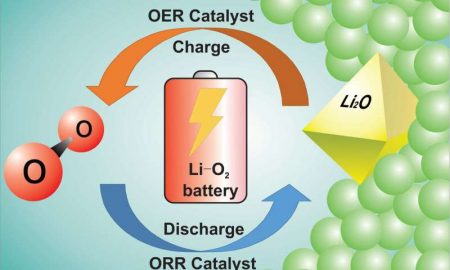
The latest contender that might one day replace today’s lithium-ion battery standard may someday come from work recently announced at Canada’s University of Waterloo. There, chemistry researchers have been working on a lithium-oxygen battery and have reported a number of breakthroughs in the journal, Science,n the last week.
What makes lithium-oxygen more attractive than lithium-ion, is the potential for higher energy density within the battery and lighter weight to power ratios. That would translate to longer running batteries and extended range in operation for electric vehicles (EVs).
So what has been holding back lithium-oxygen batteries?
Chemistry instability is the answer. The interaction of the traditional chemical electrolytes within the lithium-oxygen cells caused degradation of the porous carbon cathodes limiting battery life. The Waterloo researchers began experimenting with different electrolytes and new cathode materials. They switched out the traditional electrolytes, superoxides, and peroxides, and replaced with a stable inorganic molten salt. And instead of the porous carbon cathode they put in its place a bifunctional metal oxide catalyst.
What were the results?
The measure of a good battery is its coulombic efficiency which rates the percentage of electrons within an electrolyte that get transferred through the cathod in each discharge-recharge cycle.
At the university laboratory the battery was tested in a variety of operating environments, and at temperatures at 150 Celsius (302 Fahrenheit) degrees, the researchers identified highly-reversible efficiency across the cathode approaching 100%. They also noted that their use of lithium oxide electrolyte as opposed to lithium peroxide previously used in lithium-oxygen batteries increased energy capacity per weight by 50%.
The inventors of the battery state that commercialization may still be a long way off, but they hope others doing research in the field will take what they have created and run with it to design a commercial battery technology capable of ending lithium-ion industry dominance. Since the Kitchener-Waterloo area is an incubator for new technology startups, I suspect we will soon see a new battery storage company furthering the commercial application of this technology breakthrough.
The key is shrinking the battery elements to nanoscale so that by the time you plug the recharge cable into a power outlet the charge is instantaneous. The architecture is based on block copolymer self-assembly. Joerg Werner, a lead author of the article, proposed to take work he was doing on “self-assembling filtration membranes” and applying “the same principles to carbon materials for energy storage.”
In an article appearing in the May 16, 2018 issue of the Cornell Chronicle, Tom Fleischman describes just how the nanotechnology of the battery’s architecture was conceived.
“The gyroidal thin films of carbon – the battery’s anode, generated by block copolymer self-assembly – featured thousands of periodic pores on the order of 40 nanometers wide. These pores were then coated with a 10 nanometer-thick, electronically insulating but ion-conducting separator through electropolymerization, which by the very nature of the process produced a pinhole-free separation layer.”
The nanofabrication technology currently is in proof of concept is not without potential problems. It appears that discharge and recharge cycles gradually degrade making parts of the battery inaccessible for reuse. But the promise of a lithium-ion battery that charges in seconds makes this work at Cornell exciting. So much so that the engineers involved have applied for a patent.
If the proof of concept can turn into a real product this means lithium-ion batteries because of the nanoscale architecture can decrease in size by orders of magnitude. And at the same time, the instant charge capability will alter consumer electronics, sensors, electric vehicles, the power industry, robotics, and any other industry sector where instantaneous energy from stored devices would be advantageous.

I’ve noticed it particularly this year when I walk my pup, Maya (she’s not really a pup being 12 years old). I go out with a fully charged phone in my back pocket and come back 45 minutes later having made no phone calls, or checked emails, texts or Google, and yet the battery shows as much as a 25% drop.

But that battery problem may soon pass as scientists search for alternative electrolytes that can stand the cold. Two researchers at Fudan University, Shanghai, have experimented with organic-based chemical electrolytes that are showing considerable promise in retaining ionic conductivity in temperatures as low as -70 Celsius (-94 Fahrenheit). The electrolyte uses an ethyl acetate base and exhibits a capacity to retain a charge at 70% in -70 Celsius temperatures. At -40 Celsius (-40 Fahrenheit) the battery retained 83% capacity. And at 25 Celsius (77 Fahrenheit) 100% retention. The researchers are still playing around with the material composition of the anodes and cathodes to go along with their new organic electrolytes. The material for the cathode is made of polytriphenylamine. The anode is composed of naphthalene tetracarboxylic dianhydride. Talk about two real tongue twisters.
From the laboratory to commercial reality is the next big step. But don’t be surprised if the next generations of smartphones and EVs operate much better when a polar vortex descends on your locale in a future winter.
]]>