
October 12, 2019 – It has been a frustrating five years of searching for the latest research into regenerative medicine, and stem cell science, as I have put off making the decision to have my knee replaced with an artificial joint. It seems so many mouse-based research studies have shown that our bodies can regrow damaged cartilage in joints. So many clinical trials performed on a limited number of patients have further demonstrated the viability of a combination of implanted matrices and stem cells that could make knee replacement obsolescent.
But unfortunately, none of these advances are even close to becoming the treatment of choice in dealing with patients like me who have virtually no cartilage remaining in one of my knee joints. What the X-rays show is bone-on-bone, and what keeps me going is periodic cortisone injections and a daily application of pain killers plus CBD oil.
In less than two weeks I go for my third re-assessment knowing that this exercise is purely a formality before I get introduced to an orthopedic surgeon who will tell me that regenerative treatments remain a decade away.
I was told the same thing five years ago at the first assessment.
Should I be surprised about the ten-year forecast?
Consider that a decade ago we were told that fusion energy was only a decade away and that we were told this again this year…only a decade away. This seems to be a common mantra for so much of what we are told by scientists and engineers when it comes to innovation and breakthroughs.
Just like my knee needing a better solution than cut and replace, the world needs an energy solution like fusion to save it from the tyranny of fossil fuel companies and the pushing of their addictive product on the world economy as they lobby governments to do little if anything to stop the deadly impact on climate of their products. (Please excuse my perpetual rant on this subject.)
Having said all this, here’s the latest research piece in developmental biology that suggests we have a latent ability to regenerate joint cartilage in the same way salamanders do to regrow a lost tail or limb.
In a paper entitled, “Analysis of ‘old’ proteins unmasks dynamic gradient of cartilage turnover in human limbs,” Virginia Kraus, and four other researchers from Duke University, Durham, North Carolina, and Lund University, Lund, Sweden, have just published results that show proteins associated with microRNA reflect an “innate tissue repair capacity in human lower limb cartilages.” They are not saying that we have a salamander’s propensity to regrow an entire limb, but rather limited regeneration capacity for joint repair.
In an interview published in The Scientist, Kraus states, “We believe that an understanding of this ‘salamander-like’ regenerative capacity in humans, and the critically missing components of this regulatory circuit, could provide the foundation for new approaches to repair joint tissues and possibly whole human limbs.” This is a bit of hyperbole considering what is actually stated in the research paper itself with an emphasis on limited regeneration capacity.
So how does this microRNA and young protein discovery work?
The researchers discovered an abundance of microRNA along with young proteins that block messenger RNA from inhibiting production of new collagen.
With this microRNA, Kraus suggests it can be “injected directly into a joint to boost repair to prevent osteoarthritis after a joint injury or even slow or reverse osteoarthritis once it has developed.”
What has been further discovered is that the phenomenon of young proteins to facilitate regrowth and repair appears in greater volume the further from the body’s central trunk. So translated, that means less of the proteins in the hip joint, more in the knee, and even more in the ankle. The illustration below visually describes the discovery very well.

So maybe I can take the research paper with me when I go to my next knee assessment and ask the orthopedic surgeon to comment. I’m betting the answer will be, “it’s a decade away.”
]]>
New Clinical Trial for Treating Multiple Sclerosis Produces Promising Results
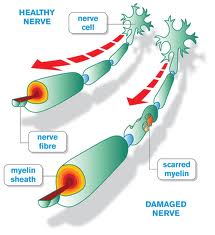
How do you switch off a selective autoimmune response in the body without compromising the entire immune system? That’s what researchers at Northwestern University set out to do in developing a treatment for multiple sclerosis (MS). MS is an autoimmune disorder in which the body’s own immune system attacks the myelin that insulates the nerve cells of the spinal cord, brain and eyes. When the myelin is destroyed those who suffer from the disease experience numbness, potential paralysis, blindness and in extreme cases death.
What the researchers found is that they could deliver billions of myelin antigens by placing them in a patient’s white blood cells and then injecting those cells into the body. In this way the body would recognize the antigens and build a tolerance to them. Current MS therapies tend to suppress the entire immune system leaving those being treated open to opportunistic diseases.
The clinical trial involved nine patients with those receiving the highest dose of white blood cells showing the greatest reduction in autoimmune response to myelin.
If this approach works with MS it may become a protocol for other autoimmune diseases such as asthma and arthritis, and for dealing with allergies that cause anaphylaxis.
New Treatment for Blindness is Noninvasive
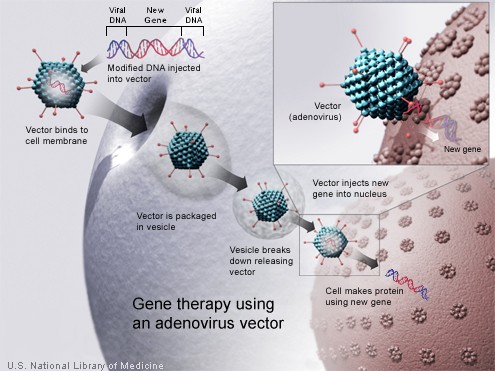
UC Berkeley researchers are inserting normal genes into eyes to help restore sight for diseases such as retinitis pigmentosa and macular degeneration. The team of researchers are using an adenovirus that has had 10 amino acids on its outer shell altered to allow it to pass through retinal cells to reach the eye’s light sensors. The diagram below illustrates how this type of gene therapy works.
Traditionally treatment for blinding diseases involved inserting a needle deep into eye which often lead to retinal detachment. But this new therapy is far more benign. All the doctor does is inject the adenovirus into the liquid vitreous humor behind the lens. The virus then does the rest finding its way through the many cell layers of the retina to replace the defective genes in the photoreceptors.
The therapy may also be used not just to insert genes but also to knock out genes that are causing deterioration in vision such as what occurs with age-related conditions like macular degeneration.
Immune Cells Key to Limb Regeneration in Salamanders
Macrophages are white blood cells that engulf and digest cellular debris and pathogens and stimulate other immune cells in the event of an injury or invasion by a foreign entity. They play a critical role in the immune system. But what role do macrophages play in limb regeneration?
Apparently a significant one according to a study just published in the U.S. Proceedings of the National Academy of Sciences. That is if we are talking about axolotl, an aquatic salamander that is the subject of the study. When macrophages were eliminated from an amputated limb site in axolotl the salamander was unable to regenerate a lost limb. When a small number of macrophages were present the limb regenerated but at a slower rate than normal. So obviously there is something that macrophages do that causes tissue to regenerate.
Salamanders can be a template for limb regeneration in humans if we can reverse engineer what happens when a limb is lost. Instead of scar tissue forming at the wound site researchers hope with the right macrophage responses they can activate limb regrowth.

Is Feeding Nine Billion Humans Even Possible on This Planet?
With over one billion seriously malnourished today in world of 7.3 billion, how will humans cope in 2050 when our population is expected to exceed 9 billion? In this month’s Nature Climate Change, an international team of scientists, members of the Agricultural Model Intercomparison and Improvement Project or AgMIP, shared a study on wheat production involving 27 different crop models and taking into consideration climate change, soil, precipitation patterns, and other factors.
Does the study give us an answer for 2050? Not yet. But it is hoped that by running the simulations and models and sharing the results with the Developed and Developing World countries that policies and procedures can be put in place to impact agricultural production of wheat positively.

China Implementing Carbon Cap-and-Trade in Select Cities Before National Rollout
It’s a well intentioned strategy but China’s first steps into controlling its CO2 emissions is built around intensity rather than total emissions. But before I go into the difference between the two you should know a little bit more about the program.
Beginning on June 18 as reported in Nature, the International Weekly Journal of Science, China will institute a carbon cap-and-trade policy for the city of Shenzhen and its more than 630 industrial sites. Shenzhen is just outside of Hong Kong and one of economic miracles in China’s growth over the last quarter century. Companies in Shenzhen are being given carbon quotas. If they exceed them they can buy credits from companies that are below their quotas. By 2015 China intends to add the cities of Beijing, Tianjin, Shanghai and Chongqing as well as Guangdong and Hubei provinces to the cap-and-trade quota system. That will be followed in 2016 by a national quota system.
So China is committed to cutting its carbon but it is measuring it by intensity rather than total emissions. Intensity is the same measure that the Canadian government uses to show its commitment to reducing carbon emissions. But intensity doesn’t if an economy continues to grow because all it does is reduce the emissions per unit of production. So if production triples and intensity goes down by 40% total emissions continue to grow.
With some of the most polluted cities in the world as seen in the compiled pictures below, China, at least, is making a start. How well will it work? What watchdog will ensure that companies are playing by the rules? Will corruption and government cronyism foul up the results? We will see.

A Postscript
Some of you were kind enough to suggest new stories in the last week. The China story was one of them. I look forward to hearing from more of you and as always welcome your questions and comments. Thanks for dropping by.
– Len Rosen
]]>