
This morning it was hard not to notice the coverage on Keystone in light of the Sunday protest by environmentalists on the Mall and in front of the White House in Washington, DC. I do not envy President Obama one bit as he wrestles with a decision to say YES or NO to build the northern segment of the Keystone pipeline. He has already approved the southern link from Cushing, Oklahoma to the Gulf Coast. The northern segment will close the link between the oil sands production sites in Northern Alberta and Cushing.
Since the President is no longer running for re-election he can make this decision without fear from an electoral backlash. But he must weigh the following when making the decision:
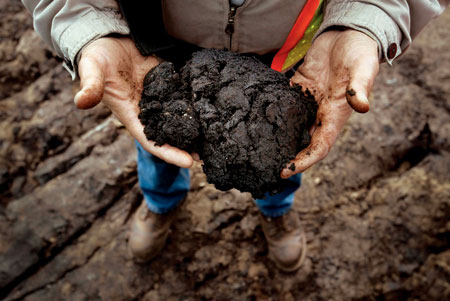
I have written many times about bitumen (see picture above), or as it is more commonly called oil or tar sand, the latter being a pejorative that suggests a dirty source of fossil fuel. It is indeed a problematic source of energy. When bitumen was first discovered along the banks of the Athabasca River in the 19th century it was mined by the bucket with the oil steamed from the sand. This was the state of the industry and technology used by oil producers until the the latter part of the 20th century. But today new technology is being tested that involves much less water and uses electromagnetic heating to free up the bitumen without open pit mining. The industry overall, however, continues to use a mix of methods, one of which is no different from the original. And for older methods of processing bitumen into synthetic crude, vast holding ponds have been created, accidents waiting to happen for the people who live in proximity or downstream from the extraction and upgrading sites.
Our Oil Dependence
The problem we face is greater than just the oil sands. We are fossil fuel dependent and oil remains a primary fuel for running our economies. As a result we have built an infrastructure in North America to ship oil everywhere you look. The map below shows current and proposed pipelines.  Note that proposed pipelines, of which Keystone is one, are drawn in white. The northern Keystone pipeline, the one being hotly contested is the one that heads south from Alberta through Montana, Wyoming, Nebraska, Kansas and Oklahoma. The President approved the southern leg from Oklahoma to the Gulf Coast last year. It’s a done deal and will serve the new production coming from hydraulic fracturing of oil shales.
There is another line in the sand battle that many Americans may not know about. It is happening right now over a Canadian domestic pipeline proposed to run from those same oil sands that Keystone is supposed to serve but in this case is routed through northern British Columbia to Kitimat, a Pacific coast port. This pipeline is intended to provide an export outlet for synthetic crude from bitumen going to Asia and California.
Another battle is shaping up over the doubling of capacity of an existing oil pipeline corridor running from the oil sands through the Fraser River valley in British Columbia to the port of Burnaby, near Vancouver, where oil would be shipped to trans-Pacific customers.
And what’s not on this map are proposals to build pipelines or reverse existing ones within Canada so that production from oil sands can be shipped east to replace imported oil to meet Canadian domestic requirements and refinery capacity.
If one or more of these pipelines gets built oil sands capacity will increase and the loss of Keystone will be somewhat mitigated for the oil producers.
The Real Issue Isn’t Keystone – It’s CO2
The primary goal of environmentalists remains the real issue to confront – the reduction of our carbon footprint on the planet. That requires much more than just drawing lines in the sand around an oil pipeline.
I’m an environmentalist, no bones about it. But I find the focus on Keystone to be facile to say the least. So whether the President decides yea or nay the real problem of CO2 emissions will not go away, at least not without a much larger effort to constrain our energy demand.
How can we do that?
Here are 7 actions we. as citizens of the world, must take if we are to succeed. And these 7 actions start with individuals who through social networking, the press, consumer behaviour and political action can exert an influence on industry and government to tackle carbon:
So whether President Obama says yes or no to Keystone it will matter little in the larger scheme of things.
If he says NO it will be a symbolic victory for environmentalists but only a baby step in tackling the problem of rising CO2.
If he says YES it will be more about short-term security of supply than about the environmental consequences because Keystone’s carbon footprint will truly be just a drop in the bucket when compared to all the other carbon emitters within our North American economy.
And if he implements one or more of the 7 actions outlined above, then we will begin to take the right steps to truly address the climate file.
