When the Galileo mission first started circling Jupiter in 1995. It made eleven close flybys of Europa and magnetometer readings from one of those a mere 150 kilometers from the moon indicated something was erupting from the surface. This flyby approximated the location where Hubble first detected cryovolcanism. And coincidentally, the area where the plume was detected showed a thermal anomaly which indicates that what is emanating from the surface is warmer than what is found on its surface. The height of that plume is estimated to have reached 160 kilometers above the surface.
The implications of the existence of water beneath Europa’s crust that is warmer indicates that the moon has conditions that might be amicable to life.
Europa is considered to be a high-probability site for exobiology. That’s because liquid water is very close to the moon’s surface.
What causes Europa’s plumes?
The interaction of Jupiter and the neighbouring Jovian moon Io produces an incredible amount of energy in the form of tidal forces on Europa. And it is these tidal forces that planetary scientists believe is causing shifting in the icy surface and allowing for cryovolcanic eruptions.
What we still don’t know is the nature of Europa’s core. Is it solid or is the entire moon water? If solid, could the warming be caused by a hot core that features marine volcanoes erupting into the global ocean, transferring heat which is then leading to cryovolcanic activity at the surface?
Or are the plumes erupting from local warm spots, pockets of water in the crust that eventually reach the surface and escape into space?
NASA has planned a mission to Europa known as the Europa Clipper. It is planned for between 2022 and 2025. The Clipper will visit Europa at least 44 times in its mission and descend to heights above the surface as low as 25 kilometers. It is likely that cryovolcanic plumes will intersect with Clipper as it flies by.
Clipper will map the subsurface ocean. In addition, the instrumentation will be able to detect chemistry and constituent matter on the surface and within Europa’s plumes. Indirectly this may be able to tell us that microbial life exists on Europa.

]]>
When I grew up there were nine planets in the Solar System and then scientists in the 1990s got cute and decided to demote Pluto to a dwarf planet. That’s because they discovered many other objects in the Kuiper Belt, a region of the Solar System in which Pluto inhabits. Then New Horizons rendezvoused with Pluto and had astronomers thinking about maybe reversing the demotion decision because Pluto ended up being far more complex and planet-like than anyone previously thought.
Planet X theorists have been around for some time. A hypothetical planet well beyond Pluto has been speculated upon for many years. Its existence would explain odd behaviours in the outer Solar System. For example why some Kuiper Belt objects clustered together and followed odd orbital paths around the Sun. Back in January of this year astronomers at Caltech said they had found evidence of Planet X and it was at that time that they give it the new name, Planet Nine. They published their findings in The Astronomical Journal in an article entitled, “Evidence for a Distant Giant Planet in the Solar System.”
In the analysis the astronomers wrote that distant Kuiper Belt objects not only cluster in orbit perihelion but also in physical space. (Perihelion is the point of orbit when an object is closest to our Sun. Physical space relates to the tight confinement of the noted Kuiper Belt objects being impacted by the suspect Planet Nine.) One of those objects is Sedna, defined today as a dwarf planet. It is much smaller than Pluto. In fact it is smaller than Charon, Pluto’s largest moon. But its orbit is far more eccentric than Pluto’s. And it is that orbit the authors argue as well as the orbit and position of other Kuiper Belt objects that has “only a probability of 0.007% to be due to chance, thus requiring a dynamical origin.” Hence the existence of a hypothetical large planetary body.

Why Planet Nine, estimated to be a super-Earth in size, similar to the mass of Uranus and Neptune, would exist in the outer reaches of the Solar System is explained by the theoretical reconstruction of the early history of our planetary system. In that construct astronomers blame Jupiter with Saturn playing a supporting role. It is believed that these two gas giants caused Planet Nine to get flung out to where it resides today.
Astronomers have called Jupiter the planetary bully because of its significant mass and powerful gravitational pull. And during the Solar System’s formation it is hypothesized that the giant planet began much closer to the Sun than its present orbit. Influenced by proximity of a second giant, Saturn, the two asserted enough gravitational influence upon each other to spiral outward to their current positions as the fifth and sixth planets.
The theoretical Planet Nine encounter with Jupiter was not as benign as that of the mutual attraction asserted with Saturn. Planet Nine got pushed by angular momentum and torque to spiral outward and assume an orbit well above the orbital plane of the other planets. The fact that it survived its close encounter with Jupiter may be explained by the angle of its approach and the distance it traveled away from the gas giant. That cannot be said for other early members of our young Solar System who may have had multiple close encounters with Jupiter ripping them apart. The evidence of those encounters can be found in both the Asteroid and Kuiper Belt today.
So where is Planet Nine? Probably 20 times further away than Neptune, the current Planet Eight, and well above the common planetary plane of our Solar System. But Planet Nine is not the only explanation given for the behaviour of Kuiper Belt objects. Another theory posits the existence of a dim Red Dwarf star whose path every 27 million years comes close enough to the Solar System to act as a disruptor of Kuiper Belt and Oort Cloud objects. Called Nemesis, or the Death Star, it has yet to be found.
Planet Nine’s existence has become the current hot theory further hyped by the latest observations describing a wobble in the Solar System that tilts it in relation to the equatorial and axial orientation of the Sun. The explanation given is that when Planet Nine got tossed by Jupiter its path around the Sun was significantly altered placing it at least 30 degrees above and below the common orbital plane of the other eight planets. The planet’s mass (speculated at anywhere from 4 to 10 times Earth), although not as large as Jupiter (it would be the fifth largest planetary object), and its far-flung orbit could be an explanation for the current 6 degree tilt of the common planetary plane. Why is that?
For an explanation you have to go back to our understanding of how the Solar System got started. When the proto-solar nebula formed the Sun the remaining gas formed a rotating disk sharing common angular momentum. The planets formed out of this gas aggregating matter over time. Their orbital inclination continued to be the same. But today we don’t see this. Instead all of the eight planets orbiting the Sun are at a 6 degree tilt when compared to our star’s axis and equatorial plane.
The theory posited is that of a distant object in the outer reaches of the Solar System exerting angular momentum providing torque leading to a twisting force that over many billions of years has grown to the current 6 degree tilt. The distance of that object from the Sun and its exaggerated orbit (a significant difference between perihelion and aphelion) helps exert even greater angular momentum than if it were closer to the centre of the Solar System and had a more circular orbital path. Over billions of years of orbits, each speculated to last more than 20,000 Earth years, that object has produced the end result we see today, a Sun with an axis of rotation offset from the planetary plane by 6 degrees making our star appear to us as if it were tilted.
That object, the elusive Planet Nine, remains theoretical. All that’s left is to find the damn thing and turn it into fact to confirm these theories. But that’s not going to be easy because there is a lot of space above and below the common orbital plane of our Solar System. And Planet Nine (see artist rendition below) is an object so distant it would only dimly reflect light from the far away Sun. Nonetheless astronomers will continue to look and theorize about the quirks that characterize our Solar System today.

Artistic rendering of Planet Nine with the Sun in the distance. Image credit: R. Hurt, IPAC, Caltech.
]]>Now to the business at hand. In the movie, 2001: A Space Odyssey, based on an Arthur C. Clarke science fiction novel, the words appearing in this posting’s title are quoted near the film’s end. How Clarke could guess that Europa might be the likeliest place to find life in the Solar System other than here on Earth remains a mystery to me. The technology to glean such information from Earth-based observation was insufficient to draw such conclusions. So yesterday when NASA announced findings from pictures and video images taken by the Hubble Space Telescope of Jupiter’s moon, you had to expect that the media would pull out Clarke’s novel and quote those words.
What did NASA share with us?
Strong evidence of the existence of water vapour erupting from Europa’s surface. States Geoff Yoder, Acting Associate Administrator for NASA’s Science Mission Directorate, “Europa’s ocean is considered to be one of the most promising places that could potentially harbor life in the solar system.”
What ocean is he talking about?
Europa is covered by an icy crust under which astronomers have suspected the existence of an ocean of salty water greater in volume than all the oceans here on Earth. And where Jupiter’s gravitational pull causes fissures to occur in the icy Europan crust, water appears to be escaping to the surface.
Observations by a team from the Space Telescope Sciences Institute (STSci) in Baltimore announced they have observed plumes of water rising 200 kilometers (125 miles) above the moon’s surface.
How could they see these plumes?
States William Sparks of STSci “The atmosphere of an extrasolar planet blocks some of the starlight that is behind it….if there is a thin atmosphere around Europa, it has the potential to block some of the light of Jupiter, and we could see it as a silhouette. And so were were looking for absorption features around the limb of Europa as it transited the smooth face of Jupiter.”
What does this all mean?
Over 15 months on 10 separate occasions scientists at STSci observed 3 incidents of plume eruptions (see the image below and note the suspected plumes in the bottom part of the picture).
These new observations confirm those made in 2012 by the Southwest Research Institute in San Antonio, which detected water vapour eruptions in Europa’s south polar region. Those eruptions were estimated to reach 160 kilometers (100 miles) in height.
The latest results will be published in the September 29th issue of the Astrophysical Journal.

When the James Webb Space Telescope is launched in 2018, one of its immediate tasks will be to confirm the Hubble’s observations. But NASA scientists are seemingly convinced that the discovery of water vapour plumes justifies seeking funding for an orbital mission to Europa in the 2020s to observe the moon close up. No landing is planned and not because of Arthur C. Clarke’s prescient words, but because the orbital mission should be able to sample the ocean by flying through the plumes. What it may find could tell us that indeed, we are not the only place in the Universe where life exists.


Juno made its closest approach, a mere 4,200 kilometers (2,500 miles) above Jupiter’s atmosphere. In addition to the images taken (the one appearing above was snapped two hours prior to the spacecraft’s closest approach to the north pole), Juno took infrared images (see photograph below) as well as recordings of radio emissions, capturing the sounds emanating from the planet below. Another instrument detected emissions of the particles that are responsible for Jupiter’s massive auroras, similar to our Northern and Southern Lights on Earth. Scientists hope to figure out the generating source of these particles.

The picture below is the first ever taken from Jupiter’s southern pole. It was taken 94,500 kilometers (58,700 miles) above the cloud tops of the planet. Similar to the image of the northern pole, the south shows a mottled group of storms of various sizes. Each is larger than the largest hurricane found here on Earth. Note some rotate clockwise while others appear to be counterclockwise.

This is just the first of 36 planned orbits of Jupiter. The 35 remaining will add immensely to our understanding of the Solar System’s largest planet. The mission is scheduled to end in February 2018 when the spacecraft will plunge into the planet’s atmosphere and disintegrate. Before then we hope to learn more about what lies beneath Jupiter’s immense atmosphere. Scientists hope to understand how Jupiter formed and what caused its mostly hydrogen and helium atmosphere to coalesce around a strong gravitational centre which may prove to be a rocky planetary core. One theory proposed states that Jupiter formed in an unstable region within the swirling nebula that had at its centre a proto-Sun. This unstable region triggered the development of the massive planet. But it doesn’t necessarily mean that there is a rocky centre. Another theory speculates that Jupiter formed after the Sun from sweeping up most of the remaining material in the nebula and leaving just enough for the other planets to form.
Juno should also refine our understanding of Jupiter’s atmosphere, its composition and structure. We already have had one of our assumptions proved incorrect in the polar images sent back to us from the spacecraft. The belts of clouds we have always associated with the planet are nowhere in evidence at either of the two poles. We now need to understand why that is.
Now the real mission begins as the spacecraft begins circling the planet for 37 orbits (see illustration below) before crashing into Jupiter’s atmosphere in 2018. Each of the first two orbits will take two months. then Juno will settle into a series of much tighter elliptical orbits of approximately 14 days. The last orbit will graze the very top of Jupiter’s thick atmosphere causing the spacecraft to disintegrate. The mission scientists don’t want the spacecraft to remain circling Jupiter indefinitely out of fear that it could encounter a Jovian satellite and crash there. The big concern is Europa where a liquid ocean lies beneath the surface. So better Juno vanish and die beneath Jupiter’s clouds then potentially contaminate a place where there may be alien life.

The orbits are polar (see image below) so they will minimally intersect with Jupiter’s magnetic field, 20,000 times more powerful than Earth’s Van Allen Belts. Even so on board instrumentation will be exposed to radiation unlike any previous spacecraft has encountered. To combat this, therefore, the electronics are encased in a titanium vault.

What type of instruments does Juno carry?

Juno gets power from its enormous solar panels that span 20 meters (66 feet) and are designed to capture energy from the light of a Sun five times more distant than here on Earth. Throughout the mission the spacecraft will remain in sunlight continuously so the likelihood of the instrumentation losing power is zero. But for redundancy the scientists have designed the package to require full power only 6 hours during each orbit of the planet.
When will we see the first close ups of Jupiter? On August 27 when the spacecraft completes its first orbit. It should make a close pass over the north pole allowing us to see Jupiter’s amazing clouds and its version of the Northern Lights. A second burn planned for October 19 will regularize Juno’s orbit to 14-days. And that’s when the real science will begin.
I grew up like most of you with the certainty that our Solar System had nine planets revolving around the Sun. But Pluto, the ninth wasn’t discovered until 1930, nineteen years before I was born. And now that I am 63 we are back to before 1930 with eight planets. But we have added a new category called dwarf planets of which Pluto is one of possibly 1,000 or more. And Pluto is the object of New Horizons, a spacecraft launched in 2006 and arriving in the dwarf planet’s vicinity by 2015.
Pluto doesn’t look or act like any of its gas giant planet neighbours. Its orbit is not circular and is inclined at an angle that has it rising above and below the orbital plain of the other planetary bodies in the Solar System. It is so far away from the Sun that it is easier to describe the distances using a different measurement than kilometers or miles, in this case Angstrom Units or AUs. One AU equals the distance between the Earth and the Sun. When Pluto is closest to the Sun it is 30 AUs. When it is furthest away it’s 50 AUs from the Sun. When New Horizons arrives near Pluto in 2015, the dwarf planet will be approximately 31 AUs from the Sun and 4.8 billion kilometers (3 billion miles) from Earth. A message sent from New Horizons in 2015 will take four hours to reach us, more than two-and-a-half times longer than messages sent by Cassini from the vicinity of Saturn.
Other than the great distance and odd shaped orbit, what else do we know about Pluto? In size Pluto (2,274 kilometers, approximately 1,400 miles in diameter) is smaller than our Moon, Io, Europa, Ganymede, Callisto, Titan and Triton. Its surface bears a slight resemblance to Iapetus, the moon I described as bipolar in my blog about Cassini. Why bipolar because from Earth-based telescopes and Hubble we can see significant contrasts in light and dark features on the dwarf planet’s surface.
We have measured the surface temperature of Pluto at between -210 and -235 degrees Celsius (-346 to – 391 Fahrenheit). The axis of Pluto appears to be acutely inclined similar to Uranus. Composition appears to be a mixture of rock and water ice (70/30). We have identified nitrogen ice, solid methane, ethane and carbon monoxide in the brightest surface regions but have yet to figure out the surface composition of darker areas. Pluto’s tenuous atmosphere is believed to primarily consist of nitrogen as it is here on Earth with lesser quantities of methane and carbon monoxide. The atmosphere may freeze when Pluto is furthest away in its orbit but New Horizons will arrive while the atmosphere is in a gaseous state.
Charon, Pluto’s primary moon was discovered in 1978. It is unusually large as moons go when compared to Pluto with a diameter of 1,206 kilometers (approximately 750 miles). That makes it the largest moon in relationship to its companion of any Solar System object. Pluto and Charon rotate synchronously keeping the same face towards each other.
 The images above are of Kuiper Belt Objects, icy sub-planets that have only recently been discovered from Earth-based telescopes and the Hubble Space Telescope. Note that Pluto is today classified as a “dwarf planet” by scientific orthodoxy as are many other Kuiper Belt Objects. Source: The Encyclopedia of Science
New Horizon’s Mission Not Just Pluto
The mission to Pluto is a rendezvous and flyby. Why? because Pluto’s gravity is so low that entering orbit around it would be very difficult. The benefit of a flyby approach may be the opportunity to study other Kuiper Belt objects that New Horizons discovers after passing by Pluto. The Kuiper Belt resides outside the orbit of Neptune and is often described in similar terms to the Asteroid Belt between Mars and Jupiter. The difference, however, is the Kuiper Belt, first discovered in the mid-1990s, features many much larger objects that we classify as dwarf planets. See some of the more recently discovered ones in the illustration above. We think most Kuiper Belt objects consist of water ice and rock similar to Pluto. Our current estimates suggest the Belt is populated by at least 1,000 objects of which many can be classified dwarf planets. With odd-shaped orbits and orbital inclinations it will be a challenge for the mission team on Earth to find and image Kuiper Belt Objects let alone image Pluto in the faint sunlight of the outer Solar System. And to add to the mission tasks, when New Horizons launched Pluto was known to have a single moon. Since then Earth-based telescopes and the Hubble have identified three more. So that means trying to capture these new moons with on board cameras and sensors.
As in the Galileo and Cassini missions to Jupiter and Saturn, New Horizons has a payload of scientific instruments (see the image and table below) that include spectrometers, telescopes, infrared and ultraviolet imagers, magnetometers and other sensors. These will be used to study Pluto, its atmosphere, image and map its surface, study the interaction of the dwarf planet and its atmosphere with the solar wind and detect the presence or lack of a magnetosphere. With solar energy and light at a level 1/1,000th of space near Earth, New Horizons uses an RTG fuelled with plutonium dioxide to provide heat and power for the instrumentation.
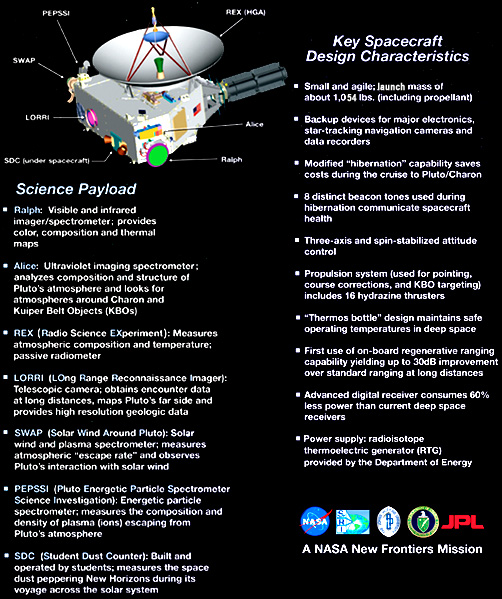
While on its way to Pluto, New Horizons has been doing science in preparation for its ultimate destination. This has included a rendezvous with Jupiter, training its seven cameras and sensors on that planet and its four largest moons. The spacecraft has sent the first images of Pluto and Charon back to Earth as it has crossed the orbits of Uranus and Neptune. When it finally arrives in three years it will, as have all our other outer planet robotic spacecraft, alter our knowledge of the Solar System once again. We will learn more about the worlds of the outer Solar System and identify new Kuiper Belt Objects to add to our growing collection of neighbours.
]]>With Jupiter our first destination, followed by Saturn, two members of the Asteroid Belt, and Pluto and Charon, these voyages straddled the end of the 20th and beginning of the 21st century. So let’s begin with our return to Jupiter on a spacecraft named Galileo and then discuss other missions in progress or planning and why we keep going back to this gas giant.
What compelled us to return to Jupiter after the successes of the Pioneer and Voyager missions? There were lots of unanswered questions about Jupiter, when it formed, where it formed whether it has a solid core and its structural composition, and which if any of its moons had liquid water and the ability to sustain life. We wanted to understand how one moon, Io, could be constantly going through the throws of reforming its crust with more active volcanoes than any other body in the Solar System including Venus.
Galileo – A Voyage of Discovery That Changed Our View of Jupiter and its Moons Forever
The Galileo mission was designed to address some of these questions. A spacecraft designed in the 1980s, it took nearly six years from its launch in 1989 to get to Jupiter. Its route took it first by Venus once and Earth twice before developing the gravity-assisted speed necessary to coast past Mars and through the Asteroid Belt to Jupiter.
While on route it rendezvoused with two asteroids, first Gaspra in 1991 and later Ida in 1993. While passing Ida it captured a picture of the asteroid and its accompanying moonlet named Dactyl. A year later on approach to Jupiter it bore first-hand witness to the destruction of Comet Shoemaker-Levy as it impacted the planet.
Galileo finally arrived at Jupiter in December 1995. It launched a companion atmospheric probe on July 13, 1995. The probe descended through 200 kilometers (124 miles) of the planet’s outer atmosphere collecting data on local weather conditions – for July 13, a dry day with a few clouds and distant lightning. As the probe descended further it experienced winds exceeding 720 kilometers (450 miles) per hour and finally vaporized in the intense heat of the atmosphere after 61 minutes of transmission.
Galileo’s path around Jupiter took it in long elongated orbits around the planet, each averaging about two months. The orbits allowed the spacecraft to sample Jupiter’s magnetosphere in different locations while performing close rendezvous with Jupiter’s many moons. After 35 of these orbits and almost eight years of operation in the planet’s vicinity Galileo was instructed to self-destruct in the Jovian atmosphere to avoid a potential contaminating impact with the moon Europa.
What answers did Galileo give us to the questions we had about Jupiter and the Jovian system?

Because of these discoveries and the many still unanswered and new questions that arose from Galileo’s mission, Jupiter is once again to be visited by a new spacecraft, Juno, that will focus on the planet exclusively. The Juno mission will be followed by a new robotic spacecraft, Juice, with a mission to study the Jovian system and in particular its ice moons.
Juno – Dissecting Jupiter to Understand How the Solar System Formed
Jupiter is the largest planet in the Solar System. Its mass is greater than all the other planets combined. Scientists theorize it was the first planet to form out of the nebula that condensed to form our proto-Sun and its planetary companions. What is not known is where Jupiter formed? The presence of large quantities of noble gases as found by Galileo suggests that Jupiter may have formed much further out than its present position as fifth planet from the Sun. Juno, the next mission to Jupiter may provide us with answers and help us learn more about the earliest period in the Solar System’s formation.
In returning to Jupiter with Juno the goal this time is to focus on the planet itself and not the larger Jovian system. Scientists hope to learn more about the origins of the Solar System by studying Jupiter, its composition, whether it has a solid core, and the mechanism behind its powerful magnetic field.

Juno is a very different spacecraft than Galileo. It is solar powered. Galileo was powered by a Radioisotope Thermal Generator (RTG). In choosing solar over RTG the spacecraft designers have built a significant solar array with three panels, each 2 meters (6 1/2 feet) wide and 9 meters (almost 30 feet) in length. The size of this array is significantly larger than any previous robotic spacecraft. Why? Because sunlight near Jupiter is 27 times weaker than sunlight near Earth.
In addition the spacecraft is designed to fly with its solar panels always sun facing to maximize its ability to power the instrumentation package on board (see image below).
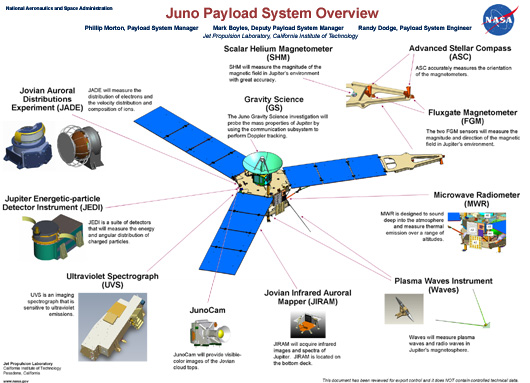
Upon its arrival in 2016 Juno will enter a close polar orbit around the planet taken it within 100 kilometers of the cloud tops. In this way Juno will be less exposed to the Jovian magnetosphere while it directs its scientific instruments at studying the planet below. After 32 to 33 orbits taking approximately one year the plan is to deorbit the spacecraft to burn up in the atmosphere in October 2017.
Juice – Europe’s Contribution to Exploring the Jovian System
The Juno mission is not our last visit to the vicinity of Jupiter. Other missions are planned including a lander with technology to drill into the surface of Europa to sample its subsurface ocean, and a new mission from the European Space Agency (ESA), named Juice, planned for a launch in 2022 with arrival at Jupiter by 2030.
Juice stands for Jupiter Icy Moons Explorer. The mission will study Europa, Ganymede and Callisto. The spacecraft will make several flybys of these moons while doing further studies of Jupiter’s atmosphere and magnetosphere and how the latter interacts with its moons. The plan includes a final rendezvous with Ganymede with Juice entering into orbit around that moon in 2032.
In choosing Ganymede as its final destination Juice will study its atmosphere, icy surface, internal structure and subsurface ocean as well as its unique magnetosphere.
Our next stop in our exploration of the outer planets – Saturn.
]]>In the late 20th century NASA conceived of a different Grand Tour. A wonderful confluence of planetary alignment became the motivator to develop technology and a plan to rendezvous with Jupiter, Saturn, Uranus and Neptune. This Solar System confluence occurs every 176 years and was going to happen in 1977. So NASA began planning in the 1960s to meet the objective of doing a Grand Tour of the outer planets of the Solar System. To do this NASA needed to work some things out.
Before launching its Grand Tour NASA had to test the technology it was developing. It did this through an interim mission involving two spacecraft, Pioneer-10 and Pioneer-11. Both were highly successful in reaching Jupiter and Saturn.
Getting to Jupiter and Saturn
A space mission to Jupiter bears little resemblance to one going to Mars. Mars is 227 million kilometers from the Sun. Earth is 150 million as a comparison. We use the distance of the Earth from the Sun as a measure we call an Astronomical Unit or AU. So Mars is 1.5 AU from the Sun. Jupiter on the other hand is 5.2 AU from the Sun.
To go from Earth to Jupiter you have to calculate where Jupiter is in its orbit related to Earth. That distance can be as close as 628 million kilometers or as far away as 928 million. Pioneer-10 launched on March 2, 1972. It was atop a three-stage Atlas-Centaur rocket with the third stage providing added thrust to achieve an escape speed of 52,000 kilometers (32,400 miles) per hour making it the fastest human-built object of its time. It passed the Moon in 11 hours and crossed the orbit of Mars in 12 weeks. A month later on April 6 Pioneer-11 followed.
NASA built both spacecraft using aluminum with boron-epoxy tubes. The instrument payloads included attitude controllers using radio beacons to maintain direction, television cameras for taking pictures of the planets, magnetometers, plasma analyzers, charged particle. ionizing and micro-meteoroid detectors, photometers, radiometers, photopolarimeter and transmission equipment to send telemetry and photographs to an Earth-based Deep Space Network of communication stations located in California, Spain and Australia. Both craft used hydrazine propulsion thrusters, silver-cadmium batteries and a Radioisotope Thermoelectric Generator (RTG). The RTG used thermocouples to convert heat to electricity from the radioactive decay of plutonium.
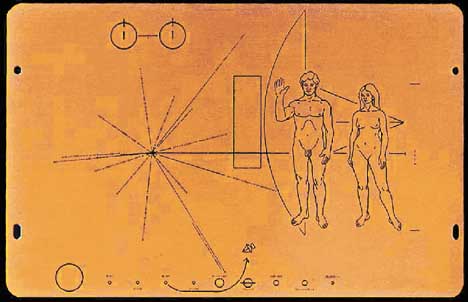
Neither spacecraft were large weighing approximately 260 kilograms (570 pounds). Both spacecraft carried a gold plaque on which information was inscribed about their origin.
Pioneer-10 was first to traverse the Asteroid Belt between Mars and Jupiter. With that success Pioneer-11 was instructed to fire its thrusters to increase velocity and change its aiming point so that Jupiter’s gravity would assist it in going on to Saturn.
Although Pioneer-10 was first to be launched it arrived at Jupiter, the first week of December 1974, a day after Pioneer-11. Both spacecraft relayed data and images about the Jovian system, its moons, magnetic field, and the presence of the solar wind. Pioneer-10 came within 130,000 kilometers (81,000 miles) of the planet’s cloud top. Pioneer-11 was even closer, just 43,000 kilometers (26,725 miles) above Jupiter’s clouds. That close approach increased the spacecraft’s speed to 173,000 kilometers (108,000 miles) per hour taking it the next 2.4 billion kilometers (1.5 billion miles) to rendezvous with Saturn.

Pioneer-11 reached Saturn on September 1, 1979 passing within 20,800 kilometers (13,000 miles) of the planet and sending back remarkable pictures that included the rings. Pioneer-11 discovered two Saturnine moons and an additional ring while studying the planet’s magnetosphere.
Both spacecraft continued to operate well beyond the completion of their primary missions with Pioneer-11 studying interplanetary space until the mid-1990s, and Pioneer-10 transmitting past the year 2000. In these two robotic spacecraft NASA had proven it could build reliable technology for the Grand Tour that soon was to follow.
The Grand Tour
For the Grand Tour NASA built two of the most complex unmanned spacecraft ever designed. Dubbed Voyager-1 and 2, the latter was launched first on August 20, 1977 aboard a Titan-Centaur rocket. Voyager-1 followed on September 5 but it was launched on a faster, shorter trajectory to have it arrive at Jupiter first.

Like their predecessors reliability over a long-duration flight meant the spacecraft would need to detect and react to internal problems without human intervention. This required the development of on-board artificial intelligence. Instrumentation included high-gain antennas, detectors of all kinds to conduct 10 different experiments, and television cameras. Both spacecraft used RTGs similar to those on Pioneer-10 and 11. They each weighed about 800 kilograms (1, 760 pounds).
Voyager-1 arrived at Jupiter on March 5, 1979. Voyager-2 followed on July 9. Voyager-1 reached Saturn on November 12, 1980 followed by Voyager-2 on August 25, 1981. The trajectory of Voyager-1 took it close to Saturn’s largest moon, Titan. The trajectory made it impossible for the spacecraft to rendezvous with Uranus and Neptune. But Voyager-2’s trajectory positioned it well for a flight to the two remaining gas giants beyond arriving at Uranus in January of 1986, and Neptune in August of 1989.
What did the two spacecraft discover? The list of firsts is amazing:

Together the two spacecraft visited more worlds than any previous spacecraft. And to this day they continue to operate, an incredible technological design achievement. As of February 2012, 35 years after launch, Voyager-1 continues to transmit data to Earth from a distance of 17.9 billion kilometers (11.1 billion miles) from the Sun, the farthest a human-made object has ever travelled. On a different trajectory Voyager-2 in February reached 14.6 billion kilometers ( 9.05 billion miles).
No voyage of human discovery has ever equalled the two Voyager missions.
]]>
