
Juno made its closest approach, a mere 4,200 kilometers (2,500 miles) above Jupiter’s atmosphere. In addition to the images taken (the one appearing above was snapped two hours prior to the spacecraft’s closest approach to the north pole), Juno took infrared images (see photograph below) as well as recordings of radio emissions, capturing the sounds emanating from the planet below. Another instrument detected emissions of the particles that are responsible for Jupiter’s massive auroras, similar to our Northern and Southern Lights on Earth. Scientists hope to figure out the generating source of these particles.

The picture below is the first ever taken from Jupiter’s southern pole. It was taken 94,500 kilometers (58,700 miles) above the cloud tops of the planet. Similar to the image of the northern pole, the south shows a mottled group of storms of various sizes. Each is larger than the largest hurricane found here on Earth. Note some rotate clockwise while others appear to be counterclockwise.

This is just the first of 36 planned orbits of Jupiter. The 35 remaining will add immensely to our understanding of the Solar System’s largest planet. The mission is scheduled to end in February 2018 when the spacecraft will plunge into the planet’s atmosphere and disintegrate. Before then we hope to learn more about what lies beneath Jupiter’s immense atmosphere. Scientists hope to understand how Jupiter formed and what caused its mostly hydrogen and helium atmosphere to coalesce around a strong gravitational centre which may prove to be a rocky planetary core. One theory proposed states that Jupiter formed in an unstable region within the swirling nebula that had at its centre a proto-Sun. This unstable region triggered the development of the massive planet. But it doesn’t necessarily mean that there is a rocky centre. Another theory speculates that Jupiter formed after the Sun from sweeping up most of the remaining material in the nebula and leaving just enough for the other planets to form.
Juno should also refine our understanding of Jupiter’s atmosphere, its composition and structure. We already have had one of our assumptions proved incorrect in the polar images sent back to us from the spacecraft. The belts of clouds we have always associated with the planet are nowhere in evidence at either of the two poles. We now need to understand why that is.
Now the real mission begins as the spacecraft begins circling the planet for 37 orbits (see illustration below) before crashing into Jupiter’s atmosphere in 2018. Each of the first two orbits will take two months. then Juno will settle into a series of much tighter elliptical orbits of approximately 14 days. The last orbit will graze the very top of Jupiter’s thick atmosphere causing the spacecraft to disintegrate. The mission scientists don’t want the spacecraft to remain circling Jupiter indefinitely out of fear that it could encounter a Jovian satellite and crash there. The big concern is Europa where a liquid ocean lies beneath the surface. So better Juno vanish and die beneath Jupiter’s clouds then potentially contaminate a place where there may be alien life.

The orbits are polar (see image below) so they will minimally intersect with Jupiter’s magnetic field, 20,000 times more powerful than Earth’s Van Allen Belts. Even so on board instrumentation will be exposed to radiation unlike any previous spacecraft has encountered. To combat this, therefore, the electronics are encased in a titanium vault.

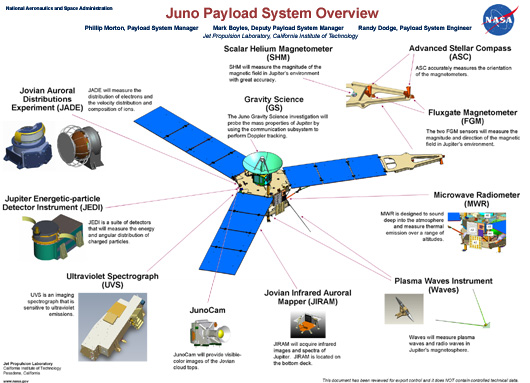
What type of instruments does Juno carry?

Juno gets power from its enormous solar panels that span 20 meters (66 feet) and are designed to capture energy from the light of a Sun five times more distant than here on Earth. Throughout the mission the spacecraft will remain in sunlight continuously so the likelihood of the instrumentation losing power is zero. But for redundancy the scientists have designed the package to require full power only 6 hours during each orbit of the planet.
When will we see the first close ups of Jupiter? On August 27 when the spacecraft completes its first orbit. It should make a close pass over the north pole allowing us to see Jupiter’s amazing clouds and its version of the Northern Lights. A second burn planned for October 19 will regularize Juno’s orbit to 14-days. And that’s when the real science will begin.
With Jupiter our first destination, followed by Saturn, two members of the Asteroid Belt, and Pluto and Charon, these voyages straddled the end of the 20th and beginning of the 21st century. So let’s begin with our return to Jupiter on a spacecraft named Galileo and then discuss other missions in progress or planning and why we keep going back to this gas giant.
What compelled us to return to Jupiter after the successes of the Pioneer and Voyager missions? There were lots of unanswered questions about Jupiter, when it formed, where it formed whether it has a solid core and its structural composition, and which if any of its moons had liquid water and the ability to sustain life. We wanted to understand how one moon, Io, could be constantly going through the throws of reforming its crust with more active volcanoes than any other body in the Solar System including Venus.
Galileo – A Voyage of Discovery That Changed Our View of Jupiter and its Moons Forever
The Galileo mission was designed to address some of these questions. A spacecraft designed in the 1980s, it took nearly six years from its launch in 1989 to get to Jupiter. Its route took it first by Venus once and Earth twice before developing the gravity-assisted speed necessary to coast past Mars and through the Asteroid Belt to Jupiter.
While on route it rendezvoused with two asteroids, first Gaspra in 1991 and later Ida in 1993. While passing Ida it captured a picture of the asteroid and its accompanying moonlet named Dactyl. A year later on approach to Jupiter it bore first-hand witness to the destruction of Comet Shoemaker-Levy as it impacted the planet.
Galileo finally arrived at Jupiter in December 1995. It launched a companion atmospheric probe on July 13, 1995. The probe descended through 200 kilometers (124 miles) of the planet’s outer atmosphere collecting data on local weather conditions – for July 13, a dry day with a few clouds and distant lightning. As the probe descended further it experienced winds exceeding 720 kilometers (450 miles) per hour and finally vaporized in the intense heat of the atmosphere after 61 minutes of transmission.
Galileo’s path around Jupiter took it in long elongated orbits around the planet, each averaging about two months. The orbits allowed the spacecraft to sample Jupiter’s magnetosphere in different locations while performing close rendezvous with Jupiter’s many moons. After 35 of these orbits and almost eight years of operation in the planet’s vicinity Galileo was instructed to self-destruct in the Jovian atmosphere to avoid a potential contaminating impact with the moon Europa.
What answers did Galileo give us to the questions we had about Jupiter and the Jovian system?

Because of these discoveries and the many still unanswered and new questions that arose from Galileo’s mission, Jupiter is once again to be visited by a new spacecraft, Juno, that will focus on the planet exclusively. The Juno mission will be followed by a new robotic spacecraft, Juice, with a mission to study the Jovian system and in particular its ice moons.
Juno – Dissecting Jupiter to Understand How the Solar System Formed
Jupiter is the largest planet in the Solar System. Its mass is greater than all the other planets combined. Scientists theorize it was the first planet to form out of the nebula that condensed to form our proto-Sun and its planetary companions. What is not known is where Jupiter formed? The presence of large quantities of noble gases as found by Galileo suggests that Jupiter may have formed much further out than its present position as fifth planet from the Sun. Juno, the next mission to Jupiter may provide us with answers and help us learn more about the earliest period in the Solar System’s formation.
In returning to Jupiter with Juno the goal this time is to focus on the planet itself and not the larger Jovian system. Scientists hope to learn more about the origins of the Solar System by studying Jupiter, its composition, whether it has a solid core, and the mechanism behind its powerful magnetic field.

Juno is a very different spacecraft than Galileo. It is solar powered. Galileo was powered by a Radioisotope Thermal Generator (RTG). In choosing solar over RTG the spacecraft designers have built a significant solar array with three panels, each 2 meters (6 1/2 feet) wide and 9 meters (almost 30 feet) in length. The size of this array is significantly larger than any previous robotic spacecraft. Why? Because sunlight near Jupiter is 27 times weaker than sunlight near Earth.
In addition the spacecraft is designed to fly with its solar panels always sun facing to maximize its ability to power the instrumentation package on board (see image below).
Upon its arrival in 2016 Juno will enter a close polar orbit around the planet taken it within 100 kilometers of the cloud tops. In this way Juno will be less exposed to the Jovian magnetosphere while it directs its scientific instruments at studying the planet below. After 32 to 33 orbits taking approximately one year the plan is to deorbit the spacecraft to burn up in the atmosphere in October 2017.
Juice – Europe’s Contribution to Exploring the Jovian System
The Juno mission is not our last visit to the vicinity of Jupiter. Other missions are planned including a lander with technology to drill into the surface of Europa to sample its subsurface ocean, and a new mission from the European Space Agency (ESA), named Juice, planned for a launch in 2022 with arrival at Jupiter by 2030.
Juice stands for Jupiter Icy Moons Explorer. The mission will study Europa, Ganymede and Callisto. The spacecraft will make several flybys of these moons while doing further studies of Jupiter’s atmosphere and magnetosphere and how the latter interacts with its moons. The plan includes a final rendezvous with Ganymede with Juice entering into orbit around that moon in 2032.
In choosing Ganymede as its final destination Juice will study its atmosphere, icy surface, internal structure and subsurface ocean as well as its unique magnetosphere.
Our next stop in our exploration of the outer planets – Saturn.
]]>
