James Martin – Techso Mogro https://techsomogro.com/ Science, Technology and the Future Mon, 28 Oct 2013 16:14:29 +0000 en-US hourly 1 https://wordpress.org/?v=6.8.1 New Report Addresses Global Challenges and the Future https://techsomogro.com/report-now-long-term-addresses-global-challenges-future/?utm_source=rss&utm_medium=rss&utm_campaign=report-now-long-term-addresses-global-challenges-future https://techsomogro.com/report-now-long-term-addresses-global-challenges-future/#respond Mon, 28 Oct 2013 16:14:29 +0000 http://www.21stcentech.com/?p=12012 Prepared by the Oxford Martin Commission for Future Generations, the report is called “Now for the Long Term.” Published on October 16, it is a wake up call to politicians and business to address climate change, economic inequality, and human health. It was inspired by James Martin who before his death and reported here, described the many challenges humanity faces in the 21st century. The authors of the report represent a “who’s who” of thought, government and business leaders on the global stage who in compiling their list of recommendations talk about the lack of collective vision in human society and the need to develop shared global values in addressing the world of the 21st century. These include social, resource, health, geopolitical and governance challenges.

The report makes many specific recommendations addressing issues I describe in many of my postings written here at Techso Mogro blog. I have selected five to share with you:


  1. Creating a coalition of countries, companies and cities to develop an action plan to address climate change. The report calls this the C-20, C-30, C-40 coalition and suggests that G20 nations participate along with 30 selected companies and 40 cities. The coalition would set greenhouse gas and carbon targets. It would oversee transportation, buildings, urban infrastructure, industry, and energy and define goals for all in seeking practical, measurable reductions in carbon emissions.
  2. Setting up of Worldstat agency to become the arbiter of quality control for global data gathering to improve the accuracy and quality of information so that humanity can make informed decisions based on agreed to international, evidence-based standards.
  3. Removing unfair and “perverse” subsidies on hydrocarbons and agriculture redirecting human efforts to improve the quality of the environment and ensure that those who are hungry have access to affordable, nutritious food.
  4. Establishing best before dates for all publicly funded international institutions so that they have to apply for renewal of their mandates to ensure that they meet the needs of the 21st century.
  5. Investing in youth to end the bankruptcy of opportunity and latent poverty they face and ensure continuity for all of society and specifically a meaningful, healthy future for them in the 21st century.


Pascal Lamy, former Director-General of the World Trade Organization, and the chairman for this report states, “20th century structures and institutions are poorly equipped for 21st century challenges…organised along out of date geopolitical lines, where those with a diminishing stake retain disproportionate power.” Lamy is talking here about the revamping of global structures for governance in making this statement, questioning the relevance of the present mix of institutions like the UN Security Council and asking if power to make decisions should be redistributed so that all humanity isn’t put at peril by political gridlock on issues of global consequence such as climate change.

In the Executive Summary of the report it concludes with the following: “Now for the Long Term aims to stimulate action and debate.  Commissioners look forward to engaging with governments, businesses, NGOs and civil society in order to take these ideas and  recommendations forward in the months and years ahead.”

So for me the take away action is to ensure the widest dissemination of the content of this report. I urge you as readers of Techso Mogro blog to make others aware, email, text and Twitter about it. Post a link on your Facebook and LinkedIn pages. If you are politically active engage your local riding association, your congressman, member of parliament, city councilor, state or provincial representative. Make them aware. Talk about it with business colleagues. Organize meetups. Otherwise this Commission’s efforts will be unheard and none of what it proposes will be acted upon.


ChangeTheWorld


]]>
https://techsomogro.com/report-now-long-term-addresses-global-challenges-future/feed/ 0
Transportation and Communication Update: The Internet of Cars is a Near Thing Today https://techsomogro.com/transportation-communication-update-internet-cars-today/?utm_source=rss&utm_medium=rss&utm_campaign=transportation-communication-update-internet-cars-today https://techsomogro.com/transportation-communication-update-internet-cars-today/#respond Thu, 27 Jun 2013 15:19:40 +0000 http://www.21stcentech.com/?p=10507 Before beginning today’s posting describing the rise of wireless vehicle networks I want to remember James Martin, futurist, telecommunications guru, and prolific author (104 books) who I had the pleasure of meeting when I worked in the publishing industry back in the 1970s. He was an intellectual force with brilliant insights into what the future would bring. I had written a blog posting commenting on a book he published last year called The Meaning of the 21st Century, in which he posed 16 challenges humanity faces. If you haven’t had the opportunity to read it you can get a sample at the following link.

Dr. Martin would have liked the subject of today’s posting. It is something he anticipated through the convergence of artificial intelligence,  wireless telecommunications and cars. The terminology describes all of this as vehicle-to-vehicle communication. But it is more than that. In the age of the Internet of Things, not just vehicles can talk to each other. So can the roads, signs and other transportation infrastructure get involved in the conversation. What this inevitably means is higher degrees of safety, less use of fossil fuels, and less polluting carbon.

Rsearch is being done at UMTRI short for University of Michigan Transportation Research Institute. Its goal is summed up by Director Peter Sweatman who states:

“Integrating the most promising approaches to mobility into a coordinated system could reduce motor vehicle fatalities and injuries as well as energy consumption and carbon emissions by as much as a factor of ten….we also estimate that freight transportation costs could be cut by a factor of three, and the need for parking could go down by a factor of three.”

To achieve these welcome results UMTRI in cooperation with the U.S. Department of Transportation is conducting the largest real-world experiment involving vehicle-to-vehicle communication in Ann Arbor, Michigan. This is ongoing right now and involves ordinary drivers who have lent 2,800 vehicles to the project, a mix of cars, trucks, buses, motorcycles and bicycles. All have been fitted with short-range transmitters and receivers that can broadcast a signal approximately 300 meters (1,000 feet). The connection is through specialized Wi-Fi operating at 5.9-Gigahertz on a network designed specifically for vehicles on the move. Not all the vehicles in the test are outfitted equally. Some just broadcast information to other vehicles in the moving network. Others though will receive warnings based on what is happening to cars and other vehicles in their immediate vicinity. For example, if a car a few vehicles ahead suddenly brakes, a car that receives warnings will see a dashboard alert appear.

This type of vehicle-to-vehicle information sharing has enormous implications. Internetworked cars can eliminate transportation bottlenecks by adjusting speeds to optimize traffic flow. Internetworked cars can anticipate and avoid collisions. And optimizing vehicle flow can reduce carbon emissions and fuel consumption, both highly desirable outcomes. The first results will be published in August of this year.

UMTRI is not alone in developing a standard for vehicle-to-vehicle communication. Google has been experimenting with autonomous vehicles that interact without human intervention. And in Europe, Car2Car represents an attempt to create an open standard for internetworking the transportation infrastructure. Add to this mix smart highways such as those being developed in the Netherlands and you have a formula for greater vehicle safety, energy savings and reduced polluting greenhouse gases. It’s hard not to want to jump on this bandwagon. I think Dr. Martin would have approved.

 

USDOT_safety-pilot01

]]>
https://techsomogro.com/transportation-communication-update-internet-cars-today/feed/ 0
Biomedicine Update: The Future of Medicine is the iDoctor https://techsomogro.com/biomedicine-update-future-medicine-idoctors/?utm_source=rss&utm_medium=rss&utm_campaign=biomedicine-update-future-medicine-idoctors https://techsomogro.com/biomedicine-update-future-medicine-idoctors/#respond Sun, 30 Dec 2012 16:54:36 +0000 http://www.21stcentech.com/?p=8152 If some pundits are right, 80% of doctors will find themselves replaced by machines in the 21st century. What kind of machines? Well more a combination of hardware and a big dollop of software to create iDoctors, computers backed by Internet-based datasets with artificial intelligence front ends and powerful analytical capability. Like Watson, the machine that whipped two human trivia champions on Jeopardy, these iDoctors would feature computers as far removed from the laptop, tablet or desktop system you are using to read this blog. They will be minimally multiple-arrayed parallel processors, and later on neuromorphic computer systems.  They will be able to assess a patient through observation and questioning. They will then suggest suitable tests, evaluate the results, make a diagnosis and come up with recommended treatment. They will be able to do this with minimal medical supervision and only if surgery or complex treatment is prescribed will require human second opinions.

Watson MD

Back in the 1970s, James Martin, the futurist and telecommunications guru, described in his book, The Wired Society, a scenario in which a patient would be pre-screened before being seen by a doctor. The pre-screening involved the patient answering a series of questions that appeared on a computer screen and based on the answer the computer would then choose the next question to ask. The program resembled a large decision tree with branches going off in all directions based on how each patient responded. In the end the computer could narrow down the investigation and advise medical staff in a report. This concept preceded the existence of the Internet and the availability of massive amounts of information from which a human or computer intelligence could draw.

Today anyone with access to the Internet can visit medical websites like WebMD, or NetDoctor and look up symptoms to try and do self-diagnosis. These sites and the online encyclopedia Wikipedia, are filled with information. What they lack is a screening mechanism in the form of an intelligent front end that can interact with the information seeker based on an understanding of symptoms and implications. Back when James Martin was writing, medical artificial intelligence was in its infancy. The systems used symbolic models of disease and related them to what the patient was describing. Today’s artificial intelligence systems, however, employ neural network architecture and can draw on vast data resources in offering an opinion on a diagnosis.
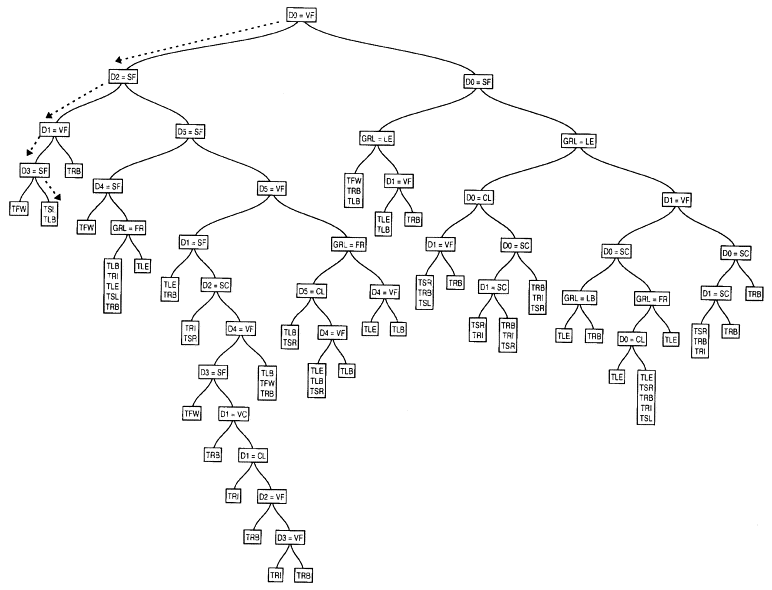
Artificial intelligence employs decision trees similar to the one depicted above to come up with diagnoses. Based on a patient's responses the program chooses different paths in its question and answer process.
Artificial intelligence employs decision trees similar to the one depicted above to come up with diagnoses. Based on a patient’s responses the program chooses different paths in its question and answer process.

Combined with widespread use of electronic medical records and surgical medical robotics, the age of the machine and the iDoctor is near at hand. Will patients be better off getting diagnosed by a machine rather than a human MD? An artificial intelligence-based medical system will be cheaper than one that is human-based. It will be more individually focused having access to a patient’s DNA profile and medical history. This will take subjective human opinion out of the mix. It will be able to interact, read and even adjust any broadcast capable medical devices used by a patient, whether a smartphone ECG reader that the patient uses regularly, or blood sugar home testing equipment, or even internal devices like pacemakers or medical nanobots. As a result the iDoctor will likely be faster and more accurate in diagnosis than 80% of existing MDs today.

Hence my opening comment. Want to try a taste of the future? Check out Androctor Anna.

Androctor


]]>
https://techsomogro.com/biomedicine-update-future-medicine-idoctors/feed/ 0
Identifying the Problems of the 21st Century – A Commentary on James Martin’s 16 Challenges https://techsomogro.com/identifying-the-problems-of-the-21st-century-a-commentary-on-james-martins-16-challenges/?utm_source=rss&utm_medium=rss&utm_campaign=identifying-the-problems-of-the-21st-century-a-commentary-on-james-martins-16-challenges https://techsomogro.com/identifying-the-problems-of-the-21st-century-a-commentary-on-james-martins-16-challenges/#comments Sat, 10 Mar 2012 00:59:10 +0000 http://21stcentech.wordpress.com/?p=3017 When I was a younger man working in the world of information technology I was an avid reader of James Martin’s books on computers and telecommunications.

Dr. James Martin, author of “The Meaning of the 21st Century”

Recently I came across “The Meaning of the 21st Century,”  in which he outlines 16 challenges that humanity faces in 21st century. I’ve added comments of my own in Italics.

  1. GLOBAL WARMING Global warming will lead to severe climate change. Unless stopped, it will upset the basic control mechanisms of planet Earth.
  2. EXCESSIVE POPULATION GROWTH World population may grow to 8.9 billion people, with a growing demand for consumer goods and carbon-based energy, far exceeding what the planet can handle. Forecasts of population growth indicate human population will start to peak around mid-century, level out and then slowly decline. Peak variable projections indicate a population as little as 9 billion or as high as 12 billion.
  3. WATER SHORTAGES Rivers and aquifers are drying up. Many farmers will not have the water essential for food growing. There will be wars over water. Freshwater is one of the most challenging issues we face.
  4. DESTRUCTION OF LIFE IN THE OCEANS Only 10% of edible fish remain in the oceans, and this percentage is rapidly declining. Aquaculture is only a partial solution to the problem of the collapse of fish stocks. Climate change influencers like CO2 are acidifying the ocean changing impacting krill, coral and shellfish, principal food sources for most marine life.
  5. MASS FAMINE IN ILL-ORGANIZED COUNTRIES Farm productivity is declining. Grain will rise in cost. This will harm the poorest countries. Agricultural production in the Developing World needs to reach the same yield levels as in the factory farms of the Developed World replacing subsistence agriculture.
  6. THE SPREAD OF DESERTS Soil is being eroded. Deserts are spreading in areas that used to have good soil and grassland. Grazing and improper land use including deforestation continue to impact soils in the Developing World contributing to desertification.
  7. PANDEMICS AIDS is continuing to spread. Infectious pandemics could spread at unstoppable rates, as they have in the past, but now with the capability to kill enormous numbers of people. Although pandemics will always put humans at risk we have the means today to contain outbreaks and develop rapid response to them when they occur.
  8. EXTREME POVERTY 2 to 3 billion people live in conditions of extreme poverty, with lack of sanitation. The difference between rich and poor is becoming ever more extreme. This is even a problem in the Developed World as indicated by the recent Wall Street protest movement and Arab Spring.
  9. GROWTH OF SHANTYCITIES Shantytowns (shantycities) with extreme violence and poverty are growing in many parts of the world. Youth there have no hope. We need a global commitment to addressing informal urban environments and the poverty and despair associated with these areas.
  10. UNSTOPPABLE GLOBAL MIGRATIONS Large numbers of people are leaving the poorest countries and shantycities, wanting to find a life in countries with opportunity. Migration from rural to urban is happening today at the rate of 80,000 per day. Migration from the Developing World to the Developed is increasingly more difficult although illegal immigration continues at a steady if not increasing pace.
  11. NON-STATE ACTORS WITH EXTREME WEAPONS Nuclear or biological weapons are becoming easier to build by terrorist organizations, political groups or individuals, who are not acting for a given state. The evidence of this development frames the beginning of the 21st century and may be with us for a long time to come.
  12. VIOLENT RELIGIOUS EXTREMISM Religious extremism and jihad may become widespread, leading to large numbers of suicide terrorists, and religious war between Muslims and Christians. This is nothing new. Religion, nationalism, and tribalism have been a part of the human condition and will continue. The real challenge will be to overcome our baser nature.
  13. RUNAWAY COMPUTER INTELLIGENCE Computers will acquire the capability to increase their own intelligence until a chain reaction happens of machines becoming more intelligent at electronic speed. Artificial intelligence and humanity will experience convergence throughout the century. The question will become can we distinguish one from the other?
  14. WAR THAT COULD END CIVILIZATION A global war like World War I or II, conducted with today’s vast number of nuclear weapons and new biological weapons, could end civilization. War in the 21st century will be fought in entirely new ways. Cyberattacks, militarization of space and new weapon technology (robotics, lasers) will change war just as the first atomic bomb altered the rules of warfare in the 20th century leading to the disappearance of global conflicts only to be replaced by regional wars.
  15. RISKS TO HOMO SAPIEN’S EXISTENCE We are heading in the direction of scientific experiments (described by Lord Martin Rees) that have a low probability of wiping out Homo sapiens. The combination of risks gives a relatively high probability of not surviving the century. Humanity will survive the century. This is just too pessimistic.
  16. A NEW DARK AGE A global cocktail of intolerable poverty and outrageous wealth, starvation, mass terrorism with nuclear/biological weapons, world war, deliberate pandemics and religious insanity, might plunge humanity into a worldwide pattern of unending hatred and violence – a new Dark Age. We are just as likely to emerge at the end of the 21st century with entirely new purpose as we look outward bound beyond our planet while using technology to restore much of what the Industrial Age has wrought.

In my blog I don’t just point out the problems but show how our human inventiveness is finding solutions. Nonetheless, James Martin has pointed out challenges we must face and overcome for humanity and the other travellers on our planet.

]]>
https://techsomogro.com/identifying-the-problems-of-the-21st-century-a-commentary-on-james-martins-16-challenges/feed/ 2