Many technical challenges are holding back the commercial development of fusion energy. One is the amount of energy needed to kickstart the ignition of sustained fusion. Vast amounts are used to kickstart fusion ignition, the point where a sustained nuclear reaction occurs. Until recently it has taken far more energy going in than has been coming out which defeats the entire exercise.
In December of 2022, the Lawrence Livermore National Laboratory (LLNL) in California was the first to achieve ignition with an experiment that produced more energy than it took to get the fusion going. LLNL used 192 lasers that focused on a tiny hollow cylinder the size of a pencil eraser. The cylinder contained a capsule of deuterium and tritium. The heat generated from the lasers reached 3 million Celsius (5.4 million Fahrenheit) which vaporized the capsule and caused the capsule to implode at a speed of 400 kilometres (248 miles) per second fusing the two elements. The output yielded 3.15 million joules, 1.5 times the energy needed to obtain ignition.
A repeat of the experiment in July 2023 produced a 1.9 times energy gain. Another experiment in October 2023 further upped the ante. LLNL states that its goal is to achieve fusion reactions yielding 10 times more energy than goes into them.
But is LLNL telling the whole story? I have my suspicions based on the latest experiments from the Joint European Torus (JET) facility in the United Kingdom. The EUROfusion partnership announced on February 8, 2024, that its controlled fusion experiment yielded 69 megajoules of sustained and controlled energy, considerably more than the LLNL experiments.
The JET facility contains a doughnut-shaped chamber called a tokamak. It is lined with magnets that trap hot plasma containing a mix of deuterium and tritium inside. The heat created is significantly higher than LLNL with temperatures hitting 150 million Celsius (270 million Fahrenheit). JET, which will be shut down shortly, is described as the largest and most successful fusion experiment in the world. But JET data shows its energy yield to be a third of the amount being put in to get sustained controlled fusion. The energy value is measured in Qs. The LLNL experiments have so far yielded a Q value of 0.7 and only for about 4 billionths of a second. That contradicts LLNL’s announcements of greater energy output.
ITER is the multinational fusion reactor project that was supposed to be completed in 2019 but remains unfinished. ITER uses a tokamak design and even when it is up and running with its first plasma in place in 2025, and full fusion complete by 2035, the facility will be an experiment and not a working commercial nuclear reactor. The goal is to sustain 500 Megawatt/hours of output by the latter date. Before it can be considered safe for commercial use, the heat generated to produce ignition will have to be managed.
Besides using tokamaks to create controlled fusion, there are other tokamak designs like the one being developed by Commonwealth Fusion Systems. Some devices bear little resemblance to a tokamak. For example, the Wendelstein 7-X is a Stellarator that looks like a hundred intertwining Mobius bands. Or there is General Fusion’s Magnetized Target Fusion device, a sphere containing plasma and nuclear fuel surrounded by pistons that pound it until compression leads to ignition.
So where does AI fit in? AI can analyze billions of data points in fractions of the time needed by humans. It can be used to test designs and analyze materials used for the containment vessels. During testing and when operating commercially it can be the plasma chamber sentinel and controller, making adjustments in real-time to maintain sustained fusion safely. Finally, it can flag problems before they happen by being an effective predictive maintenance tool.
AI is already being viewed as a way to speed up the pace of getting to a commercial fusion reactor. Commonwealth has started using AI tools to provide real-time control and optimization of the plasma in its SPARC tokamak. EUROfusion is developing a set of AI tools for fusion that will be used for successors of JET and ultimately for ITER. I am certain this hasn’t escaped the attention of others in or entering the commercial fusion reactor race.
]]>Fusion reactors, not the fission ones we are using today, are seen as a source of clean and unlimited power but the delivery date on this technology has continued to recede into the future. Or so it would seem until now.
In yesterday’s Financial Times, Clive Cookson, Science Editor, reported that two British companies may have the fusion challenge figured out. Both are outgrowths of private laboratories. Their names are Tokamak Energy and First Light Fusion. And both have recently received significant private investment to continue the development of what they describe will be working commercial fusion reactors by 2030.
Tokamak Energy was recently named Disruptor to Watch in The Sunday Times Fast Track 100, one of ten picked by the U.K. publication in recognition of the potential of its technology to fundamentally change the energy industry. The company is on track to have an operational proof-of-concept by 2025, and a commercial power plant in operation by 2030. This year it made significant progress in the magnetic containment technology needed for achieving plasmas of 100 million degrees Celsius, the temperature needed for continuous controlled fusion.
First Light Fusion, a company spun out of Oxford University, has taken a different approach from magnetic contaiment of hot plasma to create its version of continuous controlled fusion. The company calls it an advanced implosion process that achieves the high temperatures and compressions to initiate fusion. Using a large number of copper projectiles fired at hypersonic speeds into a vessel containing deuterium and tritium fuel, in 2020, the company expects to demonstrate success producing more energy than needed to start the reaction. It has plans to have a commercial fusion plant on the grid by the early 2030s.
And then there is the Canadian company, General Fusion, who is targeting a 2030 date for a commercial fusion reactor of its own design. This month the company announced it had received $65 million from Jeff Bezos to build its first prototype plant. The technology it is developing is called Magnetized Target Fusion. It uses liquid-helium contained within a plasma that receives continuous pulses to drive up the pressure to create a continuous fusion reaction. The energy yield expected is ten times greater than the amount needed to start the reaction.
The above three represent fusion projects designed on a smaller scale. They are joined by other players including:
So is commercial fusion closer to joining the energy mix for a planet that craves more power every year? It would seem it cannot come fast enough because fusion may be the panacea for the planet in mitigating climate change. Commercial fusion produces no pollutants. Its deployment would allow utilities to end fossil fuel-based power generation once and for all.

]]>
The Ever Increasingly Expensive ITER Project
Europe is home to ITER, the reactor that is one of the test beds for commercial fusion energy. ITER is a design where a vessel, called a tokamak, is designed to contain an enormous magnetic field that traps hot plasma in a continuous state to produce a controlled fusion reaction. ITER has proven to be very expensive to build and its start up has been delayed many times. The current best guess date for the reactor start up is 2025. ITER’s goal is to achieve a 10-times increase in energy output over input. If successful, EUROfusion hopes to then build a commercail version called DEMO, a smaller reactor capable of generating several hundred megawatts of electricity. But the road from ITER to DEMO remains a long one according to Cartlidge. The ITER project will only run for minutes at a time. DEMO will have to run continuously. The design is not there yet. Hence long timelines between the test and commercial product.

Stellarator May Win the Fusion Reactor Race
ITER isn’t the only fusion reactor in the race. A different design called a stellarator has been built and tested in Germany. It is the Wendelstein 7-X (W7-X) and is not a tokamak. More a cross between donut and Mobius band, W7-X is smaller. And rather than creating a single steady-state plasma, it produces many smaller ones using a number of magnetic fields generated by the ring. It doesn’t have ITER’s symmetry but in performance appears to be on a faster track to achieve sustained commercial fusion. W7-X began operation in December of 2015 with experiments continuing to March of the following year before operators decided upgrades were in order to increase energy output. Those upgrades are now done and the fusion reactor, a cross between a donut and a Mobius band, appears to confine plasma and hold better than ITER.
W7-X began operation in December of 2015 with experiments continuing to March of the following year before operators decided upgrades were in order to increase energy output. Those upgrades are now done and the fusion reactor appears to confine plasma and hold with few discernible issues.
So W7-X may change Cartlidge’s pessimistic forecast.

MIT’s Alcator C-Mod Gets a Fuel Boost
But wait, another breakthrough may speed commercial fusion’s onset. Work being done at MIT, with assistance from laboratories in Brussels and the UK, have almost by accident discovered a new nuclear fusion fuel that appears to be containable in either tokamak or stellarator designs.
MIT is using its own tokamak in experiments called the Alcator C-Mod. It is purely a passive machine so not intended for commercial production. In September 2016, using the Alcator in a fusion experiment, researchers discovered that adding trace amounts of helium-3 to the normal fuel of 95% deuterium ions and 5% hydrogen, produced energy output increases of 1,000%. This would have been hard to discover in the much larger ITER or W7-X because the amount of helium-3 is minute. The “three ion” fuel discovery was published on June 19, 2017, in an issue of Nature Physics.
It should be interesting to see results when the fuel gets introduced into ITER and W7-X. With a potential of a 1,000% energy output boost, this enhanced fuel may speed up commercial fusion’s launch date to 2030 rather than after 2050.
And it should be noted, that going back to the Moon to mine its resources now may make even more sense than ever since helium-3, only available in small quantities here on Earth, has been detected in significant amounts lying right on the lunar surface.

The technology most associated with fusion energy is called a tokamak and the organization trying to build one successfully is ITER. Back in 2012 I described the state of nuclear energy and the ITER project which was to begin construction this year with an expected completion date of 2019. Whether ITER gets completed on time it remains a very costly experiment at $40 billion U.S.
Engineers at Massachusetts Institute of Technology, however, feel that a tokamak fusion reactor doesn’t have to be as big as ITER.
Why?
Because of advances in superconductors made possible by the use of rare earths like barium copper oxide, it is possible to produce stronger magnetic field coils to withstand the 150 million Celsius (270 million Fahrenheit) temperatures generated within the plasma field contained by those coils.
The engineers have dubbed their concept, ARC, standing for Affordable, Robust and Compact. ARC will be a 270 Megawatt tokamak. It will be half the size of ITER, take much less time to construct, and will be much easier to manage for the purpose of design improvement and experiments. Instead of solid materials surrounding the fusion chamber, ARC uses liquid which can easily be circulated and replaced. The fluid as coolant will not be subject to solid degradation, and as a result costly maintenance and replacement, a weakness of the ITER tokamak design.
One of the great challenges in fusion energy is the initial energy input required to get energy out. With many designs to date the net yields have been either negative or far too small on the plus side. With the smaller form factor and different materials ARC is expected to be capable of energy output three times greater than input and with further design improvements could even achieve a multiple of five or six. At 270 Megawatts it would be capable of lighting and heating a small city.
The concept is described in the upcoming July release of the journal Fusion Engineering and Design.

It would seem as we tackle the environmental consequences of our dependence on fossil-fuel energy that nuclear would be a suitable alternative. But when we look around the world Japan is wrestling with whether to remain in the nuclear reactor game after the post-tsunami Fukushima-Daiichi meltdown, and Germany is in the process of removing nuclear from its energy mix. So the nuclear energy industry is once again hard pressed to present its solutions as a saleable alternative to other energy generating technologies. But what if we could get fusion reactors going? Now that would make quite a different statement for nuclear power. Why? Because there’s a big difference between fusion and fission reactors.
Fusion vs. Fission
Fission relies on fuels like uranium and plutonium. These are fuels that can be found in nuclear weapons. The future of fission reactor technology is looking to thorium as a fuel that may serve as a restart for this type of energy generation.
Fusion, on the other hand, relies on deuterium and tritium, neither of which are bomb materials. And unlike uranium and plutonium, deuterium is abundant, found in one out of every 6,700 atoms in a cup of seawater, and in that fraction of a cup capable of producing the equivalent energy of 72 liters (19 gallons) of gasoline. That’s enough energy to drive my SUV from Toronto to Montreal and halfway back.
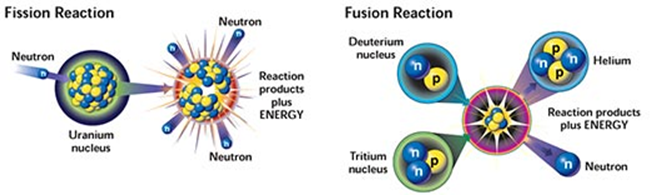
Fission brings sub-critical masses of fuel together to create a super-critical mass which starts a chain reaction that generates energy as a byproduct of the nuclear reaction. In fusion, on the other hand, the fuel gets heated to form a plasma which causes individual atoms to fuse together generating lots of energy as a byproduct.
Fission has been with us since shortly after World War II, a byproduct of building nuclear reactors to drive submarines. Naval engineers took their fission reactor designs and scaled them to create the nuclear power industry of today. Fission reactors have come in several different designs. Deuterium, heavy-water reactors, are Canadian manufactured. Light water reactors are commonly found in the United States. Fast breeder reactors can be found in France. And the Soviet Union has its own reactor designs. Today China is experimenting with thorium nuclear fission reactors. But in all of these different engineered solutions the principles remain the same. The nuclear reaction is used to generate heat and through a heat exchange system to create high-pressure steam to drive turbines connected to generators.
Fission Reactors are Not Fail Safe
We have seen several accidents in the last 40 years. Three-Mile Island, Chernobyl and Fukushima-Daiichi, all have shaken public confidence in fission technology.
Nuclear meltdowns at fission reactors pose enormous environmental problems with surrounding areas exposed to high and low doses of radiation. This happened at Chernobyl and Fukushima-Daiichi. In addition nuclear fission-based reactors create a spent fuel problem. Currently the majority of spent fission fuels get stored on premises at nuclear power plants, posing a continuing security and bio-hazard risk. The industry continues to seek a permanent burial site for what is a highly radioactive unusable byproduct of fission reactors.
Fusion Reactors are Safer
If we develop fusion reactors the inherent problems in current nuclear fission technology would vanish. Fusion energy reactors do not share the same problems associated with fission. The advantages include:
Using abundant raw materials that the Earth will never run out of, a fusion reactor can be the gold standard for nuclear energy generation going forward.
So Where Are We with Fusion?
Garage and Basement Fusors
It seems today that homemade fusion reactors, called fusors, are popping out everywhere. A recent edition of Popular Science magazine featured a story on Taylor Wilson, who at age 14 transformed his family garage in Reno, Nevada, into a nuclear laboratory with a working fusion reactor. He is not alone. According to Fusor.net, an online community of fusioneer hobbyists, there are lots of people building these low-powered fusion devices.
Fusors are based on a design originally created by Philo T. Farnsworth, the inventor of television in the 1920s. Thirty years later Farnsworth came up with the idea of a nuclear fusion reactor which he called Inertial Electrostatic Confinement or IEC. By confining atoms into a small space he created a process that would squeeze atoms so tightly that would fuse together.
The Fusor was born, but the problem with the technology he described was that it didn’t produce a net gain in energy, needing as much energy in to get the energy from the fusion reaction. That made the technology totally impractical for generating power.
Why do Fusors keep popping up in the world of hobbyists? Because two of Farnsworth’s colleagues in 1968 filed a patent for a device that was relatively inexpensive to build and included a vacuum pump, a stainless steel containment vessel, and a power source. Most basement and garage fusors to this day follow the design laid out in this patent. But no Fusor today creates a net energy gain so although fusion takes place it has little potential for solving our energy needs.

Fusion-Fission Hybrid Technology
From garages to major institutions, fusion is being worked on in laboratories and in joint ventures with private industry. One of these projects may even solve the problem of spent fuel from fission reactors.
In 2009 physicists at the University of Texas in Austin developed a concept they labelled a hybrid fusion-fission reactor. Called the Super X Divertor or SXD it included designs for generating neutrons through fusion that would then be fired at spent nuclear fuel from fission reactors. No larger than a small room each SXD would produce pure fusion energy while eliminating the waste fuel output from 10 to 15 light water fission reactors. With light water reactors predominant in the United States (over 100 in operation) this technology could eliminate the spent nuclear fuel problem. As of yet no commercial SXD has been built and it remains a concept only.

A Fusion Reactor Called LIFE
The Lawrence Livermore National Laboratory in California is home to Laser Inertial Fusion Energy, or LIFE. This is a technology at various stages in design and deployment. It uses deuterium and tritium fuel combined with a powerful laser to generate fusion for electrical power.
LIFE would include a target vessel containing a fusion chamber, blanketed by a suitable heat exchange material, an injection and tracking system to monitor the laser and reactor, the laser itself, turbines, generators and transmission lines (see diagram below).

When laser pulses reached the fusion chamber in the reactor temperatures would exceed 100 million degrees Celsius (180 million Fahrenheit). This would fuse the deuterium atoms and release energy in the form of high-energy neutrons (representing about 70% of the total energy generated), x rays, and high-energy ions. Each chamber would contain a meter-thick layer of lithium either in liquid, molten salt or solid form. The lithium would absorb the energy from the fusion reaction and provide a heat source at 600 degrees Celsius (1,112 Fahrenheit). That heat would be used to create super hot steam to drive a turbine connected to a generator. The lithium would produce an additional benefit as it is bombarded by neutrons, creating quantities of tritium to further fuel the reactor, minimizing the need to add fuel to sustain what would be in effect a continuous closed energy producing system.
Like Fusors, LIFE reactors have yet to produce more energy output than the energy going in although this is expected to change in 2012 with a goal to generate energy at 10 to 100 times greater than the energy required to fire the laser.
LIFE is competing with another even bigger project called ITER.
ITER: The Multinational Fusion Reactor Project
ITER is located in France and when completed in 2019 will be ramped up to produce the same type of energy yield as LIFE. Constructed by 6 partner nations and the European Union, ITER is big science.
Like the small science Fusor and the hybrid SXD, ITER creates high energy plasma using a confined magnetic field contained within a vacuum-sealed vessel. The ITER and SXD vessels are called tokamaks. The word tokamak comes from Russian and means a toroidal chamber containing a magnetic field and shaped like a doughnut. And that is exactly what the tokamak looks like (see the central chamber in the cutaway diagram below).
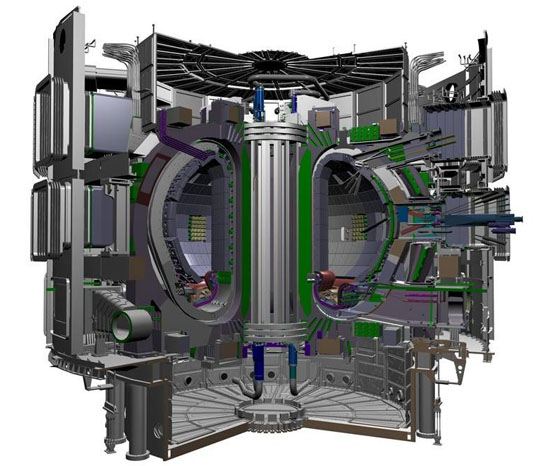
ITER uses deuterium and tritium as fuel. Within the magnetic field temperatures exceed 150 million degrees Celsius (270 million Fahrenheit). That’s hotter by far than temperatures in the Sun’s core. The magnetic field ensures that hot plasma never touches the sides of the chamber.
ITER recently announced a breakthrough developed at the University of Tennessee in Knoxville where engineers took two years to create a new material for the central solenoid, the superconducting coils that confine the plasma. Made from a combination of expoxy and glass fibers and cured at high temperatures, this material will ensure that the heat within the tokamak will not damage the magnetic field generators. It took two years to develop the technology and two days to inject it into the solenoid.
ITER has been more than 25 years in the making with conceptual design work started in 1988. The site is under construction in Aix-en-Provence in Southern France. Assembly of the tokamak is planned to start in 2015 with completion by 2018. The reactor will be fired up for the first time in 2019 and within a few years will be brought up to full power.
Fusion Reactors by 2030
At the beginning of this blog I mentioned 30 years, the usual timeline that “those in the know” make when talking about commercial fusion power generation. With the Super XD Convertor, LIFE and ITER, it appears that we will see fusion reactors well before 2042. In fact it looks very feasible for us to see a variety of technologies rolled out in commercial production by 2030. And who knows, maybe one of those garage and basement Fusors will start emitting excess amounts of energy and change the future of commercial fusion power generation even faster.
]]>
