That doesn’t mean the people of the Islamic World are not excited about scientific and technological progress. Just last week I wrote about the United Arab Emirates latest contest to award innovative developers of robots for use in healthcare, social services and other domestic needs. This week two more interesting stories have emerged. The first is a Jordanian announcement to install solar power at every mosque in the country. The second comes from Iran which recently launched its fourth domestic satellite and revealed its plans to send a human into space using its own launchers and a home grown space capsule.
Jordan’s Move to Solar
Two Jordanian government ministries have launched a tender to implement solar power initially in 120 mosques throughout the country with the final goal to have all 6,000 in the country using photovoltaic panels to generate energy.
One mosque in Amman may have been the inspiration for this initiative. Funded by congregants and local donors, the Abu Ghaweileh mosque is now powering its lighting and air conditioning using solar power. The mosque now sells its surplus energy to the national grid. This is only possible because in 2012 Jordan introduced net metering allowing the surplus from residential solar power installations to be sold back to the national utility.
When you consider the pushback against net metering from many U.S. power providers it makes you wonder who is actually participating in the energy revolution here in the 21st century.

Iranian Prototype Space Capsule Displayed at Technology Conference
At a ceremony this week to honour Iran’s achievements in space, President Hassan Rouhani posed in front of a mock up space capsule (see image below). One similar to this may be launched within the next two years possibly with an Iranian astronaut would be on board.
The country leadership in most recent announcements has made it clear that they intend to be the fourth nation to put a human into space. They are doing this with entirely home grown technologies.
The Iranian Space Agency (ISA) first achieved low-Earth orbit launch capability in 2009. In 2013 they successfully launched two monkeys into suborbital flights and safely returned them to Earth. Now they are gearing up to put a human into space. It is not known whether this first effort will be suborbital or they will attempt to attain low-Earth orbit.
For a country that has been economically sanctioned for unwillingness to disclose its nuclear plans, it is quite remarkable to find it attempting to join China, India and the United Arab Emirates in an Asian version of the Soviet-American 20th century Space Race.
Of course this latest event could be smoke and mirrors but based on the progress of the last five years both in launch capacity and the ability to build environmental systems that can sustain life in launch payloads, Iran may just succeed.

From these two announcements one can conclude that technological innovation in the 21st century has no political, religious or ideological boundaries.
]]>In my university days my field was Islamic Studies and Medieval History. I remembered writing essays about the rise of the original Umayyad Caliphate and how Islam embraced the legacy of Greece and Rome as well as science and technology from India and China in its first 500 years. This period in Islamic history formalized the mathematics that we know today as algebra (which comes from “al-gabr” which means restoration or completion in Arabic). I also studied the Ottoman Empire and its contributions to scientific and technology advancement.
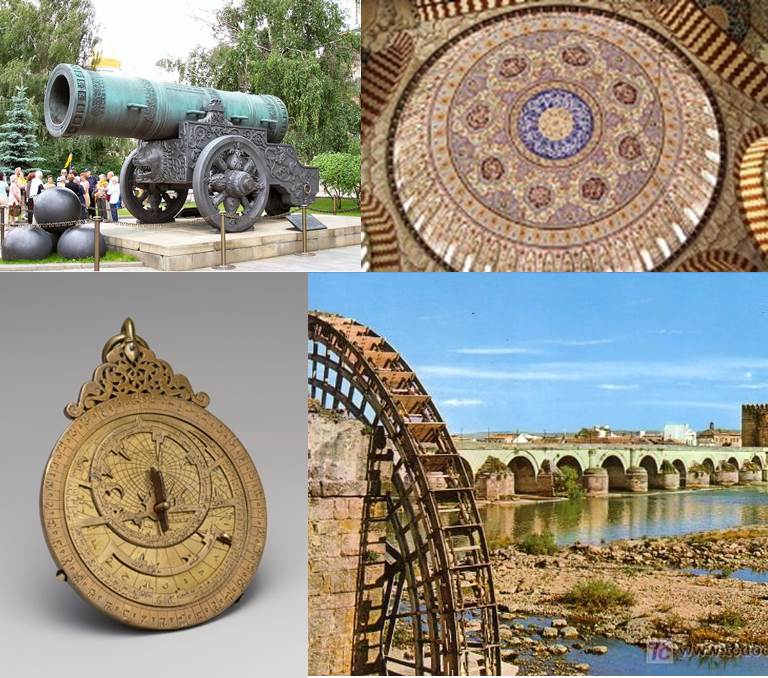
Indeed the inventions of Islamic scientists are many with a sample provided in the picture at the bottom of this posting. Islam made contributions to astronomy and celestial navigation (the astrolabe), geometry, trigonometry, chemistry, time keeping, engineering and building design (the water wheel and dome and vault construction), mathematics, medicine, and the military from musket to cannon.
It was Ottoman cannon that knocked down the wall of Constantinople in 1453. It was Ottoman muskets and other military advancements that created an empire that spanned Balkan Europe, the Ukrainian steppes and Crimea, Palestine, Lebanon, Syria, Mesopotamia, the Hijaz of Arabia and much of North Africa. So both in the theoretical and the practical, science and technology flourished and was put to effective use under a variety of Islamic dynasties.
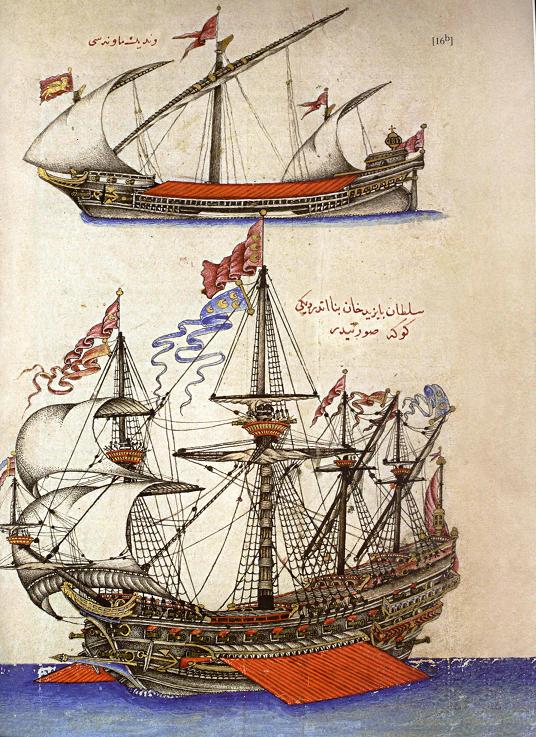
But in the 17th century, in its political and military confrontation with the Christian West, Islamic leadership turned its back on scientific and technical innovation in favor of tradition and religion. When you look at that history you can point to the moments in time when this happened, coinciding with the immediate period following the last attempt by the Ottomans to capture Vienna in 1683, and with a decline in the innovation culture that shows up very suddenly in the Otttoman navy even after the Battle of Lepanto in 1571, a battle that is described as having saved Christendom and the West. It didn’t because Ottoman sea power asserted itself well into the 17th century in the Mediterranean, Red and Arabian Seas. And then suddenly in the midst of building and outfitting new warships that incorporated Western square-rigging design, the work stopped and innovation came to an end.
The Ottoman Empire of the 18th century became the “Sick Man of Europe” as it underwent a loss of political and military power. For those who continued to study science and technology within it the methodologies of proof based on observation and not belief were discouraged. Islam under the Ottmans viewed the Western and Christian World as practicing a new religion called “scientism.”
To this day the Umma, Islam’s followers, continue to be impacted by the inability of political leadership of the day to embrace scientific methods so freely adopted in the Christian West. Which brings us to a question – is a teaching based on the Qu’ran naturally anti-science and anti-technology? Is the scientific method and a scientific outlook not possible under Islam? Is it the religion or the cultures that have adopted it that have made modern science and technology unacceptable?
The answer to the first is that today in Islam as in Christianity there are pro-science and anti-science advocates. In his efforts to create a reborn Turkey, Mustafa Kemal Ataturk, embraced science and is quoted as having said:
“We shall take science and knowledge from wherever they may be, and put them in the mind of every member of the nation. For science and for knowledge, there are no restrictions and no conditions. For a nation that insists on preserving a host of traditions and beliefs that rest on no logical proof, progress is very difficult, perhaps even impossible.”
Ataturk wanted Turkey to be as like Western nation states as possible. So he separated religion from governance and education. Turkey rapidly modernized and today is a leading player in the Islamic World, Europe, Southwest and Central Asia.
Many other Islamic states have from time to time attempted to follow in Turkey’s footsteps. But Turkey may be unique in Islam. It remained independent after World War One. That cannot be said for much of the rest of the Islamic World. One could argue that the imposed colonialism of Western and Christian nations, and their discriminatory practices are directly responsible for the decline in scientific inquiry within the modern Islamic World. It is colonialism that has created a backlash leading to an anti-scientific, religious response akin to fundamentalist Christianity that today can be seen in movements like the Muslim Brotherhood in Egypt. This anti-scientism of fundamentalist Islam places the literal interpretation of the Qu’ran above any scientific perspective. It sees the Universe as the product of an invisible hand, not too dissimilar from creationist thinking?
“Islamic scientists,” those who follow what I have described, see Western science as a pseudo-religion that projects theory as fact from the Big Bang to evolution. Instead they affirm that all scientific discovery confirms the existence of Allah and that the Universe is his creation as foretold in the Qu’ran. Having read the Qu’ran several times I find it a stretch to take a verse like Chapter 51, Verse 47: “We have built the heaven with our hands and are expanding it,” and equate it with revelation of the Big Bang. But such is the argument professed by the Islamic scientists.
It is interesting that Turkey recently opened a science and technology museum in Istanbul. In it a visitor can trace the history of advancements in science and technology within the Islamic world. But the museum largely celebrates a distant past. There is little to show that I would call contemporary.
As the 21st century unfolds it will be interesting to watch how global communications will alter the relationship between science and Islam. Global communications contributed to the Arab Spring, a political reawakening. Will it also contribute to a reemergence of Islamic scientific and technological leadership?