This month, however, a team of researchers at iRobot announced that they had developed a generic object recognition algorithm. The technology enhances artificial vision to allow a robot to discriminate among objects viewed, giving it the ability to tell the difference between a dog and a chair. As you can imagine this versatility can serve many more applications than just the vacuuming of a room.
The mathematics to detect and understand what a robot sees is highly complex involving a hundred thousand calculations per pixel or 10 billion per single VGA image. For high definition vision the number of calculations is much greater.
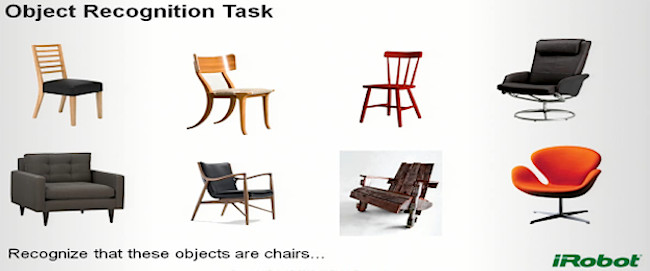
iRobot based its new algorithm on the Deformable Parts Model (DPM). DPM breaks down single objects into multiple parts and shapes and discriminates among objects in the field of view. The algorithm must calculate distance, angle, and scale of the objects it is viewing and do it in real time. It takes into consideration lighting as well. To train the new robotic vision algorithm the researchers at iRobot showed it 1,000 objects which it then classified. The iRobot team employed a separate high-speed graphic processor unit (GPU) for image detection separating vision from all other functions. Testing demonstrated that the robot vision can discriminate between a tube containing potato chips and a roll of toilet paper. It can even identify classifications of objects and individual styles within those objects as you can see in the images of the chairs below, one of the experiments conducted by the iRobot team. The algorithm can even identify a whole object by viewing only a part of one. For example, detecting a cat by only seeing a cat’s paw. It also can detect and identify compound objects such as a person sitting in a chair as opposed to just the chair or the person alone.
In 1976 NASA and the Jet Propulsion Laboratory created and launched the two Viking Martian landers. On board were two robotic arms controlled by a microcomputer. These were the arms that dug the first soil samples from the Martian surface hatching the controversy about whether Mars harbored life or not, a question that remains unanswered to this day.
Today most robots can be found in manufacturing or the military. A few are finding their way into domestic use such as the iRobot line of Roomba vacuum cleaners. Robots are continuing to change, becoming faster, more nimble, capable of specializing in a single task or being used for multiple tasks.

Compare the T3 seen above with the articulated robotic arm on Curiosity, the Mars Science Laboratory (seen below). You can see that in a matter of less than 40 years robotic arms have dramatically improved. Curiosity’s arm is 2.1 meters (7 feet) in length and unlike the T3 which served a single purpose, this arm includes a set of tools with wide ranging application. The arm has an on board colour camera that features a high resolution zoom lens. In addition the arm has a drill, alpha particle x-ray spectrometer, a CheMin mineral and chemical analyzer, SAM, an atmospheric gas analyzer, RAD, a radiation detector, DAN, a hydrogen, ice and water detector, and a scoop for recovering and testing surface and sub-surface soil samples. The arm is dexterous and capable of turning almost an entire full circle.

Where Robots are Going From Here
The next evolution of robots is taking us well beyond specialty robots and into the realm of more generalized usage. This comes courtesy of a number of organizations including one that recently made the news, Rethink Robotics, an offshoot of the robotics program at Massachusetts Institute of Technology. The company’s founder is Rodney Brooks, a co-founder of iRobot. At Rethink the mission is to make robots fit places where automation has never been practiced, in particular, small and mid-size businesses. Rethink robots will be designed to learn and become productive a few hours after coming out of the box. Each will be capable of working collaboratively with nearby humans. Each will have fine motor control, machine vision, tactile touch sensors, and multiple arms. And each will be easily reconfigurable for new work assignments.
Rethink is joined by other companies in a race to produce new robotic capability that will broaden the technology’s usage in business and in our personal lives. Among these are:
Open Source Comes to Robotics
Willow Garage is a company founded by Scott Hassan in 2006 to develop robots for non military applications using open source software to encourage independent third parties to develop the technology further. Willow Garage has developed the Robot Operating System or ROS, a library of tools for developers to create robot applications. Through its online Internet forum the software is offered freely to anyone to use, enhance or to build commercial products.
Willow Garage has created the PR2, a robot development platform for testing new robot applications and technologies. PR2 comes with a robotic arm that features a flexible wrist joint and gripper capable of holding everything from towels to brooms. The PR2 has spawned an active research community that includes universities from around the world.

]]>