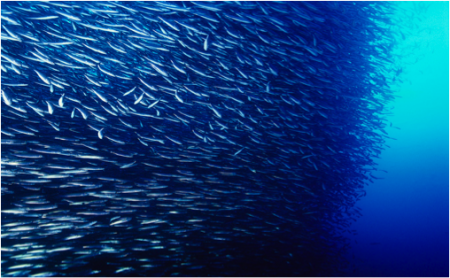
What the census shows is a literal “sea change” with Baltic and North Seas cold-water species like Atlantic herring and European sprat being replaced by Atlantic Ocean species like mackerel, horse mackerel, anchovy and sardines (pilchards). Many of the new species are larger fish entering an environment previously dominated by smaller ones. And scientists believe the explanation lies in the rise of North Atlantic Ocean temperatures in the last three decades, an increase of 1.3 Celsius (2.34 Fahrenheit) degrees. Correlated with the rise in temperature is the rapid disappearance of sea ice in the Baltic Sea, in the past frozen over much of the winter.
Commercial fishers harvest about 100 million metric tons from the oceans of the world each year. One of the richest has been the North Atlantic fishery. But now it is in steep decline. Evidence abounds whether it is the collapse of cod populations off Canada’s east coast or the disappearance of many ground fish species along continental shelves.
There had to be a reason for this and it appears global warming provides the key. Once the home to herring and sprat, Europe’s coastal waters face an invasion of new species. For the former native fish there is only one place to go – further north. And are they safe there? Only for the moment as the Arctic Ocean experiences longer ice free conditions.
In the April 30th edition of the New York Times it reported a study from the journal, Science, that stated one in six species on this planet will disappear because of global warming. The study cites lots of terrestrial examples but makes little reference to the seas of the world. But when you consider the oceans as the incubator for life on this planet its biodiversity may be even more threatened than that found on continents.
The study, the first comprehensive census of fish species in the North Atlantic, should be followed by many more so that we can begin to understand the depth of the fishery problem we may face in the near future and the implications as a primary food source for Earth’s growing population.

Today the cordgrass infestation dominates 10% of China’s coastal wetlands, a fourfold growth in the last 10 years. Most at risk are fish like the Chinese Sturgeon which thrives in shallow wetlands that the cordgrass today has turned into mudflats. And Chinese Sturgeon are not alone. Almost 60 other species of fish are now at risk while birds like the Reed Parrotbill have seen populations decline by 40%.
The Chinese now are in the business of trying to eradicate the noxious weed and near Shanghai have been constructing an 8-meter high, 27-kilometer long sea wall to block the tide from reaching 2,400 hectares of cordgrass-infested coastline. Within the walled off areas the cordgrass is being cut to the ground and then the roots are being submerged in saltwater for six months. This technique in laboratory settings has shown a high propensity to succeed in killing of the plant.

There may be even more unintended consequences from this attempted cure. In creating these walled off areas China may be further interfering with the stability of coastal wetlands and their biodiversity. So from one folly China may beget another.
Of course China is not alone in having introduced animals and plants into new habitats. Australia had an interesting experience with rabbits when they were introduced more than 150 years ago. They are still battling the little bunnies to this day. And the United States has its own experience with kudzu, a highly invasive vine first introduced from East Asia to the Americas at the United States Centennial exhibition in Philadelphia in 1876. It soon became highly fashionable in southern gardens and today has gone rogue overwhelming trees and shrubs, killing off native plants and even causing power outages as it climbs hydroelectric poles. Recently kudzu was found in Southwestern Ontario, that’s how far it has spread in its assault on North America.
Kudzu is North America’s equivalent to cordgrass, a plant from North America that has now infested China. Humans with good intentions and unintended consequences – when will we learn?
Related articles across the web
]]>
