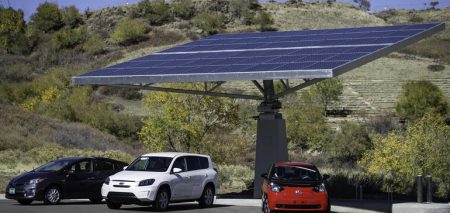
In making the tri-state announcement the parties to the agreement noted that the goal is to make EVs more attractive to purchasers by addressing the range anxiety issue. It is hoped that the building of a recharge network along the Interstate Highway system will also encourage EV charging development on other roadways and in smaller communities regionally.
Colorado has seen EV buy-in grow from 100 to 8,000 vehicles on the road since 2011. Utah currently ranks 7th in EV adoption. Nevada ranks 13th. The latter currently has 2,104 EVs and almost 32,000 hybrids registered.
The three states offer a number of EV initiatives including:
Some of the money to pay for the charging infrastructure may come from the recent Volkswagen nationwide settlement. The states may also draw on money from federal zero-emission initiatives.
The three states will also take advantage of the recent federal government commitment of $4.5 billion aimed at building a charging infrastructure for more than 40,000 kilometers (25,000 miles) of highways in 35 states to ensure that EV drivers will be able to recharge every 80 kilometers (50 miles).
There is a sense of inevitability to the rise of EVs. Automotive manufacturers have increased the number of vehicle choices since 2010 from 2 to 25 with more coming. General Motors just delivered its first Chevy Bolt to customers in the home town of Tesla Motors, Fremont, California, just to up the ante on the competition between the two companies seen as leaders in the EV marketplace. Ford Motor Company, however, has no intention of being left out of the running as a top EV competitor and is gearing up to have 40% of its entire model line all electric by 2020.
It has been an epic journey beginning with freakishly cold weather throughout Southern Ontario and points south as far as the middle of Florida. The weather was so cold it cracked the windshield on our minivan, something I have never seen happen before.
When we drove through Atlanta I thought I was visiting the set of a science fiction movie, an apocalyptic future. Jumbles of automobiles and trucks festooned the sides of the highway for over 32 kilometers (20 miles). They had either crashed or been abandoned by their drivers who ran out of gas while sitting in traffic jams caused by the freak ice storm known locally as Leon.

And then as we drove towards Valdosta, Georgia we could see the cloud deck rising that was the tail end of the storm. It resembled mountain ranges on the horizon, grey-black and foreboding.
In Florida it remained cold until we went through a heavy rainstorm at mid-state and came out the other side into tropical humidity and bright sunshine.
Now we are ensconced in our rented one-bedroom apartment for the duration of February. This is our first time doing this and we will find out if we are suited to be snowbirds, the term given to Canadians who migrate south each winter to escape our coldest and darkest days.
I’m writing this blog on a net book that I bought a number of years ago for my wife when these little PCs were all the hype. It is a Windows XP machine that I intend to convert to the Google Chrome operating system at some future date just to see how well it can perform. With Windows XP it tends to run a bit slow.
A final remark on American drivers living south of the Mason-Dixon line. When driving in ice and snow conditions across bridges, you know the ones that say “bridge may ice up,” speeding up is not the way to go. Take your foot off the gas and let the car find traction on its own. All you do is steer. I watched more drivers fishtail and careen on bridge crossings on this trip than I have ever seen in all the years that I have been driving. That’s over 49 years.

Anyway, I hope to restart writing about science and technology in the next few days. So please stay tuned and thanks for all of you who have been visiting by the thousands while I have been out-of-touch.
Len Rosen
]]>