In 2014 the United Nations predicted that 50% of the planet’s population would be on the Internet by 2017. But the latest figures show that the 50% mark will not happen until the middle of 2019 if not later. The definition for being on the Internet as far as the U.N. is concerned means a user has access to a device with connectivity at least once in three months.
Throughout the period from 2005 to 2017, growth rates for Internet access have increased annually at an 11% clip. But in the current year, the rate has slipped to 6% leaving 3.8 billion currently unconnected.
So what’s slowing connectivity? A lack of affordable telecommunications and the power to connect in many countries. The expense of putting infrastructure in place has made it difficult for Developing World countries. There is little in the way of return on investment for large utilities and telecommuncation providers when the customers are largely poor. Hence, the infrastructure doesn’t get built unless the government gets involved. And once done, telephone and data connectivity may have little appeal to users unfamiliar with the technology, or unable to pay.
What is the value proposition that Internet connectivity is bringing to areas of the Developing World where it currently doesn’t exist?
Does affordable connectivity to the Internet automatically change Developing World societies that get it?
According to Manjira Sambuli, of the World Wide Web Foundation, “technology is not a silver bullet” to societies where economic inequality is part of the social dynamic between women and men. “In some communities, the whole idea of women owning anything of their own, even a mobile phone, is frowned upon.” So wherever Internet connectivity goes, the hope is that it begins to break down social divides to address economic and educational inequality which remains pervasive in many parts of the Developing World.
A company in Toronto, Clear Blue Technologies, has made central to its business mission, the ability to deliver and remotely manage off-grid telecommunications and power to digitally isolated communities in the Developing World. It has partnered with a number of companies including Facebook and telecommunication providers working in Africa, Asia and Central and South America.
Just how difficult can it be for telecommunications companies to bring the Internet to digitally isolated communities?
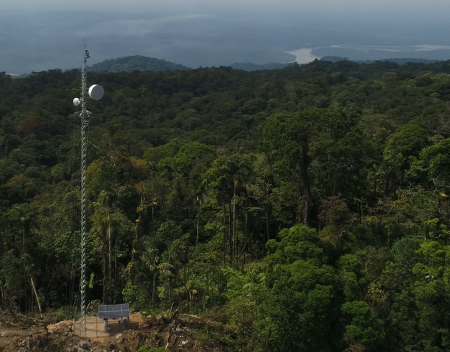
In a recent installation in the Peruvian Amazon, Clear Blue Technologies, working with Telefonica and May Telecommunications, had to carry 20 tons of equipment over a roadless landscape to a digitally isolated town of 25,000. All equipment had to be hand carried on hiking trails, taking over three hours to reach mountain tops where the systems were installed (see picture below). This deployment was for 25,000. Now imagine many of the 2 billion expected to have access being in locations equally challenging.
I am convinced that the Peter Diamandis prediction for 2025 is off by hundreds of millions if not a billion. It won’t happen without the deployment of technologies like the one Clear Blue has developed. And that means a concerted partnership among governments, utilities, software companies, telecommunications providers, and charitable foundations to help fund, deliver and operate in conditions unlike any that existed for the first 3.5 billion. In the current state of our planet, I am not sure there is the collective will or the money to connect and empower the next 2 billion before 2030.
This works because almost two-thirds of Anglican churches can be found in rural settings near or in small communities that currently are underserved by telecommunication service providers. For the British who have largely abandoned attending churches it gives new meaning and purpose to these building sites. Stated Matt Hancock, Department of Digital Culture Secretary, it means “that even a 15th-century building can help make Britain fit for the future.”
What it means for small communities and rural farms is:
Stated the Reverend Stephen Cottrell, Bishop of Chelmsford, “rural churches…have always served as a hub for their communities. Encouraging churches to improve connectivity will help tackle two of the biggest issues rural areas face – isolation and sustainability.”
It’s good to know that institutions of faith can contribute to the spread of knowledge based on reason and scientific facts. It will be interesting to see how the Church of England, and other religious institutions suffering similar declines in attendance, can benefit beyond the financial issues from making their buildings places where they serve a new type of connectivity rather than the old one of weekly services.