NASA funds ground breaking innovation a number of ways, from sponsoring school contests focused on science and engineering, to awarding prizes for space apps, to soliciting public input for new ideas that can receive seed funding to advance the science and technology behind the agency’s mission. By using contests and encouraging crowdsourcing NASA is unlocking our global potential to contribute to both Earth and space science.

Take for example the recent NIAC proposals that received Phase 1 NASA funding. NIAC stands for NASA Innovative Advanced Concepts. The program states in its press release that it “aims to turn science fiction into science fact through the development of pioneering technologies.” About a week ago the agency selected 15 proposals deemed to produce transformational technology. Each of the concepts in Phase 1 received a $100,000 U.S. award to further develop their proposals over a nine-month period. If successful upon review Phase 2 funding of up to $500,000 could be made available to further develop the technology.
The funded projects cover advances in space habitation, materials, manufacturing, robotics, instrumentation, propulsion and computing. Among those receiving initial funding include the following concepts:

NASA’s recent 2015 International Space Apps Challenge, focused on stimulating technology advances for both use here on Earth and in space, named winners in six categories this week. The areas covered included mobile applications, software, hardware, data visualization and platform solutions. NASA received submissions from 133 locations. They reviewed 949 projects involving 13,702 participants. In the end six finalists were chosen.

All winners have been invited as NASA’s guests for the September launch of the next SpaceX supply mission to the International Space Station.
But the awards and grants mentioned above are just the tip of the NASA iceberg. Each year the agency launches a challenge to high schools and colleges around the world. This year the theme chosen was build and race a rover. Fastest to assemble and navigate a prescribed track would win. The competition took place in April at the U.S. Space & Rocket Center in Huntsville, Alabama.
Team entries came from 18 U.S. states, Puerto Rico, Germany, India, Mexico and Russia.
In university competition first prize went to Team Russia of Moscow (see image below). In high school competition, University Gardens High School in San Juan,Puerto Rico took the gold.
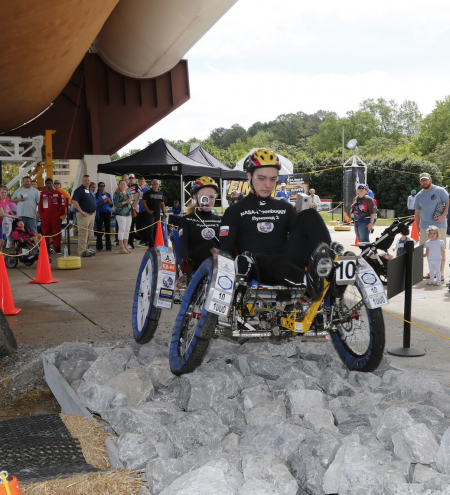
Best design award went to Auburn University and Parish Episcopal School of Dallas in their respective categories.
Rhode Island School of Design won for design innovation with a unique wheel technology.
The Featherweight Award for the lightest rover went to University of Puerto Rico and Vocational High School Teodor Aguilar Mora, also of Puerto Rico.
And the Telemetry Award went to Pittsburg State University in Kansas.
Creating vision and building expertise to solve both earthly and space problems is best illustrated by these NASA activities. It makes you wonder why in the United States Congress flat-lined the agency’s Earth sciences budget this year in favor of human spaceflight projects. What will be the long-term impact of such short-term thinking? That’s why I raised the issue recently suggesting that NASA needs crowdfunding to support one of its most essential activities, helping us through science and technology to better understand our Earth and its surroundings. That’s because NASA isn’t just about space and rockets to Mars. It is very much about our planet, tis present and future.
