The report looks at two types of long-term outcomes using exploratory and normative scenarios. Exploratory scenarios address uncertainty factors. Normative scenarios evaluate how to reach targeted outcomes. It is the latter that comes up with prescriptive formulas that lead to policy.
The 223-page report gives us insight into one fossil fuel company’s exploratory thinking. The company is Shell Oil. Since 1995, the company has produced future-looking 50-year studies that address energy demand for oil and gas and future energy choices that could displace these. In a 2001 version, looking 50 years into the future, Shell poses this question:
“What energy needs, choices and possibilities will shape a global energy system which halts the rise in human-induced carbon dioxide emissions within the next 50 years – leading to a stabilizing of atmospheric carbon 261 levels below 550 parts per million without jeopardizing economic development?”
Note, Shell isn’t even considering bending CO2 emissions parts-per-million (PPM) downward from what was in 2001 369 PPM. Its question assumes a doubling of CO2 levels in the atmosphere from the 280 PPM where we were at the beginning of the Industrial Revolution.
Considering current CO2 levels which have surpassed 420 PPM and global mean temperature rise now over 1 Celsius (1.8 Fahrenheit), that’s 1.5 Celsius over land, and 0.8 to 0.9 over seas) in asking its question, Shell appears to have no concerns about environmental consequences, just economic ones, specifically, those that affect its long-term bottom line.
Why I selected Shell because it is featured in the IEA report. But I wanted to compare Shell’s exploratory question with the public face of the company as represented by its global website where it states full support for “a net-zero world, where society stops adding to the total amount of greenhouse gases in the atmosphere…..to limit the rise in average global temperature to 1.5 Celsius.” The site further professes to pledge itself to become “a net-zero emissions energy business” and goes on to describe that it is “reducing emissions from our operations, and from the fuels and other energy products we sell to our customers.” It talks about “capturing and storing any remaining emissions using technology or balancing them with offsets.” The site includes this statement:
“We are transforming our business to meet our target, providing more low-carbon energy such as charging for electric vehicles, hydrogen and electricity generated by solar and wind power.”
How can you reconcile the company’s web persona with its internal documents that describe its thinking about the future of its energy business?
The IEA report looks at actors who are not fossil fuel and energy companies and their future speculations about the energy transition. These include the Global Scenario Group at the Stockholm Environment Institute, the World Business Council for Sustainable Development, the Intergovernmental Panel on Climate Change (IPCC), the Millennium Project, and government research bodies such as Canada’s NRCan, The Netherlands Long-term Outlook for Energy Supply, and The United Kingdom Foresight Program.
In terms of oil and natural gas supplies, even in the face of the Russia-Ukraine war, sanctions, and OPEC production cuts, the world remains awash in fossil fuels. The challenges are supply chain disruptions and the wide swings in resource costs. Supply shocks like the one Europe is currently experiencing tend to be short-lived. Alternate suppliers can be found. But climate change for the fossil fuel industry is a long-term destabilizer.
Are any actors whether businesses, governments, or non-government organizations (NGOs) driving us to that 2050 zero-emission outcome?
The IEA report notes that the normative and explorative scenarios to reach a low to zero-emissions 21st-century future require “either technological breakthroughs or truly gigantic efforts from society in terms of strong political will or epochal changes in consumer preference.” Currently, looking at our global progress through the COP annual meetings (next week is COP27) we seem to be spinning our wheels in all three of the aforementioned: the technology, the political will, and consumer motivation and understanding.
Not in the IEA report is Canada’s largest bank, RBC, revealing its climate blueprint to reduce emissions. RBC is a member of GFANZ, the consortium of banks formed by Mark Carney that at COP27 in Glasgow committed to net-zero emissions by 2050.
As stated by Dave McKay, President and CEO, “We know the greatest impact RBC can have to drive emissions reductions…is through partnerships with our clients. Our initial interim targets will help us track and measure how we’re doing in working with our clients on our ambitious net-zero goals and keep us accountable along the way.”
The bank announced a framework for the sustainable financing of clients with a CDN $500 billion lending target by 2025 based on environmental, social and governance (ESG) objectives with aspirations to have a net-zero portfolio by 2050.
In transition, the bank noted it would continue to fund the oil and gas and power generation sectors. Emissions tracking from these businesses will look at intensification rather than total emissions, in other words, reductions per unit of energy rather than total volume. That means oil and gas companies, and coal and natural-gas-fired powerplant operators will be ESG compliant for the purposes of financing if they show declining emissions per unit of production even if total emissions grow. This is hardly progress on emissions reduction supported by a bank that signed on to net-zero 2050 emissions at COP27.
The Shell and RBC examples, unfortunately, are not isolated when it comes to looking at the actions and planning of businesses related to achieving net-zero emissions by 2050. They along with many countries continue to under-commit and underperform. The latest United Nations Environment Program (UNEP) reports that the planet is on track to see atmospheric mean temperatures rise between 2.6 and 2.8 Celsius (4.7 to 5 Fahrenheit) by 2100. Described as both bleak and catastrophic, the UNEP report has been released just before COP27. Described as a dire warning to all of humanity it seems to be falling on deaf ears at the IEA, and in companies like Shell and RBC. Upon release of the report, the Chair of the Climate Crisis Advisory Group admonished government and business noting that we are flying blind into the future. A senior adviser to CONCITO, a Danish think tank and one of the authors of the UNEP report, John Christensen, was quoted by The Toronto Star stating, “If you have grandkids like me and you are thinking about what their lives might be in 50 years or so…we should be ashamed of ourselves that we’re not doing more.”
]]>
Suddenly, carbon capture has legs. Why? Because the Act includes a carbon capture subsidy. Capturing carbon dioxide (CO2) now provides polluters with an $85 per ton tax credit. And even better, the process for getting the tax credit is simpler, and who can apply for it is now open to even very small projects. The cement industry, natural gas producers, and coal-fired power plants are now armed and ready to jump on the carbon capture bandwagon.
What are the expected results in the United States? According to the Carbon Capture Coalition, which represents more than 100 companies, unions, and conservation and environmental policy organizations, carbon capture projects are expected to grow by 1,300% from now to 2035. At a recent virtual briefing held by the Carbon Capture Coalition, Shannon Heyck-Williams, Lead Climate and Energy Policy Advisor for the National Wildlife Federation noted, “we’ll need to deploy a critical mass of carbon capture, direct air capture, carbon-reuse projects, and related CO2 transport and storage infrastructure over the next decade. It’s a pretty big challenge.”
Heyck-Williams continued calling on policymakers to “pursue a three-pronged approach to get to net-zero, of capturing and managing emissions from industry and power generation, offsetting remaining emissions from hard to decarbonize sectors, and removing legacy emissions from the atmosphere.”
| Sep. 4, 2022 | 416.68 ppm |
| Sep. 4, 2021 | 413.43 ppm |
| 1 Year Change | 3.25 ppm (0.79%) |
In the last week, the IEA published its World Energy Outlook for 2021. This follows an earlier report called the Net Zero Emissions by 2050 Scenario published in May. In that document, the IEA charted a path to limit global atmospheric warming to no more than 1.5 Celsius (2.7 Fahrenheit) by 2050. But in this latest publication, the focus is on the emerging energy economy and how far we still have to go to achieve the net-zero 2050 goal. And the timing of the publication a few weeks before the global COP26 Climate Summit in Glasgow, Scotland, is no coincidence.
The new publication gives those determining future policy a detailed look at how countries are making a clean energy transition so far. It notes the new global energy economy that is emerging is not happening at a pace to meet the objective of keeping mean temperatures globally within the 1.5 Celsius threshold. It further states that fossil fuel demand continues to climb and because of this, the 1.5 Celsius rise will happen as early as 2030 with global mean atmospheric rise reaching 2.6 Celsius (4.7 Fahrenheit) over pre-Industrial levels by the end of this century.
Here are some of the highlights of this new IEA document.
As monumental as the requirement that lies ahead is, the IEA sees a shift towards net-zero already starting. Renewable energy sources are increasing at a faster rate in the last two decades than ever before, while electric vehicle sales keep setting new annual records. While energy demand continues to rise 20% per decade, so are investments in energy which are anticipated to be six times higher for renewable and clean energy sources than for oil and gas by 2030.
The key for the nations of the world to bend the climate change curve downward will be to accelerate these changes even faster. Based on current trends, clean energy annual investments will triple from current levels to approach $4 trillion USD annually by 2030. IEA forecasts predict over 3 billion electric vehicles will be on the road by then and that three Terawatt-hours of electricity will be delivered from battery storage deployment alone.
The dark side of the report states the likely consequences of not rapidly accelerating the change to meet the net-zero 2050 target. That alternate world will experience mean global temperature trajectories exceeding 3.5 Celsius (6.3 Fahrenheit) by 2100, an 80 to 130% increase in “ecological droughts,” the risk of ice sheet collapse, disruptions to ocean circulation currents, and irreversible changes to permafrost, and boreal and tropical rainforests.
Glasgow, here we come. It’s time for the politicians there to do the right thing, and do no further harm to the planet.
]]>These three countries accounted for 85% of net new carbon emissions into the atmosphere.
For the first time, the IEA looked at the burning of coal and its contribution to the 1.0 Celsius (1.8 Fahrenheit) increase in mean atmospheric temperatures since the Industrial Revolution back in the mid-19th century. It concluded that 0.3 Celsius (0.54 Fahrenheit) of the total rise came from coal usage.
Why was coal singled out? Because the growth of coal use particularly in India, South Asia, and Sub-Saharan Africa was seen as the single largest contributor of new carbon emissions in 2018. Coal-fired thermal electricity plants in 2018 were producing 30% of all global carbon dioxide (CO2) emissions. As a result, average CO2 atmospheric concentrations in 2018 rose by 2.4 parts per million from the previous year.

Overall global electricity capacity grew by 900 Terrawatt hours (TWh) in 2018, two-times faster than overall energy demand and the fastest growth since 2010. By source, half of the new capacity came from renewable energy sources as seen in the graph below.

The increasing demand for electricity, states the IEA report, came because of changing climate conditions with air conditioning requirements up in the summer (it was the fourth hottest year on record), and heating needs rising from occurrences of polar vortices during the winter in North America. The lion share of new electricity demand came from the United States and China followed by India.

]]>

Today also marks the March for Science with researchers and academics along with students and private citizens all engaged in showing their support for the scientific method, factual evidence, and the truth. The march is happening in Washington, DC, and in more than 400 other cities and locations around the planet. It is a reaction by scientists to “alternative facts” being dispensed as truths. It is a reaction to proofs over beliefs. When an American Vice President calls for evolution and creation science to be taught equally in elementary and high schools across the nation, referring to them as equal theories, and when an American President calls climate change a hoax perpetrated by the Chinese to destroy the American economy, it is not surprising that scientists speak up.

The world has entered a moment in time, a tipping point that may lead to disruption of the environment as never seen before by our species. Other forms of life have endured through environmental changes on this planet in the past. Continents have wandered. Mountain ranges have risen and washed away. Oceans have risen and covered parts of the continental land masses. And Ice Ages have scoured the landscape, lowered and raised sea levels between freezes and melts, reshaped continents, created bridges to new land where life could find new purchase.
Through the billions of years the Earth has existed it has gone through enormous changes on the surface. The Sun, our energy engine in the centre of the Solar System, has also undergone change as the billions of years have passed. Some 400 million years ago when animal life first emerged from the sea onto dry land the Sun was younger and weaker than today. This was a period on Earth when the continents were covered in green. As the plants experienced life and death they created the carbon that became the fossil fuels we have been burning for over a century. The cycle of carbon drawn into living plants followed by dying and carbon release created high levels of carbon dioxide (CO2) in the 400 million-years-ago atmosphere. Even with a weaker Sun the climate of that time was warmer than today because of CO2. And since that time CO2 has fallen and gone back up again in very natural cycles over million-year time periods. These variations correspond to the movement of continental plates, episodes of extreme volcanism, the weathering of the Earth’s surface and other natural carbon sinks to help trap CO2 within the Earth and other geological processes. And even though our Sun today is nearly 40% brighter than 400 million years ago, the Earth’s geological aging has created continuous adaptation for life to flourish. That doesn’t mean extinction events haven’t happened (see image below). They have and some have killed off close to 90% of all living things on the planet.
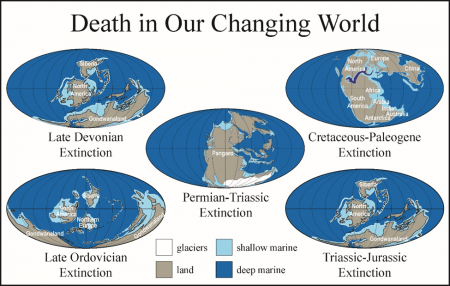
So changing climate which includes global warming and cooling has very much been an undeniable part of the planet’s geological record. But geology moves in slow cycles while humans don’t. In the short period we’ve been around, and particularly in the last 150 years of our species existence, we have introduced speed into the equation. The last time CO2 levels in the atmosphere exceeded 400 parts per million (ppm), we humans didn’t exist. And 400 million years ago CO2 levels were 2.5 times what they are right now. In fact, since that time the general trend for CO2 has seen a drop of 3.4 ppm on average for every million years. There have been greater dips and higher spikes over the 400 million years. For example 300 million years ago Earth experienced an ice age with CO2 levels below 300 ppm. A hundred million years later the Earth’s atmosphere overheated as CO2 levels rose to almost 2,000 ppm. Scientists speculate that the peaks happened because continental plates shifted causing landmasses to collide, throwing up mountain ranges, and unleashing extreme vulcanism, filling the atmosphere with high concentrations of greenhouse gasses. And the valleys that subsequently followed happened as weathering and erosion trapped greenhouse gasses underground.
Geological influences on climate will always be around. Humans may not. The pace of climate change we create may lead to our extinction. Looking to the future at our present rate of putting greenhouse gasses into the atmosphere, with no change in behaviour, CO2 levels will exceed 1,000 ppm by 2100. The most recent reports from the United Nations panel on climate change (IPCC), projects 1,370 ppm by century end, and 2,000 by 2250. That exceeds CO2 levels of 200 million years ago. Add in a Sun that is close to 40% brighter and we are indeed in unknown territory for life on this planet. There is no doubt life will continue but adaptation at a pace that equals the rate of change is difficult. The likely end result will be mass extinction comparable to previous events evident in the geological record.
So how do we reverse the trend that will push us past 1,000 ppm by the end of this century?
The International Energy Agency (IEA) has published two reports that provide a roadmap to limit the global mean temperature rise to 2 Celsius (3.6 Fahrenheit) degrees and a peak at 450 ppm.
In the first report, even without the United States participating in the Paris climate agreement, it states that if a combination of countries stop using coal the planet could achieve the 2 Celsius rise limit. A combination of China, India, Indonesia, Japan, Bangladesh, Pakistan, Vietnam, Thailand, South Korea, and a few more smaller nations would drop current annual CO2 emissions by half. The report goes on to state that stopping the use of coal would have to be accompanied by the growth of zero-emission energy sources at a rate between 12 and 18% annually from now until 2030. That would make wind and solar the predominant sources of electricity on the planet.
In the second report, the IEA looks at the mid-century mark and describes how 95% of world electricity production could come from low carbon. Other key data points in this report:
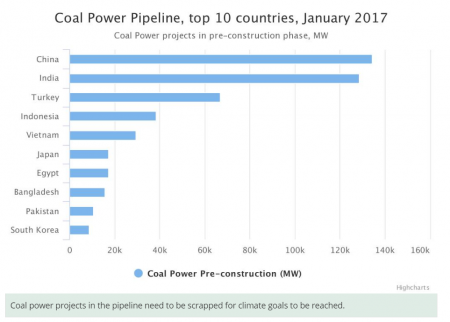
Based on recent announcements from China and India committing to freeze construction of new coal-fired power plants, and retire existing plants, the transition has begun. Now the rest have to make similar commitments.
]]>
What happened to our species in that last warming period? Early homo sapiens may have been compelled to migrate from conditions in Africa that were marginal for existence. So we may owe our global distribution as a species to past climate change. And we certainly may find many of our species on similar footing as we continue to see the impact of what is now being defined as rapid climate change.
As of January 2017, the Earth’s mean temperature had risen 1.1 Celsius (2 Fahrenheit) degrees. When you consider the Paris Climate Agreement of 2015 set 2.0 Celsius (3.6 Fahrenheit) as the upper limit of what was considered the maximum disruptive global warming target, and that 1.5 Celsius (2.4 Fahrenheit) the aim of the nations, party to the COP21 meeting, it would appear we are getting perilously close.
Now add the budgetary massacre that President Donald Trump intends to inflict on the U.S. in addressing its participation in helping achieve those climate targets and you pretty much can see the writing on the wall for hitting 2.0 let alone 1.5. The most recent analysis on America’s carbon reduction participation, a commitment to an emissions drop of 1.7 billion metric tons by 2025 (the 26 to 28% greenhouse gas reduction pledged), under Trump will fall far short, by at least 1 billion. The following infographic illustrates my point.

Sir Robert Watson, a climate scientist at the University of East Anglia in the United Kingdom states “While the data show an ever-increasing impact of human activities on the climate system, the Trump administration and senior Republicans in Congress continue to bury their heads in the sand.” He continues, “Our children and grandchildren will look back on the climate deniers and ask how they could have sacrificed the planet for the sake of cheap fossil fuel energy when the cost of inaction exceeds the cost of a transition to a low-carbon economy.”
In 2016 we have witnessed extensive damage to Australia’s Great Barrier Reef from ocean temperature rises which are accelerating. We have seen levels of carbon dioxide (CO2) in the atmosphere accelerate approaching 410 parts per million in what climate scientists describe as an unprecedented pace. Not only are we recording new sea ice minimums at the poles but also are witnessing increased acidification in these waters from dissolved CO2. The danger to polar marine life cannot be underestimated.
According to an article appearing in today’s Globe and Mail, the latest International Energy Agency report released yesterday, meeting the Paris Climate Agreement’s 2.0 Celsius upper limit will require a 40% drop in oil demand by 2050. The report indicates it would require “an unparalleled ramp up of all low-carbon technologies in all countries…the rapid phase-out of fossil fuel subsidies; [carbon] prices rising to unprecedented levels; extensive energy market reforms, and stringent low-carbon and energy-efficiency mandates” to achieve the target. Fossil fuel use, states the report, would have to peak by 2020 and then fall by 70% from today’s levels by 2050. Clearly, this cannot happen without the world’s second largest consumer of fossil fuels, the United States, being part of the solution and not a contributor to the problem.
Add to this the March 15, 2017, release of the Medical Society Consortium’s study on climate health and you would think the heads of even climate science deniers would be turned. Who is the Consortium? It is a group representing 11 medical societies and 400,000 physicians in the U.S. It states that “most Americans” are not aware of the impact of global warming on their health. That’s why the Consortium is speaking out and describing the harm being done with children, the elderly, the sick and poor most vulnerable. In the executive summary of the report the doctors point out that “climate change is already causing problems in communities in every region of our nation,” arguing that “the most important action we can take to protect our health is to reduce heat-trapping pollution by reducing energy waste and accelerating the inevitable transition to clean renewable energy.” The report goes on to state, “we are sounding the alarm that the ultimate danger of climate change is that it poses a danger to the health of every American now and in the future.”
The specifics include:
One would hope that even Donald Trump will listen to a doctor now and then.

The graph below shows that the most significant investment in renewables is happening in China with the United States and Europe trailing.

China and India are seen as the major engines of future renewable energy growth. States Birol, “China alone is responsible for about 40% of growth in the next five years.”
In 2015 153 Gigawatts of renewable electricity infrastructure was added to the world. That is 15% greater than Canada’s total energy generation capacity. China expects to add double that in the next five years. India is slated to increase its renewable capacity by 76 Gigawatts during the same five year period.
The big increase is coming from onshore wind turbines with 63 Gigawatts of new capacity. Solar accounts for 49 Gigawatts of the new energy infrastructure.
“The cost of wind dropped by about one third in the last five to six years, and that of solar dropped by 80%,” states Birol. This has happened while world oil and natural gas prices have also gone down but not to the same degree as wind and solar energy.
The IEA expects to see net new power generation capacity to become even more skewed towards renewable energy sources forecasting 60% market share by 2021.

It sounds like remarkable progress but in fact remains a small part of the total global energy mix with green energy accounting for 28% of power generation by 2021. How much of that will come from wind, solar, tidal and geothermal? Not much compared to hydroelectricity which remains the largest net new source of renewable power generation.
The biggest benefit in the growth of renewables is the decline in coal-fired cumulative capacity growth which now trails wind and solar power net new growth.
What continues to hold back solar and wind? The energy industry which has relied on thermal-power generation states that it is the predictability issue. The wind doesn’t always blow and the sun doesn’t always shine. They talk about the lack of a storage infrastructure to provide feed-in power because of the variability of these renewable technologies.
The IEA points to the lack of sufficient commitment from government with policies that put an increasing price on carbon pollution, and also to investor concerns that changing energy infrastructure could hurt their return on investment.

Apparently, the elitist scientists’ conspiracy is working because China and the United States in the last two days, in a meeting of heads of state, came to agreement on tackling CO2 and other greenhouse gases setting specific targets for capping and then reducing human produced emissions.

The two countries produce 40% of the greenhouse gases we humans contribute to the planet. So having them agree to cooperatively attack the problem represents a huge step in obtaining global agreement on carbon reductions. I can imagine all the climate change deniers freaking out about now, worried about bankrupting their countries in pursuit of a problem that, in their eyes, doesn’t exist.
For example we have Stephen Harper, Prime Minister of Canada, who in the last couple of weeks, in front of the President of France, on a state visit, and in the presence of the House of Commons, baldly lied, stating that Canada was achieving sectorial carbon reductions on target to meet its United Nations obligations. More recently the Prime Minister has stated that there will be no action on climate change if it comes at the expense of Canadian jobs. But Harper’s focus is increasingly fixated on extractive production and the petrodollars it produces for the Canadian treasury as he pursues a balanced budget and the showering of political largesse on those constituents who have voted for him.
Then there is Tony Abbott, the Prime Minister of Australia, who has stated that “coal is good for humanity” and that any meeting of heads of state such as this weekend’s G20 summit, should be focused on job creation, not climate change. The response from 400 Australians today, on Sydney’s Bondi Beach, can be seen in a picture taken by Tim Cole, AFP, Getty Images, mocking the Prime Minister and his government for not putting climate change at the forefront his agenda.

So with the U.S. and China making their announcement this week we may have the breakthrough needed to develop a successor to the Kyoto Protocol that has some teeth. It cannot come soon enough. Yesterday, the International Energy Agency (IEA) released its annual outlook report forecasting demand and consumption tending to 2040.
If you don’t know the IEA, it is an independent agency composed from 29 member countries, most of them fossil fuel producers. Its focus is on energy security and production. Only recently has it moved from looking at supply and development to the implications of fossil fuel consumption and climate change.
Based on current trends the IEA predicts world energy demand to grow by 37% from today’s levels by 2040. Coal energy will plateau in the 2020s. Oil will reach peak energy usage much closer to the 2040 date. Throughout the period leading to 2040 renewables will gain ground rapidly while nuclear, although much diminished, will remain an important contributor to low-carbon energy productio.
The IEA report sees, in 2040, energy supply equally divided between low-carbon options (nuclear, wind, solar, geothermal, tidal, wave and biomass), and fossil fuels (oil, natural gas and coal). Of the fossil fuels, natural gas will be the most significant segment. Its contribution to CO2 emissions will not be offset enough by renewables to keep global mean temperatures from rising only 2 Celsius (3.6 Fahrenheit) degrees. Instead the IEA is forecasting based on current trends a rise of 3.6 Celsius (6.5 Fahrenheit) degrees. That has devastating implications for humanity and biodiversity. The IEA, therefore, is calling for “urgent action to steer the energy system on to a safer path.”
The United States and China may have just kick started the world in the right direction. They are not alone. Over the past five years an “A-list” team in Canada has been gathering to work on developing practical policies that reconcile environmental and economic goals. They call themselves the Ecofiscal Commission. From their website comes the following explanation of what is meant by ecofiscal:
An ecofiscal policy corrects market price signals to encourage the economic activities we do want (job creation, investment, and innovation) while reducing those we don’t want (greenhouse gas emissions and the pollution of our land, air, and water).
Ecofiscal policies offer real incentives for investment in innovative technologies so that we can continue benefiting economically from our natural wealth while also providing better protection to the environment.
The revenue generated from ecofiscal policies can create further economic benefits; for example, by reducing income and payroll taxes or investing in new technologies or critical infrastructure.
Who is behind the Ecofiscal Commission? If you are Canadian you may immediately recognize some of the faces in the picture below. Started by Christopher Ragan, a well-published economics professor at McGill University and former Research Fellow at the C.D. Howe Institute, he took three years to assemble his team. Those who he recruited include members of Canada’s who’s who, former prime ministers and premiers, cabinet ministers, political party leaders, chairpersons of not-for-profits and corporations, and current and former CEOs. He gave them the following challenge: create practical and smart policies for a fairer, more productive and greener economy.

On November 4th they issued their first report. It includes: putting a price on road congestion, air and water pollution, carbon and environmental risk. It recommends giving cities better fiscal tools. And it proposes removing subsidies from those industries that contribute to greenhouse gas emissions, water and air pollution.
For those on this planet witnessing the announcements and reports issued this week we should be both alarmed and grateful. Alarmed because it is clear that the current path will lead us to global mean temperatures considered dangerous by the Intergovernmental Panel on Climate Change (IPCC). And grateful because we are finally seeing leadership in action from the two heads of state of the countries currently responsible for 40% of the CO2 going into the atmosphere today.
Is the agreement satisfactory to those on the frontline of the environmental movement such as 350.org? Probably not. China will cap its emissions but not until 2030. The United States will reduce emissions by 2025, by 28% from levels in 2005. Both leaders have set these targets and both have indicated that exceeding them in a positive way is the real goal, not just meeting them. Both face domestic opposition. But this new and friendly competition between China and the United States is an important race to run because without it we will give our descendants a harsher place in which to live based on the current forecast of the IEA. They should know. There the ones producing the energy and the CO2.
A lot has happened in a year and the IEA has once more updated its technology roadmap with a renewed focus on photovoltaics and solar thermal energy generation. Their prediction states, assuming continued technological progress and lowered production costs, that solar in all its forms could provide 27% of global electric energy by 2050. That would make it the largest source for electricity on the planet. The breakdown would be 16% photovoltaics and 11% solar thermal. To reach that number, however, the IEA states there must be a high price put on carbon.
In 2013 total solar photovoltaic electricity production equaled 36 Gigawatts installed. To hit 27% the world will have to create 200 Gigawatts capacity annually between 2025 and 2040. That’s only possible if carbon pricing penalizes fossil fuel energy sources.
And where will the energy be produced? Today China is the leader in photovoltaic energy production with the United States second. But the future is looking to places where solar energy is easier to harvest, south of the mid-latitudes and closer to the equator. These future solar energy produces will be the nations of Africa, the Indian subcontinent, and the Middle East.
Executive Director of the IEA, Maria van der Hoeven in releasing the IEA’s latest report stated, “The rapid cost decrease of photovoltaic modules and systems in the last few years has opened new perspectives for using solar energy as a major source of electricity in the coming years and decades….however, both technologies are very capital intensive: almost all expenditures are made upfront. Lowering the cost of capital is thus of primary importance for achieving the vision.”
Van der Hoeven went on to express the need for a clear and consistent policy on the part of government in support of renewables to reduce deployment risk and inspire confidence for investors. She pointed to “a record of policy incoherence, confusing signal or stop-and-go policy cycles” as being confusing to both investors and consumers and as a brake on development of new projects.

If you are interested in understanding how generating technologies are rated in terms of costs and capacity, I refer you to a U.S. Energy Information Administration annual report which provides detailed explanations. The report compares what it calls the “levelized” costs of different technologies. But purely on capacity factors, conventional coal-fired power plants operate at 85% capacity, far better than renewables. Onshore wind is rated at 34%, offshore wind at 37%, solar photovoltaic at 25% and solar thermal at 20%. Even hydroelectric power capacity ratings are no better than 52% on average.
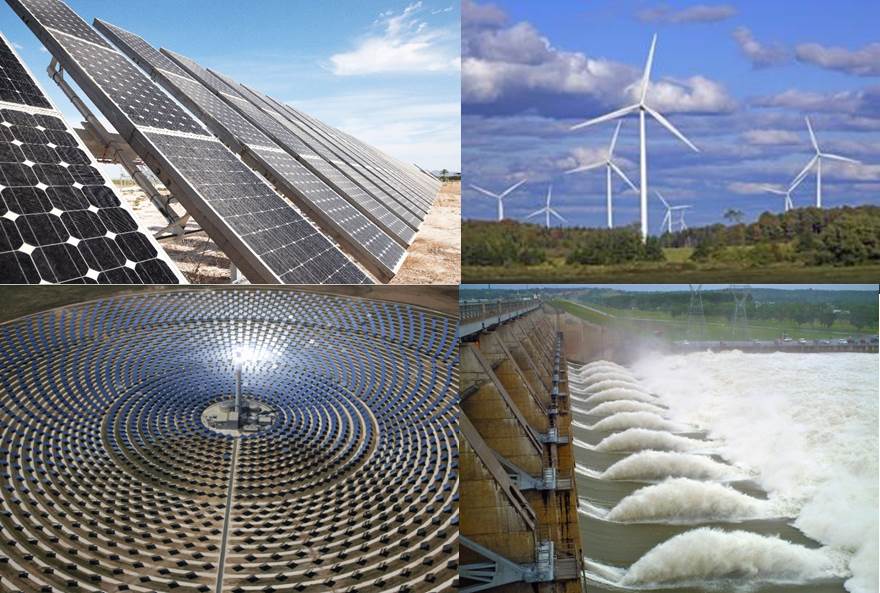
That remains the big problem for renewables. Here on Earth the wind doesn’t always blow and the Sun doesn’t always shine. Streams don’t always flow at the same rate with reservoirs behind dams getting silted up slowly reducing power generation capacity. Offsetting this is the renewable advantage, once capital costs are removed, the cost of fuel is zero. That still is not enough to offset the economic advantages of coal which remains a cheap fuel without a carbon tax, and therefore, more than cost competitive with any renewable.
But why would renewables be beating out natural gas? It is abundant, particularly with the rise in reserves of shale gas from fracking. The answer appears to be subsidies. But once subsidies disappear will industry still want to build wind and solar? Or will governments create playing conditions that continue to favour investment in renewables even without subsidies?
In the last week the President of the United States announced a new climate change policy largely driven by regulatory initiatives. And China announced a staged carbon cap and trade program for its major cities with plans to put a national program in place within three years. Are these the initiatives that will wean us from cheap coal and help us reduce the growth in carbon emissions?

]]>


