For those of you who say wait a minute, aren’t sweet potatoes and yams the same? Surprisingly, no. They are two different plant species that through convergent evolution have produced a similar tuberous root crop.
But the subject of this posting is potatoes and the stresses that food staple crop is undergoing around the world. Potatoes are particularly susceptible to fungi. As a result, potato farmers use fungicides regularly to protect their plants and the spuds they harvest.
Whether it is early die diseases that cause the plants to wilt or fungal infections that blight the tuberous roots, potatoes are under siege. In temperate climates, the plants are attacked by Verticillum dahliae, a soilborne fungus that enters through the root systems. This fungus can devastate a potato farm cutting yields by as much as 50%.
Another caused by a soil-borne fungus, Synchytrium endobioticum, leads to a condition called potato wart or potato canker. The fungus lies dormant in soil for more than 40 years waiting for cool, wet spring weather and the presence of new potato plants. The end result is unmarketable produce. Canada’s Prince Edward Island, a potato-producing province, has seen the U.S. put an import ban on its harvests.
In wetter environments, Phytophthora infestans, another fungus, is responsible for a condition called late potato blight which can destroy up to 57% of the crop. P. infestans caused the Irish potato famine back in the mid-19th century. And today it is devastating potato crops in Bangladesh and Indonesia.
Fungicides have been the standard method of fighting the blight but often farmers miss the early signs and then fight the fungus through repeated applications throughout the growing season which in Indonesia lasts up to 160 days. Farmers can end up spraying their crops up to 30 times. Not only is this expensive, but the fungicides also damage the environment and human health.
For years, government regulators in many countries have banned genetically modified (GM) crops, including potatoes. But in the last few under a partnership involving the US Agency for International Development, Michigan State University (MSU), the Bangladesh Agricultural Research Institute (BARI) and the Indonesian Center for Agricultural Biotechnology Genetic Resources Research and Development, a GM potato that is resistant to late blight has been developed.
How was it done? The researchers identified wild potato species in South America, the birthplace of potatoes and using genetic modification transferred genes into Asian varieties. More than 30,000 varieties were screened until the ten best were selected for greenhouse and field trials. These late-blight-free potatoes have now been introduced in trials in both countries.
The GM potatoes have been designated LBR which stands for late blight resistant. Trials are expected to continue for at least two or three crop cycles before the LBR potatoes become available to farmers.
Biosafety regulations in both countries have lowered their resistance to adopting GM crops. Indonesia and Bangladesh are already growing GM cotton, and sugar cane and the latter country has approved a GM eggplant which has been very successful in improving harvests and income for local farmers.
LBR potatoes will reduce the application of fungicides by more than 90%. It will also mean increased yields and a healthier environment in both countries.
]]>There are 70 species of mangrove in the world today. They occupy coastal wetlands largely in tropical and subtropical environments (see map below). They serve as nurseries for shellfish, crustaceans, fish, birds and other wildlife. They represent a significant renewable wood source. They absorb storm surges and prevent coastal erosion. They are salt tolerant filters. Their biomass is greater below ground than above which makes them effective sequesters of carbon. And with all these good things they are increasingly endangered by us.
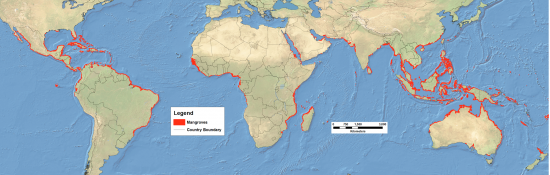
The largest concentration of mangroves is found in Indonesia. In that country’s latest study researchers calculated the amount of carbon stored by these forests to be 3.14 billion tons with each tree storing 3 to 5 times the amount of carbon of any other tree species. And yet Indonesia is seeing massive mangrove deforestation. With 25% of the world’s remaining mangrove forests estimated at 2.9 million hectares (over 4.94 million acres) Indonesia is losing 52,000 hectares (128,500 acres) every year largely to shrimp ponds. The loss of mangrove acreage is contributing 42% to Indonesia’s carbon emissions contribution annually. If the country could stop this deforestation it could immediately see carbon emissions decline from 10 to 35%.
What is happening in Indonesia has already occurred in South Florida where mangrove forests are under pressure from real estate developers seeking beachfront locations for high-rise condominiums. The Florida Department of Environmental Protection describes mangroves as significant contributors “to the overall health of the state’s southern coastal zone.”
For Florida’s commercial fisheries mangroves are essential to the health of snapper, tarpon, jack, sheepshead and other fish populations. In fact without mangroves Florida might not even be there. And yet in many areas along the state’s coast mangroves have been destroyed. In Tampa Bay the loss amounts to 44% of the total habitat. Near West Palm Beach the loss is as much as 87%.
And now climate change is threatening mangroves as weather patterns change and the atmosphere warms. While a warming climate might appear to be beneficial to the range of the mangrove spreading it closer to the poles, with atmospheric warming has come ocean warming, and the latter is contributing to sea level rise and more destructive storm surges. For isolated mangrove forests it is becoming more difficult to hold back the sea.
Add incidents like the Deepwater Horizon explosion and spill of 2010 have seen mangrove mutation rates skyrocket along the Louisiana and other Gulf Coast state wetlands. In addition Deepwater Horizon has contributed to die offs and the weakening of mangrove forests further exacerbated by polluted runoff from coastal factories, cities and farms chemically impairing the trees. The consequence for much of the Gulf Coast – negatively impacted freshwater aquifers extending several kilometers inland.
Other impacts from mangrove duress in the Gulf, Florida and other coastal areas include:
The carbon sequestering property of mangroves is being further compromised as more forests get cleared. In leaving fewer mangroves the trees get larger increasing above-ground biomass. This makes them less efficient for capturing carbon because smaller more dense forests produce much larger sub-surface systems with better sequestering capability. In addition the larger trees means less of a living canopy and less biodiversity below the forest floor in associated waterways. The loss of biodiversity means less filter feeders to clean pollutants. It means the decline in water and soil quality and fewer juvenile fish which rely on the mangrove root systems for shelter from predators.
But there is a change in attitude beginning to make its presence felt in the world of mangroves. For example:
So what is the future for mangroves? With the rise in human population greatest in the tropical and semitropical world, and with most of humanity living at or near coastlines, mangroves are highly endangered. Aquaculture is expected to significantly increase to meet food demand. And where aquaculture sets up shop mangroves vanish.
As for climate change and its byproduct, rising sea levels, scientists are still studying potential impacts. Will forests move further inland as wave erosion and storm surges deplete coastal areas? In one 1997 study a rise of 16 centimeters (approximately 6 inches) in sea level initially caused seedling growth spurts but slowed once the trees reached the sapling stage after 2.5 years. That study didn’t look at erosion impacts from storm surges and coastal flooding.
I leave you with these three final notes and hope you have a renewed appreciation for the unique value that mangroves bring to our planet:
We need robust mangrove forests to grow and prosper in this 21st century, an important piece in our chess set of options to combat climate change.

The government recognizes it has a problem. Today other than agricultural production and forest products, Indonesia is all about coal. It currently is the leading producer on the globe (see graph below). Much of it goes to fulfil China’s enormous thirst for energy. And now the nation is witnessing its own industrialization and energy demands meaning less for export. That means increased GHG emissions at a time when the country’s political leaders are pledging to reduce net carbon emissions by 26% by 2020.

Although sixth in the world in emissions Indonesia today produces a mere 2 tons of CO2 per year for each of its citizens. Why a mere? Because when compared to the 16 tons contribution for every American, Indonesia’s carbon pollution contribution appears small.
In addition 50% of Indonesian families live below the poverty line. So what happens when the country wants to raise the living standards of that 50%? It would seem the easiest way would be to make more energy available to them so that they can move to urban centres and take on better jobs. And abundant coal appears to be the fuel of choice to light those cities.
But like so many Developing Countries on the planet, Indonesia is caught between two very different moral crises. Political leaders have made pledges to international bodies to reduce GHG emissions, a noble gesture but utterly unachievable in light of the need to improve the quality of life for its citizens.
Indonesia wants to use its coal responsibly and hopes that carbon capture and sequestration (CCS) will be the solution. The goal, to capture 90% of CO2 emissions produced from fossil fuels used to generate electricity and in industrial processes. The CO2 would then be transported by pipeline to ships for safe storage. Those ships would then be sent to aging offshore oil fields where the CO2 would be pumped into the ground to enhance oil recovery. The Energy and Minerals Resource Ministry has recommended a carbon tax of $100 US per ton to finance CCS development.
If you are regular reader of this blog then you know that CCS continues to struggle as a carbon reduction strategy. Just a few weeks ago the U.S. government pulled the plug on a pilot CCS project. And the U.S. is not alone. France, Germany, Sweden and Spain just opted out of a CCS project of their own. All these countries cited the cost of CCS as being prohibitive. But maybe a $100 levy per ton of carbon on energy producers and industry may prove the right carrot and stick strategy to get CCS on track and maybe Indonesia will take a leading role in making it an option for implementing a low carbon future.

]]>

So I was surprised to read just four days ago that the World Bank had decided to finance Indonesia’s Central Java Power with $33.9 million U.S. for a 2,000 Megawatt thermal power plant. Not only that, the World Bank would act as transaction advisor for the mega-project.
If you consider Indonesia and its potential capacity for wind, solar, tidal, and wave, geothermal, biomass and hydroelectric power one wonders which side of their mouths the World Bank directors are talking out of to make their no feasible alternative stick. The country in 2012 was almost totally dependent on fossil fuel derived energy. In fact, over 95% of electricity was being generated this way with energy consumption growth at 7% annually.
So renewables in Indonesia today are at 4.8% of the national energy mix with nowhere to go but up. And the government has declared its intent to wean itself to some degree from fossil energy. The Ministry of Energy has set a 2025 goal of developing 25% renewable energy in its total energy mix. When you consider that a third of Indonesian households today have no electricity, renewable both off and the on the grid sounds like the feasible alternative, not colossal coal-fired power plants like the one the World Bank is funding.
It’s not like there isn’t renewable energy capacity in the country. A series of recent studies conclude the following:

Recently the Government of Indonesia introduced feed-in tariffs for geothermal power. They are starting to work. And now they have added feed-ins for solar photovoltaics and wind. So while the World Bank expresses concern about rising global temperatures, and the cost of climate change, and while it talks about no longer funding coal-based projects, it ends up subsidizing a coal-fired power plant that will undoubtedly increase Indonesia’s carbon emissions and not move the country to renewable energy at a faster pace.
Talk about hypocrisy on a global scale!
]]>
In a period of less than two months that’s 6 recorded incidents large enough to make headlines. Now think of all the small marinas and ports where, as you walk by you notice a sheen on the water surface, and you begin to understand just how serious the problem of oil pollution is. How much more can our oceans, lakes and rivers absorb from destructive human behavior? Who can you admonish when the self-destructive behavior is endemic to our entire species? Just something to consider here in the second decade of the 21st century.