
Yevgen Erik, of Redwood City, California, the inventor, sees SolarGaps as an answer for homeowners who can’t install rooftop solar panels. Since every home has windows and a need for blinds it seemed like an obvious way to combine two functions in one.
An Indiegogo crowdfunding campaign has raised over $111,000 U.S. since its launch on June 15, 2017. From the Indiegogo site, SolarGaps is described as suitable for renters, homeowners, and businesses seeking to reduce energy use and become participants in the transition to a low-carbon, renewable energy life and work style.
Features include:
SolarGaps intends to be shipping to its first customers by October 2017. Pricing ranges from $390 to $1,910
U.S. Indiegogo contributors can get a SolarGaps single slat for a donation of $39 U.S. plus shipping. The demo slat produces enough power to charge a mobile phone.
A special one square meter (10-foot square) fully automated and motorized SolarGap blind is also available to Indiegogo donors for $270 U.S. plus shipping, 50% off the retail price.
And while the campaign remains open you can place a $249 non-refundable deposit and get SolarGap blinds you purchase later at a 30% discount with the deposit applied to your first purchase.

What is AirBuddy? A tankless diving system that gives a recreational swimmer a 45 minute underwater experience far more exciting than snorkeling and far less onerous than scuba diving. Without scuba
A tankless system that gives a recreational swimmer a 45 minute underwater dive, far more exciting than snorkeling, and far less onerous than a scuba dive. Why the latter? Because with AirBuddy you don’t need scuba tanks. That means no heavy gear, no weights for buoyancy, and less underwater drag from bulky tanks on your back.
Seen below, the AirBuddy system includes a compressor that floats on the surface of the water with a highly visible diver flag. You can see the outflow valve where the hose connects in the top right image underneath the float.

AirBuddy includes a rechargeable battery to power the air compressor, the inflatable float, a single air supply hose and a regulator mouthpiece. A second supply hose and regulator are options.
It operates by drawing surface air through the compressor where it is pressurized to give the diver breathable air when underwater. Total dive time is 45 minutes at a depth of 12 meters on a single battery charge. The average recharge cycle using a standard AC outlet is about 3.5 hours. With an optional second hose and regulator, two divers can use an AirBuddy and explore underwater to depths of 6 meters.
AirBuddy is not meant to replace scuba diving gear. Instead it’s for those who do casual shallow water diving off coral reefs or beaches while on vacation. The entire system weighs 9.5 kilograms (21 pounds). That’s almost 70% lighter than scuba gear, and it fits in a travel bag making it easy to bring along on your next tropical beach vacation.
With the entire system weighing 9.5 kilograms (21 pounds), it is 70% lighter than scuba gear. And it easily can fit into a travel bag to bring along on tropical beach vacation.

On Indiegogo so far, AirBuddy has raised over $280,000 U.S., 208% more than its target crowdfunding goal.
A pledge of $599 U.S. puts a reserve deposit on an AirBuddy system at 23% below the retail price of $1,759.00. So you get the AirBuddy for $1,349. The balance is due in advance of the expected June 2018 delivery date.
]]>
In keeping with that mission spirit the company has created a product it describes as a community chlorine maker. Designated the MSR SE200(TM), the company has launched an Indiegogo crowdfunding campaign to raise $50,000 U.S. to put 2,500 units in the hands of low-resource communities around the world in 2017, giving them the power to produce their own bacteria-free freshwater.
Drinking water is a challenge for many in the world. According to the World Health Organization (WHO), 4.2 billion today get freshwater through piped connections with 2.4 billion receiving water through public taps, protected wells and boreholes. That leaves 663 million relying on unimproved water sources including 159 million dependent on surface water. WHO estimates 1.8 billion get drinking water today from sources contaminated by human and animal waste. Contaminated water transmits diseases including cholera, dysentery, typhoid and polio. 842,000 people (361,000 of them children under the age of five) die from diarrhoea annually from unsafe drinking water. And although we have seen improvements in delivering uncontaminated freshwater the WHO estimates that by 2025 half of the world’s population will be residing in water-stressed areas which will make clean freshwater even more scarce.
Chlorine can stop waterborne infections but its availability in low and middle-income countries is limited by a lack of transportation infrastructure, poor storage facilities, and insufficient quantities for treating community drinking water.
The MSR SE200 is a potential drinking-water solution that is a simple, effective and an inexpensive way to create chlorine through a process of mixing salt and water and then having the battery-powered or pluggable device treat the brine through an electrolysis process to produce enough chlorine in five minutes to treat 200 liters of water. The average human needs to consume a liter of water a day, so that’s enough treated drinking water for 200.
World Vision, PATH, the Lemelson Foundation, Laird Norton Family Foundation, and Washington Global Health Alliance have partnered and funded MSR at various stages in developing the SE200. The company donated 100 kits to Haiti to decontaminate freshwater after the country was hit by Hurricane Matthew in October destroying many remote communities in the southwestern part of the country.

The Indiegogo campaign has a month to go and so far has raised more than $21,000 from 279 backers. If you want to participate a pledge of $160 will provide enough money to send one device to reach 200 people in need. The company will also give you a 30% discount coupon for purchases of any of its MSR gear. A minimum pledge of $10 will help provide treated water for 2 families, $30 for a classroom, $50 for over 60 people, $80 for over 100, and $320 a buy one and give one device offer.
For the more adventurous supporters a $16,000 campaign pledge will get you a trip to a World Vision community in Kenya. You can add on an optional safari while you are there. The pledge doesn’t include airfare, visas and vaccinations.
Corporate sponsors can pledge $40,000 to deliver 250 devices to 50,000 users to treat their own water. The sponsors company brand will be imprinted on each MSR SE200 shipped. The product is ready to ship now.

]]>
Mosquitoes, of all insects, represent our greatest disease threat. Whether Malaria, Dengue, Yellow fever, Chikungunya, West Nile or Zika, these diseases cause hundreds of millions to fall ill and lead to death for several million every year.
Malaria is endemic in 91 countries and as global warming changes the range of the mosquitoes responsible for its spread, will grow to be an even greater threat in the 21st century.
Dengue risks one-third of the planet today and causes 20 million cases annually with 6,000 turning into the more serious haemorrhagic fever.
And now Zika, is the new threat to both pregnant mothers and their fetuses, linked to microcephaly in newborns and outbreaks of Guillain-Barre Syndrome in adults.
Most people believe an open water source is the typical breeding ground for mosquitoes. But in the case of Zika, it’s the urban left over water in open rain barrels, pails, pot, and old tires with small amounts of dirty water that presents the ideal breeding ground for Aedes aegypti, the Zika, Dengue, and Chikungunya deliverer.
And now another invasive mosquito newcomer in North America, Aedes albopictus, may become a co-host and spreader of these viral threats. These are two mosquito species that bite in daylight when most of us are out and about and not the ones that get you by the campfire or on the dock of your cottage in the evening.
So how can you protect yourself over and above covering up or applying DEET (diethyltoluamide), the king of mosquito repellants?
A new Indiegogo campaign features a product developed by Toronto-based Greenlid Envirosciences. It’s a biodegradable biological trap designed for deployment anywhere mosquitoes can be found. It’s ideal for use in backyard gardens and in urban locales. It goes by the name BioTraps.
BioTraps is a container made a compostable, biodegradable paper material containing a sufficient amount of pyrethroid insecticide and larvicide to kill mosquitoes. The BioTraps are designed to be good holders of rainwater and grey water (the dirtier the better). Traps are placed between 3 and 6 meters (10 to 20 feet) apart throughout your garden. Ideally they should be placed in shady and wind-protected areas, away from your children and pets although the insecticide and larvicide in each container is low dose.
When a female mosquito lands on a BioTrap she is killed. And the larvicide takes care of the eggs when hatched. The traps are low cost and disintegrate in 4 to 6 weeks. With mosquito season extending for longer periods of time in temperate climates you need to replace BioTraps several times through a summer biting season.
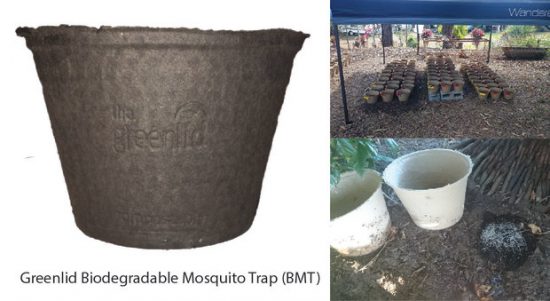
Greenlid has built a global distribution network for its product and the Australian state of Queensland is buying BioTraps to combat Dengue fever outbreaks. So far the Indiegogo site has raised 40% of the $50,000 campaign goal with 20 days left to go. The money the company receives from the campaign will help it to offset shipping and production costs.
A pledge of $25 U.S. gets you 5 BioTraps for next summer’s mosquito season. A pledge of $10 lets the company deliver 5 BioTraps to communities in the Developing World where mosquito-borne diseases are endemic. For $50 gets you receive 15 BioTraps, about a 3-month supply for a small yard, and Greenlid donates 15 BioTraps to communities in need. A $100 pledge gets you 75 BioTraps with 50 donated by Greenlid with the logistics handled by its charitable partners.
For those more generous who want to become an acknowledged sponsor, you have a range of pledge choices starting at $1,500 and increasing to $5,000. These pledges will allow the company to donate enough BioTraps to protect communities in areas susceptible to mosquito-borne disease.
The sponsored product will begin shipping next month in time to help countries in the Southern Hemisphere as their summer approaches. For home orders to North American pledges and purchases expect to receive your BioTraps starting in March 2017.
Greenlid Envirosciences is also the developer of Greenlid, a 100% recyclable container for home composting. The product was featured in an episode of The Dragon’s Den, the Canadian program that is the inspiration for ABC’s Shark Tank.
How so I say to myself. I’m a musician who has spent the better part of my life mastering four instruments of which the guitar is not one. Learning to play well on even one has required thousands of hours of practice. So how can someone with no musical background suddenly be able to pick up and play a guitar, the one instrument I still want to learn? Learning six-string guitar has become an ambition of mine. My father played and I inherited his guitar plus all of his music. But for some reason at age 67 I feel intimidated by the instrument.
That’s why I am both amazed and frankly “pissed off” by what MI Guitar does. How dare they make it this easy to play. Watch this YouTube video and you will see what I mean.
MI Guitar is truly an instrument anyone should be able to master. Its six strings don’t run along a traditional fretboard. Instead the strings appear only on the body of the instrument and where the frets would be in a normal acoustic guitar you have pressure-sensitive buttons that represent chord positions and individual strings. To find the right chord is simple. Follow the number guide that comes with every song in Magic Instruments catalog that comes in a companion mobile app available on Apple or Android devices.
The big difference other than learning technique is that playing MI Guitar doesn’t require you to know music nomenclature and chord charts. You just have to know numbers and the lyrics associated with them. Strum the strings or individually pluck one while pressing the numbered button indicated and you have the chord or note to go with the song and lyric.
The song catalog is free for 30 days. After that you pay a subscription fee of $5.99 U.S. a month, or purchase individual songs for $0.99. Composers of their own music can play by picking key and scale options. The guitar provides all the commonly played chords instantaneously including major and minor, sixths, sevenths and more so you can improvise. The learning curve is so very small.
Other features to note:
In its Indiegogo campaign, MI Guitar has raised $397,300 to date, 762% more than what it was asking for when it launched the crowdfunding effort just a few weeks ago. The company’s plan are to start shipping by March 2017. Early adopters can purchase the guitar for $299 plus shipping. Suggested retail price right now is considerably higher at $584.


Pilot is the first smart earpiece language translator. Wearers hear what is being said to them in their own language regardless of the language the other person speaks. On Star Trek the device was a universal translator. Here in the 21st century they call it Pilot. Pilot consists of an unobtrusive ear piece (comes in red, black or white). A secondary earpiece allows for wireless streaming of music. And the smartphone app that comes with Pilot toggles between languages or lets the user upload basic translations to a smartphone for reading offline. It even allows for multiple language conversations in conference mode.
Languages include English, Spanish, French, Italian and Portuguese available by May 2017. By fall 2017 Pilot will translate German, Hebrew, Arabic, and Russian. Additional languages include a variety of Slavic, East Asian and African dialects and languages. Languages can be downloaded through the app.
Pilot features a dual noise-cancelling microphone, speech recognition, machine translation and speech synthesis. Translation is simultaneous with slight latency.
Pilot is rechargeable with onboard Bluetooth and near-field magnetic induction communication. It runs on a lithium-ion battery with 4 to 6 hours talk time.
When the company launched its Indiegogo campaign it was seeking $75,000 U.S. So far it has exceeded expectations by more than 2,500 per cent and raised close to $2 million from more than 8,400 contributors. Talk about fulfilling a whole bunch of Trekkies dreams.
You can still pre-order by pledging $199 U.S. on the Indiegogo site. That will get you a full Pilot system with its two ear pieces, the mobile smartphone app and a portable recharger. For more information about the inventor and company visit Waverly Labs, based in New York City.

The inventors of Atmotube want you to think more about what you breathe in each day. The idea is you can raise your awareness about both local outdoor environment pollution as well as indoor air quality. In work environments it can identify unsuspected hazards from indoor pollution that normally you don’t think about.
The company promotion video and materials state, “Every day we unconsciously take more than 20,000 breaths. Unless we have a problem, we don’t think about WHAT we’re breathing in, and how that air might affect our bodies.” Having read this by now you are consciously thinking about your breathing and about to get hooked because the message continues…“there are dangers lurking in the air…..carbon monoxide poisoning can happen when you breathe in even small amounts of the gas causing terrible headaches and dizziness….other volatile organic compounds such as formaldehyde and benzene….linked to an increased risk of heart disease, stroke, liver and brain damage and even cancer….most people don’t find out they’ve been exposed to toxic air until it’s too late.”
Now that you are paranoid about every breath you take you can, by purchasing an Atmotube, be alert to all the potential dangers in the air around you. Using this compact titanium cylinder with its gas sensor you can track more than 21 airborne pollutants including solvents, cleaning fluids, cooking byproducts and particulate matter. You also get readouts on temperature and humidity. Atmotube even detects the trace pollutant gases emitted by mold and mildew. Clip one to your purse or belt and continuously receive an Air Quality Score that pops up on your smartphone app. And for those wanting to track of global warming’s number one cause, rising carbon dioxide levels, you can stay up to date with the best that atmospheric scientists produce although your readings will be local and not global.
Earlier this year the company launched its Indiegogo crowdfunding campaign. With 22 days left they have exceeded the $52,000 U.S. goal by 268%, raising over $139,000 in pledges. Order Atmotube on their website for $69.00 U.S. But if you go to the Indiegogo site, you can still get a 10-pack bundle for $660.00 plus shipping (no charge for shipping in the U.S.), a perfect gift for all your friends and family at Christmas.
Then there’s the 25 and 50 pack distributor and reseller bundles which should be of interest to Chinese retailers in cities like Beijing and Shanghai. After all if they can sell a can of fresh air made in the Canadian Rockies to consumers why not an air quality monitor that reminds them why their customers need that canister in the first place.
But I’m kidding. I do see some legitimate reasons for purchasing an Atmotube. If you are suspicious about unexplained symptoms like headaches and lightheadedness in a workplace or home environment, and you don’t want to call in air quality experts, then the sensor should quickly verify air quality and even identify the pollutant source. I also can see the value for asthmatics or people suffering from obstructive pulmonary disease, airborne allergies and other respiratory conditions.
Two surprising omissions. One of the most volatile pollutants found in home basements, radon gas and ground-level ozone, the latter, a leading cause of childhood asthma in urban areas. I wonder why these were missed. And on a more personal note, I would like to know that Atmotube can detect cat dander in the air? For as much as I love cats from a distance they don’t love me when I get near them. If I can be forewarned at the entrance to a building or home where there are cats and kittens then I’m buying.

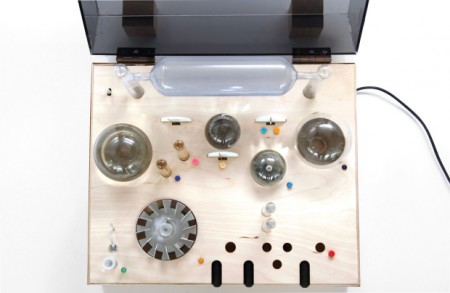
In a recent Indiegogo crowdfunding exercise, the inventors of Amino raised over $30,000 US, 229% above their target request. Described as a counter-top sized bio-lab, the kit comes with projects to grow living cells, create fragrances, flavors, new medicines and more. It is, in effect, the equivalent of a professional biological laboratory made simple. It describes itself as “a small and simple-to-use hardware system that enables anyone to grow and take care of living cells….the world’s first publicly available bioengineering platform that can be used at home, in labs or in schools.”
The creators description likens DNA to software and living cells to mini DNA factories with Amino providing the means for cells to be cultured outside their normal environments using the medium and tools within the kit. You get a bacterial culture, pipettes, incubator, agar plates and sensors built into a color-coded dashboard. Amino is genetic engineering and synthetic biology “accessible to everyone.”
The first Amino One kits come in two flavors. Amino Glow and Amino Explorer. Amino Glow turns E. coli into a living night light. Amino Explorer allows users to work with DNA to optimize violacein production, an anti-cancer, anti-parasitic research compound. Both kits come with automated cleaning systems so your cultures can’t accidentally get loose in your home or school.
Future planned Amino Apps will be priced between $150 and $400 depending on the DNA program and components. Food refills are also available to keep your cell cultures growing and in the case of E. coli, glowing.
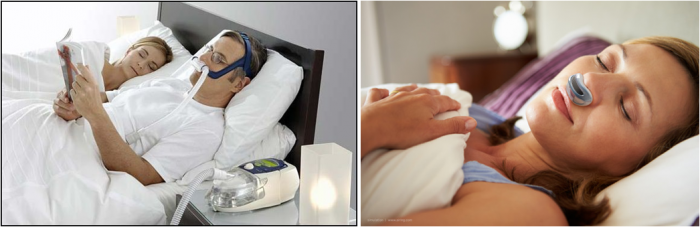
The technology that is prevalent to treat sleep apnea is called Continuous Positive Airway Pressure (CPAP). Patients wear an oral appliance at night that includes a mask, hose and air pump. The pump’s air pressure is initially determined by a sleep specialist after a study that has the patient going to a sleep centre where they get hooked up to all kinds of sensors in an overnight test. CPAP has been life changing for those who suffer from the disorder. But a new device being funded on Indiegogo may prove to be revolutionary for sleep apnea sufferers.
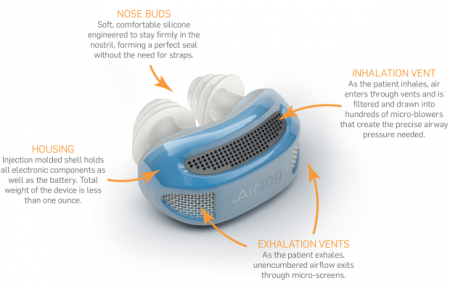
It is called the Airing. It is hoseless, maskless and cordless, a micro-CPAP device weighing 25 grams (less than one ounce) that is far more comfortable and far less cumbersome than what is being used by millions today.
Current CPAP technology is far from perfect (see image on left below). The masks can come off the face during the night. The seals are not perfect. The sound of the air pump causes sleep disturbances. The hoses can get caught. And the devices need to be cleaned to ensure they don’t become a biological trap for infectious diseases.
Airing in contrast (being worn by the user in the image below on the right) is used once and then recycled. So each night the user gets a brand new micro-CPAP device.
How can Airing do this when other CPAP technologies cannot?
Each Airing is made of injection molded plastic. The ventilation system features micro-blowers, the same kind of technology used to ablate heat from the microprocessors in your computer. The built-in battery gives the device enough energy for a full night of protection The nose buds are designed to fit into nasal passages to maintain a perfect seal, so no straps are needed to hold it in place. With each inhale the micro-blowers deliver the precise amount of air pressure to the airways and lungs. Each exhale flows through micro-screen vents that sit below the inhalation vent. Airing eliminates snoring completely, a common occurrence for those diagnosed with sleep apnea.
When the company launched its Indiegogo campaign this month to raise $100,000 US., within 6 days it had attracted over 6,500 investors and $625,000 in pledges.
If you currently suffer from sleep apnea, or if you are using or have used and abandoned your CPAP device (which apparently happens a lot) then Airing could prove to be very liberating and a good buy. Interested in acquiring some. At the Indiegogo site if you pledge $70 you get a month’s supply. A pledge of $199 gets you 120 and possibly many sound nights’ sleeps.
This week I learned about the Storm Electric Bike. Named after Storm Sondors, a San Francisco-based inventor, the bike features an easily switchable lithium-ion battery pack, with a range of up to 80 kilometers (50 miles), and rechargeable in 90 minutes. The eBike is no slim-line, light-weight racing cycle. Weighing in at a little over 20 kilograms (45 pounds) it features fat, all terrain tires and a rugged frame. The battery pack lies within a compartment inserted in the frame between the wheels.
On the Indiegogo site, the eBike appears in bright yellow with the tires attached to 74 centimeter (29 inch) orange wheel rims. The look (see image below) is distinctive, a bit campy and avant garde. If Sondors drove by on his you would notice. His forays into Golden Gate Park, astride the eBike, have been traffic stoppers.

Priced currently at $499 US during the Indiegogo campaign (regularly $1,299), the Storm Electric Bike features an all steel frame, 380-watt motor and top speed of 32 kilometers (20 miles) per hour. It is designed to operate in all terrain from riding on the beach to climbing a mountain trail or just tooling around the neighbourhood. And it comes in a number of colour combinations besides the original show-stopper that Sondors drives (see images below).
Most impressive has been the response on the Indiegogo site. Sondors started his campaign to raise $75,000 US on February 1st. It is now February 3rd and already he has pledges exceeding $1 million with a March 3rd campaign deadline. That’s a crowdfunding triumph.
What does Sondors want to do with the money? Manufacture the eBike in quantity to meet the amazing demand beginning on March 15th with plans to deliver by May 1st.


