Now let’s talk about the present. A new business startup out of Brooklyn, New York, called Modern Meadow, intends to take in vitro from the lab to commercial production. Meat would be cultured in large vats. The company founder, Andras Forgacs, previously developed 3-D printed human tissue for biomedical applications. He realized that if he can use cells and a 3D printer to grow human skin, then why not leather. And if he could assemble a living organ, then why not meat protein.
Today the McDonald quarter pounder uses up a lot of Earth resources. Every hamburger patty requires 3 kilograms (6.7 pounds) of feed grain, 200 liters (52.8 gallons) of freshwater, 6.9 square meters (74.5 square feet) of grazing and feed crop production space, 1,093 joules (1.036 BTUs) of energy, and releases over 6 kilograms (13.4 pounds) of CO2. Is this sustainable for the future? The answer is no.
Why? Because meat consumption is going up despite the rise of the Vegan population in the Developed World. The Developing World is looking to add meat in their daily diets. Currently, humans consume 300 million tons of the stuff a year. But with our population expected to exceed 9 billion by 2050, the amount of meat we consume will easily exceed 500 million tons annually.
Modern Meadow believes that increasing livestock herds is not the answer. There is a better way and our London hamburger taste test of last year is showing us the way. Growing meat from stem cell cultures at an industrial scale is the answer. It solves so many problems. It means less land is used for herding and foraging. It means no fear of disease from animal food sources. And it means ending the industrial slaughter of animals for human consumption. And once we have production scaled to make it affordable we can produce meat anywhere, even in space habitats and for crews on long-duration space flights.
Modern Meadow already knows how to grow human tissue for medical applications. It has expertise in bio-printing, the use of 3D printers and computers to assemble tissue. And now it is applying what it has developed for the purpose of mass-producing meat and leather. The company has already received a $10 million investment from Hong Kong billionaire, Li Ka-shing. And in the last week, the company’s founder was interviewed by David Talbot at the MIT Emtech conference.
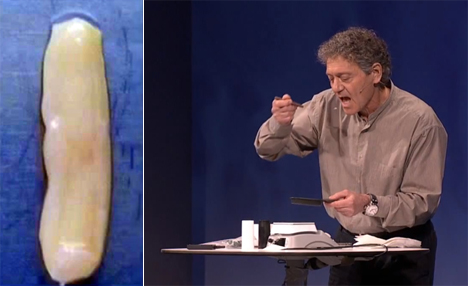
Talbot asked Forgacs (seen in the picture below tasting his own product) about taste testing of what is called “steak chips.” These are manufactured cow muscle chips that can be given a variety of flavours. According to those in the know, they taste like crispy beef jerky. But Forgacs right now is only doing private tastings. You and I will have to wait about five years before we’ll see steak chips and other Modern Meadow products in refrigerators and on store shelves.
Deemed the “Frankenburger,” in vitro meat is about to be served to a select number of guests in London in the United Kingdom during the first week of August. Frankenburgers are not to be confused with “frankenfoods,” a moniker associated with genetically modified organisms or GMO for short. The Frankenburger is synthetic meat grown from harvested cow stem cells. Each consists of 3,000 grain-sized strips of artificially created beef.
The burger doesn’t come cheap. If any of these guests were paying they’d be forking over $325,000 U.S. for each patty. Instead an anonymous donor is paying for all of the burgers being served at this gala event.
Mark Post, a medical physiologist at Maastricht University, The Netherlands, seen in the picture below, has been the “guru of in-vitro” meat for some time. His goal is to change the way humans produce meat protein by moving it away from harvested living animals to lab manufacturing. A single stem cell from one animal has the potential to feed the globe. At the same time moving meat production from the farm to the lab frees up land and water and reduces the food production infrastucture focused on livestock.
Post argues that our current practices to grow meat use 70% of total agricultural capacity. Moving it from the field and farm to the lab means humans will just need a few donor herds used to harvest stem cells for providing the “seeds” for producing the meat we will eat. In vitro meat will need 99% less land, will consume 82 to 96% less water, and will reduce greenhouse gas emissions by between 78 and 95%.
In vitro meat, therefore, appeals to the environmental movement. But it also appeals to vegetarians who don’t eat meat as a protest against the slaughtering of animals.
Lots of hurdles remain before in vitro meat will be found on grocery shelves. One is that meat is never uniform. it is a mix of different cells types from meat fiber to fat. Currently, however, the synthetic meat that will be served in London comes from a single cultivated stem cell. But synthetic meat can eventually be grown from multiple cell types with improvements over that grown on hoof. Saturated fats can be replaced with unsaturated fat giving the meat the same wonderful flavour without the cholesterol.
Post states that despite the lack of fat, his in vitro burger meat tastes pretty good. Well next week others will taste Frankenburgers and render their verdict. We’ll keep you and the billions of animals we grow and harvest posted. After all the latter have an even bigger vested interest in the outcome.

]]>


