The post Peanut Allergies – Why They Are a Thing and What to do About Them appeared first on Techso Mogro.
]]>I know a little bit about anaphylaxis. It has happened to me twice. The first time it was a hornet sting. The second time it was mango. Both sent me to the hospital with the latter an overnight stay. To combat my insect venom reaction I took rush therapy exposing myself to bee and yellow jacket venom in small quantities until I could no longer tolerate the reaction. This type of desensitization is quite effective. It’s different than getting a hay fever shot to deal with seasonal allergies which I remember being part of my routine in my teenage years. But with insect bites and stings, the desensitization treatment worked because I’ve since been stung by wasps with no anaphylaxis. Mango allergy, however, has been a different story. I just avoid the fruit entirely, and when I go into a restaurant or on vacations, I inform those preparing my food to ensure they are not handling mangoes before meal preparation for me. So far it has worked with a backup EpiPen just in case. Too bad, because before my mango episode I loved eating them.
Peanut butter allergies are far more common than what caused my anaphylaxis episodes. Why is that? The Mayo Clinic explanation leaves me wanting. It talks about the risk factors noting that peanut allergies happen mostly in toddlers and infants because of an immature digestive system. The presence of peanut proteins can be from the nuts themselves, from peanut products like butter and cookies, from contact with a person who has recently eaten peanuts or something made with them, or from dust or aerosols containing peanut residue or oils. Peanut allergies are more likely to occur in individuals with other allergies, or with a family history of seasonal or food allergies, and may manifest in people with skin conditions like eczema.
I recently became a grandfather. My daughter never exhibited a peanut allergy. And she and her husband have introduced peanuts into my granddaughter’s diet early. The Mayo Clinic suggests within 4 to 6 months after birth as a way of reducing the risk of developing the allergic response.
The Mayo Clinic states that “the only way to prevent a reaction is to avoid peanuts and peanut products altogether.” But that’s not the only way according to the Murdoch Children’s Research Institute (MCRI) which along with the Telethon Kids Institute recently discovered a way to reprogram genes to shut down the allergic immune response. They published in May an article in the journal Allergy entitled “Remission of peanut allergy is associated with rewiring of allergen-driven T helper 2-related gene networks” which describes their discovery. Using oral immunotherapy the research findings showed that T helper 2-associate gene networks could be reprogrammed to suppress the response.
Professor Mimi Tang from MCRI notes that in studying the immune response of children with and without allergies they were able to detect “profound differences in network connectivity patterns between children who were allergic and those who were in remission. The same changes were also seen when we compared gene networks before and after immunotherapy.”
The study done in Melbourne, Australia, involved 62 children with peanut allergies between the ages of 1 and 10. In a controlled experiment half were given a placebo, and half received a probiotic oral immunotherapy treatment. Of the former, only 4% displayed remission from peanut allergy, but in the latter group, the immunotherapy worked for 74%.
Sarah Ashley, a doctor at MCRI described the science. “Certain changes in the allergen-specific immune cells, called Th2 cells, are critical to achieving lasting remission. Th2 cells are essential for generating allergen-specific antibodies and the development of food allergies. We found that the Th2 signalling that drives allergy is turned off in children in remission.”
In recent years when I would be flying for business purposes, airlines would note in onboard literature that their planes and the food being served including snacks were peanut free. Schools sent notes home to parents advising them not to have their children bring peanut butter sandwiches for lunch or snacks. But now with these research results, and with the method endorsed by the Mayo Clinic and others that advise parents to introduce peanuts into an infant’s diet very early, the goober allergy may finally be on the wane.
The post Peanut Allergies – Why They Are a Thing and What to do About Them appeared first on Techso Mogro.
]]>The post Biomedicine – Part 11: Curing Technologies in the 21st Century Continued – Curing Cancer appeared first on Techso Mogro.
]]>When the genes in normal (somatic) cells mutate cell behaviour may change over time leading to cancer. Mutations are a normal part of the life of a cell. That’s because when cells divide they replicate their DNA but imperfectly.
In a previous blog we talked about telomeres, the ends of the DNA strands in our chromosomes and how the telomeres shorten over time with each cell division eventually leading to cellular death. But it is not just telomeres that change during cell division. Other parts of the DNA can get scrambled or lost. We call these changes mutations. Since mutations happen all the time why do some become cancerous while others remain benign?
Medical researchers suspect that specific mutations in sections of our DNA that regulate the cell life cycle, when accumulated over time, cause cancer. Mutations that govern other cellular functions appear to have no malignant implications.
Here are some additional facts about cancer.
As researchers study cancer they are discovering new ways to treat it and reviewing some old ideas that showed promising results in the past. Let’s look at where we were with cancer, where we are today, and where we will be in the near future in the 21st century.
Seeking a Vaccine that Cures Cancer
Does the name William Coley ring a bell? For most of you, probably not. Born in 1862, Dr. Coley, an American surgeon who decided to devote himself to finding a cure for cancer, was the first to note that exposure to an infection could arouse a person’s immune system to shrink tumors.
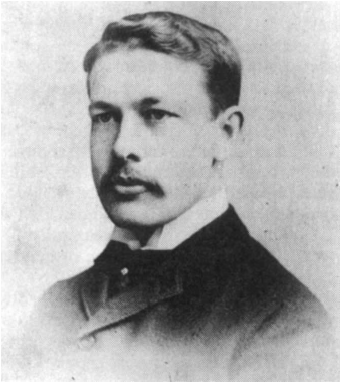
Dr. Coley studied sarcoma (bone cancer) at his New York hospital and identified a prior case of a German immigrant who had been operated on several times to excise a tumor in his left cheek. Each time the tumor regrew and after the final operation the remaining wound became infected. Surgeons were convinced that the man’s case was terminal but 4-1/2 months after he was discharged the tumor had vanished. When Dr. Coley studied the case he discovered that Streptococcus Pyogenes, a common bacterium that causes strep throat, was the source of the wound infection. The history of the case showed that the man had several outbreaks of fever and these outbreaks coincided with dramatic changes to the tumor. Dr. Coley concluded that the infection had saved the man’s life by stimulating his immune system to eradicate not only the bacterium but also the cancer.
Dr. Coley tested his theory on late-stage sarcoma patients first injecting them with live Streptococcus Pyogenes bacterium. The injections caused the tumors to shrink but in two cases the strep infections killed the patients. Dr. Coley then experimented with heat-treated bacterium injections. His first patient was a 16-year old boy suffering from a massive abdominal tumor. Known as Coley Fluid and later Coley’s Toxin, when injected into the tumor mass, produced the symptoms of an infectious disease (fever and chills) but not the full-blown illness itself. Repeat injections caused the tumor to shrink and eventually disappear. With no further cancer treatment the patient was discharged and survived another 26 years. Death was from a heart attack and not cancer.
Today the work of Dr. Coley continues at the Cancer Research Institute in New York. Founded by Dr. Coley’s daughter, the Institute studies how our immune system responds to cancer. In the 1970s doctors at the institute discovered that Bacille Calmette-Guerin or BCG could be used to treat early onset cancer of the bladder. The Institute has also studied cell proteins, called cytokines, and their immunotherapeutic effect on tumors.
Far from being Coley’s Toxin, seen by many in the medical establishment as quackery, current research is proving that Dr. Coley’s approach may lead to multiple cancer vaccines similar to the HPV cancer vaccine used to prime the immune system to kill human papillomavirus, a cause of cervical cancer.
Provenge is a vaccine developed by Dendreon, a company in Seattle. Designed to initially treat late-stage prostate cancer, Provenge is patient-specific. Cells from a patient are collected and then exposed to a chemical bath that contains cytokines that activate the immune system to attack the cancer. The cells are reinjected into the patient over the period of a month. Clinical trials on 512 advanced prostate cancer patients have been encouraging with 1/3 of the vaccinated patients remaining alive after 3 years. Plans are to introduce Provenge into earlier stage prostate cancer clinical trials.
We now know through the legacy of Dr. Coley that immunotherapy works. But what is the actual mechanism within our cells that leads to cancer? Research using baker’s yeast is yielding some exciting results.
Why Yeast Holds Clues to Curing Cancer
Saccharomyces cerevisiae is baker’s yeast, the yeast we humans have been using for milennia to make bread and fermented beverages. When a biologist, Leland Hartwell, decided to study cancer he chose yeast to help him model and understand the cell cycle.
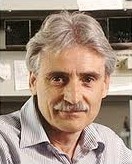
Hartwell was able to identify more than 100 genes directly involved in yeast cells that impacted life cycle. He called these Cell Division Cycle genes or CDCs. Hartwell identifed specific yeast genes responsible for different parts of the cell cycle and found similar characteristics in human cells. Since CDC genes either stimulate or inhibit cell division at very specific times in the cell lifecycle, Hartwell was able to identify the genes that didn’t operate in a normal manner. These included:
Any mutation to these genes could lead to what he described as driving with a stuck-accelerator and broken-brakes with no awareness that something has gone wrong resulting in out-of-control cell replication and the development of cancerous tumors.
What are the implications of this research in our search for cures for cancer in humans? Knowing that mutations in genes that control the lifecycle of our cells causes cancer should allow us to develop targeted therapeutic drugs specifically aimed at stopping runaway tumor growth. The tailor-making of drugs, called pharmacogenomics, should result in patient-specific cancer chemotherapy treatment without the side effects we normally associate with today’s treatments.
Having discovered the genetic mechanism that fuels cancer, the challenge is to find a way of delivering the cure and scientists may have discovered that answer. Read on.
RNA, Nanotechnology and Cures for Cancer
We’ve talked about Ribonucleic Acid or RNA in previous blogs. RNA interference or RNAi is a recent discovery and has enormous implications in delivering a cure for cancer. Why? Because RNAi can be used to silence the activity of specific genes within a cell. It does this by destroying messenger RNA or mRNA, the molecular messenger that carries coded information in genes to the protein factories needed to manage the cell’s lifecyle.
The challenge scientists faced was finding a way to dleiver RNAi to a target without it degrading. When RNA is normally injected into the bloodstream it quickly degrades. That’s where nanoparticles come in. American researchers have developed a vaccine that contains a nanoparticle drug that can deliver RNAi to cancer cells. Using a polymer that self-assembles to create the nanoparticle, and coated with a chemical that provides each particle with protection from binding to any cells it encounters within the bloodstream, the nanoparticles target surface receptors on cancer cells, penetrate and destroy them and cause minimal side effects to surrounding healthy cells.
It has taken 15 years to develop nanotechnology delivery systems. RNAi was discovered in 1998. What will we witness in the next 15 years? We are getting much closer to one of the Holy Grails of modern medicine, a cancer cure.
The post Biomedicine – Part 11: Curing Technologies in the 21st Century Continued – Curing Cancer appeared first on Techso Mogro.
]]>The post Biomedicine – Part 10: Bioengineering the End to Aging appeared first on Techso Mogro.
]]>Our Biological Limits
In the latter part of the 18th century the average human lived 24 years. By the end of the 19th the average lifespan had doubled. In the second decade of the 21st century we are approaching a doubling again. Is there a biological limit?
We are the sum of our genetics. How long your parents lived may indicate how long you will live. But then again it may not. We know that altering genes can alter the lifespan of animals and plants we study in laboratories. We have doubled the lifespan of mice by splicing genetic material into their chromosomes.

In an earlier blog we described the structure of DNA, genes, base pairs and chromosomes. It may be helpful to click on the link provided as a quick refresher before reading further.
We have two DNA repositories in every cell in our body (blood cells not included). That DNA is found in the nucleus and mitochondria within the cell. The DNA organizes itself as chromosomes. When cells replicate the chromosomes divide and copy themselves. This is called mitosis.
Telomeres are repeating DNA base pair sequences that sit at the end of each chromosome. They act as buffers to ensure that DNA replication during mitosis remains accurate. A ribonucleic protein enzyme, telomerase, maintains the telomeres. As cells divide some telomere information does not replicate, usually between 25 and 200 base pairs. The average telomere can be as long as 15,000 base pairs so what is lost is not significant until the cells divide many times. The accumulation of lost base pairs starts adding up.
Why do we lose telomeres? This may be a reflection of our natural aging process, the unwinding of our biological clock so to speak. Or telomeres may shorten because of external forces such as exposure to toxins, disease or injury. Ultimately when chromosomes no longer have a telomere buffer cells they no longer can divide and we call this cellular state senescence. The Hayflick limit, named after the scientist (see the image below) who, in 1961, first discovered this phenomenon, is the natural limit of a cell’s life after multiple replication.

Do all cells have a Hayflick limit? Apparently not as scientists have observed in studying cancer. Tumor cells do not suffer from DNA strand shortening. They can infinitely replicate because in cancer cells telomerase remains active restoring telomere length. Other cells that don’t exhibit the shortening of telomeres include sperm and egg cells. Hormones may impact telomerase activity and telomere lengths. It is believed that estrogen plays a role and may explain why women live on average longer than men.
If we were to alter the behaviour of our normal cells by stimulating telomerase could we reverse the aging process, ending senescence? This is possible. Use of telomerase in laboratory settings has shown that it can confer “immortality” on several types of human cells. That same capability makes telomerase one of the key factors in cancerous tumor cell growth and is leading to research into telomerase inhibitors that would transform cancer cells by starving them of the protein and putting them into senescence.
Telomeres alone do not extend life. If they were the sole means by which we could stop aging we have the technology to produce on mass altered cells containing high levels of telomerase and bank these for use to cure incalculable diseases. Right now scientists believe that stopping telomere shortening may add 10 to 30 years to the average life span. That would mean a child born today could expect to easily achieve an average lifespan of a century.
Other Factors to Consider that Impact Aging
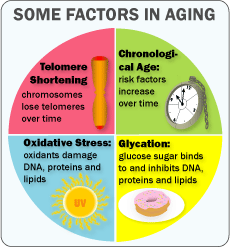
If you are over 60, which I am, your risk dying doubles every 8 years. Research shows that shortening of telomeres only accounts for 4% of the difference. Chronological age and gender account for an additional 33%. The remaining 63% can be attributed to:
Oxidation sounds like a strange contributor to aging. After all, we need oxygen to breathe and a byproduct of this basic life function is oxidants. Oxidants result from oxygen combining with sugar to produce energy and byproducts called free radicals. Not all free radicals are internally produced. They can also come from infections, inflammation, alcohol, smoking, excessive sun exposure, radiation from x-rays and environmental toxins. Free radicals can have a negative impact on individual cells, proteins and fatty tissue. Free radicals over time can build up in the body and are associated with aging. In a recent study the lifespan of worms was increased by 44% by neutralizing oxidants.
Glycation involves excess glucose binding with our DNA, proteins and fats. Excess glucose begins to interfere with normal body tissue functions. The older we get the more the glucose creates health problems contributing to aging let alone body mass. Research shows that restricting calorie intake and selecting foods low in sugar leads to reduced age-related disease and extended lifespans in mice to monkeys.
Inflammation is the body’s natural response against infections and injuries. It also contributes to tissue injury and ultimately to aging. Chronic or persistent inflammation without significant infection is evidence of an immune system that no longer recognizes host body tissue as its own. As we age autoimmune conditions including chronic inflammation become more prevalent. Chronic inflammation destroys normal cells and contributes to the aging of the cardiovascular and nervous system. Inflammation contributes to age-related neurodegenerative diseases, such as Alzheimer’s and Parkinson’s.
Stress harms DNA and speeds the aging process. A study in 2004 showed that psychological stress shortens telomeres in immune cells. Evidence shows that stress, the endocrine system response and the occurrence of disease define age more than chronological aging. Certain diseases occur when anabolic hormone levels start to decline and catabolic hormones start to increase. The latter, such as Cortisol, can contribute to the breakdown of body tissue. As proof of just how much stress contributes to aging and premature death, interviewers who spoke with centenarians found that they exhibited healthy coping strategies in dealing with illness describing their behaviours as accepting, non worrying and taking life one day at a time.
Immune Response refers to the specialized cells generated by our bodies to fight off disease. Researchers in Israel at the Technion studied the natural decline in the immune system as we age. This inability to fight off diseases when we are older is one of the reasons for the statistics about the risks to humans when they reach 60 and over. By suppressing B-lymphocyte immune cells in aging mice and using a drug commonly used to treat rheumatoid arthritis, the mice were able to manufacture healthy replacements using bone marrow. Clinical trials have begun in human populations suffering from B-cell lymphoma.
What are the prospects for human immortality?
The SENS Foundation is dedicated to re-engineering our bodies to end aging through rejuvenation biotechnology. These biotechnologies cover major research areas including cell loss, tissue atrophy, nuclear and mitochondrial mutations, immunotherapy, and targeted ablation. The goals are:
If we eliminate all of these physical processes inherent in aging and develop appropriate delivery systems for restoration and repair some scientists project that we can live 1,000 years. Will someone born in the 21st century be the first millenarian?
The post Biomedicine – Part 10: Bioengineering the End to Aging appeared first on Techso Mogro.
]]>