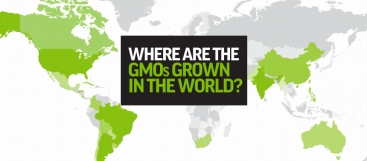
In 2012 according to a report released last year on GMO crops the Developing World represented 52% of all hectares dedicated to these types of crops. Farmers cultivated a record 170.3 million hectares of GMO crops in 2012. That represented an increase of 10.3 million hectares from 2011.
This trend to acceptance of GMO by an increasing number of farmers despite resistance from many who describe the produce as “frankenfoods,” speaks to its many benefits:
This unprecedented change in the Developing World has witnessed the adoption of GMO crops at a rate three times faster and five times bigger than in the Developed World. Globally 2012 saw a new record in the number of farmers adopting GMO with 90% of them, 15 million, represented by small plot growers from within Developing World countries. These farms, classified as subsistence in the past, now have the opportunity to free themselves from the cycle of continuous poverty.
I know that many of you reading this blog posting may be averse to GMO on principle. But the reality of food demand for a growing world population, most of it happening in the Developing World, is making GMO a technology of significance. Food security is overcoming fear, uncertainty and doubt.
Here are some additional statistics you may find interesting:
The European Union is the one region in the world that continues to question the science of GMO in food crops. This is the only part of the world where GMO crop planting declined with notably Germany, Sweden and Poland creating regulations that discouraged farmers from considering the technology.
In Africa where agriculture represents 35% of the gross domestic product and employs 70% of the labour force, population growth and changing climate are creating tensions around adoption of GMO crops. GMO planting has been approved in Burkina Faso, Egypt and South Africa. But has been confined to test fields in Uganda, Kenya, Nigeria and a number of other African countries. This hesitancy is somewhat tied to the European Union’s policies of limited acceptance of GMO. But according to the International Food Policy Research Institute, the demographic pressures will soon push African policy makers to adopt GMO as an answer to poverty and food challenges on the continent.
Add the challenges of environmental degradation of arable lands, growing desertification in marginal farming areas, and the impact of climate change weather events, and you have a degree of uncertainty that agrifood producers need to mitigate against. So the business of growing food has significant challenges to face as our human population grows to 9 billion plus by 2050. Can production keep up or exceed population? Can we improve the infrastructure that supports the planting, harvesting and distribution of food? Can we continue to improve on the types and yields of food we grow? Can we restore agriculture to degraded lands? Can we adapt what we grow to meet what climate change will throw at us?
The State of Agriculture
Today 12% of the planet surface is used for agriculture. Roughly 3% is defined as dry. Dry lands support 30% of our global population and are increasingly drawing on aquifers and other freshwater surface sources to supplement rainfall. Today they are under water stress and trending to worse.
Rain-supported agriculture occupies 80% of the world’s arable land and produces 60% if its crops. Africa, South Asia and South America rely most on rainfall to grow staple crops. They are also the areas at highest risk for soil degradation both in rain-supported and dry agricultural zones. And Africa, South Asia and Soth America are the places on the planet where human population is expected to grow significantly between now and mid century.
Irrigation is critical to agriculture. Almost 40% of global increases in food production is associated with the introduction of irrigation projects to areas previously deemed marginal or dry. To meet food demand for the human population of 2050, based on current agricultural practices investment in irrigation of growing areas needs to increase. There are two problems. The first is that most groundwater sources have been tapped beyond capacity with few new discoveries of any significant size. The second involves surface waters. There are few fewer places where humans can divert water by damming rivers. Fallout from any new projects includes the necessity to relocate human and animal populations, often deterioration in drinking water downstream from dam sites, a decline in the downstream fisheries, water level changes that impact river traffic. None of these issues are trivial and when you combine them with projects that cross national boundaries you can see the potential for water conflicts breaking out. Some prognosticators about the future go as far as to state that the next world war will be fought over freshwater access.
Finally, a word about forest agriculture. Called agroforestry it is a land use system that integrates agricultural crops, livestock and forest resources. Instead of burning or clearing forest lands, agroforestry leaves much of the forest intact with crops interspersed among trees. The trees are harvested as well producing fruit and nuts and providing firewood for fuel. The trees in agroforestry lots act as natural protectors and barriers to wind and protect crops beneath and around them from weather events that could otherwise damage growth. The root systems minimize erosion and maintain soil moisture levels even during periods of drought. Although modern agroforestry may still be in its infancy, it owes its origins to practices that go back thousands of years in places like Amazonia and the Congo. We are only getting back to these practices after learning from our many mistakes.
The State of Hunger
Have you heard of the Global Hunger Index or GHI? In a report put together by the International Food Policy Research Institute or IFPRI, Concern Worldwide and Welthungerhilfe, it states that 20 countries in 2012 faced levels of hunger that were deemed alarming or extremely alarming. These were located in South Asia and Sub-Saharan Africa. The index measures a number of key indicators to arrive at its conclusions. One of these is the number of underweight children. Another is child mortality. And a third is the calorie intake of the general population. On a 100-point scale in which zero equals no hunger, and 100 equals famine, the GHI has been using data from 120 countries to come up with an annual report. The 2012 study reflects data from 2005 to 2010. The good news is the proportion of humanity defined as hungry has declined as a percentage since 1990. The bad news is the absolute number has grown. The map below illustrates those areas on the planet where GHI scores have increased or decreased. Note the green countries. These have made significant progress in feeding their populations. Whereas countries from orange to red are those that continue to have higher incidents of hunger within their populations.

The Solutions


