We see the Sun as a constant and yet we know it is not because the geological record proves the latter. Radiative output has varied dramatically which may explain how Earth has gone through cycles of cooling and heating with the latest cooling trend happening in the last 50 million years. Hence the Ice Age of the past 2.75 million years with glaciers expanding and contracting in rhythm with the amount of solar radiation, and the wobble of the Earth’s axis. Throughout these last few million years, each cycle of glaciation and interglacial warming has been cooler than the last. The peaks have been lasting approximately 100,000 years.
But other natural cycles have also played a role in this recent climate variability. The 41,000-year periodicity caused by Earth’s non-circular orbit combined with the axial tilt variability has impacted the northern hemisphere more than the southern leading to the more pronounced cycles of glaciation in the former than the latter. Throughout, however, Antarctica has remained ice-bound.
The recent Ice Ages, however, don’t compare to what geologists describe as an extreme period of cooling that lasted from 750 million to 580 million years in the past. Evidence indicates an ice-ball Earth from the poles to the equator. Orbital mechanics and solar radiation levels were probably contributing factors to this extreme climate event. What reversed it remains a bit of a mystery? And how early single and multi-cellular life survived the 170 million years of extreme cold is a mystery as well. Could the ice build-up on Earth’s surface have altered the axial wobble to the point where it impacted Earth’s internal circulation within the mantle? Could that have contributed to a period of volcanic activity causing greenhouse gas outgassing to warm the atmosphere and cause the extreme glacial event to end? We are still searching for answers to these questions.
We know today that planets in our Solar System do not all have similar axial tilts to Earth. The most noted exception is Uranus whose axis lies close to 90 degrees from the vertical. In effect as Uranus rotates around the Sun, it acts like a bowling ball rolling down a lane. What caused this to happen on that planet? Could it have been a planetary-sized collision in its past? Could Earth’s axial rotation at some point become as extreme as that of Uranus? Would the magnetic orientation within sedimentary rocks laid down during that past global Ice Age help us understand if a change to Earth’s axis played a significant factor in the 170 million-year period?
These are interesting speculations that the geological record may soon reveal. But there is nothing in Earth’s past history that compares to our present. Because right now, global atmospheric warming caused by our industrial activities and explosive population growth over the past 170 years is affecting the Earth’s axial tilt physically as polar ice vanishes with warming atmosphere and seas.
In an article appearing in The Guardian this past week, Damian Carrington writes, “the massive melting of glaciers as a result of global heating has caused mark shifts in the Earth’s axis of rotation since the 1990s.” In other words, the poles are shifting, not the magnetic ones although they are as well, but the physical poles that mark the antipodes of the Earth’s axis. The loss of hundreds of billions of tons of ice annually is the cause with scientists recording the shift in the rate of axial drift since 1995, 17 times greater than the preceding period. In fact, the polar positions since 1980, the research shows, have moved 4 meters (more than 13 feet). Now that doesn’t sound like a lot, but prior to this life influencing the physical movement of Earth’s axis wasn’t in the cards.
The researchers ruled out other axial triggers that include movements within the mantle that affect continental drift, activity within the oceans from the seafloor to surface waves, and atmospheric changes such as winds and air currents that could contribute to changes to our axial wobble.
So it is us. We, humans, are even impacting the alignment of the Earth’s axis. The change, a mere 4 meters, isn’t a lot. But who would have thought our activity on the planet’s surface could lead to such a consequence?
]]>
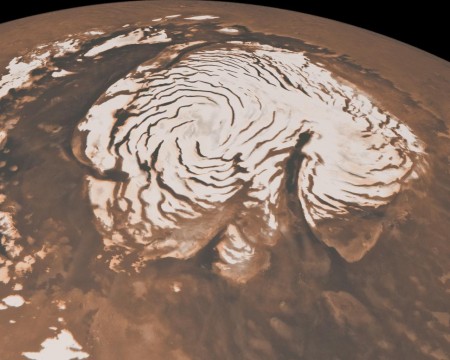
A detailed analysis by the Mars Reconnaissance Orbiter using its subsurface radar, SHARAD, has concluded that Martian poles get warmer during ice ages causing the ice to retreat. The water vapour released into the atmosphere migrates toward the equator leading to large accumulations of glaciers and ground ice at mid-latitudes.
On Earth our Ice Ages have produced significant accumulations in the polar regions with extensive growth of ice fields and glaciers. But the ice doesn’t migrate to the equatorial region of the planet.
Today Mars is experiencing a warming period and that is causing polar ice fields to grow. SHARAD data shows the poles have seen ice accumulations grow by a depth of 300 meters (980 feet) since the last ice age some 370,000 years ago.
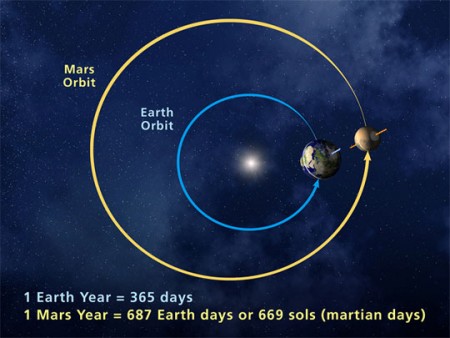
What triggers ice ages on Mars? Scientists suspect it is the planet’s axial tilt. There are times as Mars more exaggerated orbit (it is more of an oval than Earth’s as seen in image below) combines with axial tilt to create optimal conditions for the warming of polar regions which then lose ice volume to temperate and equatorial areas on the planet. When the warm polar periods end as Mars axial tilt and distance from the Sun reverse conditions, the migration of ice goes pole-ward.
If the ice accumulated in the polar caps were to be uniformly spread across the planet, Mars would have a global layer 60 centimeters (about 2-feet) thick. That’s how much surface water still remains on the planet.
]]>
The cyclical changes were first observed by Milutin Milankovitch, a Serbian astronomer and mathematician, who calculated their magnitude. He determined there were three specific cycles impacting Earth climate.
Milankovitch Cycles Explained
The first was eccentricity. This is the shape of Earth’s orbit around the Sun, not circular but elliptical. At aphelion, the furthest point in Earth’s elliptical orbit Earth receives 6% less solar radiation than at perihelion, the closest point. When the ellipse exaggerates than the difference can be a delta of 20 to 30% in terms of solar energy received.
The second is axial tilt. Earth’s axis wobbles at a periodicity rate of 41,000 years. During that time the angle changes from 24.5 to 21.5 degrees. Today the axial tilt is at 23.5 degrees which should mean more exaggerated seasons as solar radiation to polar regions is impacted negatively in the winter and more positively in the summer. But some scientists believe that a less pronounced axial tilt promotes the growth of ice sheets because warmer winters attract more moisture to the poles leading to increased snowfalls. At the same time the moderate tilt means summers are cooler at the poles and hence less melt occurs. We humans haven’t been around long enough to fully measure a single cycle so we really don’t have the data as of yet to know which theory is correct.
The third is precession, a measure of the Earth’s axial wobble, a different phenomenon than tilt. It appears that the Earth wobbles like a spinning top going back and forth. That wobble has the Earth’s axis pointing some times to Polaris (the North Star), and at other times pointing to Vega. The periodicity of precession is every 23,000 years. The wobble coincides with aphelions and perihelions. When the axis points to Vega the Northern Hemisphere experiences winter at the aphelion and summer at the perihelion leading to greater seasonal contrasts.

Add Human Generated Carbon Dioxide to Milankovitch Cycles
In a study published in Nature back in January of this year, scientists at the Potsdam Institute for Climate Impact Research, looked at human interference with the Earth’s natural climate cycles. States lead author, Andrey Ganopolski, “Even without man-made climate change we would expect the beginning of a new ice age no earlier than in 50.000 years from now – which makes the Holocene as the present geological epoch an unusually long period in between ice ages.”
The study concludes that human-generated carbon dioxide (CO2) emissions from the burning of fossil fuels is now in sufficient volume to delay the onset of the next Ice Age by 50,000 years. In other words the natural cycle observed in the geological record is broken. We will skip an entire Ice Age cycle. States Ganopolski, “It is mind-boggling that humankind is able to interfere with a mechanism that shaped the world as we know it.”
The researchers created an Earth system model that simulated past Ice Ages and the global carbon cycle looking at ice volume in the Northern Hemisphere. It was determined that even small increases in CO2 impact ice sheet formation. Emissions of 1,000 to 1,500 Gigatons of CO2 postponed the onset of Northern Hemisphere continental glaciation by 100,000 years.
Our modern civilization is a product of past glaciations. Human civilization arose as the last Ice Age melted away. We carved out our agricultural revolution and first cities from that ice legacy of rivers, deltas and lakes left in the melting wake. And now, because of our human civilization we face a new geological era of anthropogenic origin dubbed the “Deglacial” according to Potsdam Institute Director, Hans Joachim Schellnhuber, a contributing author to the study.

]]>
The Commission is an independent body and includes political leaders, NGO chairs, scientists and academics from around the world. With the latest alarming findings it makes many recommendations. Among these are:

Although I see no reference to zoning the world’s oceans, an idea which I have written about and believe would help to begin the process of conservation and recovery, the commissioners have in their recommendations begun to address ways to better measure and protect vulnerable ecosystems and hold governments to account should they fail to meet sustainability goals.
But we still know so little about how our oceans play a role in impacting climate. We suspect they have an enormous impact but how and when? In a recent scientific study we have a new take on that relationship and its timing. Researchers from the University of Southampton, the National Oceanography Centre, and Australian National University, studying the past 5.3 million years have found that deep sea ocean cooling and continental ice volume cycles in the onset of the Ice Age didn’t coincide. The glaciers and sea ice that spread across North America, Eurasia and northward from Antarctica 2.15 million years ago as it turns out was preceded by ocean cooling 550,000 years ahead of the Ice Age onset.
How do we know? Researchers studied core sampling of ocean sediments, similar to those seen in the photograph below, looking at oxygen isotope ratios to calculate ancient water temperature. Sampling was done off the Straits of Gibraltar.

For the scientists participating in the study the discovery may have implications in our study of CO2 atmospheric concentrations and their subsequent impact on global temperatures and sea level changes. Right now scientists are discovering that the Deep Ocean is getting warmer, not colder as was discovered in the core samples dating back 5.3 million years. But that raises the question, could a similar time delay happen from the presence of increased CO2 in the atmosphere? Could that mean we may see the onset of extreme climate change delayed further into the future?
We continue to learn about the complexity of our Earth systems and sometimes find surprising outcomes in our investigations. The climate change lag discovered and reported in this latest research tells us just how much more we need to know about the balance between atmosphere, ocean and climate. It also tells us that we may face different results over the next millennia resulting from the lag observed between ocean and observed climate changes on land.
Last week a study was published in Nature Geoscience showing that some areas of the Himalayas were gaining ice steadily. The study compared data collected on the Space Shuttle Endeavour in 2000 with the French SPOT5 satellite data collected in 2008. In a 5,615 square kilometer area of the Karakorum mountains (on the border area where China, Pakistan and India meet) the data indicated substantial increases in the ice mass.
First of all, is this good news or bad news? For the people of India and Pakistan who rely on the ice pack to feed the rivers of their respective countries an increasing ice mass is indeed good news. For climate change advocates it might be considered bad news. But is it? Is it possible for glaciers to grow in a world where atmospheric CO2 is on the increase? Shouldn’t these high alpine glaciers be melting just like the ice in the Arctic, Greenland and Antarctica?

When looking at local changes to alpine glaciers one has to consider local weather. The Himalayas are not the only glaciers that have grown in recent years while Arctic sea ice has been melting. On the other hand the glaciers of the Andes Mountains and the snows of Kilimanjaro in Africa have been retreating since the mid-19th century before CO2 began its climb to present day levels.
In 2008 some Alaskan glaciers gained ice mass because of a colder and wetter winter, spring and summer along the coast of the Panhandle. Those who argue that climate change is not real cite the Alaska example as proof that global warming is just natural variability and not CO2 related. But over the last century Alaska’s glaciers are melting more than accumulating new ice mass. The Himalayan data has to be looked at similarly. The problem is we have only the 8 year period between two space-based observations to define a trend. Climatologists would argue that 8 years is hardly enough.
Recently I wrote about what ended the last Ice Age in North America. It is interesting that the rise in atmospheric CO2 happened at the end of the melt, not before it started.
For climate change deniers atmospheric CO2 rises are episodic. We’ve seen them before and we’ll see them millions of years in the future. But climate scientists universally acknowledge that the recent rise in atmospheric CO2 is dramatic and correlates to the rise in human global population and the activities associated with our technological civilization.
On Earth Day it is important that we recognize that we owe all life on this planet an opportunity to thrive. If human activity is contributing to increased pollution, mass extinction, acidification of our oceans, then we need to do something about it.
]]>I call the cause a trifecta event, three different causal interconnected links that induced the change that allows me to live in Toronto, a place once under more than 1.6 kilometers (1 mile) of ice. What were the three?
Axial Wobble
For humans who have built modern civilization within a few thousand years, the idea that the Earth axis is not always stable, canted at an angle of 23.5 degrees, is hard to accept. We know today that the axial tilt is not constant. It changes. Not only does it vary from 24 to 22.5 degrees, sometimes it wobbles. One of those wobbles happened 20,000 years ago. The wobble meant the northern hemisphere received a lot more direct sunlight and that started the meltdown. The meltdown had an impact on the oceans, the next part of our trifecta.
Ocean Currents
In North America we learn about the Gulf Stream, the warm water current that flows from the Gulf of Mexico across the North Atlantic to warm up the shores of Europe giving that area of the world a more benign climate than areas of North America at the same latitude. Just compare London, England with Calgary, Alberta, both at 51 degrees north and you will see what I mean.
The Gulf Stream is part of a global conveyor belt of ocean currents (check out the map below). The technical terms for this phenomenon is Meridional Overturning Circulation (MOC). Warm water overrides cold water which is more dense and sinks. When freshwater from melting glaciers enters the ocean the outwash is even less dense than warm saltwater and displaces it.

That displacement is exactly what happened when our Earth experienced the axial wobble 20,000 years ago starting the glacial meltdown. With the North Atlantic flooded with freshwater, equatorial water from the South Atlantic was blocked from moving north.
Now comes the final piece of our trifecta puzzle.
Changes to CO2 Levels
Our oceans are great carbon sinks. In fact 43% of the CO2 produced by animals, humans and industrial pollutants gets absorbed into the ocean. CO2 is delivered to the deep ocean by cold water as it sinks bonding with other elements in the ocean to form dissolved carbonate, CO3, and hydrogen carbonate ions, HCO3. Phytoplankton and other creatures extract carbon from ocean water and combine it with calcium to form calcium carbonate, CaCO3, the material of shells and other exoskeletons.
Where CO2 dissolves into cold ocean water, it does the opposite in warm where it readily escapes. And because warm water is surface water the escape is into the atmosphere. So our South Atlantic starting less than 20,000 years ago began to get warmer and with no place to go because of the freshwater flooding the North Atlantic, released CO2 into the atmosphere.
How much CO2? The answer is quite a bit. CO2 levels which tend to be lower during period of glaciation, rose from 180 parts per million (ppm) to 260 ppm. With more CO2 in the atmosphere the Earth experienced a global runaway greenhouse effect with temperatures rising and accelerating the glacial melt.
The only bump on the road to rising temperatures was a second massive influx of freshwater about 11,600 years ago, a period called the Younger Dryas, when water from Lake Agassiz (the site of the current Great Lakes in North America) rushed into the North Atlantic after the ice dam in the St. Lawrence River valley broke. That vent caused a 1,000 year stoppage in rising atmospheric temperatures but they climbed right back.
Today we are experiencing rising CO2 levels of a similar magnitude to the one that happened to end the Ice Age (see the chart below). What does that mean for the Earth? Will we continue to see glacial meltdowns? And if we do would the melting of Greenland’s ice sheets or the Antarctic cause another MOC sending us into a period of cooling.

Studying historic changes to atmospheric composition and temperature has all scientists agreeing. Our climatological record provides us with evidence of significant and abrupt changes. Can we afford to ignore rising CO2 levels?
]]>


