How ridiculous.
This may come to an end in 2017 as many banks around the globe adopt Blockchain technology faster than expected according to IBM which has produced a report entitled Leading the Pack in Blockchain Banking: Trailblazers Set the Pace. IBM’s Institute for Business Value combined with the Economist Intelligence Unit did a survey of 200 banks from 16 countries asking them their expectations about blockchains. Currently only a small number of banks have adopted the technology largely in pilot projects. But the survey shows that a number of banks intend to use it for retail payments and consumer lending, trade finance, corporate lending and reference data.
What is blockchain?
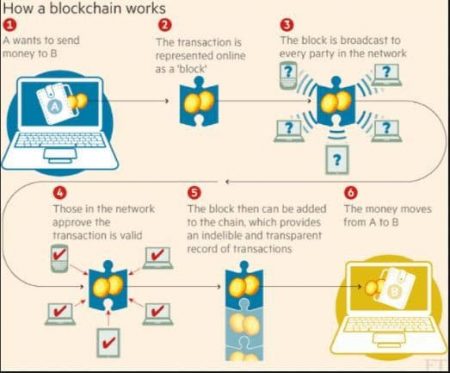
Originally designed for the handling of transactions using digital currencies such as Bitcoin, blockchain is becoming an effective way to digitally track all kinds of currencies and other assets. Blockchain is a way of structuring data. Using it you can create a digital ledger that can be distributed across a network of computers. Blockchain provides a secure method for transactions because it uses advanced cryptography.
Blockchain doesn’t require a central authority as a point of validation for any transactions using it. A transaction that gets recorded in the blockchain ledger can be added to by network participants. When added the new information is evaluated and validated by all members. It then becomes an additional block added to the chain.
In a February 2016 article appearing in The Wall Street Journal, Steven Norton describes how a company would use blockchain. He writes:
“Assume an organization has 10 transactions per second. Each of those transactions receives its own digital signature. Using a tree structure, those signatures are combined and given a single digital fingerprint — a unique representation of those transactions at a specific time. That fingerprint is sent up the tree to the next layer of infrastructure, such as a service provider or telecom company. This process happens for every organization in the network until there is a single digital fingerprint that encompasses all the transactions as they existed during that particular second. Once validated, that fingerprint is stored in a blockchain that all the participants can see. A copy of that ledger is also sent back to each organization to store locally. Those signatures can be continuously verified against what is in the blockchain, giving companies a way to monitor the state and integrity of a particular asset or transaction.”
In yesterday’s edition of Fortune, Lucinda Shen, writes that IBM is predicting 66% of banks will be operating using blockchain for commercial operations. She describes successful tests of blockchain for bond transactions and cross-border payments by eight different banks.
The embracing of blockchain by banks is seen as a way of reducing costs and speeding up transactions by cutting down on time to reconcile disparate data such as trying to send a money gift to a couple getting married in France from here in Canada without going through the hoops I described above.
]]>
Google isn’t alone in announcing quantum advancements. States Serguei Beloussov, CEO of Acronis, a cloud data protection, backup and disaster recovery service provider, “it is a technology that is developing very rapidly…..companies like Amazon, Alibaba, Google, want to be in front of that change.” But as optimistic as the quantum engineers act, it seems we are always talking about it being a decade away. Beloussov was a former doubting Thomas. He in past quotes stated that we wouldn’t see a working quantum computer materialize for another 20 to 40 years. But now he is far more optimistic stating “in the past two years, especially in the past year, there have been many advances in the field which were very hard to predict so it’s possible that these changes [can arrive closer to] the next five to ten years….personally, I think it will be less than ten years.”
One of the driving forces pushing quantum computing advancement is security. It appears that we are reaching the limits of encryption on binary-based computer systems. The advancements in artificial intelligence alone may make systems that we once thought 100% secure, an open book to hackers. That means data from communications to financial reports and national intelligence will no longer be secure.
As the illustration above states, with quantum computers we may see the end of security. Quantum computers aren’t susceptible to the hacking technology we are vulnerable to today. That’s because extracting a quantum bit (qubit) is very hard. A hacker trying to read quantum data has to deal with the physics of quantum mechanics in which the state of a bit is not limited to a “0” or “1”, an “on” or “off” or a “yes” or “no.
As seen in the illustration below a quantum bit can assume positions anywhere between and around a “0” or “1.” This fuzziness of position makes any attempt to tamper with data written on a quantum device impossible to hack into without either destroying the state of the data bit or alerting the user to the attempt. And even if alerted, the user’s data isn’t compromised.
With a quantum e-mail server Hillary Clinton’s and the Democratic National Committee’s emails would remain private. No chance Russian hackers or Wikileaks could share their contents with the world as we have seen in the last month in the run up to the American November presidential election.

One of the issues holding quantum computers back, however, is the absence of software. Last year I wrote about Cambridge Quantum Computing Limited and their release of the first DOS or operating system for quantum computers. Another company located in Vancouver, 1QBit, has been contracted to build software for D-Wave Fortune 50 customers. And in May this year D-Wave announced the launch of Quantum for Quants, an online community focused on the financial community to encourage the development of software tools for that industry. At the time of the announcement, Marcos de Lopez de Prado, Senior Managing Director, Lawrence Berkeley National Laboratory, stated, “Quantum computers enable us to use the laws of physics to solve intractable mathematical problems…..it will change the job of the mathematician and computer scientist in the years to come.” The Quantum for Quants community will share in the development of quantum software applications for finance.
And not to be forgotten is IBM and its foray into quantum computing. In the last few months IBM has announced the first publicly accessible quantum computer, a five qubit system (D-Wave’s are 1,000 qubit systems) that is accessible over the Internet. IBM calls its Quantum Experience the “birth of quantum cloud computing,” giving anyone hands-on access to working with quantum bits. The IBM initiative is focused on building a universal quantum computer programmable to do any computing task at an exponentially faster rate than existing computing systems and to apply the technology in science and business.
States Dario Gil, Vice President of Science and Solutions at IBM Research, “it is a beautiful challenge to pursue the path to build the first universal quantum computer, but it requires us to change how we think about the world.” Why is that? Because we live in a world governed by classical physics and its rules and limitations. They don’t exist in the world of quantum mechanics which opens up a natural world of quantum effects we have trouble conceiving let alone understanding.
So do we have an answer to the question posed in the headline of this posting? If you believe the experts, we have never been closer to commercial quantum computing. The timeline…..maybe 5, maybe 10 years, or maybe 40. So stay tuned to this website for the next quantum breakthrough pronouncement. Until then we remain subject to silicon, Moore’s Law and the limitations of binary logic.
]]>
The physical structure of the chip is modeled after mammalian brains. Every 250 neurons are organized into 4,096 identical blocks. Data fed in gets processed by repeating circuits. In demonstration SyNapse was able to recognize in real time distinct objects such as people, automobiles and bicycles from the video of a road intersection. A laptop programed to do the identical task took 100 times longer and consumed 100,000 times more power.
IBM intends to connect many thousands of these SyNapse chips to create a supercomputer capable of problem solving the way we humans do. Conventional computing stores data and instructions in separate blocks of memory shuttling back and forth between the two to execute a solution. SyNapse chips don’t require the separation. The neurons and synapses intertwine and individual neurons only fire when they receive instructions from another neuron.
What SyNapse will be able to do only massive parallel computing can accomplish today. But there is a downside. SyNapse will require programmers to master a whole new way of coding. For this IBM has created a suite of code writing tools.

Watson’s artificial intelligence gives it the skill to discern patterns in complex data. Applying this ability to the many challenges Africa is experiencing from freshwater shortages to mass rural to urban migration will prove a useful tool for cross country planning initiatives.
IBM will partner with the pan-African Center of Excellence for Data-Driven Development that includes universities, development agencies, NGOs and business start-right across the continent.
Here are some interesting facts that Africa will have to deal with in the coming decades:

IBM will invest $100 million U.S. over a decade to help Africans find solutions using the Watson cognitive computing platform. This is technology that has the ability to sift through large amounts of data and find emerging patterns and correlations. With Watson seeking answers to Africa’s challenges the continent could find itself emerging as a strong economic player in the global community rather than the “sick man” of the planet.
So what started as a project to build a computer to beat the best human contestants in a television game show is turning into a world beater of a technology.

It turns that some of polymers in plastic bottles kills Candida albicans, a fungi that infects the ices of mice. IBM created a polymer-based compound that although not yet tested in humans works better in mice than any antifungal drug and causes no harming side effects.
The fungi develops resistance to the normal antifungal drugs after several applications but not the polymer-based compound. What it appears to do is disrupt the microbes’ outer membrane. The chemistry is rather interesting. Belonging to a group known as molecular glasses it starts off as individual molecules that self-assemble into larger weakly-bonded structures. The compound quickly breaks down so it passes through the body and won’t contaminate waterways.
The compound is being tested on other antibiotic-resistant bacterial infections with very promising results. IBM sees the possibility of developing commercial products like mouthwashes and shampoos containing the compound to treat skin infections.
In the pictures below you see two shots of Candida albicans, one before and one after applying the polymer compound. In the second shot all that is left is cellular debris. So maybe we have found the ultimate way to recycle all those bottles after all?

DVS is the first camera to mimic the physiology of the human retina. Unlike an ordinary digital or analog camera which takes in everything seen through a viewfinder, the DVS only responds to any change in a scene just the way individual neurons work in the human eye. So the DVS senses and records movement, new objects entering the field of view, alterations to lighting and other subtleties using far less power and memory to record a scene. It can bring out details that are undetectable by existing camera technologies.
The camera contains 26 transistors and 3 capacitors. It can view a range of lighting conditions from moonlight to full sun. It uses standard CS-mount lenses.
Current applications include enhanced computer and robotic vision, laboratory experiments involving fluid dynamics and tracking of turbulence, long-term climate change tracking seasonal ice changes in remote areas, and sleep behavior studies.
If you are interested in learning more contact [email protected] or +41 78 795 2907.

Successors to Deep Blue have added more processors and decreased power requirements. Blue Gene, a more recent product of IBM research improves performance by a factor of 100 over Deep Blue. In March 2005, Blue Gene had reached peak performance of more than 100 teraflops, capable of doing simulations that used to take hours in nanoseconds. But Blue Gene, for all its computational skill, occupied up to 20 refrigerator-sized racks and continued to consume massive amounts of power, although considerably less than Deep Blue.

“The challenge of computer design in the 21st century will be energy efficiency,” says Eric Kronstadt, IBM Research’s director of exploratory server systems. “Blue Gene’s highly efficient design enables it to pack more compute power per cubic centimeter, by far, than any other computer in its class.” Blue Gene as a successor to Deep Blue demonstrates this, a trend to smaller, more powerful, less energy consuming computing technology. We appear however to be reaching the limits of what current silicon-based technology can provide in terms of computational capability and power consumption. We need, therefore, to vastly reduce both form factor and power consumption if we are going to approach the goal of designing artificial intelligence with human characteristics.

One of our distinct human advantages over artificial intelligence in terms of processing capability is our ability to do it with minimal power requirements. Our human brain runs on no more than 20 watts of power equal to the refrigerator bulb you turned on when you went to get an apple from the crisper to provide your brain with fuel. When you compare that with the computer I am using to write this blog, the factor of size and power consumption are minuscule. If we were to build a computer with the brain power equivalent to your brain or mine today we would require a power source equal in size to a small hydroelectric facility.
So our current technology of transistors and computer chips remain crippled by power consumption constraints. That’s why Dr. Kwabena Boahen, at Stanford University, is doing research on shrinking the power requirements for computing technology. Dr. Boahen states, ” Energy efficiency isn’t just a matter of elegance. It fundamentally limits what we can do with computers.”
In our next posting we will look at quantum computers, neuromorphic chip technologies and bio circuits. These are the cutting edge technologies that are driving the next stage in the computer revolution.
]]>


